SLIDE 1
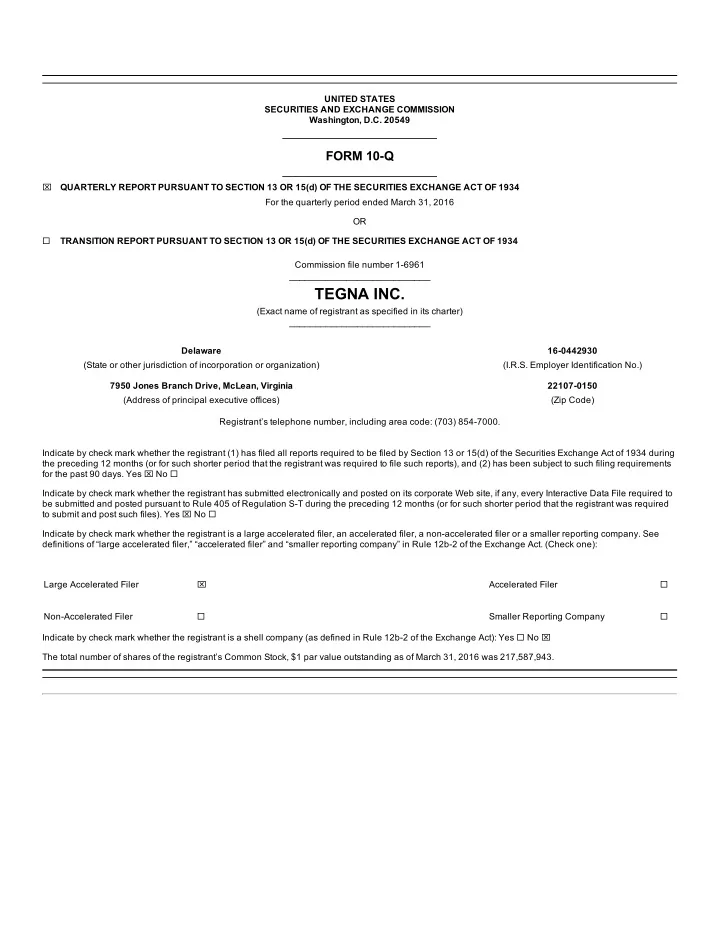
UNITED STATES SECURITIES AND EXCHANGE COMMISSION Washington, D.C. 20549
_______________________
FORM 10-Q
_______________________
x QUARTERLY REPORT PURSUANT TO SECTION 13 OR 15(d) OF THE SECURITIES EXCHANGE ACT OF 1934 For the quarterly period ended March 31, 2016 OR ¨ TRANSITION REPORT PURSUANT TO SECTION 13 OR 15(d) OF THE SECURITIES EXCHANGE ACT OF 1934 Commission file number 1-6961
___________________________
TEGNA INC.
(Exact name of registrant as specified in its charter)
___________________________
Delaware 16-0442930 (State or other jurisdiction of incorporation or organization) (I.R.S. Employer Identification No.) 7950 Jones Branch Drive, McLean, Virginia 22107-0150 (Address of principal executive offices) (Zip Code) Registrant’s telephone number, including area code: (703) 854-7000. Indicate by check mark whether the registrant (1) has filed all reports required to be filed by Section 13 or 15(d) of the Securities Exchange Act of 1934 during the preceding 12 months (or for such shorter period that the registrant was required to file such reports), and (2) has been subject to such filing requirements for the past 90 days. Yes x No ¨ Indicate by check mark whether the registrant has submitted electronically and posted on its corporate Web site, if any, every Interactive Data File required to be submitted and posted pursuant to Rule 405 of Regulation S-T during the preceding 12 months (or for such shorter period that the registrant was required to submit and post such files). Yes x No ¨ Indicate by check mark whether the registrant is a large accelerated filer, an accelerated filer, a non-accelerated filer or a smaller reporting company. See definitions of “large accelerated filer,” “accelerated filer” and “smaller reporting company” in Rule 12b-2 of the Exchange Act. (Check one): Large Accelerated Filer x Accelerated Filer ¨ Non-Accelerated Filer ¨ Smaller Reporting Company ¨ Indicate by check mark whether the registrant is a shell company (as defined in Rule 12b-2 of the Exchange Act): Yes ¨ No x The total number of shares of the registrant’s Common Stock, $1 par value outstanding as of March 31, 2016 was 217,587,943.
SLIDE 2
INDEX TO TEGNA INC. March 31, 2016 FORM 10-Q
Item No. Page PART I. FINANCIAL INFORMATION 1. Financial Statements Condensed Consolidated Balance Sheets as of March 31, 2016 and December 31, 2015 3 Consolidated Statements of Income for the Quarters Ended March 31, 2016 and March 29, 2015 5 Consolidated Statements of Comprehensive Income for the Quarters Ended March 31, 2016 and March 29, 2015 6 Condensed Consolidated Statements of Cash Flows for the Quarters Ended March 31, 2016 and March 29, 2015 7 Notes to Unaudited Condensed Consolidated Financial Statements 2. Management’s Discussion and Analysis of Financial Condition and Results of Operations 21 3. Quantitative and Qualitative Disclosures about Market Risk 29 4. Controls and Procedures 29 PART II. OTHER INFORMATION 1. Legal Proceedings 30 1A. Risk Factors 30 2. Unregistered Sales of Equity Securities and Use of Proceeds 30 6. Exhibits 30 SIGNATURES 31
2
SLIDE 3 PART I. FINANCIAL INFORMATION Item 1. Financial Statements TEGNA Inc. CONDENSED CONSOLIDATED BALANCE SHEETS In thousands
- Mar. 31, 2016
- Dec. 31, 2015
(Unaudited) ASSETS Current assets Cash and cash equivalents $ 79,206 $ 129,200 Trade receivables, net of allowances of $9,406 and $9,092, respectively 561,489 556,351 Other receivables 19,775 18,738 Prepaid expenses and other current assets 87,584 94,262 Current discontinued operation assets — 6,608 Total current assets 748,054 805,159 Property and equipment Cost 994,974 984,185 Less accumulated depreciation (543,960) (525,866) Net property and equipment 451,014 458,319 Intangible and other assets Goodwill 3,956,113 3,919,726 Indefinite-lived and amortizable intangible assets, less accumulated amortization 3,051,845 3,065,107 Investments and other assets 262,147 256,990 Noncurrent discontinued operation assets — 657 Total intangible and other assets 7,270,105 7,242,480 Total assets $ 8,469,173 $ 8,505,958 The accompanying notes are an integral part of these unaudited condensed consolidated financial statements. 3
SLIDE 4 TEGNA Inc. CONDENSED CONSOLIDATED BALANCE SHEETS In thousands, except share amounts
- Mar. 31, 2016
- Dec. 31, 2015
(Unaudited) LIABILITIES AND EQUITY Current liabilities Accounts payable and current portion of film contracts payable $ 102,924 $ 124,654 Accrued liabilities 279,121 296,815 Dividends payable 30,704 31,033 Income taxes 27,264 15,742 Deferred income 138,363 132,650 Current portion of long-term debt 646 646 Current discontinued operation liabilities — 5,243 Total current liabilities 579,022 606,783 Noncurrent liabilities Income taxes 16,965 18,191 Deferred income taxes 889,977 883,141 Long-term debt 4,196,722 4,169,016 Pension liabilities 176,267 178,844 Other noncurrent liabilities 152,481 168,573 Total noncurrent liabilities 5,432,412 5,417,765 Total liabilities 6,011,434 6,024,548 Redeemable noncontrolling interests 26,088 24,666 Commitments and contingent liabilities (See Note 12) Equity TEGNA Inc. shareholders’ equity Common stock of $1 par value per share, 800,000,000 shares authorized, 324,418,632 shares issued 324,419 324,419 Additional paid-in capital 474,484 539,505 Retained earnings 7,166,528 7,111,129 Accumulated other comprehensive loss (131,137) (130,951) Less treasury stock at cost, 106,830,689 shares and 104,664,452 shares, respectively (5,676,713) (5,652,131) Total TEGNA Inc. shareholders’ equity 2,157,581 2,191,971 Noncontrolling interests 274,070 264,773 Total equity 2,431,651 2,456,744 Total liabilities, redeemable noncontrolling interests and equity $ 8,469,173 $ 8,505,958 The accompanying notes are an integral part of these unaudited condensed consolidated financial statements. 4
SLIDE 5 TEGNA Inc. CONSOLIDATED STATEMENTS OF INCOME Unaudited, in thousands, except per share amounts Quarters Ended
- Mar. 31, 2016
- Mar. 29, 2015
Operating revenues: Media $ 443,829 $ 396,417 Digital 337,903 335,074 Total 781,732 731,491 Operating expenses: Cost of revenues and operating expenses, exclusive of depreciation 248,256 226,577 Selling, general and administrative expenses, exclusive of depreciation 281,034 264,751 Depreciation 22,233 24,279 Amortization of intangible assets 28,290 28,688 Facility consolidation — 4,724 Total 579,813 549,019 Operating income 201,919 182,472 Non-operating (expense) income: Equity income (loss) in unconsolidated investees, net 2,933 (1,249) Interest expense (61,713) (70,670) Other non-operating items 2,379 24,464 Total (56,401) (47,455) Income before income taxes 145,518 135,017 Provision for income taxes 42,108 51,015 Income from continuing operations 103,410 84,002 Income (loss) from discontinued operations, net of tax (7,474) 43,481 Net income 95,936 127,483 Net income attributable to noncontrolling interests (10,492) (14,590) Net income attributable to TEGNA Inc. $ 85,444 $ 112,893 Earnings from continuing operations per share - basic $ 0.42 $ 0.31 Earnings (loss) from discontinued operations per share - basic $ (0.03) $ 0.19 Net income per share – basic $ 0.39 $ 0.50 Earnings from continuing operations per share - diluted $ 0.42 $ 0.30 Earnings (loss) from discontinued operations per share - diluted $ (0.04) $ 0.19 Net income per share – diluted $ 0.38 $ 0.49 Weighted average number of common shares outstanding: Basic shares 219,286 227,089 Diluted shares 223,254 231,931 Dividends declared per share $ 0.14 $ 0.20 The accompanying notes are an integral part of these unaudited condensed consolidated financial statements. 5
SLIDE 6 TEGNA Inc. CONSOLIDATED STATEMENTS OF COMPREHENSIVE INCOME Unaudited, in thousands Quarters Ended
- Mar. 31, 2016
- Mar. 29, 2015
Net income $ 95,936 $ 127,483 Redeemable noncontrolling interests (income not available to shareholders) (925) (1,233) Other comprehensive income (loss), before tax: Foreign currency translation adjustments 1,201 (32,309) Pension and other post-retirement benefit items: Recognition of previously deferred post-retirement benefit plan costs 1,900 15,077 Other — 18,539 Pension and other post-retirement benefit items 1,900 33,616 Unrealized loss on available for sale investments during the period (1,983) — Other comprehensive income, before tax 1,118 1,307 Income tax effect related to components of other comprehensive income (loss) (738) (9,141) Other comprehensive income (loss), net of tax 380 (7,834) Comprehensive income 95,391 118,416 Comprehensive income attributable to noncontrolling interests, net of tax (10,133) (7,791) Comprehensive income attributable to TEGNA Inc. $ 85,258 $ 110,625 The accompanying notes are an integral part of these unaudited consolidated financial statements. 6
SLIDE 7 TEGNA Inc. CONDENSED CONSOLIDATED STATEMENTS OF CASH FLOWS Unaudited, in thousands Quarters Ended
- Mar. 31, 2016
- Mar. 29, 2015
Cash flows from operating activities: Net income $ 95,936 $ 127,483 Adjustments to reconcile net income to net cash flow from operating activities: Depreciation and amortization 50,635 81,570 Stock-based compensation 4,757 9,114 Other gains/losses on sales of assets 5,135 12,385 Equity income in unconsolidated investees, net (2,933) (5,058) Pension contributions, net of pension expense (752) (5,606) Change in other assets and liabilities, net (25,720) (44,913) Net cash flow from operating activities 127,058 174,975 Cash flows from investing activities: Purchase of property and equipment (16,449) (19,121) Payments for acquisitions of businesses, net of cash acquired (53,059) (8,624) Payments for investments (10,047) (5,000) Proceeds from investments 4,617 7,883 Proceeds from sale of assets — 103,813 Net cash flow (used for) from investing activities (74,938) 78,951 Cash flows from financing activities: Proceeds from (payments of) borrowings under revolving credit facilities, net 42,000 (130,000) Debt repayments (18,062) (10,025) Dividends paid (30,853) (45,257) Repurchases of common stock (75,411) (37,520) Other, net (19,788) (13,536) Net cash flow used for financing activities (102,114) (236,338) Effect of currency exchange rate change on cash — (391) Increase (decrease) in cash and cash equivalents (49,994) 17,197 Cash and cash equivalents from continuing operations, at beginning of period $ 129,200 $ 110,305 Cash and cash equivalents from discontinued operations, at beginning of period — 8,179 Balance of cash and cash equivalents at beginning of period $ 129,200 $ 118,484 Cash and cash equivalents from continuing operations, end of period $ 79,206 $ 122,256 Cash and cash equivalents from discontinued operations, end of period — 13,425 Balance of cash and cash equivalents at end of period $ 79,206 $ 135,681 Supplemental cash flow information: Cash paid for income taxes, net of refunds $ 27,430 $ 17,675 Cash paid for interest $ 35,261 $ 47,981 The accompanying notes are an integral part of these unaudited condensed consolidated financial statements. 7
SLIDE 8 TEGNA Inc. NOTES TO UNAUDITED CONDENSED CONSOLIDATED FINANCIAL STATEMENTS NOTE 1 – Basis of presentation Basis of presentation: Our accompanying unaudited condensed consolidated financial statements have been prepared in accordance with U.S. generally accepted accounting principles (GAAP) for interim financial reporting, the instructions for Form 10-Q and Article 10 of the U.S. Securities and Exchange Commission (SEC) Regulation S-K. Accordingly, they do not include all information and footnotes which are normally included in the Form 10-K and annual report to shareholders. In our opinion, the condensed consolidated financial statements reflect all adjustments of a normal recurring nature necessary for a fair presentation of results for the interim periods presented. The condensed consolidated financial statements should be read in conjunction with the audited consolidated financial statements of TEGNA included in our Annual Report on Form 10-K for the year ended December 31, 2015 (the “2015 Form 10-K”). The preparation of these condensed consolidated financial statements requires us to make estimates and assumptions that affect the amounts reported in the condensed consolidated financial statements and accompanying notes. Actual results could differ from these estimates. Significant estimates include, but are not limited to, income taxes including deferred taxes, pension benefits, evaluation of goodwill and other intangible assets for impairment, and
- contingencies. The consolidated financial statements include the accounts of subsidiaries we control and variable interest entities if we are the primary
- beneficiary. We eliminate intercompany balances and transactions in consolidation.
Beginning in the fourth quarter fiscal year 2015, we changed our financial reporting cycle to a calendar year-end and end-of-month quarterly reporting
- cycle. Accordingly, our 2015 fiscal year began on December 29, 2014 (the day after the end of the 2014 fiscal year) and ended on December 31, 2015.
Historically, our fiscal year and quarterly reporting was a 52-53 week cycle that ended on the last Sunday of the calendar quarter. As a result of the change in
- ur reporting calendar, certain quarters will have different end dates and number of days compared to the prior year quarter. The impact of the change in our
reporting calendar did not have a material impact on our financial statements; and therefore, we have not restated the historical results. On the first day of our fiscal third quarter, June 29, 2015, we completed the spin-off of our publishing businesses. Our Company was renamed TEGNA Inc. and our stock now trades on the New York Stock Exchange under the symbol TGNA. The new publishing company retained the name Gannett Co., Inc. (Gannett) and now trades on the New York Stock Exchange under the symbol GCI. In addition, during the fourth quarter of 2015, we sold substantially all of the businesses within our Other Segment. With the completion of these separations, we disposed of the former Publishing and Other Segments in their entirety and ceased to consolidate their assets, liabilities and results of operations in our consolidated financial statements. Accordingly, we have presented the financial condition and results of operations of the former Publishing and Other Segments as discontinued operations in the accompanying condensed consolidated financial statements for all periods presented. See Note 13 for a summary of discontinued operations. Accounting guidance adopted in 2016: In April 2015, the Financial Accounting Standards Board (FASB) issued guidance that changes the way companies present debt issuance costs on the balance sheet. Under the new guidance, debt issuance costs are reported as a direct deduction from the carrying amount of the debt liability, similar to debt discounts, rather than as an asset as has been done previously. Amortization of the costs will continue to be reported as interest expense. We adopted this guidance in the first quarter of 2016 and have applied the new guidance on a retrospective basis, wherein the balance sheet of each period presented is adjusted to reflect the effects of applying the new guidance. As disclosed in Note 6, as of March 31, 2016 and December 31, 2015, we had $30.5 million and $31.8 million, respectively, of debt issuance costs related to our term debt each of which was recorded as a direct deduction to the carrying amount of the associated debt liability. Debt issuance costs related to our revolving credit facility remained in long-term assets
- n our balance sheet as permitted under the new guidance.
In September 2015, the FASB issued guidance that requires an acquirer to recognize adjustments to provisional amounts recorded in a business combination in the reporting period in which the adjustments are determined. Recognizing the entire impact of a measurement period adjustment in a single reporting period may introduce earnings volatility and reduces comparability between periods when the adjustments are material. Past measurement period adjustments for us have not been material. We adopted and applied this guidance in the first quarter of 2016, our required adoption period, with no impact on
- ur condensed consolidated financial statements.
In March 2016, the FASB issued guidance that changes certain aspects of the accounting for employee share-based payments. The FASB permitted early adoption of this guidance, and we elected to early adopt in the first quarter of 2016. We believe the new guidance reduces the complexity for accounting for share-based payments which, in turn, improves the usefulness of the information provided to the users of our financial statements. Below is a summary of the most significant changes. 8
SLIDE 9
- All excess tax benefits and tax deduction shortfalls will be recognized as income tax benefit or expense in the income statement (under the prior
guidance these amounts were generally recognized in additional paid-in capital on the balance sheet). The tax effects of exercised or vested awards will be treated as discrete items in the reporting period in which they occur. This guidance is being applied prospectively beginning in the first quarter of 2016. The adoption of this element of the accounting standard reduced our first quarter income tax provision by $4.4 million and the tax rate by approximately three percentage points, resulting in an increase to basic and dilutive EPS of approximately $0.02.
- The guidance updated the classification in the Statement of Cash Flows in two areas: 1) Excess tax benefits will now be classified along with other
income tax cash flows as an operating activity (under prior guidance it was separated from operating activities and presented as a financing activity), and 2) Cash paid by an employer to taxing authorities when directly withholding shares for tax withholding purposes will be classified as a financing activity (prior to our adoption of the new guidance, we classified such payments as cash outflow from operating activities). Changes to the classification of the Statement of Cash Flows were made on a retrospective basis, wherein each period presented was adjusted to reflect the effects
- f applying the new guidance. The following table details the impact of adopting this element of the standard on our Statement of Cash Flows (in
thousands):
Quarter Ended Mar. 31, 2016 Quarter Ended Mar. 29, 2015 Previous Accounting Method As Currently Reported Effect of Accounting Change Previously Reported As Currently Reported Effect of Accounting Change Change in other assets and liabilities, net $ (49,985) $ (25,720) $ 24,265 $ (74,424) $ (44,913) $ 29,511 Net cash flow from operating activities $ 102,793 $ 127,058 $ 24,265 $ 145,464 $ 174,975 $ 29,511 Other, net $ 4,477 $ (19,788) $ (24,265) $ 15,975 $ (13,536) $ (29,511) Net cash used for financing activities $ (77,849) $ (102,114) $ (24,265) $ (206,827) $ (236,338) $ (29,511)
New accounting pronouncements not yet adopted: In May 2014, the FASB issued a new standard related to revenue recognition. Under the new standard, recognition of revenue occurs when a customer obtains control of promised goods or services in an amount that reflects the consideration which the entity expects to receive in exchange for those goods or services. In addition, the standard requires disclosure of the nature, amount, timing, and uncertainty of revenue and cash flows arising from contracts with customers. We will adopt the standard no later than January 1, 2018 (companies are permitted to early adopt the standard in the first quarter of 2017). While we are currently assessing the impact of the new standard, we currently do not expect this new guidance to have a material impact on our consolidated financial statements. In February 2016, the FASB issued new guidance related to leases which will require lessees to recognize assets and liabilities on the balance sheet for leases with lease terms of more than 12 months. Consistent with current GAAP, the recognition, measurement, and presentation of expenses and cash flows arising from a lease by a lessee primarily will depend on its classification as a finance or operating lease. However, unlike current GAAP—which requires
- nly capital leases to be recognized on the balance sheet—the new guidance will require both types of leases to be recognized on the balance sheet. The
new guidance is effective for us beginning in the first quarter of 2019 and will be adopted using a modified retrospective approach. We are currently evaluating the effect it is expected to have on our consolidated financial statements and related disclosures. In January 2016, the FASB issued new guidance that amended several elements surrounding the recognition and measurement of financial instruments. Most notably for our company, the new guidance requires equity investments (except those accounted for under the equity method of accounting, or those that result in consolidation) to be measured at fair value with changes in fair value recognized in net income. Under current GAAP, changes in fair value for
- ur available-for-sale equity investment are recorded as unrealized gains or losses through other comprehensive income until such investment is sold. The
new guidance is effective for us beginning in the first quarter of 2019 and will be adopted using a cumulative-effect adjustment. Early adoption is permitted. We recorded approximately $2.0 million in unrealized losses on our available for sale investment in the Consolidated Statements of Comprehensive Income for the quarter ended March 31, 2016. Losses of this nature in the future will be recorded within the Condensed Consolidated Statements of Income under this new guidance. 9
SLIDE 10 NOTE 2 - Acquisitions and dispositions In March 2016, CareerBuilder acquired 100% of Aurico Inc. (Aurico), a provider of background screening and drug testing which services both U.S. and international customers. Aurico expands CareerBuilder’s product line to include another critical step in the job hiring process. The fair value of the assets acquired and liabilities assumed were based on a preliminary valuation and, as such, our estimates and assumptions are subject to change as additional information is obtained about the facts and circumstances that existed as of the acquisition date. The primary areas of the purchase price allocation that were not yet finalized are related to fair value of intangible assets and income taxes. On March 18, 2016, we sold Sightline Media Group (Sightline) to Regent Companies LLC. Our Sightline business unit was previously classified as held for sale as of the end of fiscal year 2015, and as a result, the operating results of Sightline have been included in discontinued operations in our condensed consolidated financial statements for all periods presented. See Note 13 for further discussion. NOTE 3 - Goodwill and other intangible assets The following table displays goodwill, indefinite-lived intangible assets, and amortizable intangible assets as of March 31, 2016 and December 31, 2015 (in thousands):
- Mar. 31, 2016
- Dec. 31, 2015
Gross Accumulated Amortization Gross Accumulated Amortization Goodwill $ 3,956,113 $ —
$
3,919,726 $ — Indefinite-lived intangibles: Television station FCC licenses 1,191,950 — 1,191,950 — Trade names 925,171 — 925,019 — Amortizable intangible assets: Customer relationships 913,695 (164,234) 903,652 (145,398) Other 269,921 (84,658) 265,148 (75,264) Customer relationships include subscriber lists and advertiser relationships while other intangibles primarily include retransmission agreements, network affiliations, developed technology and patents. Amortizable intangible assets are amortized on a straight-line basis over their estimated useful lives. In connection with our acquisition of Aurico, we recorded other intangible assets of $15.1 million, related to technology, customer relationships and trade name, which will be amortized over a weighted average period of 8 years. The following table summarizes the changes in our net goodwill balance by segment through March 31, 2016 (in thousands): Media Digital Total Balance at Dec. 31, 2015: Goodwill $ 2,579,418 $ 1,402,240 $ 3,981,658 Accumulated impairment losses — (61,932) (61,932) Net balance at Dec. 31, 2015 2,579,418 1,340,308 3,919,726 Activity during the period: Acquisition — 33,345 33,345 Foreign currency exchange rate changes — 3,042 3,042 Total — 36,387 36,387 Balance at Mar. 31, 2016: Goodwill 2,579,418 1,438,627 4,018,045 Accumulated impairment losses — (61,932) (61,932) Net balance at Mar. 31, 2016 $ 2,579,418 $ 1,376,695 $ 3,956,113 The increase in our Digital Segment’s goodwill during the first quarter of 2016 is associated with our acquisition of Aurico, all of which will be amortized for tax purposes. 10
SLIDE 11 NOTE 4 - Investments and other assets Our investments and other assets consisted of the following as of March 31, 2016 and December 31, 2015 (in thousands):
- Mar. 31, 2016
- Dec. 31, 2015
Deferred compensation investments $ 77,004 $ 77,199 Cash value life insurance 64,581 68,332 Equity method investments 32,285 27,824 Available for sale investment 26,107 28,090 Deferred debt issuance cost 12,546 13,620 Other long term assets 49,624 41,925 Total $ 262,147 $ 256,990 Deferred compensation investments: Employee compensation-related investments consist of debt and equity securities which are classified as trading securities and fund our deferred compensation plan liabilities. Equity method investments: Investments where we have the ability to exercise significant influence but do not control are accounted for under the equity method of accounting. Significant influence typically exists when we own between 20% and 50% of the voting interests in a corporation, own more than a minimal investment in a limited liability company, or hold substantial management rights in the investee. Under this method of accounting, our share of the net earnings or losses of the investee is included in non-operating income, on our consolidated statements of income. We evaluate our equity method investments for impairment whenever events or changes in circumstances indicate that the carrying amounts of such investments may be impaired. If a decline in the value of an equity method investment is determined to be other than temporary, a loss is recorded in earnings in the current period. Certain differences exist between our investment carrying value and the underlying equity of the investee companies, principally due to fair value measurement at the date of investment acquisition and due to impairment charges we recorded for certain investments. No material impairments were recorded in the quarters ended March 31, 2016 and March 29, 2015. Cost method investments: The carrying value of cost method investments at March 31, 2016 was $17.3 million and was $8.6 million at December 31, 2015, and are included within other long-term assets in the table above. The increase is primarily due to our investment in Whistle Sports during the first quarter of 2016. NOTE 5 - Income taxes The total amount of unrecognized tax benefits that, if recognized, would impact the effective tax rate was approximately $11.4 million as of March 31, 2016 and $12.5 million as of December 31, 2015. The amount of accrued interest and penalties payable related to unrecognized tax benefits was $1.7 million as of March 31, 2016 and December 31, 2015. It is reasonably possible that the amount of unrecognized benefits with respect to certain of our unrecognized tax positions will increase or decrease within the next 12 months. These changes may be the result of settlement of ongoing audits, lapses of statutes of limitations or other regulatory developments. At this time, we estimate the amount of gross unrecognized tax positions may be reduced by up to approximately $2.8 million within the next 12 months primarily due to lapses of statutes of limitations and settlement of ongoing audits in various jurisdictions. 11
SLIDE 12 NOTE 6 - Long-term debt Our long-term debt is summarized below (in thousands):
- Mar. 31, 2016
- Dec. 31, 2015
Unsecured floating rate term loan due quarterly through August 2018 $ 75,800 $ 83,700 VIE unsecured floating rate term loans due quarterly through December 2018 1,777 1,938 Unsecured floating rate term loan due quarterly through June 2020 170,000 180,000 Borrowings under revolving credit agreement expiring June 2020 762,000 720,000 Unsecured notes bearing fixed rate interest at 10% due April 2016 193,429 193,429 Unsecured notes bearing fixed rate interest at 7.125% due September 2018 70,000 70,000 Unsecured notes bearing fixed rate interest at 5.125% due October 2019 600,000 600,000 Unsecured notes bearing fixed rate interest at 5.125% due July 2020 600,000 600,000 Unsecured notes bearing fixed rate interest at 4.875% due September 2021 350,000 350,000 Unsecured notes bearing fixed rate interest at 6.375% due October 2023 650,000 650,000 Unsecured notes bearing fixed rate interest at 5.50% due September 2024 325,000 325,000 Unsecured notes bearing fixed rate interest at 7.75% due June 2027 200,000 200,000 Unsecured notes bearing fixed rate interest at 7.25% due September 2027 240,000 240,000 Total principal long-term debt 4,238,006 4,214,067 Debt issuance costs (30,513) (31,800) Other (fair market value adjustments and discounts) (10,125) (12,605) Total long-term debt 4,197,368 4,169,662 Less current portion of long-term debt maturities of VIE loans 646 646 Long-term debt, net of current portion $ 4,196,722 $ 4,169,016 For the first three months of 2016, our long-term debt increased by $27.7 million, primarily due to additional borrowing of $42.0 million from the revolving credit facility, and from amortization of debt issuance costs and debt discounts of $1.3 million and $2.5 million, respectively. These increases were partially
- ffset by debt payments of $18.1 million during the first quarter of 2016.
On April 1, 2016 we made a debt repayment of approximately $203.1 million (comprised of principal and accrued interest) related to our unsecured notes bearing fixed rate interest of 10%. The payment was made using borrowings from our revolving credit facility. On April 30, 2016, we had unused borrowing capacity of $362.9 million under our revolving credit facility. 12
SLIDE 13 NOTE 7 - Retirement plans Our principal retirement plan is the TEGNA Retirement Plan (TRP). The TRP is a new pension plan that was formed in connection with the spin-off of our publishing businesses. The TRP assumed certain assets and liabilities from the Gannett Retirement Plan, with the remaining pension obligations being retained by Gannett. The disclosure table below includes the pension expenses of the TRP and the TEGNA Supplemental Executive Retirement Plan (SERP). Our former G.B. Dealey Retirement Plan was merged with the TRP plan on December 31, 2015. The total net pension obligations, both current and non-current liabilities, as of March 31, 2016 were $184.1 million. Our pension costs, which include costs for qualified and nonqualified plans, are presented in the following table (in thousands): Quarters Ended
- Mar. 31, 2016
- Mar. 29, 2015
Service cost-benefits earned during the period $ 250 $ 233 Interest cost on benefit obligation 6,350 5,652 Expected return on plan assets (a) (6,750) (7,497) Amortization of prior service cost 150 148 Amortization of actuarial loss 1,700 1,468 Expense for company-sponsored retirement plans $ 1,700 $ 4
(a) At the beginning of 2016, we updated our expected annual long-term rate of return on our TRP plan assets to 7.0% from 8.0%. This change resulted in incremental pension costs of approximately $1.4 million in the first quarter of 2016, and will result in approximately $5.5 million of incremental pension costs for the full year 2016.
We do not plan to make contributions to our TRP pension plan in 2016 because none are required under our current assumptions and current funding
- level. During the quarters ended March 31, 2016 and March 29, 2015, we made $2.4 million and $3.2 million of benefit payments, respectively, to participants
- f the SERP.
13
SLIDE 14 NOTE 8 - Supplemental equity information The following table summarizes equity account activity for the quarter ended March 31, 2016 and March 29, 2015 (in thousands):
TEGNA Inc. Shareholders’ Equity Noncontrolling Interests Total Equity Balance at Dec. 31, 2015 $ 2,191,971 $ 264,773
$
2,456,744 Comprehensive income: Net income 85,444 10,492 95,936 Redeemable noncontrolling interests (income not available to shareholders) — (925) (925) Other comprehensive income (loss) (186) 566 380 Total comprehensive income 85,258 10,133 95,391 Dividends declared (30,524) — (30,524) Stock-based compensation 4,757 — 4,757 Treasury shares acquired (75,411) — (75,411) Other activity, including shares withheld for employee taxes (18,470) (836) (19,306) Balance at Mar. 31, 2016 $ 2,157,581 $ 274,070
$
2,431,651 Balance at Dec. 28, 2014 $ 3,254,914 $ 234,359
$
3,489,273 Comprehensive income: Net income 112,893 14,590 127,483 Redeemable noncontrolling interests (income not available to shareholders) — (1,233) (1,233) Other comprehensive (loss) (2,268) (5,566) (7,834) Total comprehensive income 110,625 7,791 118,416 Dividends declared (45,371) — (45,371) Stock-based compensation 9,114 — 9,114 Treasury shares acquired (37,520) — (37,520) Other activity, including shares withheld for employee taxes and tax windfall benefits 2,723 (969) 1,754 Balance at Mar. 29, 2015 $ 3,294,485 $ 241,181
$
3,535,666
In July 2015, CareerBuilder acquired a majority ownership in Textkernel, a software company that provides semantic recruitment technology. Additionally, in 2012, CareerBuilder acquired a majority ownership in Economic Modeling Specialists Intl. (EMSI), a software firm that specializes in employment data and labor market analytics. The minority shareholders of these acquired businesses hold put rights that permit them to put their equity interests to CareerBuilder. Since redemption of the noncontrolling interests is outside of our control, the minority shareholders’ equity interest are presented
- n the Condensed Consolidated Balance Sheets in the caption “Redeemable noncontrolling interests.”
14
SLIDE 15 The following table summarizes the components of, and the changes in, Accumulated Other Comprehensive Loss (AOCL), net of tax and noncontrolling interests (in thousands): Retirement Plans Foreign Currency Translation Other Total Thirteen Weeks: Balance at Dec. 31, 2015 $ (116,496) $ (20,129) $ 5,674 $ (130,951) Other comprehensive income (loss) before reclassifications — 635 (1,983) (1,348) Amounts reclassified from AOCL 1,162 — — 1,162 Other comprehensive income (loss) 1,162 635 (1,983) (186) Balance at Mar. 31, 2016 $ (115,334) $ (19,494) $ 3,691 $ (131,137) Balance at Dec. 28, 2014 $ (1,172,245) $ 391,113 $ 2,363 $ (778,769) Other comprehensive income (loss) before reclassifications 14,831 (26,744) — (11,913) Amounts reclassified from AOCL 9,645 — — 9,645 Other comprehensive income (loss) 24,476 (26,744) — (2,268) Balance at Mar. 29, 2015 $ (1,147,769) $ 364,369 $ 2,363 $ (781,037) AOCL components are included in computing net periodic post-retirement costs which include pension costs in Note 7 and our other post-retirement benefits (health care and life insurance). Reclassifications from AOCL related to these post-retirement plans include the following (in thousands): Quarters Ended
- Mar. 31, 2016
- Mar. 29, 2015
Amortization of prior service credit $ 50 $ (618) Amortization of actuarial loss 1,850 15,695 Total reclassifications, before tax 1,900 15,077 Income tax effect (738) (5,432) Total reclassifications, net of tax $ 1,162 $ 9,645 15
SLIDE 16 NOTE 9 - Earnings per share Our earnings per share (basic and diluted) are presented below (in thousands, except per share amounts): Quarters Ended
- Mar. 31, 2016
- Mar. 29, 2015
Income from continuing operations attributable to TEGNA Inc. $ 92,918 $ 69,412 Income (loss) from discontinued operations, net of tax (7,474) 43,481 Net income attributable to TEGNA Inc. $ 85,444 $ 112,893 Weighted average number of common shares outstanding - basic 219,286 227,089 Effect of dilutive securities: Restricted stock 1,295 2,267 Performance share units 1,673 1,692 Stock options 1,000 883 Weighted average number of common shares outstanding - diluted 223,254 231,931 Earnings from continuing operations per share - basic $ 0.42 $ 0.31 Earnings (loss) from discontinued operations per share - basic (0.03) 0.19 Net income per share - basic $ 0.39 $ 0.50 Earnings from continuing operations per share - diluted $ 0.42 $ 0.30 Earnings (loss) from discontinued operations per share - diluted (0.04) 0.19 Net income per share - diluted $ 0.38 $ 0.49 Our calculation of diluted earnings per share includes the dilutive effects for the assumed vesting of outstanding restricted stock units, performance share units, and exercises of outstanding stock options based on the treasury stock method. The diluted earnings per share amounts exclude the effects of approximately 20,000 and 300,000 of stock awards for the quarters ended March 31, 2016 and March 29, 2015, respectively, as their inclusion would be anti- dilutive. 16
SLIDE 17
NOTE 10 - Fair value measurement We measure and record in the accompanying condensed consolidated financial statements certain assets and liabilities at fair value. U.S. GAAP establishes a hierarchy for those instruments measured at fair value that distinguishes between market data (observable inputs) and our own assumptions (unobservable inputs). The hierarchy consists of three levels: Level 1 - Quoted market prices in active markets for identical assets or liabilities; Level 2 - Inputs other than Level 1 inputs that are either directly or indirectly observable; and Level 3 - Unobservable inputs developed using our own estimates and assumptions, which reflect those that a market participant would use. The following table summarizes our assets and liabilities measured at fair value in the accompanying Condensed Consolidated Balance Sheets as of March 31, 2016 and December 31, 2015 (in thousands): Fair Value Measurements as of Mar. 31, 2016 Level 1 Level 2 Level 3 Total Deferred compensation investments $ 77,004 $ — $ — $ 77,004 Available for sale investment 26,107 — — 26,107 Total $ 103,111 $ — $ — $ 103,111 Fair Value Measurements as of Dec. 31, 2015 Level 1 Level 2 Level 3 Total Deferred compensation investments $ 77,199 $ — $ — $ 77,199 Available for sale investment 28,090 — — 28,090 Total $ 105,289 $ — $ — $ 105,289 Deferred compensation investments of $77.0 million as of March 31, 2016 and $77.2 million as of December 31, 2015, consist of securities which are traded on public exchanges and are, therefore, classified as Level 1 assets. The available for sale investment is our 1.5% holding of Gannett’s outstanding shares, which has been classified as a Level 1 asset as the shares are listed on the New York Stock Exchange. In addition to the financial instruments listed in the table above, we hold other financial instruments, including cash and cash equivalents, receivables, accounts payable and debt. The carrying amounts for cash and cash equivalents, receivables and accounts payable approximated their fair values. The fair value of our total long-term debt, based on the bid and ask quotes for the related debt (Level 2), totaled $4.37 billion at March 31, 2016 and $4.31 billion at December 31, 2015. 17
SLIDE 18 NOTE 11 - Business segment information We classify our operations into two reportable segments: Media: consisting of our 46 television stations operating in 38 markets, offering high-quality television programming and digital content; and Digital: primarily consisting of our Cars.com and CareerBuilder business units which operate in the automotive and human capital solutions industries, respectively. Our reportable segments have been determined based on our management and internal reporting structure, the nature of products and services offered by the segments, and the financial information that is evaluated regularly by our chief
The Digital Segment and the digital revenues line exclude online/digital revenues generated by digital platforms that are associated with our Media Segment’s operating properties as such amounts are reflected in the Media Segment. Summary operating results for each of our business segments were as follows (in thousands): Quarters Ended
- Mar. 31, 2016
- Mar. 29, 2015
Operating Revenues: Media $ 443,829 $ 396,417 Digital 337,903 335,074 Total $ 781,732 $ 731,491 Operating Income (net of depreciation, amortization and facility consolidation): Media $ 169,299 $ 176,880 Digital 47,219 48,181 Corporate (14,599) (18,860) Unallocated (a) — (23,729) Total $ 201,919 $ 182,472 Depreciation, amortization and facility consolidation: Media $ 19,441 $ 21,261 Digital 30,361 33,709 Corporate 721 2,721 Total $ 50,523 $ 57,691 Identifiable assets:
- Mar. 31, 2016
- Dec. 31, 2015
Media $ 4,782,916 $ 4,799,375 Digital 3,529,356 3,529,124 Corporate 156,901 170,194 Total (b) $ 8,469,173 $ 8,498,693
(a) Unallocated expenses in 2015 represent certain expenses that historically were allocated to the former Publishing Segment but that could not be allocated to discontinued
- perations as they were not clearly and specifically identifiable to the spun-off businesses.
(b) For Dec. 31, 2015, the total of business segment identifiable assets excludes assets recorded in discontinued operations on the consolidated balance sheet of $7.3 million.
18
SLIDE 19 NOTE 12 - Other Matters Commitments, contingencies and other matters We, along with a number of our subsidiaries, are defendants in judicial and administrative proceedings involving matters incidental to our business. We do not believe that any material liability will be imposed as a result of these matters. Media Voluntary Retirement Program During the first quarter of 2016, we initiated a Voluntary Retirement Program (VRP) at our Media Segment. Under the VRP, Media employees meeting certain eligibility requirements were offered buyout payments in exchange for voluntarily retiring. Based on actual acceptances through March 31, 2016, we have accrued a VRP separation obligation totaling $9.5 million as of March 31, 2016. We expect additional VRP charges to be recognized until the completion of the plan in the second quarter of 2016. Upon separation, employees accepting the VRP will receive salary continuation payments primarily based on years of service, the majority of which will occur evenly over the next 12 month period. NOTE 13 - Discontinued Operations On June 29, 2015, we completed the previously announced spin-off of our publishing businesses, creating a new independent publicly traded company, Gannett Co., Inc., through the distribution of 98.5% of our interest in Gannett to holders of our common shares. On June 29, 2015, each of our shareholders of record as of the close of business on the record date of June 22, 2015 received one share of Gannett common stock for every two shares of TEGNA common
- stock. Following the distribution, we own 1.5% of Gannett outstanding common shares. We will continue to own Gannett shares for a period of time not to
exceed 5 years after the distribution. As disclosed in our 2015 Form 10-K, in conjunction with the spin-off of the publishing businesses, we entered into a separation and distribution agreement with Gannett and also entered into various other agreements to effect the separation and provide a framework for a short term set of transition services as well as a tax matters agreement and an employee matters agreement. During the fourth quarter of 2015, we sold our subsidiaries Clipper Magazine (Clipper), a direct mail advertising magazine business, and Mobestream Media (Mobestream), maker of a mobile rewards/coupon platform, to Valassis Direct Mail, Inc. On March 18, 2016, we sold Sightline Media (Sightline) to Regent Companies LLC. Our Sightline business unit was previously included within our Other Segment and was classified as held for sale as of December 31, 2015. With the sale of these businesses, we divested all the operations of our Other Segment. Accordingly, we have presented the financial condition and results of operations of the former Publishing and Other Segments as discontinued operations. 19
SLIDE 20 Financial Statement Presentation The former publishing businesses and businesses within the Other Segment are presented as discontinued operations in our Condensed Consolidated Balance Sheet and the Condensed Consolidated Statements of Income. In our Consolidated Statement of Cash Flows, the cash flows from discontinued
- perations are not separately classified but supplemental cash flow information is presented below. The financial results of discontinued operations through
March 31, 2016, are presented as a loss from discontinued operations, net of income taxes, on our Condensed Consolidated Statements of Income. For earnings per share information on discontinued operations see Note 9. Discontinued operations for the first quarter of 2016 are attributable to our former Sightline business through the date of sale while results for the first quarter of 2015 were comprised of the operating results of both the Publishing Segment and Other Segment. The table below presents the financial results of discontinued operations (in thousands): Quarters Ended
- Mar. 31, 2016
- Mar. 29, 2015
Other Publishing Other Total Operating revenues $ 3,379
$
694,751 $ 46,523 $ 741,274 Income (loss) from discontinued operations, before income taxes (6,299) 64,858 (11,868) 52,990 Provision for income taxes (1,175) (13,269) 3,760 (9,509) Income (loss) from discontinued operations, net of tax (7,474) 51,589 (8,108) 43,481 The depreciation, amortization, capital expenditures and significant cash investing items of discontinued operations were as follows (in thousands): Quarters Ended
- Mar. 31, 2016
- Mar. 29, 2015
Other Publishing Other Total Depreciation $ 112 $ 24,996 $ 208 $ 25,204 Amortization — 3,399 — 3,399 Capital expenditures — (6,347) (82) (6,429) Proceeds from sale of certain assets — 5,655 — 5,655 Payments for investments — (2,000) — (2,000) Proceeds from investments — 7,883 — 7,883 The financial results reflected above may not represent our Publishing and Other Segments stand-alone operating results, as the results reported within income from discontinued operations, net, include only certain costs that are directly attributable to those businesses and exclude certain corporate overhead costs that were previously allocated for each period. 20
SLIDE 21 Item 2. Management’s Discussion and Analysis of Financial Condition and Results of Operations Company Overview Our company is comprised of a dynamic portfolio of media and digital businesses that provide content that matters and brands that deliver. We deliver highly relevant, useful and smart content, when and how people need it, to make the best decisions possible. Our forward-thinking portfolio is comprised of
- ne of the largest, most geographically diverse broadcasters in the U.S. and two leading digital companies, Cars.com and CareerBuilder. Combined,
TEGNA’s brands have tremendous reach. Each month, we connect with more than 90 million people across our broadcast and digital media platforms. During 2015, we made a number of significant strategic changes to enhance shareholder returns and improve the company. On June 29, 2015, we completed the separation of our publishing businesses. Our company was renamed TEGNA Inc. and our stock now trades on the New York Stock Exchange under the symbol TGNA. The new publishing company retained the name Gannett Co., Inc. (Gannett) and now trades on the New York Stock Exchange under the symbol GCI. In the fourth quarter of 2015, we also sold Clipper Magazine and Mobestream Media which were formerly businesses within our Other
- Segment. Additionally, during the first quarter of 2016, we completed the sale of our Sightline Media Group business unit. Accordingly, we have presented the
financial condition and results of operations of the former Publishing and Other Segments as discontinued operations in the accompanying condensed consolidated financial statements for all periods presented. After these strategic changes, we now operate two reportable segments: Media and Digital. We organize our business segments based on our management and internal reporting structure, the nature of products and services offered by the segments, and the financial information that is evaluated regularly by our chief operating decision maker.
- TEGNA Media (Media Segment) - includes 46 television stations (including one station under service agreements) in 38 markets. We are the largest
independent station group of major network affiliates in the top 25 markets, reaching approximately one-third of all television households nationwide (more than 35 million households). The primary sources of our Media Segment’s revenues are: 1) core advertising which includes local and national nonpolitical advertising; 2) political advertising revenues which are driven by elections and peak in even years (e.g. 2016, 2014) and particularly in the second half of those years; 3) retransmission revenues representing fees paid by satellite and cable operators and telecommunications companies to carry our television signals on their systems; 4) digital revenues which encompass digital marketing services and advertising on the stations’ websites and tablet and mobile products; and 5) payments by advertisers to television stations for other services, such as production of programming from third parties and production of advertising material.
- TEGNA Digital (Digital Segment) - is comprised of four business units including Cars.com, CareerBuilder, G/O Digital and Cofactor (also operating
as ShopLocal). Cars.com operates a leading online destination for automotive consumers offering credible, objective information about car shopping, selling and servicing. Cars.com has approximately 30 million monthly visits to its web properties including, approximately 20 million visits per month across mobile devices. Cars.com generates revenues through online subscription advertising products targeting car dealerships and national advertisers through its own direct sales force as well as its affiliate sales channels. In 2015, Cars.com expanded into the area of service, introducing a solution that provides information about reputable certified repair shops and allows consumers to get estimates on potential vehicle
- repairs. We own a controlling 53% interest in CareerBuilder, a global leader in human capital solutions specializing in HR software as a service to
help companies with every step of the recruitment process. CareerBuilder has made significant investments over the past few years to accelerate its transformation into a global leader in the HR Software-as-a Service (SaaS) business. CareerBuilder earns revenue through placement of job postings on its network of websites, subscriptions to its human capital SaaS product, background screening services and various other recruitment solutions (including employment branding services and access to online resume databases). Our Digital Segment also includes G/O Digital, a one- stop shop for digital marketing services for local businesses, and Cofactor (also operating as ShopLocal), a digital marketing company that is uniquely positioned to bridge the divide between the online and offline worlds and enable brands to intelligently deliver content everywhere, driving sales locally. In addition to the above reportable segments, our corporate category includes activities that are not directly attributable or allocable to a specific reportable segment. This category primarily consists of broad corporate management functions including legal, human resources and finance. The largest components of our consolidated operating expenses are payroll and benefits. Other significant operating expenses include the costs of locally produced content and purchased syndicated programming in the Media Segment, and sales and marketing costs within the Digital Segment. 21
SLIDE 22 Consolidated Results from Operations The following discussion is a quarterly period-to-period comparison of our consolidated results of continuing operations on a GAAP basis. The period-to- period comparison of financial results is not necessarily indicative of future results. In addition, see the section on page 25 titled ‘Results from Operations - Non-GAAP Information’ for additional tables presenting information which supplements our financial information provided on a GAAP basis. Our consolidated results of operations on a GAAP basis were as follows (in thousands, except per share amounts):
Quarters Ended
% of Total
% of Total Change Operating revenues: Media $ 443,829 57% $ 396,417 54% 12% Digital 337,903 43% 335,074 46% 1% Total operating revenues $ 781,732 100% $ 731,491 100% 7% Operating expenses Operating expenses exclusive of depreciation $ 529,290 91% $ 491,328 90% 8% Depreciation, Amortization, and Facility Consolidation 50,523 9% 57,691 10% (12%) Total operating expenses $ 579,813 100% $ 549,019 100% 6% Total operating income $ 201,919
$
182,472 11% Non-operating expense 56,401 47,455 19% Provision for income taxes 42,108 51,015 (17%) Net income attributable to noncontrolling interests (10,492) (14,590) (28%) Net income from continuing operations attributable to TEGNA Inc. $ 92,918
$
69,412 34 % Earnings from continuing operations per share - basic $ 0.42
$
0.31 35% Earnings from continuing operations per share - diluted $ 0.42
$
0.30 40%
Operating Revenues and Expenses Our operating revenues were $781.7 million in the first quarter of 2016, an increase of 7% from $731.5 million in the same quarter last year. The increase was driven by strong Media and Digital Segment revenue growth. Media Segment revenues increased 12% for the first quarter driven by robust growth in retransmission revenue and record first quarter political advertising revenue. Digital Segment revenues increased 1% driven by continued organic growth at Cars.com, partly offset by lower revenue at CareerBuilder due to reductions in transaction-based lower-margin revenues as well as a decrease of $9.6 million
- f revenue due to the sale of our PointRoll business at the end of last year. Excluding the impact of PointRoll’s prior year revenue, Digital Segment revenues
were up 4%. Operating expenses increased 6% for the quarter due primarily to higher Media Segment programming fees, investments in growth initiatives within both the Media and Digital Segments, charges related to a voluntary early retirement program incurred by our Media Segment in the first quarter of 2016 and a gain recognized on a building sale in the first quarter of 2015. These increases were partially offset by a reduction in corporate expenses reflecting continued efficiency efforts as well as the absence of publishing-related unallocated costs. Excluding the impacts of the workforce restructuring in the first quarter of 2016 and of the building sale in the first quarter of 2015, operating expenses increased by 2%. We reported operating income of $201.9 million in the first quarter of 2016 compared to $182.5 million in the first quarter of 2015, an 11% increase primarily driven by increases in revenue discussed above and a significant reduction in corporate expenses and the absence of publishing-related unallocated costs. As a result, our consolidated operating margins improved to 26% in the first quarter of 2016 compared to 25% during the same quarter in 2015. Non-Operating Expense Non-operating expense increased from $47.5 million in the first quarter of 2015 to $56.4 million in the first quarter of 2016 primarily due to the absence of the $43.9 million gain on the sale of Gannett Healthcare Group (GHG) in the first quarter of 2015 partially offset by the absence of costs related to the spin-off
- f our former publishing businesses. Interest expense was $61.7
22
SLIDE 23 million in the first quarter of 2016, compared to $70.7 million in the first quarter of 2015. These changes reflect lower average debt outstanding due to the repayments made in the fourth quarter of 2015 as well as lower average interest rates. The total average outstanding debt was $4.24 billion for the first quarter of 2016, compared to $4.46 billion in the first quarter of 2015. The weighted average interest rate on total outstanding debt was 5.64% for the first quarter of 2016 compared to 6.03% last year. Income Tax Expense Income tax expense decreased from $51.0 million in the first quarter of 2015 to $42.1 million in the first quarter of 2016, a decrease of 17%. Our reported effective income tax rate (after deducting net income attributable to noncontrolling interests) was 31.2% for the first quarter of 2016, compared to 42.4% for the first quarter of 2015. The first quarter 2016 tax rate benefited by three percentage points due to the recognition of excess tax benefits on stock compensation awards in accordance with a new accounting pronouncement on share-based compensation, as well as reduced state tax expense as compared to the first quarter of 2015 as a result of changes in our legal entity structure. Additionally, the first quarter 2015 rate was higher due to nondeductible spin-related transaction costs. Net income from continuing operations attributable to TEGNA Inc. Net income from continuing operations attributable to TEGNA Inc. consists of net income reduced by net income attributable to noncontrolling interests, primarily from CareerBuilder. We reported net income from continuing operations attributable to TEGNA Inc. of $92.9 million or $0.42 per diluted share for the first quarter of 2016 compared to $69.4 million or $0.30 per diluted share for the first quarter of 2015. Net income attributable to noncontrolling interests was $10.5 million in the first quarter of 2016 compared to $14.6 million in the first quarter of 2015. The weighted average number of diluted shares outstanding for the first quarter of 2016 decreased by 8.7 million shares to 223.2 million from 231.9 million in 2015. The decline reflects shares repurchased in 2015 and the first quarter of 2016, partially offset by share issuances to settle equity-based
- awards. See Part II, Item 2 for information on share repurchases.
Segment Results We organize our business into two business segments: Media and Digital based on management and internal reporting structure, the nature of products and services offered by the segments and the financial information that is evaluated regularly by our chief operating decision maker. Net sales of our business segments exclude intersegment sales as these activities are eliminated in consolidation. The following is a discussion of the operating results of our Media and Digital Segments. Media Segment Results A summary of our Media Segment results is presented below (in thousands): Quarters Ended
- Mar. 31, 2016
- Mar. 29, 2015
Change Operating revenues $ 443,829 $ 396,417 12% Operating expenses: Operating expenses, exclusive of depreciation (a) 255,089 198,276 29% Depreciation 13,748 13,296 3% Amortization 5,693 5,598 2% Transformation items — 2,367 *** Total operating expenses (a) 274,530 219,537 25% Operating income $ 169,299 $ 176,880 (4%)
(a) First quarter of 2016 includes charges primarily related to a voluntary early retirement program of approximately $10.4 million in 2016. First quarter of 2015 includes a $12.7 million gain on the sale of a building.
23
SLIDE 24 Media Segment revenues are grouped into five categories: Core (Local and National), Political, Retransmission, Digital and Other. The following table summarizes the year-over-year changes in these select revenue categories (in thousands). Quarters Ended
- Mar. 31, 2016
- Mar. 29, 2015
Change Core (Local & National) $ 249,021 253,108 (2%) Political 15,744 2,054 *** Retransmission (a) 146,812 110,188 33% Digital 27,718 23,808 16% Other 4,534 7,259 (38%) Total $ 443,829 $ 396,417 12%
(a) Reverse compensation to network affiliates is included as part of programming costs and therefore is excluded from this line.
Media Segment revenues in the first quarter of 2016 increased 12% to $443.8 million, driven primarily by robust growth in retransmission revenue and record first quarter political advertising revenue as well as continued growth in digital revenue. Core advertising revenues, which consist of Local and National non-political advertising, decreased 2% to $249.0 million in the first quarter of 2016. This was primarily driven by lower Super Bowl revenue due to six fewer television stations that aired the Super Bowl in the first quarter of 2016. The Super Bowl moved from our 17 NBC stations in 2015 to our 11 CBS stations in 2016, which impacted the first quarter 2016 revenue results by $4.6 million. Excluding the Super Bowl impact, our strongest revenue categories for the first quarter included automotive, medical, travel, home improvement, and restaurants, partially offset by softness in the insurance/banking, media/telecommunications, retail, and education advertising categories. Political advertising revenues increased to a first quarter record-high of $15.7 million compared to $2.1 million in the same quarter last year. Digital revenues within our Media Segment increased 16% to $27.7 million in the first quarter of 2016 reflecting continued growth from digital marketing services products. Media Segment operating expenses for the first quarter of 2016 increased 25% to $274.5 million primarily due to higher programming fees, investments in growth initiatives, charges incurred related to the voluntary early retirement program that was offered to certain Media employees during the first quarter of 2016, and the absence of a $12.7 million building sale gain in the first quarter of 2015. Excluding the impacts of the early retirement program charges this year and the building sale gain last year, Media Segment operating expenses increased 15%. Digital Segment Results The Digital Segment includes results for our stand-alone digital subsidiaries including Cars.com, CareerBuilder, G/O Digital and Cofactor (also operating as ShopLocal). On Nov. 12, 2015, we sold PointRoll which was part of Cofactor. Many of our other digital offerings are highly integrated within our Media Segment offerings, and therefore the results of these integrated digital offerings are reported within the operating results of our Media Segment. A summary of our Digital Segment results is presented below (in thousands): Quarters Ended
- Mar. 31, 2016
- Mar. 29, 2015
Change Operating revenues $ 337,903 $ 335,074 1% Operating expenses: Operating expenses, exclusive of depreciation 260,323 253,184 3% Depreciation 7,764 8,262 (6%) Amortization 22,597 23,090 (2%) Transformation items — 2,357 *** Total operating expenses 290,684 286,893 1% Operating income $ 47,219 $ 48,181 (2%) Digital Segment operating revenues increased 1% to $337.9 million in the first quarter of 2016 compared to $335.1 million in 2015, primarily driven by continued strong organic growth at Cars.com. Revenues for Cars.com were up 6% primarily due to increases from our direct sales, which were up 9%, driven by increased dealer market penetration and new product sales. CareerBuilder revenues decreased 2% for the first quarter of 2016, further impacted by the transition to a greater concentration of SaaS products and away from lower margin, transaction-based business. 24
SLIDE 25 Digital Segment operating expenses increased 1% to $290.7 million in the first quarter of 2016 primarily reflecting accelerating investments in sales force and growth initiatives across our Digital Segment businesses. As a result of these factors, Digital Segment operating income decreased 2% to $47.2 million for the quarter. Corporate Expense Corporate expense decreased 23% to $14.6 million in the first quarter from $18.9 million in the first quarter of 2015, mainly driven by continued efficiency efforts and re-sizing of our operations in support of our business segments. Results from Operations - Non-GAAP Information Presentation of Non-GAAP information We use non-GAAP financial performance and liquidity measures to supplement the financial information presented on a GAAP basis. These non-GAAP financial measures should not be considered in isolation from, or as a substitute for, the related GAAP measures, and should be read in conjunction with financial information presented on a GAAP basis. We discuss in this report non-GAAP financial performance measures that exclude from our reported GAAP results the impact of special items consisting of workforce restructuring charges, facility consolidation charges, certain gains and expenses recognized in
- perating and non-operating categories and a credit to our income tax provision, as well as the tax effect of the above special items. We believe that such
expenses, charges and gains are not indicative of normal, ongoing operations and their inclusion in results makes for more difficult comparisons between years. We discuss Adjusted EBITDA, a non-GAAP financial performance measure that we believe offers a useful view of our overall business operations. Adjusted EBITDA is defined as net income from continuing operations attributable to TEGNA before (1) net income attributable to noncontrolling interests, (2) income taxes, (3) interest expense, (4) equity income (losses), (5) other non-operating items, (6) workforce restructuring, (7) facility consolidation charges, (8) non-cash rent expense, (9) depreciation and (10) amortization. When Adjusted EBITDA is discussed in reference to performance on a consolidated basis, the most directly comparable GAAP financial measure is net income from continuing operations attributable to TEGNA. We do not analyze non-operating items such as interest expense and income taxes on a segment level; therefore, the most directly comparable GAAP financial measure to Adjusted EBITDA when performance is discussed on a segment level is Operating income. We use non-GAAP financial performance measures for purposes of evaluating business segment and consolidated company performance. Therefore, we believe that each of the non-GAAP measures presented provides useful information to investors by allowing them to view our businesses through the eyes of
- ur management and Board of Directors, facilitating comparison of results across historical periods, and providing a focus on the underlying ongoing
- perating performance of our businesses.
25
SLIDE 26 Discussion of special charges and credits affecting reported results Our results for the first quarter of 2016 included the following items we consider special and not indicative of our normal ongoing operations:
- Charges associated with the Voluntary Retirement Program at our Media Segment (which includes payroll and related benefit costs); and
- Certain other non-operating costs incurred by our Digital Segment.
Results for the first quarter of 2015 included the following special items:
- Costs associated with workforce restructuring;
- Facility consolidation which primarily included a Seattle, WA building sale gain associated with optimizing our real estate portfolio;
- Non-operating costs related to the spin-off of our former publishing businesses; and
- Other non-operating gain of $43.9 million related to the sale of Gannett Healthcare Group.
Reconciliations of certain line items impacted by special items to the most directly comparable financial measure calculated and presented in accordance with GAAP on our consolidated statements of income follow (in thousands, except per share amounts):
Special Items Quarter Ended Mar. 31, 2016 GAAP measure Primarily Workforce restructuring Non-operating items Non-GAAP measure Operating expenses
$
579,813 $ (10,398) $ — $ 569,415 Operating income 201,919 10,398 — 212,317 Other non-operating items 2,379 — 653 3,032 Total non-op (expense) income (56,401) — 653 (55,748) Income before income taxes 145,518 10,398 653 156,569 Provision for income taxes 42,108 4,008 — 46,116 Net income from continuing operations attributable to TEGNA 92,918 6,390 653 99,961 Earnings from continuing operations per share - diluted
$
0.42 $ 0.03
$
— $ 0.45 Special Items Quarter Ended Mar. 31, 2015 GAAP measure Workforce restructuring Facility consolidation Non-operating items Special tax credit Non-GAAP measure Operating expenses
$
549,019 $ (1,197) $ 7,985
$
— $ —
$
555,807 Operating income 182,472 1,197 (7,985) — — 175,684 Other non-operating items 24,464 — — (25,680) — (1,216) Total non-op (expense) income (47,455) — — (25,680) — (73,135) Income before income taxes 135,017 1,197 (7,985) (25,680) — 102,549 Provision for income taxes 51,015 445 (2,969) (16,318) 390 32,563 Net income from continuing operations attributable to TEGNA Inc. 69,412 752 (5,016) (9,362) (390) 55,396 Earnings from continuing operations per share - diluted
$
0.30 $ —
$
(0.02) $ (0.04) $ —
$
0.24
26
SLIDE 27 Adjusted EBITDA - Non-GAAP Reconciliations of Adjusted EBITDA to net income presented in accordance with GAAP on our Condensed Consolidated Statements of Income are presented below (in thousands): Quarters Ended
- Mar. 31, 2016
- Mar. 29, 2015
Change Net income from continuing operations attributable to TEGNA Inc. (GAAP basis) $ 92,918 $ 69,412 34% Net income attributable to noncontrolling interests 10,492 14,590 (28%) Provision for income taxes 42,108 51,015 (17%) Interest expense 61,713 70,670 (13%) Equity (income) in unconsolidated investees, net (2,933) 1,249 *** Other non-operating (income) items, net (2,379) (24,464) (90%) Operating income (GAAP basis) $ 201,919 $ 182,472 11% Workforce restructuring 10,398 1,197 *** Facility consolidation — 4,724 *** Building sale gain — (12,709) *** Adjusted operating income (non-GAAP basis) 212,317 175,684 21% Depreciation 22,233 24,279 (8%) Adjusted amortization (non-GAAP basis) 28,290 28,688 (1%) Non-cash rent 1,650 — *** Adjusted EBITDA (non-GAAP basis) $ 264,490 $ 228,651 16% Our Adjusted EBITDA increased 16% to $264.5 million for the first quarter of 2016. The increase was driven by strong results in the Media Segment, the significant decline in corporate expenses as a result of the re-sizing of our support platforms and continuing efficiency efforts, and the absence of publishing- related unallocated costs in the first quarter of 2015. Certain Matters Affecting Future Operating Results The following items will affect year-over-year comparisons for 2016 results:
- Media Segment Revenues - Media Segment revenues will be favorably impacted by year-over-year comparisons due to the anticipated political and
Olympic revenues in fiscal year 2016. Based on current trends, we anticipate increases in retransmission revenue, political advertising and digital revenue to result in Media Segment revenue growth of 10% to 12% for the second quarter of 2016, compared to the second quarter of 2015. However, revenue growth will, in part, be dependent on the timing of political advertising spending throughout the rest of 2016 both within the presidential campaigns as well as for contests in the House and Senate.
- Media Voluntary Retirement Program - In the first quarter of 2016, we initiated a Voluntary Retirement Program (VRP) at our Media Segment. Under
the VRP, Media employees meeting certain eligibility requirements were offered buyout payments in exchange for voluntarily retiring. Eligible employees had until the April 7, 2016, to elect to volunteer to retire under the plan. As such, we anticipate additional buyout expense to be recorded in the second quarter of 2016 associated with additional acceptances. Most of the buyout payments will occur evenly over the next 12 month period.
- CareerBuilder Investment - CareerBuilder has continued its transformation from lower margin sourcing and screening transactional business to
focus on broader Software-as-a-Service offerings which are expected to provide for higher margins and longer-term relationships with clients as valued partners. This transition has and will continue to impact CareerBuilder growth rates over the balance of the year. We expect CareerBuilder's revenue comparison for the second quarter of 2016 over the same quarter last year to increase more than the first quarter 2016 year over year comparison.
- Income Tax Provision - As disclosed in Note 1 to the unaudited condensed consolidated financial statements, in the first quarter of 2016 we adopted
new guidance issued by the FASB that changes certain aspects of the accounting for employee share-based payments. This accounting change will result in additional volatility in our effective tax rate because the amount of the expense or benefit is dependent on future changes in our stock price which cannot be predicted. The tax rates in the first and fourth quarters of our fiscal year will be most impacted by this as a majority of our stock awards vest in those quarters. Our tax rate may also be impacted by the timing of stock option exercises, which, by definition are unpredictable. 27
SLIDE 28
- Change in Financial Reporting Cycle - Beginning in the fourth quarter fiscal year 2015, we changed our financial reporting cycle to a calendar year-
end and end-of-month quarterly reporting cycle. Accordingly, our 2015 fiscal year began on December 29, 2014 (the day after the end of the 2014 fiscal year) and ended on December 31, 2015. Historically, our fiscal year and quarterly reporting was a 52-53 week cycle that ended on the last Sunday of the calendar quarter. As a result of the change in our reporting calendar, our 2016 third and fourth quarters will have a different number of days compared to the prior year quarter. Our third quarter of 2016 will have 92 days, compared to 91 days for the third quarter of 2015. Our fourth quarter of 2016 will have 92 days, compared to 95 days for the fourth quarter of 2015. Liquidity, Capital Resources and Cash Flows Our cash generation capability and financial condition, together with our borrowing capacity under our revolving credit agreement, are sufficient to fund
- ur capital expenditures, interest, dividends, share repurchases, investments in strategic initiatives and other operating requirements. Over the longer term,
we expect to continue to fund debt maturities, acquisitions and investments through a combination of cash flows from operations, borrowings under our revolving credit agreement and funds raised in the capital markets. In 2015, our Board of Directors approved an $825 million share repurchase program to be completed over a three-year period ending June 2018. During the first quarter of 2016, we spent $75.4 million to repurchase 3.2 million of our shares at an average share price of $23.89, and as of March 31, 2016, we had $553.6 million remaining under this authorization. At the end of the first quarter, our total long-term debt was $4.20 billion. Cash and cash equivalents at the end of the first quarter totaled $79.2 million. On April 1, 2016, we made a debt repayment of approximately $203.1 million (comprised of principal and accrued interest) related to our unsecured notes bearing fixed rate interest of 10%. The payment was made using borrowings from our revolving credit facility. On April 30, 2016, we had unused borrowing capacity of $362.9 million under our revolving credit facility. Our financial and operating performance, as well as our ability to generate sufficient cash flow to maintain compliance with credit facility covenants, are subject to certain risk factors; see below section titled “Certain Factors Affecting Forward-Looking Statements.” Cash Flows Our net cash flow from operating activities was $127.1 million for the first quarter of 2016, compared to $175.0 million for the first quarter of 2015. The decrease in net cash flow from operating activities was due to the absence of our publishing businesses which generated approximately $77.8 million of
- perating cash flow in the first quarter of 2015. The decrease was partially offset by an increase in income from continuing operations during the first quarter
- f 2016, primarily associated with higher retransmission and political advertising revenues.
Cash outflows used for investing activities totaled $74.9 million for the first quarter of 2016, compared to cash inflows of $79.0 million for the same period in 2015. The decrease in cash flow from investing activities was primarily due to $103.8 million received in the first quarter of 2015 from the sale of certain businesses and assets, including Gannett Healthcare Group. There were also higher payments for acquisitions of businesses in the first quarter of 2016 compared to the same period in 2015. In the first quarter of 2016, we paid $63.1 million for business acquisitions and investments compared to $13.6 million in the same period in 2015. Cash flows used for financing activities totaled $102.1 million for the first quarter of 2016, compared to $236.3 million for the same period in 2015. The decrease in cash flows used for financing activities reflects the use of proceeds from the sales of businesses and assets in the first quarter of 2015 to repay
- utstanding debt. We made $18.1 million in debt payments in the first quarter of 2016 compared to $140.0 million in the first quarter last year. We invested
$75.4 million and $37.5 million during the quarters ended March 31, 2016 and March 29, 2015, to repurchase 3.2 million and 1.1 million shares of our common stock, respectively. 28
SLIDE 29 Non-GAAP Liquidity Measure Our free cash flow, a non-GAAP liquidity measure, was $110.6 million for the quarter ended March 31, 2016 and $155.9 million for the first quarter of
- 2015. Our free cash flow in the first quarter of 2016 is lower than the first quarter in 2015 driven by the same factors affecting cash flow from operating
activities discussed above. Free cash flow, which we reconcile to “net cash flow from operating activities,” is cash flow from operating activities reduced by “purchase of property, plant and equipment.” We believe that free cash flow is a useful measure for management and investors to evaluate the level of cash generated by operations and the ability of our operations to fund investments in new and existing businesses, return cash to shareholders under our capital program, repay indebtedness or to use in other discretionary activities. Reconciliations from “Net cash flow from operating activities” to “Free cash flow” follow (in thousands): Quarters Ended
- Mar. 31, 2016
- Mar. 29, 2015
Net cash flow from operating activities $ 127,058 $ 174,975 Purchase of property and equipment (16,449) (19,121) Free cash flow $ 110,609 $ 155,854 Certain Factors Affecting Forward-Looking Statements Certain statements in this Quarterly Report on Form 10-Q contain certain forward-looking statements regarding business strategies, market potential, future financial performance and other matters. The words “believe,” “expect,” “estimate,” “could,” “should,” “intend,” “may,” “plan,” “seek,” “anticipate,” “project” and similar expressions, among others, generally identify “forward-looking statements". These forward-looking statements are subject to certain risks and uncertainties that could cause actual results and events to differ materially from those anticipated in the forward-looking statements. Our actual financial results may be different from those projected due to the inherent nature of projections. Given these uncertainties, forward-looking statements should not be relied on in making investment decisions. The forward-looking statements contained in this Form 10-Q speak only as of the date of its filing. Except where required by applicable law, we expressly disclaim a duty to provide updates to forward-looking statements after the date of this Form 10-Q to reflect subsequent events, changed circumstances, changes in expectations, or the estimates and assumptions associated with them. The forward- looking statements in this Form 10-Q are intended to be subject to the safe harbor protection provided by the federal securities laws. Item 3. Quantitative and Qualitative Disclosures about Market Risk For quantitative and qualitative disclosures about market risk, refer to the following sections of our 2015 Annual Report on Form 10-K: “Item 7A. Quantitative and Qualitative Disclosures about Market Risk.” Our exposures to market risk have not changed materially since December 31, 2015. At the end of the first quarter of 2016, we had $1.01 billion in long-term floating rate obligations outstanding. These obligations fluctuate with market interest rates. By way of comparison, a 50 basis points increase or decrease in the average interest rate for these obligations would result in a change in annualized interest expense of $5.0 million. The fair value of our total long-term debt, based on bid and ask quotes for the related debt, totaled $4.37 billion at March 31, 2016 and $4.31 billion at December 31, 2015. Item 4. Controls and Procedures Our management, with the participation of our principal executive officer and principal financial officer, has evaluated the effectiveness of the Company’s disclosure controls and procedures as of March 31, 2016. Based on that evaluation, our principal executive officer and principal financial officer concluded that our disclosure controls and procedures are effective, as of March 31, 2016, to ensure that information required to be disclosed in the reports that we file
- r submit under the Securities Exchange Act of 1934 are recorded, processed, summarized and reported within the time periods specified in the Securities
and Exchange Commission’s rules and forms. There have been no material changes in our internal controls or in other factors during the fiscal quarter that have materially affected, or are reasonably likely to materially affect, our internal controls over financial reporting. 29
SLIDE 30 PART II. OTHER INFORMATION Item 1. Legal Proceedings There have been no material developments with respect to the judicial and administrative proceedings previously disclosed in our 2015 Annual Report
- n Form 10-K (2015 Form 10-K).
Item 1A. Risk Factors While we attempt to identify, manage and mitigate risks and uncertainties associated with our business, some level of risk and uncertainty will always be
- present. “Item 1A. Risk Factors” of our 2015 Form 10-K describes the risks and uncertainties that we believe may have the potential to materially affect our
business, results of operations, financial condition, cash flows, projected results and future prospects. We do not believe that there have been any material changes from the risk factors previously disclosed in our 2015 Form 10-K. Item 2. Unregistered Sales of Equity Securities and Use of Proceeds
Period Total Number of Shares Purchased Average Price Paid per Share Total Number of Shares Purchased as Part of Publicly Announced Program Approximate Dollar Value of Shares that May Yet Be Purchased Under the Program January 1, 2016 - January 31, 2016 854,000 $23.92 854,000 $608,630,574 February 1, 2016 - February 29, 2016 1,017,000 $23.37 1,017,000 $584,861,436 March 1, 2016 - March 31, 2016 1,286,000 $24.27 1,286,000 $553,649,116 Total First Quarter 2016 3,157,000 $23.89 3,157,000 $553,649,116
In 2015, our Board of Directors approved an $825 million share repurchase program to be completed over a three-year period ending June 2018. During the first quarter of 2016, we spent $75.4 million to repurchase 3.2 million of our shares at an average price of $23.89. Under the program, management has discretion to determine the dollar amount of shares to be repurchased and the timing of any repurchases in compliance with applicable law and regulation. Item 6. Exhibits Incorporated by reference to the Exhibit Index attached hereto and made a part hereof. 30
SLIDE 31
SIGNATURES
Pursuant to the requirements of the Securities Exchange Act of 1934, the registrant has duly caused this report to be signed on its behalf by the undersigned thereunto duly authorized.
Date: May 4, 2016 TEGNA INC. /s/ Clifton A. McClelland III Clifton A. McClelland III Vice President and Controller (on behalf of Registrant and as Chief Accounting Officer)
31
SLIDE 32 EXHIBIT INDEX Exhibit Number Exhibit Location 3-1 Third Restated Certificate of Incorporation of TEGNA Inc. Incorporated by reference to Exhibit 3-1 to TEGNA Inc.’s Form 10-Q for the fiscal quarter ended April 1, 2007. 3-1-1 Amendment to Third Restated Certificate of Incorporation of TEGNA Inc. Incorporated by reference to Exhibit 3-1 to TEGNA Inc.’s Form 8-K filed on May 1, 2015. 3-1-2 Amendment to Third Restated Certificate of Incorporation of TEGNA Inc. Incorporated by reference to Exhibit 3-1 to TEGNA Inc.’s Form 8-K filed on July 2, 2015. 3-2 By-laws, as amended through December 8, 2015. Incorporated by reference to Exhibit 3-2 to TEGNA Inc.’s Form 8-K filed on December 11, 2015. 4-1 Specimen Certificate for TEGNA Inc.’s common stock, par value $1.00 per share. Incorporated by reference to Exhibit 2 to TEGNA Inc.’s Form 8-B filed on June 14, 1972. 10-1* Amendment No. 3 to the TEGNA Inc. 2001 Omnibus Incentive Compensation Plan dated as of February 23, 2016. Incorporated by reference to Exhibit 10-1 to TEGNA Inc.'s Form 8-K filed on February 26, 2016. 31-1
Rule 13a-14(a) Certification of CEO. Attached.
31-2
Rule 13a-14(a) Certification of CFO. Attached.
32-1
Section 1350 Certification of CEO. Attached.
32-2
Section 1350 Certification of CFO. Attached.
101 The following financial information from TEGNA Inc. Quarterly Report on Form 10- Q for the quarter ended March 31, 2016, formatted in XBRL includes: (i) Condensed Consolidated Balance Sheets at March 31, 2016 and December 31, 2015, (ii) Condensed Consolidated Statements of Income for the fiscal quarters ended March 31, 2016 and March 29, 2015, (iii) Condensed Consolidated Statements of Comprehensive Income for the fiscal quarters ended March 31, 2016 and March 29, 2015, (iv) Condensed Consolidated Cash Flow Statements for the fiscal quarters ended March 31, 2016 and March 29, 2015, and (v) the notes to condensed consolidated financial statements. Attached.
* Asterisks identify management contracts and compensatory plans or arrangements.
We agree to furnish to the Commission, upon request, a copy of each agreement with respect to long-term debt not filed herewith in reliance upon the exemption from filing applicable to any series of debt representing less than 10% of our total consolidated assets. 32
SLIDE 33 EXHIBIT 31-1 CERTIFICATIONS I, Gracia C. Martore, certify that: 1. I have reviewed this quarterly report on Form 10-Q of TEGNA Inc.; 2. Based on my knowledge, this report does not contain any untrue statement of a material fact or omit to state a material fact necessary to make the statements made, in light of the circumstances under which such statements were made, not misleading with respect to the period covered by this report; 3. Based on my knowledge, the financial statements, and other financial information included in this report, fairly present in all material respects the financial condition, results of operations and cash flows of the registrant as of, and for, the periods presented in this report; 4. The registrant’s other certifying officer and I are responsible for establishing and maintaining disclosure controls and procedures (as defined in Exchange Act Rules 13a-15(e) and 15d-15(e)) and internal control over financial reporting (as defined in Exchange Act Rules 13a-15(f) and 15d-15(f)) for the registrant and we have: a) Designed such disclosure controls and procedures, or caused such disclosure controls and procedures to be designed under our supervision, to ensure that material information relating to the registrant, including its consolidated subsidiaries, is made known to us by others within those entities, particularly during the period in which this report is being prepared; b) Designed such internal control over financial reporting, or caused such internal control over financial reporting to be designed under
- ur supervision, to provide reasonable assurance regarding the reliability of financial reporting and the preparation of financial
statements for external purposes in accordance with generally accepted accounting principles; c) Evaluated the effectiveness of the registrant’s disclosure controls and procedures and presented in this report our conclusions about the effectiveness of the disclosure controls and procedures, as of the end of the period covered by this report based on such evaluation; and d) Disclosed in this report any change in the registrant’s internal control over financial reporting that occurred during the registrant’s most recent fiscal quarter (the registrant’s fourth quarter in the case of an annual report) that has materially affected, or is reasonably likely to materially affect, the registrant’s internal control over financial reporting; and 5. The registrant’s other certifying officer and I have disclosed, based on our most recent evaluation of internal control over financial reporting, to the registrant’s auditors and the audit committee of the registrant’s board of directors (or persons performing the equivalent functions): a) All significant deficiencies and material weaknesses in the design or operation of internal control over financial reporting which are reasonably likely to adversely affect the registrant’s ability to record, process, summarize and report financial information; and b) Any fraud, whether or not material, that involves management or other employees who have a significant role in the registrant’s internal control over financial reporting. /s/ Gracia C. Martore Gracia C. Martore President and Chief Executive Officer (principal executive officer) Date: May 4, 2016
SLIDE 34 EXHIBIT 31-2 CERTIFICATIONS I, Victoria D. Harker, certify that: 1. I have reviewed this quarterly report on Form 10-Q of TEGNA Inc.; 2. Based on my knowledge, this report does not contain any untrue statement of a material fact or omit to state a material fact necessary to make the statements made, in light of the circumstances under which such statements were made, not misleading with respect to the period covered by this report; 3. Based on my knowledge, the financial statements, and other financial information included in this report, fairly present in all material respects the financial condition, results of operations and cash flows of the registrant as of, and for, the periods presented in this report; 4. The registrant’s other certifying officer and I are responsible for establishing and maintaining disclosure controls and procedures (as defined in Exchange Act Rules 13a-15(e) and 15d-15(e)) and internal control over financial reporting (as defined in Exchange Act Rules 13a-15(f) and 15d-15(f)) for the registrant and we have: a) Designed such disclosure controls and procedures, or caused such disclosure controls and procedures to be designed under our supervision, to ensure that material information relating to the registrant, including its consolidated subsidiaries, is made known to us by others within those entities, particularly during the period in which this report is being prepared; b) Designed such internal control over financial reporting, or caused such internal control over financial reporting to be designed under
- ur supervision, to provide reasonable assurance regarding the reliability of financial reporting and the preparation of financial
statements for external purposes in accordance with generally accepted accounting principles; c) Evaluated the effectiveness of the registrant’s disclosure controls and procedures and presented in this report our conclusions about the effectiveness of the disclosure controls and procedures, as of the end of the period covered by this report based on such evaluation; and d) Disclosed in this report any change in the registrant’s internal control over financial reporting that occurred during the registrant’s most recent fiscal quarter (the registrant’s fourth quarter in the case of an annual report) that has materially affected, or is reasonably likely to materially affect, the registrant’s internal control over financial reporting; and 5. The registrant’s other certifying officer and I have disclosed, based on our most recent evaluation of internal control over financial reporting, to the registrant’s auditors and the audit committee of the registrant’s board of directors (or persons performing the equivalent functions): a) All significant deficiencies and material weaknesses in the design or operation of internal control over financial reporting which are reasonably likely to adversely affect the registrant’s ability to record, process, summarize and report financial information; and b) Any fraud, whether or not material, that involves management or other employees who have a significant role in the registrant’s internal control over financial reporting. /s/ Victoria D. Harker Victoria D. Harker Chief Financial Officer (principal financial officer) Date: May 4, 2016
SLIDE 35
EXHIBIT 32-1 CERTIFICATION PURSUANT TO 18 U.S.C. SECTION 1350, AS ADOPTED PURSUANT TO SECTION 906 OF THE SARBANES-OXLEY ACT OF 2002 In connection with the Quarterly Report of TEGNA Inc. (“TEGNA”) on Form 10-Q for the quarter ended March 31, 2016 as filed with the Securities and Exchange Commission on the date hereof (the “Report”), I, Gracia C. Martore, president and chief executive officer of TEGNA, certify, pursuant to 18 U.S.C. Section 1350, as adopted pursuant to Section 906 of the Sarbanes-Oxley Act of 2002, that: (1) the Report fully complies with the requirements of Section 13(a) of the Securities Exchange Act of 1934; and (2) the information contained in the Report fairly presents, in all material respects, the financial condition and results of operations of TEGNA. /s/ Gracia C. Martore Gracia C. Martore President and Chief Executive Officer (principal executive officer) May 4, 2016
SLIDE 36
EXHIBIT 32-2 CERTIFICATION PURSUANT TO 18 U.S.C. SECTION 1350, AS ADOPTED PURSUANT TO SECTION 906 OF THE SARBANES-OXLEY ACT OF 2002 In connection with the Quarterly Report of TEGNA Inc. (“TEGNA”) on Form 10-Q for the quarter ended March 31, 2016 as filed with the Securities and Exchange Commission on the date hereof (the “Report”), I, Victoria D. Harker, chief financial officer of TEGNA, certify, pursuant to 18 U.S.C. Section 1350, as adopted pursuant to Section 906 of the Sarbanes-Oxley Act of 2002, that: (1) the Report fully complies with the requirements of Section 13(a) of the Securities Exchange Act of 1934; and (2) the information contained in the Report fairly presents, in all material respects, the financial condition and results of operations of TEGNA. /s/ Victoria D. Harker Victoria D. Harker Chief Financial Officer (principal financial officer) May 4, 2016
SLIDE 37