TED Talk: The Future of Legal Services from the Buyers Viewpoint - - PDF document

ted talk the future of legal services from the buyers
SMART_READER_LITE
LIVE PREVIEW

TED Talk: The Future of Legal Services from the Buyers Viewpoint - - PDF document

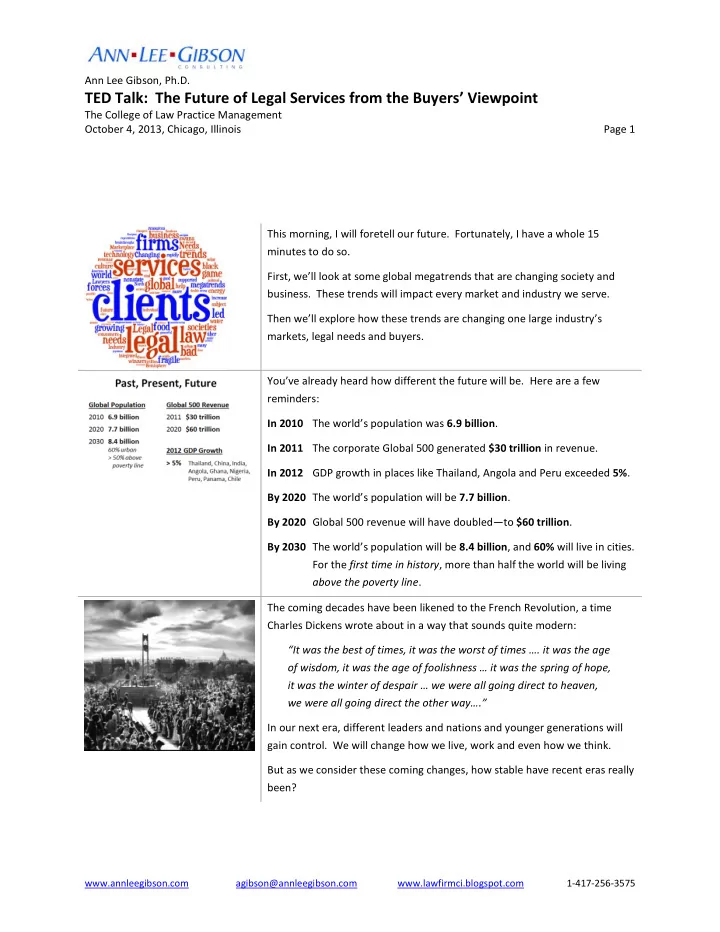
Ann Lee Gibson, Ph.D. TED Talk: The Future of Legal Services from the Buyers Viewpoint The College of Law Practice Management October 4, 2013, Chicago, Illinois Page 1 This morning, I will foretell our future. Fortunately, I have a whole


slide-1
SLIDE 1

Ann Lee Gibson, Ph.D.

TED Talk: The Future of Legal Services from the Buyers’ Viewpoint

The College of Law Practice Management October 4, 2013, Chicago, Illinois Page 1

www.annleegibson.com agibson@annleegibson.com www.lawfirmci.blogspot.com 1-417-256-3575

This morning, I will foretell our future. Fortunately, I have a whole 15 minutes to do so. First, we’ll look at some global megatrends that are changing society and

  • business. These trends will impact every market and industry we serve.

Then we’ll explore how these trends are changing one large industry’s markets, legal needs and buyers. You’ve already heard how different the future will be. Here are a few reminders: In 2010 The world’s population was 6.9 billion. In 2011 The corporate Global 500 generated $30 trillion in revenue. In 2012 GDP growth in places like Thailand, Angola and Peru exceeded 5%. By 2020 The world’s population will be 7.7 billion. By 2020 Global 500 revenue will have doubled—to $60 trillion. By 2030 The world’s population will be 8.4 billion, and 60% will live in cities. For the first time in history, more than half the world will be living above the poverty line. The coming decades have been likened to the French Revolution, a time Charles Dickens wrote about in a way that sounds quite modern: “It was the best of times, it was the worst of times …. it was the age

  • f wisdom, it was the age of foolishness … it was the spring of hope,

it was the winter of despair … we were all going direct to heaven, we were all going direct the other way….” In our next era, different leaders and nations and younger generations will gain control. We will change how we live, work and even how we think. But as we consider these coming changes, how stable have recent eras really been?

slide-2
SLIDE 2

Ann Lee Gibson, Ph.D.

TED Talk: The Future of Legal Services from the Buyers’ Viewpoint

The College of Law Practice Management October 4, 2013, Chicago, Illinois Page 2

www.annleegibson.com agibson@annleegibson.com www.lawfirmci.blogspot.com 1-417-256-3575

Since World War II, the US has been involved in armed conflicts in Asia, the Middle East, Europe, Africa and Latin America. One US President was assassinated, and two others escaped assassination attempts. We suffered terrorist attacks in Oklahoma and New York. 625,000 Americans died of AIDS, and another 1.2 million are infected with

  • HIV. On the positive side, African-Americans, women and gays won civil

rights they were long denied. In post-war Europe, countries rebuilt dramatically. The 1950s brought the Cold War. The ‘60s saw Europe split by the Iron Curtain. The ‘80s and ‘90s brought Glasnost, German reunification and USSR dissolution, which opened up Eastern Europe to capitalism. Today the European Union includes 27 countries. Fifteen of them share a common currency. Since the Great Depression of the 1930s, the US has undergone 13

  • recessions. I was in the work force for seven of them.

I’ve had careers in three very different industries, was employed at ten institutions and companies, and had a dozen temporary gigs. For the last 16 years I’ve been self-employed. That’s what “stability” used to look like. Every generation is imprinted by the circumstances and mood of the world they’re born into. In this room are three generations. We baby boomers rejected our parents’ traditional values. We discovered sex, drugs, and rock and roll. Then we got jobs and spent the rest of our lives at the office. Now we’re discovering arthritis and retirement, but we’re still influenced by

  • ur youthful ideologies.

Gen Xs discovered Billy Idol, entrepreneurship and work-life balance. You’re less ideological than Boomers and have more education. Some call you the MTV generation, but you’re really the MBA generation. You take risks and solve problems. You start and manage businesses with

  • confidence. You’re pragmatic and get the job done.
slide-3
SLIDE 3

Ann Lee Gibson, Ph.D.

TED Talk: The Future of Legal Services from the Buyers’ Viewpoint

The College of Law Practice Management October 4, 2013, Chicago, Illinois Page 3

www.annleegibson.com agibson@annleegibson.com www.lawfirmci.blogspot.com 1-417-256-3575

Gen Ys, or Millennials, are special, too. Your strong sense of community includes the whole world. You’re the first digital natives. For you, virtual is real. Your first loyalty is to yourself, not institutions. Your process is experiential. I have no idea how you and the legal project management guys are going to coexist. Yet we all face the same future. Every five years, the National Intelligence Council publishes a report about global trends, uncertainties, and possible future scenarios for the next 15-20

  • years. These reports are widely used in planning exercises around the world.

The latest report identifies four global trends in force through 2030. These trends will deepen and intertwine to produce a qualitatively different world than any of us were born into. The report also identifies other forces—some within and some outside our control—and four potential futures The first global trend is individual empowerment. This trend will accelerate substantially in the next 15-20 years due to poverty reduction, growth of the global middle class, more education, new communications and manufacturing technologies, and better health care. This is the most important trend. It is both a cause and effect of most other trends, including the expanding global economy and rapid growth of developing countries. Individuals will use their power to cause both productive and destructive effects. The second trend is diffusion of power. Going forward, there will be no world-wide hegemonic power. Pax Americana is over. Real power will shift to networks and coalitions in a multi-polar world. This shift is true of global and regional political relationships. It is also true of business, cultural and social relationships. Temporary networks will spring up inside and between enterprises. For individuals, these first two trends mean the world is becoming a place where whom you know and which conversations you were present for define your influence more than your current job title does.

slide-4
SLIDE 4

Ann Lee Gibson, Ph.D.

TED Talk: The Future of Legal Services from the Buyers’ Viewpoint

The College of Law Practice Management October 4, 2013, Chicago, Illinois Page 4

www.annleegibson.com agibson@annleegibson.com www.lawfirmci.blogspot.com 1-417-256-3575

The third trend is changing demographic patterns. We will see unprecedented and widespread aging. By 2030 the median ages of populations in most of Europe and in Japan, South Korea and Taiwan will be 45 years or older. There, economic activity will slow. In areas where the median population rises above 25 years, we will see lower crime rates and fewer revolutions. Global migration will increase as both rich and developing countries suffer from workforce shortages. The fourth trend is about the nexus between food, water and energy. Demand for these will grow substantially due to increasing populations. By 2030, demand for food and water will rise 40%. But here’s the kicker: Growing more food requires more water. Moving water to where food is grown requires energy. Generating bio-fuels uses up land and water that otherwise would be used to grow food. So tackling problems that pertain to any one of these commodities is linked to supply and demand for the other two. By 2030 half the world’s population will live in areas with severe water

  • stress. Fragile states in Africa and the Middle East are most at risk of

food/water shortages, but China and India are also vulnerable. This nexus will lead us to new technologies and new societal decisions. To paraphrase that unsolicited advice offered in the movie The Graduate: “I just want to say one word to you. Just one word. Water! There’s a great future in water.” And from the “Who would have believed this? department,” the US is about to become energy independent, perhaps by 2020. Recent shale gas discoveries will give us enough natural gas to meet our domestic needs and generate potential global exports for decades. These discoveries, along with some new oil extraction technologies and possible energy policy changes will improve the US trade balance and expand our economy, not to mention what could happen to OPEC.

slide-5
SLIDE 5

Ann Lee Gibson, Ph.D.

TED Talk: The Future of Legal Services from the Buyers’ Viewpoint

The College of Law Practice Management October 4, 2013, Chicago, Illinois Page 5

www.annleegibson.com agibson@annleegibson.com www.lawfirmci.blogspot.com 1-417-256-3575

Global megatrends are not the only forces shaping our future. Non-state actors will use their increasing influence to solve global problems and forward their own agendas. As governments become less effective, institutions and individuals will flex their superior resources and freedom to act. Non-state actors include megacities, global corporations, IT and communications companies, universities and entertainment media. They include religious and business leaders, inventors, activists and terrorists. They will leverage personal relationships, big data analysis, social media, celebrity, and disruptive technologies. They will build networks and patchworks appropriate to the challenge at hand. As always, there is the threat of exceedingly rare but dire events (black swans) that could cause great disruption—things like pandemics, solar- geomagnetic storms, WMDs, and more rapid climate change than we anticipated. We can worry about these things, but we cannot prevent or control them. On the bright side, new technologies will reshape every industry. These include nanotechology, 3D printing, robotics, genetically modified

  • rganisms, new composite materials, construction methods, sustainable

energy, aviation, and surface transportation. In fact, every problem we encounter has the potential to spur new inventions and create or revolutionize industries. The US healthcare is just one industry that’s changing rapidly in response to these trends and forces. It is burgeoning because baby boomers are aging. [DEMOGRAPHIC CHANGES] By 2020, public/private healthcare spending will reach $4.5 trillion. By 2025, healthcare spend will be 25% of the US GDP. Healthcare is actually many different industries that deliver, among other things, pharmaceuticals, medical devices, primary care, long-term care, hospital services. Let’s look closer at one of these industries—hospital systems.

slide-6
SLIDE 6

Ann Lee Gibson, Ph.D.

TED Talk: The Future of Legal Services from the Buyers’ Viewpoint

The College of Law Practice Management October 4, 2013, Chicago, Illinois Page 6

www.annleegibson.com agibson@annleegibson.com www.lawfirmci.blogspot.com 1-417-256-3575

Hospital services are increasingly funded by government, but delivered by for-profit companies. Services are diverging into lower-priced commodities and expensive, high-margin services. Boomers are now buying more expensive services and are retiring in places that offer good medical care. [URBANIZATION] Something you may not know is that the largest US hospital system was founded by the same people who created Kentucky Fried Chicken. [NON- STATE ACTORS] Those founders leveraged the value of vertically integrated supply chains and brands. Hospital systems benefit from the same economies of scale found in all fast-growing franchise operations. Today, government and private payers are pushing back hard on hospital pricing, as are journalists and consumer-activists. [NON-STATE ACTORS; INDIVIDUAL EMPOWERMENT] But looming ahead are labor shortages of doctors, nurses and other workers that will force prices back up. [DEMOGRAPHIC CHANGES] This tension between lower funding and rising costs will invite the entrance of new technologies and even more buyer changes to disrupt the industry. Big hospital systems are run mostly by white men, including the general

  • counsel. That may change. But below the top level, the in-house legal staff

is much more diverse. Those who hire outside counsel right now are mostly Gen Xs and will soon include Gen Ys. In-house lawyers are typically recruited from law firms that already serve the company. Hospital systems need a wide array of legal services: Transactional Litigation M&A Commercial Securities Tort Antitrust White Collar Lobbying Internal Investigations Labor & Employment Insurance Real Estate Class Actions Intellectual Property Bankruptcy Environmental Law Government Civil Proceedings

slide-7
SLIDE 7

Ann Lee Gibson, Ph.D.

TED Talk: The Future of Legal Services from the Buyers’ Viewpoint

The College of Law Practice Management October 4, 2013, Chicago, Illinois Page 7

www.annleegibson.com agibson@annleegibson.com www.lawfirmci.blogspot.com 1-417-256-3575

Hospital system in-house lawyers discuss their challenges with each other, so savvy firms keep lawyers seconded inside the company to gather current intelligence. Firms will also create clear career paths for some of their lawyers to move in-house permanently, and then safeguard those relationships. In-house lawyers always need to learn how changing healthcare regulations will affect their company. But training budgets are tight, so savvy firms will

  • ffer the right education and training quickly.

When hospital systems grow and have new needs, smart firms add new

  • resources. As the company improves its supply chains, smart firms will

improve theirs with LPM and LPI that deliver higher value/cost ratios. As the company forces commodity prices lower, smart firms rebalance their

  • portfolios. They will bundle and price high- and low-value work together

using fixed fees. They will recruit laterals who already work for the

  • company. They will ponder questions like these:
  • 1. If a client is expanding fast, protecting its brand, having its margins

squeezed from three sides, suffering labor shortages, refining supply chains, and seeking disruptive technologies, which legal services will it need more of and less of?

  • 2. As a client grows larger, how can we stop firms five states away from

taking our business?

  • 3. If our client has subsidiaries that supply everything from bed linen to

bypass surgery, why haven’t they created a legal subsidiary? How can our firm deliver the same value a legal subsidiary would? What other value can we deliver that a legal subsidiary could not?

slide-8
SLIDE 8

Ann Lee Gibson, Ph.D.

TED Talk: The Future of Legal Services from the Buyers’ Viewpoint

The College of Law Practice Management October 4, 2013, Chicago, Illinois Page 8

www.annleegibson.com agibson@annleegibson.com www.lawfirmci.blogspot.com 1-417-256-3575

Regardless of which industries you and your firms serve, these are the kinds

  • f questions you must think of, answer, and act on.

To sum up, tomorrow’s consumers and citizens want more independence and freedom. They reject big command and control organizations for flatter, more efficient and even temporary ones. They are living longer and better

  • lives. They need more and cleaner food, energy and water.

In response, food is already being grown differently. Fossil and green energy industries are transforming themselves. Entertainment and hospitality destinations are going virtual. Cities are becoming denser and more vertical. Telecom is becoming bio-telecom. Detroit and Tokyo are now designing driverless cars. And all this change is accelerating. No matter which generation we belong to, our clients are going to need all the help we can give. I will close with a quotation from that timeless sage Yogi Berra: “The future ain’t what it used to be.” Ladies and gentlemen, thank you! Since 1998, Ann Lee Gibson, Ph.D., has been a consultant advising law firms on projects and issues concerning new business development. She has helped law firms win over $750 million in new business. Before that, she led the marketing programs at Gibson, Dunn & Crutcher and the Nossaman firm. In 2010, her book Competitive Intelligence: Improving Law Firm Strategy and Decision Making was published in London by The Ark Group. She is a Fellow in the College of Law Practice Management and a member of the Legal Marketing Association’s International Hall of Fame.

slide-9
SLIDE 9
slide-10
SLIDE 10
slide-11
SLIDE 11
slide-12
SLIDE 12
slide-13
SLIDE 13
slide-14
SLIDE 14
slide-15
SLIDE 15
slide-16
SLIDE 16
slide-17
SLIDE 17
slide-18
SLIDE 18