Technology in Mauritius United Nations / South Africa Symposium on - - PowerPoint PPT Presentation
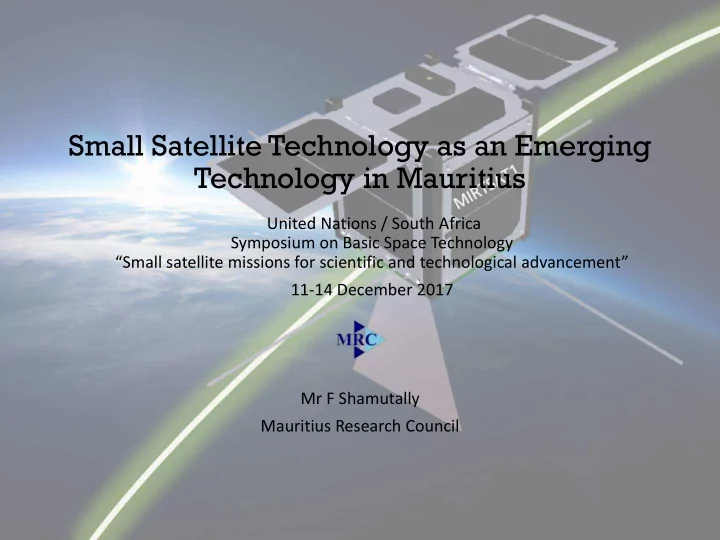
Small Satellite Technology as an Emerging Technology in Mauritius United Nations / South Africa Symposium on Basic Space Technology Small satellite missions for scientific and technological advancement 11-14 December 2017 Mr F Shamutally
- Set up in May 1992
- Apex body advising Government on all matters concerning
scientific, technological, research and innovation issues.
- Also act as the national research and innovation agency and
focal point for the promotion and coordination of research, development and innovation responding to the social and economic needs of the country.
- It helps to facilitate the creation of knowledge through
research and innovation in all fields of science - including the social sciences - and technology, and thereby contribute to the improvement of the quality of life.
- Provide research grants, incubators
Mauritius Research Council
Overview of MRC
Vision
- “Shaping up the Mauritius of tomorrow through
research, technology and innovation” Mission
- "Promoting
and pioneering research for sustainable development to enhance the quality
- f life of the people of Mauritius“
ISO 9001:2008 Certified since July 2016
- Foster,
promote and co-ordinate research and development in all spheres of scientific, technological, social and economic activities;
- Advise the government on all matters concerning scientific
and technological policies;
- Lay guidelines for, and initiate the formulation of research
and development policies on a national basis; and
- Encourage commercial utilisation of research and
development results in the national interest.
MRC Objectives
- Renewable Energy
- Ocean Technology, Ocean Resources and Ocean Services
- ICT/BPO/Telecommunications
- Life Sciences (Health, Medical & Pharmaceutical)
- Manufacturing
- Traffic Management
- Social Issues
- Agro-industry
- Emerging Technologies (e.g Robotics, IoT, NanoSatellites, etc…)
STRATEGIC AREAS FOR RESEARCH & INNOVATION
- Era where accelerated technological advancement
- New technologies important for innovation
- Great importance for the Government of Mauritius
- Climb up the innovation ladder
- Adopt new technologies to tackle national challenges,
accelerating the economic development of the country.
- Enhance competitiveness of the economy.
Emerging Technologies in Mauritius
MRC – Emerging Sector - NanoSats
- Emerging Sector - New
- NanoSatellite technology
- Advanced
technology, smartphones, small electronic devices, powerful microprocessors
- Building satellites has become more affordable
- Its small size makes use of wasted space
- More efficient and capability of bigger older
satellites
- Launching into LEO is also becoming more
affordable
- Can be used for capacity building
- For research purposes and solve key problems
- f the country
CubeSats as a solution to current issues
- Mauritius net food importer with 22.1% of total
imports accounting for food.
- Limited
agricultural land and continually decreasing at average rate of 750 Ha annually.
- Around 30% of food wasted or lost to pest,
diseases and improper storage.
- Rising concern of food safety with excessive
dosage of agro chemicals.
- Large EEZ, no fish tracking problems, illegal
fishing, ocean surveillance also a rising concern
- Remote islands with very few inhabitants and
islets with concervation and leisure activities. However, no internet connectivity.
1st Maurit itia ian Satell llit ite in in Space?
The first Mauritian satellite
- A first time in the Country
- MRC proposed the idea to local stakeholders
- To gauge the needs for a first Mauritian
NanoSat in space
- To share interest, collaborate and agree on a
mission statement
- Benefits of such a project are found to be
significant
- This project will promote and accelerate
interest in small satellites technology in the country.
- For the 50th anniversary of Mauritius, big step,
shows strong commitment towards innovation.
Local applications
- Aim
to tackle issues pertinent to the sustainable development goals.
- Food Security (SDG 2)
- Promote awareness to youth on small satellite
technologies (SDG 4)
- Promote innovation (SDG 9)
- Marine life (SDG 14)
- Agriculture (SDG 15)
- Seeking international collaboration in this field
in terms of access to new technologies, knowledge enhancement and capacity building (SDG 17)
Local applications
- Food Crop Management
- Thermal infrared images from satellites can help in
monitoring & managing crop vegetation, irrigation scheduling, plant disease and pathogen detection and crop yield estimation and forecasting.
- Soil properties such as salinity
- Agroclimatic and crop suitability maps
- Fire detection in crops.
- Improved food security, early warning system
- Provide access to updated and regular maps on sea
surface temperature (SST) to aid in research in
- ceanography.
- Seasonal change in SST determines fish migratory
patterns.
- Existing datasets can be updated and enhanced
with new data such as updated landuse map or fish migration map.
Near infrared (NIR) aerial image and yield map show similar spatial patterns. Images taken by Cornerstone Mapping and courtesy of USDA-ARS
Mauritius Island 1
- Inter Island communication of the Rep. of
Mauritius where Internet barely exists.
Project Mission Statement
- To enhance access to space application tools
for sustainable development in Mauritius through capacity building in basic satellite technology and creation of a collaborative network with renowned international space related agencies
- Allow Mauritian authorities to get acquainted
with the legal and regulatory considerations and responsibilities related to satellite projects
- Use the development of the first ever Mauritian
satellite as a platform to promote space technology in Mauritius and to encourage the development of more sophisticated satellites in the future to support the needs of Small Island Developing States (SIDS) and of the African continent.
Mission Objectives
- Verify the performance of the on-board
subsystems – if all operational
- Establish communication to and from the
satellite
- Broadcast an update from the internet to an
islet of the Republic of Mauritius using the on- board communication subsystem
- Ensure that the on-board payload is operational
- Collect thermal infrared images of Mauritius
and surrounding regions in the Mauritian EEZ
Design
For more information regarding the design, please contact Mr Faraaz Shamutally as follows: f.Shamutally@mrc.intent.mu Tel: +230 465 1235 Fax: +230 465 1239
Design
Orbit it Desig ign
Design
- Longwave
IR Camera with theoretical resolution of roughly 550m x 550m.
UNOOSA/JAXA KiboCUBE Prog.
- The MIRT-SAT1 will contribute to developing
human knowledge and capacity to undertake activities in the field of space science and technology in Mauritius.
- It will also contribute to enhancing research
and development through the technological demonstration of deploying and operating the CubeSat in the country, which will be a first.
- This Programme offers opportunity to deploy
the CubeSat from the ISS Kibo module.
- Proposal submitted under this programme
during the KiboCUBE 2nd Round in March 2017
- Shortlisted among the high-quality proposals.
Our Team
International collaboration
- Clyde Space (Glasgow, UK) – assistance for
design, integration and testing of the 1U CubeSat platform as well as dedicated nanosatellite training.
- Submit
proposal under the UKSA IPP as international partner to Clyde Space
- ASTOS Solutions (Germany) – assistance for
mission analysis (orbit design, communication link budget and sunlight hours).
Future Work
- Explore more opportunities to launch the
satellite
- Extend collaboration to more institutions local
and international
- Investigate other applications for a possible
3U/6U CubeSat
- Develop a space industry in Mauritius
- Meet with collaborators and stakeholders
- Come up with a roadmap
Thank You!
6th Floor Ebene Heights, 34 Cybercity, Ebene Mauritius Tel: +230 4651235 Fax: +230 4651239 Email: mrc@intent.mu