Technology Acceptance Model Technology Acceptance Model (TAM) Fred - - PowerPoint PPT Presentation

technology acceptance model
SMART_READER_LITE
LIVE PREVIEW

Technology Acceptance Model Technology Acceptance Model (TAM) Fred - - PowerPoint PPT Presentation

Technology Acceptance Model Technology Acceptance Model (TAM) Fred Davis (1986) PhD Thesis at MIT Adaption of Fishbein and Ajzens Theory of Reasoned Action (TRA) Davis paper Perceived usefulness, perceived ease of use,


slide-1
SLIDE 1

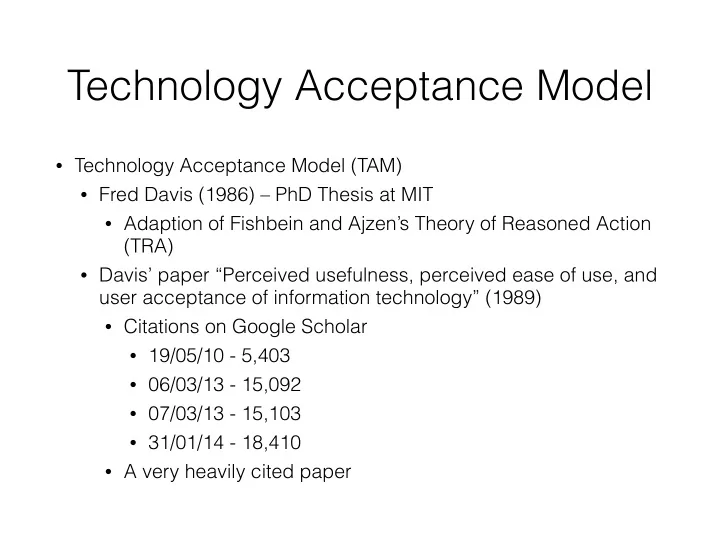
Technology Acceptance Model

  • Technology Acceptance Model (TAM)
  • Fred Davis (1986) – PhD Thesis at MIT
  • Adaption of Fishbein and Ajzen’s Theory of Reasoned Action

(TRA)

  • Davis’ paper “Perceived usefulness, perceived ease of use, and

user acceptance of information technology” (1989)

  • Citations on Google Scholar
  • 19/05/10 - 5,403
  • 06/03/13 - 15,092
  • 07/03/13 - 15,103
  • 31/01/14 - 18,410
  • A very heavily cited paper
slide-2
SLIDE 2

Technology Acceptance Model

  • Technology Acceptance Model (TAM)
  • External Variables include “system characteristics, training, user

involvement in design, and the nature of the implementation process” (Venkatesh & Davis, 1996)

  • These ‘[...] directly influence the perceived usefulness and

perceived ease of use’, in turn mediating behavioural intention to use” (Davis, 1993)

External Variables Perceived Usefulness Perceived Ease

  • f Use

Actual System Use Behavioural Intention

Final Version of Technology Acceptance Model (TAM). Source: (Venkatesh & Davis, 1996)

slide-3
SLIDE 3

Problems with TAM Research

  • TAM is a parsimonious model
  • This strength is also its weakness
  • Researchers have “overlooked essential determinants of

decisions and actions […]” (Bagozzi, 2007)

  • Why do people use a technology in the first place?
  • Think of COMPGA10 – People & Security
  • TAM has been augmented many times
  • Introducing new variables to explain why parts of the

model work the way they do

  • Age, gender, voluntariness, age, training,

innovativeness, anxiety, etc.

slide-4
SLIDE 4

Adding New Variables to TAM

  • Example studies:
  • Gender Differences in the Perception and Use of E-Mail: An Extension to

the Technology Acceptance Model - David Gefen and Detmar W. Straub - MIS Quarterly , Vol. 21, No. 4 (Dec., 1997), pp. 389-400

  • Featherman, Mauricio. "Extending the technology acceptance model by

inclusion of perceived risk." (2001)

  • Yang, Hee-dong, and Youngjin Yoo. "It's all about attitude: revisiting the

technology acceptance model." Decision Support Systems 38.1 (2004): 19-31

  • Lee, Younghwa, Jintae Lee, and Zoonky Lee. "Social influence on

technology acceptance behavior: self-identity theory perspective." ACM SIGMIS Database37.2-3 (2006): 60-75

  • Gefen, David, Elena Karahanna, and Detmar W. Straub. "Trust and TAM in
  • nline shopping: An integrated model." MIS quarterly (2003): 51-90
  • etc., etc., etc.
slide-5
SLIDE 5

External Variables & TAM

1 Source: Lee, Younghwa, Kenneth A. Kozar, and Kai RT Larsen. "The technology acceptance model: Past, present, and

future." The Communications of the Association for Information Systems 12.1 (2003): 53.

slide-6
SLIDE 6

TAM Research

  • Each paper follows the scientific method:
  • Description of TAM and identified shortcoming(s)
  • Hypothesised augmented TAM
  • Hypothesised linkages between variables
  • Data collected – usually a survey
  • Data analysed – usually structural equation modelling
  • Results explained
  • Conclusions

!

  • But is this enough? Is this the right approach?
slide-7
SLIDE 7

Bagozzi’s (2007) Critique

  • Focus on extending TAM by introducing new variables

has broadened, not deepened, it

  • No understanding of why does a particular variable

influence technology adoption

  • Venkatesh et al. (2007):
  • Identified problems with researchers focusing on

‘tweaking’ of TAM, rather than the more important issues in technology adoption

  • Extensions to TAM are “[…] a patchwork of many largely

unintegrated and uncoordinated abridgements”(Bagozzi, 2007, p.252)

slide-8
SLIDE 8

TAM References

  • Bagozzi, R.P. (2007). The Legacy of the Technology Acceptance Model and a

Proposal for a Paradigm Shift. Journal of the Association of Information Systems. 8 (4). p.pp. 244–254.

  • Davis, F.D. (1986). A technology acceptance model for empirically testing new

end-user information systems : theory and results. Thesis. [Online]. Available from: http://dspace.mit.edu/handle/1721.1/15192.

  • Davis, F.D. (1989). Perceived usefulness, perceived ease of use, and user

acceptance of information technology. MIS Quarterly: Management Information

  • Systems. 13 (3). p.pp. 319–339.
  • Lee, Younghwa, Kenneth A. Kozar, and Kai RT Larsen. "The technology

acceptance model: Past, present, and future." The Communications of the Association for Information Systems 12.1 (2003): 53.

  • Venkatesh, V. & Davis, F.D. (1996). A Model of the Antecedents of Perceived Ease
  • f Use: Development and Test. Decision Sciences. 27 (3). p.pp. 451–481.
  • Venkatesh, V., Morris, M.G., Davis, G.B. & Davis, F.D. (2003). User acceptance of

information technology: Toward a unified view. MIS Quarterly: Management Information Systems. 27 (3). p.pp. 425–478.

slide-9
SLIDE 9

A Good Thesis (from COMPGA99)

  • Addresses one or more challenging information

security problems

  • Describes why this problem is important

!

  • Describes related work that has already been done

in the area and what the state of the art currently is

!

  • Proposes solutions and gives a critical evaluation
  • f the proposed solutions
slide-10
SLIDE 10

A Good Thesis (from COMPGA99)

  • Addresses one or more challenging information

security problems

  • Describes why this problem is important

!

  • Describes related work that has already been done

in the area and what the state of the art currently is

!

  • Proposes solutions and gives a critical evaluation
  • f the proposed solutions

Observation, Problem Definition & Initial Data Gathering Literature Review Hypotheses/Proposed Models

slide-11
SLIDE 11

A Good Thesis (from COMPGA99)

!

  • Gives an easy to read presentation of the results,

uses precise and correct technical terms

!

  • It gives a balanced and critical evaluation of the

proposed solutions

!

  • May point to further interesting research questions
slide-12
SLIDE 12

A Good Thesis (from COMPGA99)

!

  • Gives an easy to read presentation of the results,

uses precise and correct technical terms

!

  • It gives a balanced and critical evaluation of the

proposed solutions

!

  • May point to further interesting research questions

Data Collection Analysis & Results Discussion Conclusions & Further Work

slide-13
SLIDE 13

A Good Thesis

  • Ties the different parts of the thesis together to form

a whole coherent argument

!

  • It displays creativity, thoroughness, logical and

critical reasoning, etc.

slide-14
SLIDE 14

A Good Thesis

  • Ties the different parts of the thesis together to form

a whole coherent argument

!

  • It displays creativity, thoroughness, logical and

critical reasoning, etc. A well structured, logical narrative with an obvious beginning, middle and end

slide-15
SLIDE 15

MSc Dissertation Tips

  • Start straight away!

!

  • Ensure you have a well formed research question/problem
  • Which you can justify
  • Is succinct – one sentence ideally
  • Print it out and put it above your desk

!

  • Stay focused on research question/problem
  • But don’t be afraid to slightly shift focus - if justifiable

!

  • Don’t treat literature review as an afterthought
slide-16
SLIDE 16

MSc Dissertation Tips

  • Be very aware of “scope creep”

!

  • Plan your time
  • Simple project plan – Excel or Word will do
  • How can a software project be a year late?
  • “one day at a time” – Fred Brooks, The Mythical Man

Month, 1975

!

  • Draft a table of contents early on
  • Summary of each section
  • Helps maintain focus
slide-17
SLIDE 17

MSc Dissertation Tips

  • Can you clearly identify your hypotheses?

!

  • Revisit and refine your COMPGA11 literature review
  • Will need rewriting to refocus it to fit in with the dissertation

approach and structure, and page limits

!

  • User studies take time and effort
  • Plan well in advance!

!

  • Get someone to read it
  • Someone not expert in the field
slide-18
SLIDE 18

MSc Dissertation Tips

  • Keep in regular contact with supervisor(s)

!

  • Do not expect supervisor to solve problems for you
  • r tell you what to do

!

  • Try to think of possible solutions to discuss with

your supervisor

slide-19
SLIDE 19

COMPGA11 Literature Review

Example of Peer-to-Peer (P2P) File Sharing Literature Review

What is P2P? History of P2P What is motivation for P2P? Problems with P2P Causes of inadvertent disclosure via P2P P2P technologies P2P empirical studies Incidents of inadvertent disclosure Summary of research into problems of P2P

COMPGA11

Good/bad use

  • f P2P

Overview of P2P topic, real-world problems, existing research in field, identified gaps

P2P file-sharing

slide-20
SLIDE 20

Dissertation Literature Review

Examples of existing UIs for feedback and control Mental models Cognitive problems Existing theories about users’ perceptions of privacy Theoretical Foundations of Privacy Problems with existing UI approaches What is P2P? History of P2P What is motivation for P2P? Problems with P2P Causes of inadvertent disclosure via P2P P2P technologies P2P empirical studies Incidents of inadvertent disclosure Summary of research into problems of P2P

COMPGA11

Good/bad use

  • f P2P

Dissertation

More specific focus on inadvertent disclosure, peoples’ mental models, perceptions of privacy, problems with UIs Overview of P2P topic, real-world problems, existing research in field, identified gaps

P2P file-sharing

Caveat: This list is not exhaustive!

slide-21
SLIDE 21

Dissertation Literature Review

Examples of existing UIs for feedback and control Mental models Cognitive problems Existing theories about users’ perceptions of privacy Theoretical Foundations of Privacy Problems with existing UI approaches What is P2P? History of P2P What is motivation for P2P? Problems with P2P Causes of inadvertent disclosure via P2P P2P technologies P2P empirical studies Incidents of inadvertent disclosure Summary of research into problems of P2P

COMPGA11

Good/bad use

  • f P2P

Dissertation

More specific focus on inadvertent disclosure, peoples’ mental models, perceptions of privacy, problems with UIs Overview of P2P topic, real-world problems, existing research in field, identified gaps

P2P file-sharing

Caveat: This list is not exhaustive!

Structured by a) technology and history; b) real world problems; c) studies into problems..... Structured by a) inadvertent sharing, b) privacy perceptions; c) privacy theories; d) UIs; e) studies into UIs and privacy perceptions.....

slide-22
SLIDE 22

Dissertation Literature Review

Examples of existing UIs for feedback and control Mental models Cognitive problems Existing theories about users’ perceptions of privacy Theoretical Foundations of Privacy Problems with existing UI approaches What is P2P? History of P2P What is motivation for P2P? Problems with P2P Causes of inadvertent disclosure via P2P P2P technologies P2P empirical studies Incidents of inadvertent disclosure Summary of research into problems of P2P

COMPGA11

Good/bad use

  • f P2P

Dissertation

More specific focus on inadvertent disclosure, peoples’ mental models, perceptions of privacy, problems with UIs Overview of P2P topic, real-world problems, existing research in field, identified gaps

P2P file-sharing

Caveat: This list is not exhaustive!

COMPGA11 lit. rev. informs dissertation lit. rev (but they must be different)