! Technical Development Paradigms ! Are we working with Cars or - - PDF document

technical development paradigms are we working with cars
SMART_READER_LITE
LIVE PREVIEW

! Technical Development Paradigms ! Are we working with Cars or - - PDF document

Dr C.J. Burman The Development Facilitation and Training Institute , University of Limpopo, World Vision - Complex Adaptive Systems: New Strategies for Transformational Development 31 st August, 2010 Dr C.J. Burman, The Development,


slide-1
SLIDE 1

Dr C.J. Burman

The Development Facilitation and Training Institute, University of Limpopo,

World Vision - Complex Adaptive Systems: New Strategies for Transformational Development

31st August, 2010

09/01/10 Dr C.J. Burman, The Development, Facilitation and Training Institute (DevFTI), University of Limpopo: World Vision, Arusha, Tanzania 2

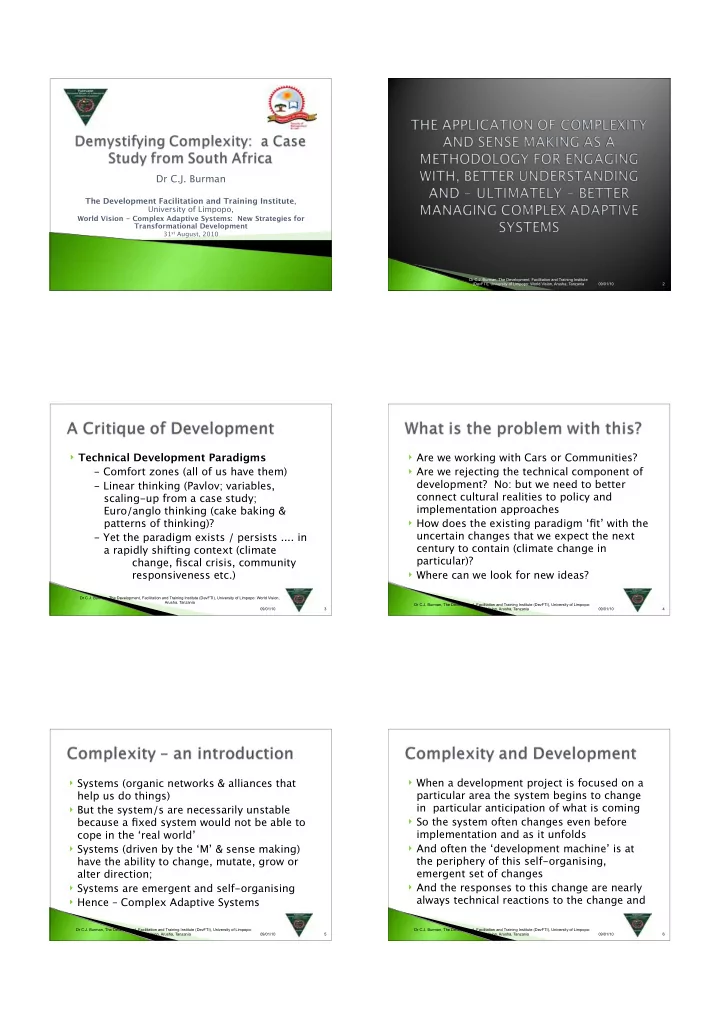
! Technical Development Paradigms

  • Comfort zones (all of us have them)
  • Linear thinking (Pavlov; variables,

scaling-up from a case study; Euro/anglo thinking (cake baking & patterns of thinking)?

  • Yet the paradigm exists / persists .... in

a rapidly shifting context (climate change, fiscal crisis, community responsiveness etc.)

Dr C.J. Burman, The Development, Facilitation and Training Institute (DevFTI), University of Limpopo: World Vision, Arusha, Tanzania 09/01/10 3

! Are we working with Cars or Communities? ! Are we rejecting the technical component of

development? No: but we need to better connect cultural realities to policy and implementation approaches

! How does the existing paradigm ‘fit’ with the

uncertain changes that we expect the next century to contain (climate change in particular)?

! Where can we look for new ideas?

09/01/10 Dr C.J. Burman, The Development, Facilitation and Training Institute (DevFTI), University of Limpopo: World Vision, Arusha, Tanzania 4

! Systems (organic networks & alliances that

help us do things)

! But the system/s are necessarily unstable

because a fixed system would not be able to cope in the ‘real world’

! Systems (driven by the ‘M’ & sense making)

have the ability to change, mutate, grow or alter direction;

! Systems are emergent and self-organising ! Hence – Complex Adaptive Systems

09/01/10 Dr C.J. Burman, The Development, Facilitation and Training Institute (DevFTI), University of Limpopo: World Vision, Arusha, Tanzania 5

! When a development project is focused on a

particular area the system begins to change in particular anticipation of what is coming

! So the system often changes even before

implementation and as it unfolds

! And often the ‘development machine’ is at

the periphery of this self-organising, emergent set of changes

! And the responses to this change are nearly

always technical reactions to the change and

09/01/10 Dr C.J. Burman, The Development, Facilitation and Training Institute (DevFTI), University of Limpopo: World Vision, Arusha, Tanzania 6
slide-2
SLIDE 2

! Development becomes a tussle for power:

the community system is already motivated and changing with one ambition (gorilla)

! And the developmental machine (another

system) is motivated by another ambition

! So the two inter-connected systems are even

more complex as they react / respond to the

  • ther system’s reactions

! Is this useful if we want to see improved

  • utcomes (community) in the face of
09/01/10 Dr C.J. Burman, The Development, Facilitation and Training Institute (DevFTI), University of Limpopo: World Vision, Arusha, Tanzania 7

! Community-University Partnership

Programme, funded by the Department: Science and Technology in South Africa

! Focus: Community Engagement in the face of

continuous change

! The case study focused on the application of

complexity approaches to a Community Engagement project: Boys 2 Men

! Designing a Mentorship Programme &

understanding the cultural system to do so

Dr C.J. Burman, The Development, Facilitation and Training Institute (DevFTI), University of Limpopo: World Vision, Arusha, Tanzania 09/01/10 8 09/01/10 9 Dr C.J. Burman, The Development, Facilitation and Training Institute (DevFTI), University of Limpopo: World Vision, Arusha, Tanzania 09/01/10 Dr C.J. Burman, The Development, Facilitation and Training Institute (DevFTI), University of Limpopo: World Vision, Arusha, Tanzania 10

Bio-medical knowledge HIV; circumcision; human rights & facilitation tips Respond to community interest & girls interest; other Respond to difficult questions from boys; other Circumcision (efficacy / efficiency); other ! Called a Review of Boys 2 Men ! We wanted a better understanding of the

system the mentors will work in

! And to reinforce / adjust our work plan for

the mentorship design (& ofger a platform for the existing facilitators to share knowledge)

! Pre-hypothesis approach ! Future Backwards ! Archetype Construction ! The abridged findings are listed below

09/01/10 Dr C.J. Burman, The Development, Facilitation and Training Institute (DevFTI), University of Limpopo: World Vision, Arusha, Tanzania 11

Capricorn District Mopane District Facilitators

09/01/10 Dr C.J. Burman, The Development, Facilitation and Training Institute (DevFTI), University of Limpopo: World Vision, Arusha, Tanzania 12
slide-3
SLIDE 3

DevFTI

09/01/10 Dr C.J. Burman, The Development, Facilitation and Training Institute (DevFTI), University of Limpopo: World Vision, Arusha, Tanzania 13

Capricorn District DevFTI

09/01/10 Dr C.J. Burman, The Development, Facilitation and Training Institute (DevFTI), University of Limpopo: World Vision, Arusha, Tanzania 14

Mopane District DevFTI

09/01/10 Dr C.J. Burman, The Development, Facilitation and Training Institute (DevFTI), University of Limpopo: World Vision, Arusha, Tanzania 15

! Confirms DevFTI’s concerns that circumcision

is a cultural issue

! Highlighted the complexity of the Initiation

School

! Shows difgerent perspectives of the same

focus area (B2M)

! Useful visual discussion documents (insights

into the complex adaptive system)

! The process is simple and it helps to identify

issues for the designing a Mentor Programme

09/01/10 Dr C.J. Burman, The Development, Facilitation and Training Institute (DevFTI), University of Limpopo: World Vision, Arusha, Tanzania 16

! Construction of fictional personalities who

express common values, attitudes and behaviours in the system

! Enables deeper analysis of more specific

cultural issues from the perspective of system sub-groups

! Involves anecdote circles [empirical micro-

narrative capture], coding of data and then more images

09/01/10 Dr C.J. Burman, The Development, Facilitation and Training Institute (DevFTI), University of Limpopo: World Vision, Arusha, Tanzania 17

A structure in decay (a common theme); youth intent

  • n destructive behaviour despite the formal warnings

posted. Stereotype Influence Buddies 50% Sexual 17% Circumcisio n 17% Community 17%

09/01/10 Dr C.J. Burman, The Development, Facilitation and Training Institute (DevFTI), University of Limpopo: World Vision, Arusha, Tanzania 18
slide-4
SLIDE 4

Associated with corruption, excessive greed and materialism with little interest in upholding family Stereotype Influence Circumcision 13% Sexual 26% Community 13% Upstanding People 13% Youth 38%

09/01/10 Dr C.J. Burman, The Development, Facilitation and Training Institute (DevFTI), University of Limpopo: World Vision, Arusha, Tanzania 19

Demonstrably ‘macho’ that is a blend of both modern and traditional values associated with ‘false

09/01/10 Dr C.J. Burman, The Development, Facilitation and Training Institute (DevFTI), University of Limpopo: World Vision, Arusha, Tanzania 20

Stereotype Influence Macho 23% Sexual 16% Family 16% Drugs 15% Gentleman 8% Sport 8% Circumcisio n 8% Outcast 8% Young women as being dependent on partners for money, manipulative, lazy, gossiping and sabotaging.

09/01/10 Dr C.J. Burman, The Development, Facilitation and Training Institute (DevFTI), University of Limpopo: World Vision, Arusha, Tanzania 21

Stereotype Influence Violence 20% Workshop 20% Community 20% Tradition 20% Legal 20% The participants were adamant that the outcast is

  • female. She is stubborn, strong, self-suffjcient and

despite the community’s determination to reject the archetype her survival instinct obstinately resists. Stereotype Influence Sexual 33% Developmen t 33% Workshop 22% Violence 11%

09/01/10 Dr C.J. Burman, The Development, Facilitation and Training Institute (DevFTI), University of Limpopo: World Vision, Arusha, Tanzania 22

! The approach has roots in complexity and

sense making techniques based upon a pre- hypothesis approach

! The data we have is thick ! It informs us of the players and cultural

influencers within an emerging, self-

  • rganising complex system

! And the data is useful for designing a

Mentorship Programme that fits our complex context

09/01/10 Dr C.J. Burman, The Development, Facilitation and Training Institute (DevFTI), University of Limpopo: World Vision, Arusha, Tanzania 23

! We have talked to old men about how the

Initiation Schools have changed

! We will be talking to the Traditional Healers

when I return

! We are going to see if we can’t get the B2M

programme in the Initiation Schools

! WHY? Because responding to challenges

using this approach means we are going to try and disrupt the influence of the Initiation Schools & reinforce the positive impacts

09/01/10 Dr C.J. Burman, The Development, Facilitation and Training Institute (DevFTI), University of Limpopo: World Vision, Arusha, Tanzania 24
slide-5
SLIDE 5

! This requires leadership buy-in ! It is not rocket science but does require a

shift in mindset about what we want to achieve

! In the context of HIV-prevention this is

logical because US7.4B (AVAC data) invested in vaccine & microbicides

! Condoms & male circumcision are the bulk of

prevention strategies available today – yet that depends on linear presumptions

09/01/10 Dr C.J. Burman, The Development, Facilitation and Training Institute (DevFTI), University of Limpopo: World Vision, Arusha, Tanzania 25

! Out of the 50 people sitting here ! I bet that many of you have an intractable

challenge at work

! That you intuitively believe will not go away

unless you do something difgerntly And complexity, mixed with sense making, may assist you to do that.

09/01/10 Dr C.J. Burman, The Development, Facilitation and Training Institute (DevFTI), University of Limpopo: World Vision, Arusha, Tanzania 26 09/01/10 Dr C.J. Burman, The Development, Facilitation and Training Institute (DevFTI), University of Limpopo: World Vision, Arusha, Tanzania 27

Areas of high instability Areas ready for change (target resources here) Areas where change is unlikely (don’t waste resources here) New pattern formation (new cultural phenomenon emerging – keep an eye on this area as we don’t know what it is yet)

Questions

Tell me, and I’ll forget, Show me, and I may not remember, Involve me, and I’ll understand.

(Native American proverb or Confucius)

09/01/10 Dr C.J. Burman, The Development, Facilitation and Training Institute (DevFTI), University of Limpopo: World Vision, Arusha, Tanzania 28