Technical Assistance If you experience technical difficulties Use - - PDF document

technical assistance
SMART_READER_LITE
LIVE PREVIEW

Technical Assistance If you experience technical difficulties Use - - PDF document

10/27/2020 Medical Marijuana and The ADA Hashing Out How States and Employers Cope with Medical Marijuana Use Will begin at 11:00 a.m. Eastern Time Audio and visuals are provided through the online webinar platform Access to presentation


slide-1
SLIDE 1

10/27/2020 1

Medical Marijuana and The ADA

Hashing Out How States and Employers Cope with Medical Marijuana Use

Will begin at 11:00 a.m. Eastern Time

  • Audio and visuals are provided through the online webinar platform
  • Access to presentation handouts was included in the email reminder you

received for this session

  • This session will be open-captioned

1

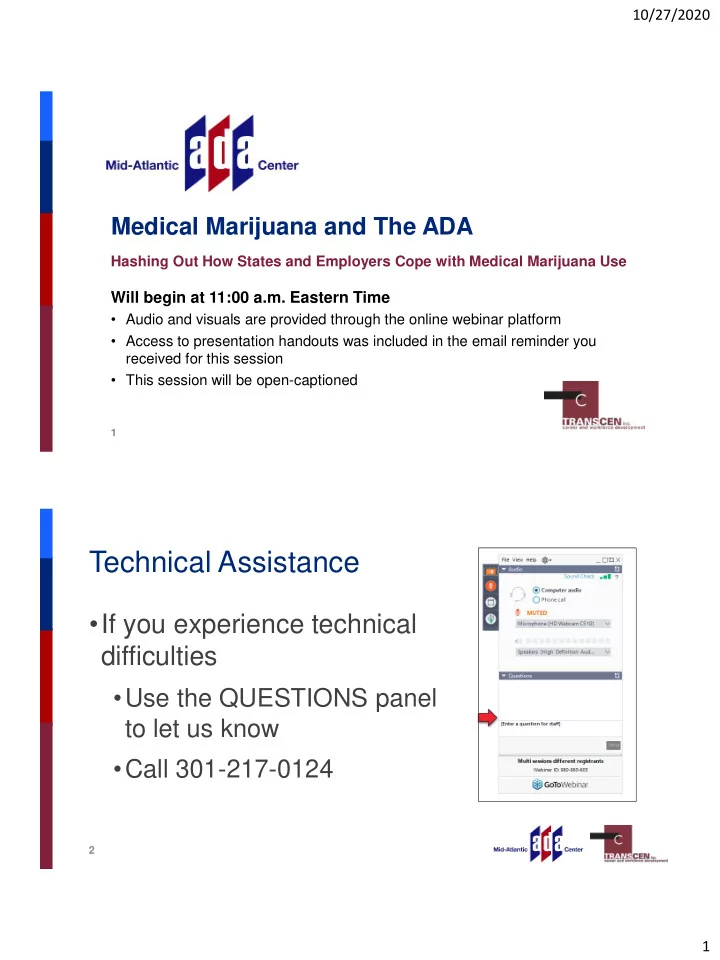
Technical Assistance

  • If you experience technical

difficulties

  • Use the QUESTIONS panel

to let us know

  • Call 301-217-0124

2

slide-2
SLIDE 2

10/27/2020 2

Audio

  • Expand the audio panel to

select computer audio or phone call

3

Video

  • Use the divider line to

enlarge or reduce the video feed

4

slide-3
SLIDE 3

10/27/2020 3

Questions and Comments

  • Use the QUESTIONS panel

5

Archive

  • This webinar is being recorded and can

be accessed next week

  • You will receive an email with information
  • n how to access the archive

6

slide-4
SLIDE 4

10/27/2020 4

About Your Presenters…

TransCen, Inc.

  • Improving the lives of people with disabilities through meaningful work

and community inclusion

  • Mid-Atlantic ADA Center,

a project of TransCen, Inc.

  • Funded by National Institute on Disability, Independent Living, and

Rehabilitation Research (NIDILRR), Administration for Community Living, U.S. Department of Health and Human Services

7

Medical Marijuana and the ADA

H A S H I N G O U T H OW S TAT E S A N D E M P L OY E R S C O P E W I T H M E D I C A L M A R I J U A N A U S E Presented by: Monika Taliaferro

slide-5
SLIDE 5

10/27/2020 5

Disclaimer

The information provided during this presentation does not, and is not intended to, constitute legal nor medical advice; instead, all information, content, and materials are for general informational purposes only. Please consult with your attorney and/or medical professional to determine whether the information provided pertains to your situation before acting or refraining to act on the information provided during this presentation. This training is a representation of my views, not the views of my employer. All liability with respect to actions taken or not taken based on the contents of this site are hereby expressly disclaimed. The content is provided "as is“; no representations are made that the content is error-free.

9

Topics

  • Key Terms
  • History

– Medicinal Cannabis – Cannabis and the ADA

  • Medicinal Cannabis in the Workplace

–ADA –State Laws

10

slide-6
SLIDE 6

10/27/2020 6

Objectives (1-3)

  • Explain the history behind the “illegal drug provision” of the ADA.
  • Interpret the ADA’s definition of “illegal drug” to support the argument that

marijuana is an illegal drug under the ADA.

  • Interpret the ADA’s definition of “illegal drug” to support the argument that

marijuana is not an illegal drug under the ADA.

11

Objectives (4-7)

  • Discuss court cases that have addressed medical marijuana use and the ADA.
  • Identify reasonable accommodations for applicants and employees who are

users of medical marijuana.

  • Describe examples of states that protect users of medical marijuana in the

workplace.

  • Differentiate between when reasonable accommodations are required for

medical cannabis

12

slide-7
SLIDE 7

10/27/2020 7

Terms to Know

13

Marijuana / Cannabis

“Marijuana, which can also be called weed, pot, dope, or cannabis, is the dried flowers and leaves of the cannabis plant. It contains mind-altering (e.g., psychoactive) compounds like tetrahydrocannabinol, or THC, as well as other active compounds like cannabidiol, or CBD, that are not mind-altering.” – Centers for Disease Control and Prevention (CDC)

14

slide-8
SLIDE 8

10/27/2020 8

Possible Uses

  • Alzheimer's disease
  • Appetite loss
  • Cancer
  • Crohn's disease
  • Eating disorders such

as anorexia

  • Epilepsy
  • Glaucoma
  • Mental health conditions

like schizophrenia and posttraumatic stress disorder (PTSD)

  • Multiple sclerosis
  • Muscle spasms
  • Nausea
  • Pain
  • Wasting syndrome

(cachexia)

  • Inflammation

15

Medical Benefits of CBD and THC

16

slide-9
SLIDE 9

10/27/2020 9

How is Medical Cannabis Used?

  • Smoke/vaporize
  • Mixed with food (AKA edibles)
  • Brewed as tea
  • Oil
  • Tinctures
  • Capsules
  • Lotions

17

Health Risks

  • Addiction

– 1 in 10 become addicted. If under the age of 18, 1 in 6 will become addicted.

  • Heavy users of marijuana can have short-term problems with attention,

memory, and learning, which can affect relationships and mood.

  • Smoking can damage lung tissue.
  • Frequent use in high doses may lead to disorientation, anxiety and paranoia.
  • T

emporary psychosis (hallucinations or paranoia)

18

slide-10
SLIDE 10

10/27/2020 10

Cannabis History

19

Before the 1900’s

  • Cannabis was grown in the US by settlers for hemp.
  • Cannabis was used grown by settlers for hemp and used for

medicinal purposes.

20

slide-11
SLIDE 11

10/27/2020 11

Mexican Revolution of 1910

  • Mexicans began to legally immigrate to USA.
  • Cannabis smoking becomes popular.
  • “Marijuana” becomes negative connotation associated with

immigrants.

  • States began to regulate marijuana to control immigrants.

21

The Stigma

  • "They are a very undesirable lot and the habit is growing in California very fast;

the fear is now that it is not being confined to the Hindoos alone but that they are initiating our whites into this habit.” – Henry J. Finger, California's State Board of Pharmacy 1911

  • Mexican, Crazed by Marihuana, Runs Amuck With Butcher Knife. The

New York Times 1925

22

slide-12
SLIDE 12

10/27/2020 12

1930

  • Harry Anslinger appointed First Director of Federal Bureau of

Narcotics

23

Anslinger Hearing Testimony

  • "I wish I could show you what a small marihuana cigaret can do to
  • ne of our degenerate Spanish-speaking residents. That's why our

problem is so great; the greatest percentage of our population is composed of Spanish-speaking persons, most of who are low mentally, because of social and racial conditions.”

  • Letter from journalist read by Anslinger during hearings

24

slide-13
SLIDE 13

10/27/2020 13

Reefer Madness Movie Poster

25

Regulations

  • 1937

– The first federal law regulating Marijuana use and possession is the Marijuana Tax Act of 1937. (MTA). Taxed Marijuana sales and cultivation.

  • 1969

– MTA held unconstitutional.

  • 1970

– Control Substance Act - marijuana listed as a Schedule 1 drug which means it has no medical use and high potential for abuse

26

slide-14
SLIDE 14

10/27/2020 14

Erlichman Quote

“We knew we couldn't make it illegal to be either against the war or black, but by getting the public to associate the hippies with marijuana and blacks with heroin, and then criminalizing both heavily, we could disrupt those communities. We could arrest their leaders, raid their homes, break up their meetings, and vilify them night after night on the evening news. Did we know we were lying about the drugs? Of course we did.” – John Erlichman, a senior advisor to Nixon

27

Discussion

  • How did these early depictions impact how we view cannabis today?
  • What are your perceptions about cannabis? Where do your perceptions stem

from?

  • Do you believe there are medicinal benefits of cannabis?

28

slide-15
SLIDE 15

10/27/2020 15

States Where Marijuana is Legal

29

Cannabis and the ADA

30

slide-16
SLIDE 16

10/27/2020 16

ADA and Drug Use History

  • The draft of the ADA did not have an illegal drug use provision
  • Under Rehabilitation Act of 1973, drug users received benefits by

claiming that drug use is a disability

  • Congress wanted to avoid providing protections under the ADA for

illegal drug users

31

ADA “illegal drug” exemption

“For purposes of this chapter, the term “individual with a disability” does not include an individual who is currently engaging in the illegal use of drugs, when the covered entity acts on the basis of such use.”

32

slide-17
SLIDE 17

10/27/2020 17

ADA Illegal Drug Definition

“The term “illegal use of drugs” means the use of drugs, the possession or distribution of which is unlawful under the Controlled Substances Act. Such term does not include the use of a drug taken under supervision by a licensed health care professional, or other uses authorized by the Controlled Substances Act or other provisions of Federal law.”

33

Employee Interpretation

“The term “illegal use of drugs” means the use of drugs, the possession or distribution of which is unlawful under the Controlled Substances Act. Such term does not include the use of a drug taken under supervision by a licensed health care professional, or other uses authorized by the Controlled Substances Act or other provisions of Federal law.”

34

slide-18
SLIDE 18

10/27/2020 18

Employer Interpretation

“The term “illegal use of drugs” means the use of drugs, the possession or distribution of which is unlawful under the Controlled Substances Act. Such term does not include the use of a drug taken under supervision by a licensed health care professional, or other uses authorized by the Controlled Substances Act or other provisions of Federal law.”

35

ADA Does not Protect Marijuana Users

36

slide-19
SLIDE 19

10/27/2020 19

Cannabis approved Under Federal Law

  • one cannabis-derived drug product:

–Epidiolex (cannabidiol/CBD)

  • Approved by FDA to treat seizures.
  • Schedule

V drug

  • Legal in all states.

37

Synthetic Cannabis Approved Under Federal Law

  • Three synthetic cannabis-related drug products :

– Marinol (dronabinol/ THC) - approved as Schedule III drug to treat nausea associated with chemotherapy. May cause positive drug test. – Syndros (dronabinol/THC) - approved as Schedule II drug to treat nausea associated with chemotherapy. – Cesamet (nabilone) - approved as Schedule II drug to treat nausea associated with chemotherapy and weight loss associated with AIDS.

38

slide-20
SLIDE 20

10/27/2020 20

EEOC v. Pines of Clarkston

  • Employee terminated after testing positive for marijuana.
  • Employee admitted using marijuana to treat epilepsy in accordance with state law.
  • Employer questioned employee about her disability and expressed concerns about employee

being able to handle the stress of the job due to her epilepsy.

39

Settlement

  • Employer motioned for summary judgement
  • Court denied the request holding that there was a genuine issue of fact as to whether the

Employer terminated Employee because of her disability and not her marijuana use.

  • The case settled for $42, 500.

40

slide-21
SLIDE 21

10/27/2020 21

Cannabis and States

41

State Approaches

  • Protect medicinal use through Anti-discrimination laws
  • Law explicitly states accommodation not required.
  • Law explicitly requires accommodation
  • Silent as to whether accommodation required

42

slide-22
SLIDE 22

10/27/2020 22

States That Require an Accommodation

43

Nevada

  • The only state that explicitly requires an accommodation by law

…employer must attempt to make reasonable accommodations for the medical needs of an employee who engages in the medical use of cannabis if the employee holds a valid registry identification card, provided that such reasonable accommodation would not: (1) pose a threat of harm or danger to persons or property,” (2) impose an undue hardship on the employer,” or (3) prohibit the employee from fulfilling any and all of his or her job responsibilities.”

44

slide-23
SLIDE 23

10/27/2020 23

States That Protect Medicinal Use

45

States with Ant-Discrimination Laws

  • Arizona
  • Arkansas
  • Connecticut
  • Delaware
  • District of Columbia*
  • Illinois
  • Maine
  • Minnesota
  • New

York

  • Nevada
  • Oklahoma
  • Pennsylvania
  • Rhode Island
  • West

Virginia

46

slide-24
SLIDE 24

10/27/2020 24

District of Columbia

  • Private Employers

– May refuse to hire an employee who tests positive for marijuana (DC Code 32-931).

  • District Government Employers

– Positive marijuana test does not disqualify employee unless the employee works in safety sensitive position or if there is reasonable suspicion that the employee is under the influence. – Safety sensitive employee is permitted to take a second drug test.

47

Rhode Island

"[a] qualifying patient cardholder who has in his or her possession a registry identification card shall not be . . . denied any right or privilege . . . for the medical use of marijuana.”

48

slide-25
SLIDE 25

10/27/2020 25

Rhode Island Court reasoning

  • Employer’s policy only prohibited drug use at work.
  • Law required Employer to accommodate marijuana use outside of the workplace.
  • Employer’s burden is minimal – did not need to change policy, restructure change, modify

shifts.

  • It is not a violation of CSA to hire someone uses medical marijuana outside the workplace.

49

Connecticut

“[U]nless required by federal law or required to obtain funding: ... (3) No employer may refuse to hire a person or may discharge, penalize or threaten an employee solely on the basis of such person's or employee's status as a qualifying patient or primary caregiver under [the law]. Nothing in this subdivision shall restrict an employer's ability to prohibit the use of intoxicating substances during work hours or restrict an employer's ability to discipline an employee for being under the influence of intoxicating substances during work hours.”

50

slide-26
SLIDE 26

10/27/2020 26

Court Reasoning

  • Drug Free Workplace Act (DFWA) does not require drug testing.
  • DFWA does not prevent hiring a person who uses illegal drugs outside the

workplace.

51

Drug Free Workplace Act

  • publish a statement notifying employees that the unlawful manufacture,

distribution, dispensation, possession, or use of a controlled substance is prohibited in the workplace and specifying the actions that will be taken against employees for violations of the prohibition;

  • establishing a drug-free awareness program to inform employees about--

– the dangers of drug abuse in the workplace; – policy of maintaining a drug-free workplace; – available drug counseling, rehabilitation, and employee assistance programs; and – the penalties that may be imposed on employees for drug abuse violations.

52

slide-27
SLIDE 27

10/27/2020 27

Delaware

  • an employer may not discriminate against a person in hiring, termination, or any term or

condition of employment, or otherwise penalize a person, if the discrimination is based upon either of the following:

  • a. The person's status as a cardholder; or
  • b. A registered qualifying patient's positive drug test for marijuana components or

metabolites, unless the patient used, possessed, or was impaired by marijuana on the premises of the place of employment or during the hours of employment.

53

Pennsylvania

  • No employer may discharge, threaten, refuse to hire or otherwise discriminate or retaliate against

an employee regarding an employee's compensation, terms, conditions, location or privileges solely

  • n the basis of such employee's status as an individual who is certified to use medical marijuana.
  • Nothing in this act shall require an employer to make any accommodation of the use
  • f medical marijuana on the property or premises of any place of employment.
  • This act shall in no way limit an employer's ability to discipline an employee for being under the

influence of medical marijuana in the workplace or for working while under the influence

  • f medical marijuana when the employee's conduct falls below the standard of care normally

accepted for that position.

54

slide-28
SLIDE 28

10/27/2020 28

West Virginia Law

  • No employer may discharge, threaten, refuse to hire or otherwise discriminate or retaliate

against an employee regarding an employee's compensation, terms, conditions, location or privileges solely on the basis of such employee's status as an individual who is certified to use medical cannabis.

  • Nothing in this act shall require an employer to make any accommodation of the use of

medical cannabis on the property or premises of any place of employment. This act shall in no way limit an employer's ability to discipline an employee for being under the influence of medical cannabis in the workplace or for working while under the influence of medical cannabis when the employee's conduct falls below the standard of care normally accepted for that position.

  • Nothing in this act shall require an employer to commit any act that would put the employer
  • r any person acting on its behalf in violation of federal law.

W.

  • Va. Code Ann. § 16A-15-4 (West)

55

West Virginia

  • Prohibits termination based on medicinal cannabis use
  • Employers must publish written drug testing policy
  • Not required to accommodate cannabis use at work
  • Limits types of work an employee can perform while under the influence (more than three

nanograms of active tetrahydrocannabis per milliliter of blood in serum) of cannabis

56

slide-29
SLIDE 29

10/27/2020 29

Maryland

  • …may not be subject to arrest, prosecution, or any civil or administrative penalty, including a

civil penalty or disciplinary action by a professional licensing board, or be denied any right or privilege, for the medical use of or possession of medical cannabis.

  • Employer may terminate employee who tests positive for marijuana.

57

States Not Required to Accommodate

58

slide-30
SLIDE 30

10/27/2020 30

Not Required to Accommodate In the Workplace

  • Alaska
  • California
  • Colorado
  • Florida
  • Georgia
  • Maine
  • Massachusetts
  • Michigan
  • Missouri
  • Montana
  • New Hampshire
  • New Jersey
  • New Mexico
  • Oregon
  • Ohio
  • Pennsylvania
  • Rhode Island
  • Vermont
  • Washington
  • West Virginia

59

West Virginia Accommodation Law

  • No employer may discharge, threaten, refuse to hire or otherwise discriminate or retaliate

against an employee regarding an employee's compensation, terms, conditions, location or privileges solely on the basis of such employee's status as an individual who is certified to use medical cannabis.

  • Nothing in this act shall require an employer to make any accommodation of the use of

medical cannabis on the property or premises of any place of employment. This act shall in no way limit an employer's ability to discipline an employee for being under the influence of medical cannabis in the workplace or for working while under the influence of medical cannabis when the employee's conduct falls below the standard of care normally accepted for that position.

  • Nothing in this act shall require an employer to commit any act that would put the employer
  • r any person acting on its behalf in violation of federal law.

W.

  • Va. Code Ann. § 16A-15-4 (West)

60

slide-31
SLIDE 31

10/27/2020 31

BEST PRACTICES

61

Analysis

  • Determine whether medicinal cannabis is legal under state law.

– If the medical cannabis is illegal under state law?

  • An accommodation is likely not required.

– If the medical cannabis is legal under state law?

  • Is there a law that prohibits termination for medicinal marijuana use?
  • Is there a law that requires the employer to accommodate medicinal

use of the drug?

62

slide-32
SLIDE 32

10/27/2020 32

REASONABLE ACCOMMODATIONS

  • Modify drug testing policy
  • Permit offsite drug-use
  • Adjusting shift times to avoid impairment.

63

Disadvantages of Accommodation

  • “Employees who tested positive for marijuana had 55% more industrial accidents, 85% more

injuries and 75% greater absenteeism compared to those who tested negative, according to a study published by the National Institute on Drug Abuse.”

– LA Times

64

slide-33
SLIDE 33

10/27/2020 33

UNDERSTAND DRUG TESTING

  • Urine tests generally don’t measure the

amount of THC in a person’s system

  • Unable to tell when the person last used.
  • Unable to tell whether the person is under

the influence.

65

Best Practices 2

  • Develop written cannabis policy and provide notice to employees
  • Treat cannabis like alcohol
  • Avoid pre-employment testing for cannabis unless the position

requires it (See Nevada)

  • Provide accommodations for medicinal cannabis users
  • Prohibit cannabis use at work
  • Prohibit working under the influence

66

slide-34
SLIDE 34

10/27/2020 34

Additional Information

  • Stephen M. Scannell, Medical Marijuana and the ADA: Following the Path Blazed by State

Courts to Extend Protection, 12 St. Louis U. J. Health L. & Pol'y (2019). Available at: Saint Louis University School of Law

  • National Conference of State Legislators

67

Certificates and Credits: CODE

****

  • Check the reminder email you received about this session for

instructions on obtaining a certificate of participation or credits for this webinar

  • Please email the code above to ADAtraining@transcen.org

by 5 PM E.T. on November 5, 2020

68

slide-35
SLIDE 35

10/27/2020 35

ADA National Network

  • Ten regional centers provide

guidance, training, and materials on the ADA

  • 1-800-949-4232
  • ADAta.org

69

Thank You for Joining Us!

Mid-Atlantic ADA Center

Toll-free: 800-949-4232 (DE, DC, MD, PA, VA, WV) Local: 301-217-0124 ADAinfo@transcen.org ADAinfo.org

70