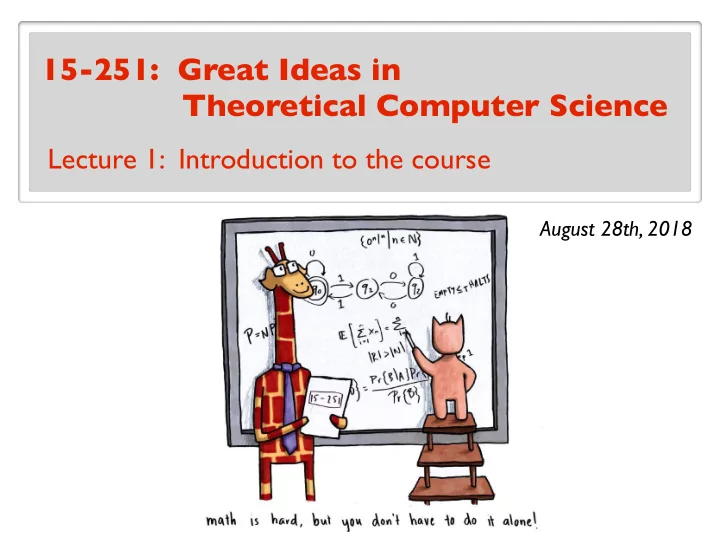
SLIDE 1 15-251: Great Ideas in
Theoretical Computer Science
Lecture 1: Introduction to the course
August 28th, 2018
SLIDE 2
Teaching Assistants Instructors
SLIDE 3
Course webpage: www.cs.cmu.edu/~15251 Lecture tomorrow: DH 2315 6:30 - 7:50pm
SLIDE 4
What is computer science? What is theoretical computer science?
SLIDE 5 What is computer science?
Is it a branch of:
- science?
- engineering?
- math?
- philosophy?
- sports?
SLIDE 6 “Computer Science is no more about computers than astronomy is about telescopes.” Motivational Quote of the Course
- Edsger Dijkstra
- Michael Fellows
SLIDE 7 Physics
Theoretical physics Experimental physics Applications/Engineering
- come up with mathematical models
- derive the logical consequences
- test mathematical models with experiments
- make observations about the universe
Nature’s language is mathematics
SLIDE 8
The role of theoretical physics
Observed Phenomenon Mathematical Model Explore Consequences Test Consequences Real World Abstract World Applications
SLIDE 9 Physics
- science?
- engineering?
- math?
- philosophy?
- sports?
SLIDE 10
Computer Science
The science that studies computation. Computation: manipulation of information/data. Algorithm: description of how the data is manipulated. Computational problem: the input-output pairs. Usually Input Output “Computer”
SLIDE 11
Computer Science
The science that studies computation. Computation: manipulation of information/data. Usually Input Output Calculator Algorithm: description of how the data is manipulated. Computational problem: the input-output pairs.
SLIDE 12
Computer Science
The science that studies computation. Computation: manipulation of information/data. Usually Input Output Laptop Algorithm: description of how the data is manipulated. Computational problem: the input-output pairs.
SLIDE 13
Computer Science
The science that studies computation. Computation: manipulation of information/data. Usually Input Output Human Algorithm: description of how the data is manipulated. Computational problem: the input-output pairs.
SLIDE 14
“Computers” in early 20th century
SLIDE 15
Computer Science
The science that studies computation. Computation: manipulation of information/data. Usually Input Output Evolution Algorithm: description of how the data is manipulated. Computational problem: the input-output pairs.
SLIDE 16
The computational lens Computational biology Computational physics Computational chemistry Computational neuroscience Computational economics … Computational finance Computational linguistics Computational statistics Computational social choice
SLIDE 17 The role of theoretical computer science
Build a mathematical model for computation. Explore the logical consequences. Gain insight about computation. Look for interesting applications.
CMU undergrad CMU Prof. OK, we don’t have everybody
http://youtu.be/pTeZP-XfuKI https://goo.gl/gGkpMv http://youtu.be/J4TkHuTmHsg
SLIDE 18
The role of theoretical computer science
Computation Mathematical Model Explore Consequences Real World Abstract World Applications Only done recently
SLIDE 19
We have been using algorithms for thousands of years.
SLIDE 20
Euclid’s algorithm (~ 300BC):
def gcd(a, b): while (a != b): if (a > b): a = a - b else: return a
We have been using algorithms for thousands of years.
b = b - a
SLIDE 21
Formalizing computation
Algorithm/Computation was only formalized in the 20th century! Someone had to ask the right question.
SLIDE 22
David Hilbert, 1900
The Problems of Mathematics
“Who among us would not be happy to lift the veil behind which is hidden the future; to gaze at the coming developments of our science and at the secrets of its development in the centuries to come? What will be the ends toward which the spirit of future generations of mathematicians will tend? What methods, what new facts will the new century reveal in the vast and rich field of mathematical thought?”
SLIDE 23 2 of Hilbert’s Problems
Is there a finitary procedure to determine if a given multivariate polynomial with integral coefficients has an integral solution? Entscheidungsproblem (1928) Is there a finitary procedure to determine the validity
- f a given logical expression?
(Mechanization of mathematics)
¬∃x, y, z, n ∈ N : (n ≥ 3) ∧ (xn + yn = zn)
e.g. Hilbert’s 10th problem (1900) e.g. 5x2yz3 + 2xy + y − 99xyz4 = 0
SLIDE 24
2 of Hilbert’s Problems
Fortunately, the answer turned out to be NO.
SLIDE 25 2 of Hilbert’s Problems
Meanwhile… in New Jersey… a certain British grad student, unaware of all these debates…
Gödel (1934):
Discusses some ideas for mathematical definitions of
- computation. But not confident what is a good definition.
Church (1936):
Invents lambda calculus. Claims it should be the definition of an “algorithm”.
Gödel, Post (1936):
Arguments that Church’s claim is not justified.
SLIDE 26 2 of Hilbert’s Problems
Alan Turing (1936, age 22):
Describes a new model for computation, now known as the Turing Machine.™
Gödel, Kleene, and even Church:
“Umm.
- Yeah. He nailed it. Game over. ‘Algorithm’ defined.”
Turing (1937):
TMs lambda calculus
SLIDE 27
Formalization of computation: Turing Machine
Turing Machine:
SLIDE 28
Church-Turing Thesis
Church-Turing Thesis: The intuitive notion of “computable” is captured by functions computable by a Turing Machine. Any computational problem that can be solved by a physical device, can be solved by a Turing Machine. (Physical) Church-Turing Thesis Real World Abstract World Church-Turing Thesis
SLIDE 29 Back to Hilbert’s Problems
Is there an algorithm (a TM) to determine if a given multivariate polynomial with integral coefficients has an integral solution? Entscheidungsproblem (1928) Is there an algorithm (a TM) to determine the validity of a given logical expression? (Mechanization of mathematics)
¬∃x, y, z, n ∈ N : (n ≥ 3) ∧ (xn + yn = zn)
e.g. Hilbert’s 10th problem (1900) e.g. 5x2yz3 + 2xy + y − 99xyz4 = 0
SLIDE 30
Back to Hilbert’s Problems
Entscheidungsproblem (1928) Hilbert’s 10th problem (1900) There is no algorithm to solve this problem. Matiyasevich-Robinson-Davis-Putnam (1970): There is no algorithm to solve this problem. Turing (1936):
SLIDE 31 Computer science
- science?
- engineering?
- math?
- philosophy?
- sports?
SLIDE 32
More on Theoretical Computer Science (TCS)
SLIDE 33 2 Main Questions in TCS
Computability of a problem: Is there an algorithm to solve it? Complexity of a problem: Is there an efficient algorithm to solve it?
- time
- space (memory)
- randomness
- quantum resources
SLIDE 34 Computational Complexity
Complexity of a problem: Is there an efficient algorithm to solve it?
- time
- space (memory)
- randomness
- quantum resources
2 camps:
- trying to come up with efficient algorithms
(algorithm designers)
- trying to show no efficient algorithm exists
(complexity theorists)
SLIDE 35 Computational Complexity
2 camps:
- trying to come up with efficient algorithms
(algorithm designers)
- trying to show no efficient algorithm exists
(complexity theorists)
multiplying two integers protein structure prediction computing Nash Equilibria of games simulation of quantum systems factoring integers detecting communities in social networks
SLIDE 36
Some other interesting questions
P vs NP
SLIDE 37
Some other interesting questions
Time vs Space
SLIDE 38
Some other interesting questions
Deterministic vs Randomized
SLIDE 39
Some other interesting questions
Cryptography and Security
SLIDE 40
Some other interesting questions
Socioeconomics (e.g. privacy, fairness)
SLIDE 41
Some other interesting questions
Learning Theory
SLIDE 42
Some other interesting questions
Quantum Computation
SLIDE 43
Some other interesting questions
…
SLIDE 44
Learning Objectives
SLIDE 45
Part 1: Formalizing the notions of problems, algorithms, and computability. Part 2: Computational complexity: theory and applications. Part 3: Randomness in CS and some highlights of theoretical CS. Perspective 1 Overview of Topics
SLIDE 46
Finite automata Turing machines Graph theory P vs NP Approximation algorithms Probability Randomized algorithms Basic number theory Cryptography Uncountability and Undecidability Time complexity Quantum computation
BIG-PICTURE COURSE
…
Error-Correcting Codes Communication Complexity
SLIDE 47
- Provide a formal introduction to the
foundations of computer science.
- Improve your rigorous, logical and abstract thinking skills.
- Prepare you to be innovators in computer science.
- Push you to strive for clarity of thought and
clarity in expression of thought.
Goals Perspective 1
SLIDE 48 Theoretical Computer Scientists Computer Scientists Mathematicians
Perspective 2
SLIDE 49 Theoretical Computer Scientists Computer Scientists Mathematicians
Perspective 2
SLIDE 50 Computational Thinkers CMU SCS core belief: all scientists should be here
Theoretical Computer Scientists Computer Scientists Mathematicians
Perspective 2
SLIDE 51 Mathematical Thinkers CMU SCS core belief: all computer scientists should be here
Theoretical Computer Scientists Computer Scientists Mathematicians
Perspective 2
SLIDE 52 Mathematical Thinkers Goal #1
Computer Scientists Mathematicians Theoretical Computer Scientists
Perspective 2
SLIDE 53 Mathematical Thinkers Goal #2
(maybe)
Theoretical Computer Scientists Computer Scientists Mathematicians
Perspective 2
SLIDE 54
Mathematics is like… cilantro. There are 5 kinds of people when it comes to cilantro. Perspective 3
SLIDE 55 Perspective 3
- 1. People who do not know what cilantro is.
SLIDE 56 Perspective 3
- 1. People who do not know what cilantro is.
SLIDE 57 Perspective 3
고수 Coriander (leaves)
ngò φύλλα κόλιανδρου ெகாtதமl(
кинза הרבסוכ Coriandrum sativum زینشگ ةربزكلا
- 1. People who do not know what cilantro is.
SLIDE 58 Perspective 3
- 2. People who love cilantro.
SLIDE 59 Perspective 3
- 3. People who think cilantro is fine.
Goal: have everyone at least in this category by the end of the course.
SLIDE 60 Perspective 3
- 4. People who don’t like cilantro.
Still gotta try it. Hope to move you to previous category. If not, hope you can eat cilantro if necessary.
SLIDE 61 Perspective 3
- 5. People with a genetic condition that makes cilantro
taste like soap.
Is this true?
SLIDE 62
Video