
SLIDE 1
1
Tax Reform in Utah
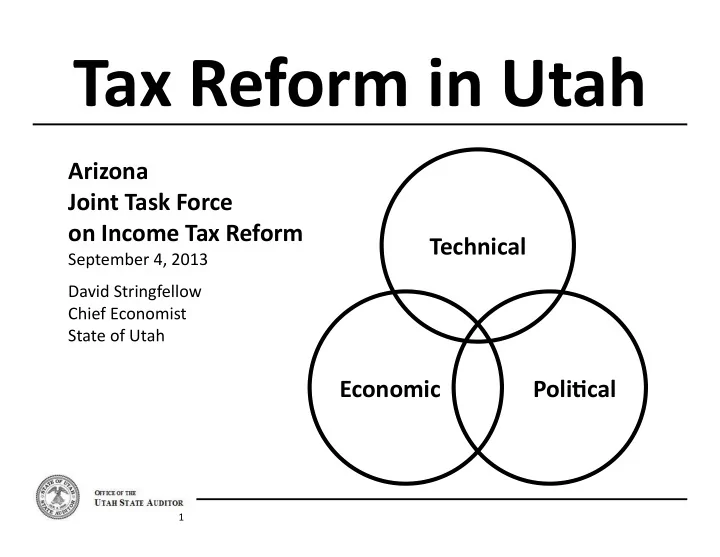
Technical Economic Polical Arizona Joint Task Force
- n Income Tax Reform
September 4, 2013 David Stringfellow Chief Economist State of Utah
Tax Reform in Utah Arizona Joint Task Force on Income Tax Reform - - PowerPoint PPT Presentation
Tax Reform in Utah Arizona Joint Task Force on Income Tax Reform Technical September 4, 2013 David Stringfellow Chief Economist State of Utah Economic Poli cal 1 Outline of this Presenta on History of Utahs Reform Timeline
1
Technical Economic Polical Arizona Joint Task Force
September 4, 2013 David Stringfellow Chief Economist State of Utah
2
History of Utah’s Reform
Timeline Movaon Implementaon
Analysis of Utah’s Reform
Theory Tax Model Informaon Retrospecve
History · Timeline · Movaon · Implementaon · Analysis · Theory · Tax Model · Informaon · Retrospecve
3
Income tax reform spanned nearly 5 years.
Governor Walker’s Recommendaons
for Utah’s Future
2004 2005 2006 2007 2008 2009 2010 2011
SB 153 Tax Reform Task Force SB 4001 Income Tax Amendments Dual System SB 223 Tax Amendments Single Rate System Tax Review Commission
Change in
Withholding Tables
First Single Rate Tax Due History · Timeline · Movaon · Implementaon · Analysis · Theory · Tax Model · Informaon · Retrospecve
4
Four public bodies extensively debated reform.
Tax Reform Task Force ‐ 4 Senate, 9 House, 2 Execuve staff Tax Review Commission ‐ 2 Senate, 2 House, ~10 tax experts Interim Revenue and Taxaon ‐ 5 Senate, 12 House Legislature ‐ 29 Senate, 75 House
Tax Reform was a major focus of two Governor’s.
Olene Walker Jon Huntsman Jr
History · Timeline · Movaon · Implementaon · Analysis · Theory · Tax Model · Informaon · Retrospecve
5
History · Timeline · Movaon · Implementaon · Analysis · Theory · Tax Model · Informaon · Retrospecve
The Income Tax Reform passed unanimously.
6
The movaon was mulfaceted.
History · Timeline · Movaon · Implementaon · Analysis · Theory · Tax Model · Informaon · Retrospecve
Economic
Opmal Taxaon Broad Base Low Rate Tax Incidence Efficiency Distorons Incenves Equity Benefits Received Ability to Pay Horizontal Equity Vercal Equity Transparency
Polical
Comprehensive Revenue Sufficiency Diversity Volality Tax Cuts / Tax Hikes Winners and Losers Compeveness Business Friendly Recruing / Entrepreneurship Administraon Simplicity
Technical
Modeling Data Calculaons Simulaons Dynamic Effects Increased Acvity Budget Impacts Revenue Forecasts Distribuonal Analysis Volality Behavior Compliance Cliffs, Marginal Impacts
7
Economists view the exercise of reform differently.
History · Timeline · Movaon · Implementaon · Analysis · Theory · Tax Model · Informaon · Retrospecve
Theory
Standard Theory is that a tax system should be chosen to maximize a social welfare funcon subject to a set of constraints. Opmality is value laden. Ramsey ‐ Taxes inversely proporonal to consumer’s elascity of demand. Buchannan ‐ Lump sum taxes. Mirrlees ‐ Taxing is a game of imperfect informaon surrounding revealed abilies.
Pracce
Broad Base, Low Rate. What are the Effecve Marginal Tax Rates? What idenfiable characteriscs can differenate taxpayers?
8
Policians are concerned about the interests of people and groups of people. Are unwilling to act without trust in the answers to quesons.
History · Timeline · Movaon · Implementaon · Analysis · Theory · Tax Model · Informaon · Retrospecve
Funding ‐ How will tax changes impact current and future budgets? Constuents ‐ Who wins and who loses? Taxpayers ‐ Will this make it easier for them to pay? Business ‐ Are people going to want to move here because of this?
9
Data and technical experse is oen fractured, inconsistent, dilute, and incapable of answering relevant quesons.
History · Timeline · Movaon · Implementaon · Analysis · Theory · Tax Model · Informaon · Retrospecve
Data ‐ Hard to obtain, guarded by laws to protect privacy Models ‐ Difficult to program, require a grasp of big data, stascs, tax law, pro‐
gramming, simulaons, forecasng, economics, polics, accounng.
Communicaon ‐ The model needs to produce charts, graphs, tables of the
impacts from potenal reform that are externally and internally consistent.
10
Implementaon was incremental and demand driven.
History · Timeline · Movaon · Implementaon · Analysis · Theory · Tax Model · Informaon · Retrospecve
Geng the economic, polical, and technical spheres to interact producvely was not trivial.
Staff from the Legislature, Governor, Tax Commission worked collabora‐
vely.
Many models and systems for addressing quesons were consolidated in‐
to a single simulaon forecast model.
Policy makers had broad access to the staff, the simulaon model, official
informaon came from a common source.
The simulaon model was used live, during meengs, to answer ques‐
11
Tax Experts had a forum to voice preferences and explore opons.
History · Timeline · Movaon · Implementaon · Analysis · Theory · Tax Model · Informaon · Retrospecve
Tax Experts were a part of every public body. The Governor used a group of private tax experts in addion to
staff economists to dra proposals.
12
There were four different public bodies listening to tax reform proposals.
History · Timeline · Movaon · Implementaon · Analysis · Theory · Tax Model · Informaon · Retrospecve
Each body focused on different aspects of reform. Advocacy groups parcipated acvely in the process. The various groups held meengs throughout the state to encourage
feedback from taxpayers.
Broad Policy Principles were narrowed to Frameworks which became
Legislaon.
13
Models and staff consolidated effort into a single model.
History · Timeline · Movaon · Implementaon · Analysis · Theory · Tax Model · Informaon · Retrospecve
A Standard Simulaon Model was used to evaluate proposals
comprehensively.
Staff worked collaboravely, I was a dual employee of both the
Governor’s Office and Tax Commission.
The law was modified to allow legislave staff to access de‐
idenfied tax data.
14
Tax reform was the most analycally intensive exercise
History · Timeline · Movaon · Implementaon · Analysis · Theory · Tax Model · Informaon · Retrospecve
Standardize all of the data and calculaons. Common tool to build trust in the analysis. Simulaon model provided distribuonal effects of tax reform. Simulaon model calculated the budgetary impact of reform. Simulaon model forecast future revenue collecons. Online Tax Calculators comparing reforms.
15
The model came from Utah and Federal Tax Informaon.
History · Timeline · Movaon · Implementaon · Analysis · Theory · Tax Model · Informaon · Retrospecve
Took ~1 million records from prior year’s Utah tax filings. Merged with ~1 million records from Federal filings (IMF, IRTF). Produced synthec datasets of future taxpayers controlled to populaon
by age forecasts.
Federal informaon contained detailed sources of income, these were
grown stochascally according to Global Insights forecasts.
A Monte Carlo sampling (30 full sets of taxpayer’s) of each of 4 future
years of returns was calculated and normalized to produce a representa‐ ve sample of future returns.
Federal and State Taxes were recalculated based on new income and were
then compared with various systems of reform.
Summary stascs, graphs, tables, charts, fiscal notes were generated.
16
Diagram of the model.
History · Timeline · Movaon · Implementaon · Analysis · Theory · Tax Model · Informaon · Retrospecve
17
Distribuonal Effects
History · Timeline · Movaon · Implementaon · Analysis · Theory · Tax Model · Informaon · Retrospecve
Tax Increases Income Percenles
18
Distribuonal Effects—Group Analysis
Likelihood of Tax Increase within a group
History · Timeline · Movaon · Implementaon · Analysis · Theory · Tax Model · Informaon · Retrospecve
19
Distribuonal Effects—Group Analysis
Specific Tax Change of de‐idenfied Taxpayer
History · Timeline · Movaon · Implementaon · Analysis · Theory · Tax Model · Informaon · Retrospecve
20
Budgetary Effects
Actual collecons were $2,561,383,572 forecast error was 0.37% with tax growing 12.5% This was 18 months before fiscal year end.
History · Timeline · Movaon · Implementaon · Analysis · Theory · Tax Model · Informaon · Retrospecve
21
Volality Analysis
The Single Rate System would have lost less revenue than the other systems during the 2002 recession. Slight improvements in volality
History · Timeline · Movaon · Implementaon · Analysis · Theory · Tax Model · Informaon · Retrospecve
22
Volality Analysis
Underlying Volality is mostly a funcon of economic acvity, but the tax system can contribute by amplifying or dampening volality.
History · Timeline · Movaon · Implementaon · Analysis · Theory · Tax Model · Informaon · Retrospecve
23
Progressivity Analysis
Slightly more progressive Lorentz Curves and Suits Index
History · Timeline · Movaon · Implementaon · Analysis · Theory · Tax Model · Informaon · Retrospecve
24
Progressivity Analysis
Taxpayers with Income above $100,000 pay a slightly higher share of
Taxpayers with Income above $100,000 pay ~62% of total tax but received 48% of tax cut.
History · Timeline · Movaon · Implementaon · Analysis · Theory · Tax Model · Informaon · Retrospecve
25
Segmented Income Analysis
The Median Taxpayer within each income percenle had about a 0.5% tax cut
History · Timeline · Movaon · Implementaon · Analysis · Theory · Tax Model · Informaon · Retrospecve
26
Effecve Rate Changes
What were prior effect rates and how did they change at the margin?
History · Timeline · Movaon · Implementaon · Analysis · Theory · Tax Model · Informaon · Retrospecve
27
Effecve Rate Changes
Most Taxpayers paid less in taxes
History · Timeline · Movaon · Implementaon · Analysis · Theory · Tax Model · Informaon · Retrospecve
28
Effecve Rate Changes
Most High Income Taxpayers faced lower effecve marginal tax rates. Middle Income Taxpayers faced higher marginal rates with credits phasing out
History · Timeline · Movaon · Implementaon · Analysis · Theory · Tax Model · Informaon · Retrospecve
29
Intense Effort Required to Reform Taxes.
It took a lot of resources and reallocaon of resources to accomplish. It absorbed many public officials me for over 3 years. Analysis, specifically the Tax Simulaon Model was key to success. Product of the Reform was a Single Rate System. It produced an individual tax cut of around $190 million on $2.5 billion. More progressive, larger share of the tax cut went to lower income. Expanded the Tax Base from ~$38 billion to ~$60 billion (2007). Lowered the statutory Tax Rate from 7% to 5%. Change in the Withholding Tables caused early confusion. Makes Utah more compeve, aligns statutory rate with marginal rate.
History · Timeline · Movaon · Implementaon · Analysis · Theory · Tax Model · Informaon · Retrospecve
30
History · Timeline · Movaon · Implementaon · Analysis · Theory · Tax Model · Informaon · Retrospecve
Why?
Single rate shows propensity, if not promise, to not ‘soak the rich’. General trend in lower top marginal rates and fewer rate structures. Deducons and Exempons disproporonally help the rich, conversion to
tax credits allows for targeted incenves for acvies to specific groups.
Marginal Incenves maer more for behavioral changes than the overall
level of taxaon.
This happened in the context of broader tax reform which changed sales
taxes, corporate taxes, and other business taxes.
Stabilizes Utah’s finances and leaves it compevely posioned relave to
tax systems in other states.
Current analysis confirms the accuracy of Simulaon Model forecasts. David Stringfellow, Chief Economist, State of Utah ‐ Office of the Utah State Auditor