Take two minutes to get your Notebooks, Signals, Calculators, & - - PowerPoint PPT Presentation

take two minutes to get your notebooks signals
SMART_READER_LITE
LIVE PREVIEW

Take two minutes to get your Notebooks, Signals, Calculators, & - - PowerPoint PPT Presentation

AIM (3.1) : How do we identify and represent imaginary and complex numbers? Take two minutes to get your Notebooks, Signals, Calculators, & Student Orgzniers before we begin today's lesson. Alert! Alert! Aim 3.1: How do we identify and

slide-1
SLIDE 1

Alert!

AIM (3.1) : How do we identify and represent imaginary and complex numbers?

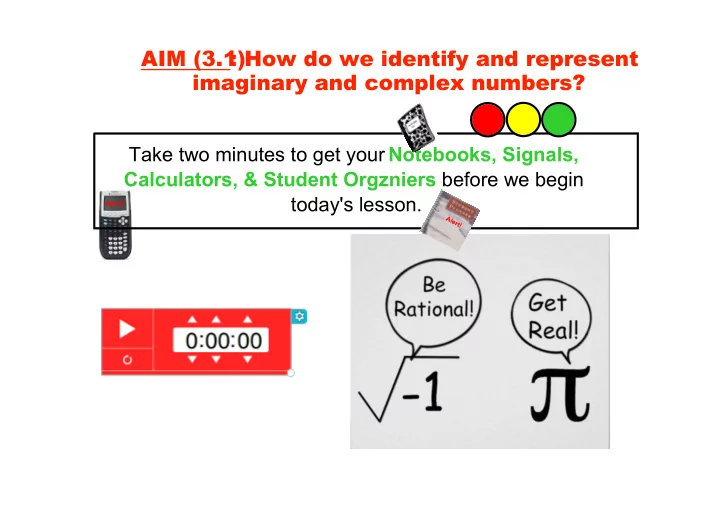
Take two minutes to get your Notebooks, Signals, Calculators, & Student Orgzniers before we begin today's lesson.

Alert!

slide-2
SLIDE 2

Do­Now Begins!

Aim 3.1: How do we identify and represent imaginary and complex numbers? HW: Worksheet 3.1, all EVEN problems

Alert!

1) 2) 3) 4)

Simplify each radical expression. Make sure your final answer has no negative terms in the radicand (underneath the radical sign).

slide-3
SLIDE 3

Aim 3.1: How do we identify and represent imaginary and complex numbers? HW: Worksheet 3.1, all EVEN problems

1) 2) 3) 4)

slide-4
SLIDE 4

Announcements: 1) (Optional) DeltaMath assignment: Review #3, due Friday.

(Every 10 questions complete = +2 on Midterm Exam.)

2) Tutoring: Mr. Lo is available after school Monday & Friday: Right after school 3) MACS Robotics club does not meet this Wednesday (Halloween)

A l e r t !

slide-5
SLIDE 5

What are Imaginary Numbers for?

Used for: Signal Processing (Cellphone signals), Electricity (AC & DC Waves), Quadratics (when parabolas don't touch the x­axis)

Aim 3.1: How do we identify and represent imaginary and complex numbers? HW: Worksheet 3.1, all EVEN problems

slide-6
SLIDE 6

A number that is expressed in terms of the square root of a negative number (usually the square root of −1, represented by i ).

Imaginary Number

The imaginary unit, i , is the number whose square root is equal to negative 1.

The Imaginary Unit

Aim 3.1: How do we identify and represent imaginary and complex numbers? HW: Worksheet 3.1, all EVEN problems

slide-7
SLIDE 7

Aim 3.1: How do we identify and represent imaginary and complex numbers? HW: Worksheet 3.1, all EVEN problems

Simplifying Radicals with Negatives

  • Ex. 1
  • Ex. 2
  • Ex. 3
  • Ex. 4

A radical is not considered simplified if there is a negative radicand.

slide-8
SLIDE 8

Aim 3.1: How do we identify and represent imaginary and complex numbers? HW: Worksheet 3.1, all EVEN problems

  • Ex. 5
  • Ex. 6

Simplify each negative radical expression.

slide-9
SLIDE 9
  • Ex. 5
  • Ex. 6

Simplify each negative radical expression.

Neither Correct Both Correct One Correct

Aim 3.1: How do we identify and represent imaginary and complex numbers? HW: Worksheet 3.1, all EVEN problems

slide-10
SLIDE 10

Disuss with Your Neighbor

  • Ex. 5
  • Ex. 6

What do you notice about the answers when taking an even vs. an odd root of a negative number?

Aim 3.1: How do we identify and represent imaginary and complex numbers? HW: Worksheet 3.1, all EVEN problems

slide-11
SLIDE 11

EVEN INDEXES: If the radicand is negative, the roots are imaginary only if the index is EVEN. ODD INDEXES:

Roots of Negative Numbers

If the radicand is negative, the roots are real and negative.

Aim 3.1: How do we identify and represent imaginary and complex numbers? HW: Worksheet 3.1, all EVEN problems

slide-12
SLIDE 12

What is the imaginary unit and when do we use it to simplify expressions?

Aim 3.1: How do we identify and represent imaginary and complex numbers? HW: Worksheet 3.1, all EVEN problems

slide-13
SLIDE 13

Aim 3.1: How do we identify and represent imaginary and complex numbers? HW: Worksheet 3.1, all EVEN problems

Simplifying Square Roots with Negative Radicands

Assess as You Work

1 3

I got it! I don't get it I'm not sure

2

slide-14
SLIDE 14

Aim 3.1: How do we identify and represent imaginary and complex numbers? HW: Worksheet 3.1, all EVEN problems 0 ­ 3 Correct 7 ­ 8 Correct 4 ­ 6 Correct

slide-15
SLIDE 15

Aim 3.1: How do we identify and represent imaginary and complex numbers? HW: Worksheet 3.1, all EVEN problems

Any number that can be written in the form "a + bi " where a and b are real numbers.

Complex Number

  • Ex. 3 + 2i, ­4 + i, 5 ­ 2i

*All numbers can be written as a complex number.

  • Ex. 7i =

3 =

slide-16
SLIDE 16

Adding & Subtracting Complex Numbers

  • Ex. 1
  • Ex. 2

Aim 3.1: How do we identify and represent imaginary and complex numbers? HW: Worksheet 3.1, all EVEN problems