Table of Contents Berner Fachhochschule-Technik und Informatik - - PowerPoint PPT Presentation

table of contents
SMART_READER_LITE
LIVE PREVIEW

Table of Contents Berner Fachhochschule-Technik und Informatik - - PowerPoint PPT Presentation

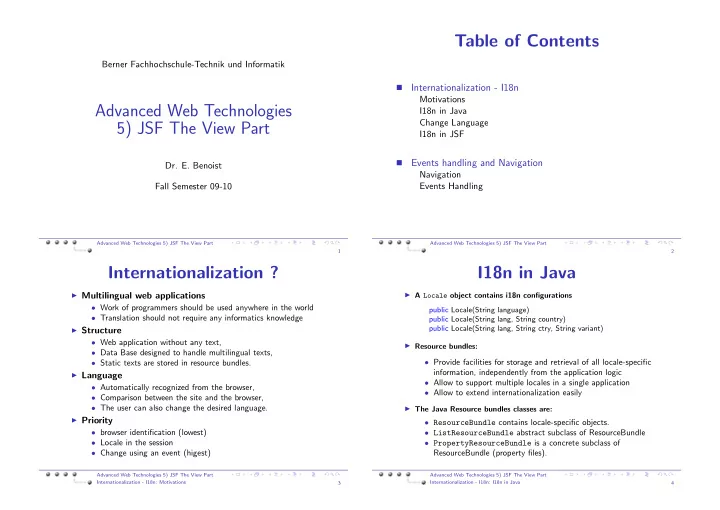
Table of Contents Berner Fachhochschule-Technik und Informatik Internationalization - I18n Motivations Advanced Web Technologies I18n in Java Change Language 5) JSF The View Part I18n in JSF Events handling and Navigation Dr. E.


slide-1
SLIDE 1

Berner Fachhochschule-Technik und Informatik

Advanced Web Technologies 5) JSF The View Part

  • Dr. E. Benoist

Fall Semester 09-10

Advanced Web Technologies 5) JSF The View Part 1

Table of Contents

  • Internationalization - I18n

Motivations I18n in Java Change Language I18n in JSF

  • Events handling and Navigation

Navigation Events Handling

Advanced Web Technologies 5) JSF The View Part 2

Internationalization ?

◮ Multilingual web applications

  • Work of programmers should be used anywhere in the world
  • Translation should not require any informatics knowledge

◮ Structure

  • Web application without any text,
  • Data Base designed to handle multilingual texts,
  • Static texts are stored in resource bundles.

◮ Language

  • Automatically recognized from the browser,
  • Comparison between the site and the browser,
  • The user can also change the desired language.

◮ Priority

  • browser identification (lowest)
  • Locale in the session
  • Change using an event (higest)

Advanced Web Technologies 5) JSF The View Part Internationalization - I18n: Motivations 3

I18n in Java

◮ A Locale object contains i18n configurations

public Locale(String language) public Locale(String lang, String country) public Locale(String lang, String ctry, String variant)

◮ Resource bundles:

  • Provide facilities for storage and retrieval of all locale-specific

information, independently from the application logic

  • Allow to support multiple locales in a single application
  • Allow to extend internationalization easily

◮ The Java Resource bundles classes are:

  • ResourceBundle contains locale-specific objects.
  • ListResourceBundle abstract subclass of ResourceBundle
  • PropertyResourceBundle is a concrete subclass of

ResourceBundle (property files).

Advanced Web Technologies 5) JSF The View Part Internationalization - I18n: I18n in Java 4

slide-2
SLIDE 2

Resource Bundle (Example)

public class MyResourceBundle extends ResourceBundle { private String keys = ”Msg1 Msg2 Msg3”; public Object handleGetObject(String key) { if (key.equals(”Msg1”) return ”Hello world!”; if (key.equals(”Msg2”) return ”Hello i18n!”; ...; return null; } public Enumeration getKeys() { return new StringTokenizer(keys); } }

Advanced Web Technologies 5) JSF The View Part Internationalization - I18n: I18n in Java 5

Resource Bundle

◮ Retreve localized information

To retrieve a localized value for a given key, you should use

  • ne the methods
  • getObject,
  • getString or
  • getStringArray

from the class ResourceBundle:

◮ public Object getObject(String key)

  • first tries to obtain the value using handleGetObject.
  • If not successful, it calls the getObject method of the parent

resource bundle, assuming it is not null.

  • The other two methods are convenience methods that casts

the object returned.

Advanced Web Technologies 5) JSF The View Part Internationalization - I18n: Change Language 6

Property Resource Bundles

A Property Resource Bundle is a collection of text elements stored in a property file.

  • A property file is a text file containing properties. Therein:
  • A property is specified as ”key = value” or ”key : value”
  • Line beginning with ”!” or ”#” are comments
  • ”\” is used to indicate line continuation

# File name: I Classes.properties ApplicationTitle=Classes in dept. I DisplayButtonText=Display EndButtonText=Exit I1=I1a, I1b, I1c, \ I1p, I1q, I1r I2=I2a, I2b, I2c, \ I2p, I2q, I2r I3=I3SE, I3TM, I3WI, I3p, I3q I4=I4t, I4v, I4w

Advanced Web Technologies 5) JSF The View Part Internationalization - I18n: Change Language 7

Language selection in HTTP

◮ Browser sends its preference in the HTTP Header

  • Which languages are supported
  • Which formats are supported
  • . . .

GET http://cms.hta−bi.bfh.ch/typo3/index.php HTTP/1.1 Host: cms.hta−bi.bfh.ch ... Accept−Language: fr, fr−ch;q=0.83, en;q=0.66, en−us;q=0.50,\ de;q=0.33, de−ch;q=0.16 Accept−Encoding: gzip, deflate, compress;q=0.9 Accept−Charset: ISO−8859−1, utf−8;q=0.66, ∗;q=0.66 Keep−Alive: 300 Proxy−Connection: keep−alive

Advanced Web Technologies 5) JSF The View Part Internationalization - I18n: I18n in JSF 8

slide-3
SLIDE 3

I18n in JSF

◮ Declare the supported Locales

  • In the faces-config.xml file

◮ Create for each supported language a Properity file

  • project/src/ch/bfh/toto/Toto.properites

◮ Replace any output string in the JSP files with a

message <h:outputText value=”#{bundle.title}”/>

◮ Give the possiblity for the user to change language

Advanced Web Technologies 5) JSF The View Part Internationalization - I18n: I18n in JSF 9

Declare locales in faces-config.xml

<faces−config> <application> <locale−config> <default−locale>en</default−locale> <supported−locale>fr</supported−locale> <supported−locale>de</supported−locale> <supported−locale>es</supported−locale> </locale−config> </application> ...

Advanced Web Technologies 5) JSF The View Part Internationalization - I18n: I18n in JSF 10

Create a property file

◮ Create files in your src arborescence

  • Example

project/src/ch/bfh/jsf/Resources.properties

  • project/src/ch/bfh/jsf/Resources_fr.properties

# # This file is used to store localized expressions # Autor: E.Benoist # title=Hello world message=Try to find out what I think congratulation=Congratulation

Advanced Web Technologies 5) JSF The View Part Internationalization - I18n: I18n in JSF 11

Change Expressions in the JSP files

◮ Load the bundle, according to the Locale

<f:loadBundle basename=”carstore.bundles.Resources” var=”bundle”/>

◮ Write a message

<h:outputText styleClass=”maintitle” value=”#{bundle.chooseLocale}” />

Advanced Web Technologies 5) JSF The View Part Internationalization - I18n: I18n in JSF 12

slide-4
SLIDE 4

Change the Locale

◮ Reacting to an event

  • Generate an ActionEvent in a form (works also with a button):

<d:map id=”worldMap” current=”NAmericas” immediate=”true” action=”storeFront” actionListener=”#{carstore.chooseLocaleFromMap}”>

  • Or

<h:commandLink id=”NAmerica” action=”storeFront” actionListener=”#{carstore.chooseLocaleFromLink}”>

  • In the Bean

public void chooseLocaleFromMap(ActionEvent actionEvent) { AreaSelectedEvent event = (AreaSelectedEvent) actionEvent; String current = event.getMapComponent().getCurrent(); FacesContext context = FacesContext.getCurrentInstance(); context.getViewRoot().setLocale((Locale) locales.get(current)); resetMaps(); }

Advanced Web Technologies 5) JSF The View Part Internationalization - I18n: I18n in JSF 13

Return a Localized message

◮ Messages can be returned by a bean

  • Manged beans are used for this purpose
  • They should be internationalized

◮ Idea

  • Write all messages in a MessageBundle (with a property file)
  • Load this class in your program
  • Answer to getXXX with a localized message.

Advanced Web Technologies 5) JSF The View Part Internationalization - I18n: I18n in JSF 14

Example of Localized Message

◮ In the constructor of the bean

FacesContext context = FacesContext.getCurrentInstance(); ResourceBundle data = null; Enumeration keys = null; components = new HashMap(); // load the labels resources = ResourceBundle.getBundle(CarStore.CARSTORE PREFIX + ”.bundles.Resources”, context.getViewRoot().getLocale());

◮ When a message is requested

  • ptionLabel = resources.getString(optionKey);

Advanced Web Technologies 5) JSF The View Part Internationalization - I18n: I18n in JSF 15

Navigation Rules

◮ Design the way to surf from one page to the next

  • Form and link contain action attribute

<h:commandLink id=”SAmerica” action=”storeFront”> <h:outputText value=”#{bundle.spanish}” /> </h:commandLink>

  • This link should correspond to an entry in the

faces-config.xml <navigation−rule> <from−view−id>/chooseLocale.jsp</from−view−id> <navigation−case> <from−outcome>storeFront</from−outcome> <to−view−id>/storeFront.jsp</to−view−id> </navigation−case> </navigation−rule>

Advanced Web Technologies 5) JSF The View Part Events handling and Navigation: Navigation 16

slide-5
SLIDE 5

Navigation Rules II

◮ Value can be returned by a program

  • In the JSP we have a button

<h:commandButton action=”#{guess.testValue}” value=”Test”/>

  • in the managed bean guess

public String testValue(){ if(guess==value) return FOUND; if(guess == −1) hint = HINT NOT VALID; // ... return NOT FOUND; }

Advanced Web Technologies 5) JSF The View Part Events handling and Navigation: Navigation 17

Navigation Rules III

◮ In the faces-config.xml

<navigation−rule> <from−view−id>/guess.jsp</from−view−id> <navigation−case> <from−outcome>success</from−outcome> <to−view−id>/congratulation.jsp</to−view−id> </navigation−case> <navigation−case> <from−outcome>failure</from−outcome> <to−view−id>/guess.jsp</to−view−id> </navigation−case> </navigation−rule>

Advanced Web Technologies 5) JSF The View Part Events handling and Navigation: Navigation 18

Navigation Rules IV

◮ Writen URL (in the browser) is the called one

  • Convenient since it answer a request to this page
  • Problematic, since we are not any more in this JSP file

◮ Solution

  • Create a redirect rule

<navigation−rule> <from−view−id>/guess.jsp</from−view−id> <navigation−case> <from−outcome>success</from−outcome> <to−view−id>/congratulation.jsp</to−view−id> <redirect /> </navigation−case> ...

Advanced Web Technologies 5) JSF The View Part Events handling and Navigation: Navigation 19

Navigation Rules V

◮ Some redirections are common to any file: Solution wildcards

<navigation−rule> <from−view−id>/∗</from−view−id> <navigation−case> <from−outcome>error</from−outcome> <to−view−id>/error.jsp</to−view−id> <redirect /> </navigation−case> </navigation−rule>

Advanced Web Technologies 5) JSF The View Part Events handling and Navigation: Navigation 20

slide-6
SLIDE 6

Navigation Rules VI

◮ Using from-action

  • Suppose for one page, we have two possible actions:

startOverAction and answerAction that may return the same value again

<navigation−case> <from−action>#{quiz.answerAction}</from−action> <from−outcome>again</from−outcome> <to−view−id>/again.jsp</to−view−id> </navigation−case> <navigation−case> <from−action>#{quiz.startOverAction}</from−action> <from−outcome>again</from−outcome> <to−view−id>/index.jsp</to−view−id> </navigation−case>

Advanced Web Technologies 5) JSF The View Part Events handling and Navigation: Navigation 21

Events Handling

◮ Two types of events

  • Value Changed (javax.faces.event.ValueChangeEvent)
  • bserves changes to the user interface component property

◮ Expanding a tree, ◮ changing the text of a field

  • Action (javax.faces.event.ActionEvent)

Observes the activation of a descendent of a UICommand

◮ buttons ◮ hyperlinks Advanced Web Technologies 5) JSF The View Part Events handling and Navigation: Events Handling 22

Events Handling (Cont.)

◮ Example I: Value Changed listener on an input text field

<h:inputText id=”userId” value=”#{login.userId}”> <f:valueChangedListener type=”ch.bfh.jsf.UserLoginChanged” <h:/inputText>

◮ Example II: Action event listener on a command button

<h:commandButton id=”login” commandName=”login”> <f:actionListener type=”ch.bfh.jsf.LoginActionListener” /> </h:commandButton>

Advanced Web Technologies 5) JSF The View Part Events handling and Navigation: Events Handling 23

Action Event

◮ Generated by a button or an hyperlink

  • h:commandButton
  • h:commandLink

<h:commandLink id=”NAmerica” action=”storeFront” actionListener=”#{carstore.chooseLocaleFromLink}”> <h:outputText value=”#{bundle.english}” /> </h:commandLink>

◮ Handled by a managed bean

public void chooseLocaleFromLink(ActionEvent event) { String current = event.getComponent().getId(); FacesContext context = FacesContext.getCurrentInstance(); context.getViewRoot().setLocale((Locale) locales.get(current)); resetMaps(); }

Advanced Web Technologies 5) JSF The View Part Events handling and Navigation: Events Handling 24

slide-7
SLIDE 7

ActionEvent with an image

◮ In the JSP

<h:commandButton image=”toto.jpg” actionListener=”#{rushmore.listen}” action=”#{rushmore.act}”

◮ In the java file

public void listen(ActionEvent e){ FacesContext context = FacesContext.getCurrentInstance(); String clientID = e.getComponent().getClientID(context); int x = new Integer((String)requestParams.get(clientId+”.x”)).intV int y = new Integer((String)requestParams.get(clientId+”.y”)).intV ...

  • utcome = ...

} public String act(){ return outcome; }

Advanced Web Technologies 5) JSF The View Part Events handling and Navigation: Events Handling 25

Value Changed Events

◮ Called if an element has been changed ◮ in the jsp file

<h:selectOneMenu value=”#{form.country}” onchange=”submit()” valueChangeListener=”#{form.countryChanged}”> <f:selectItems value=”#{form.coutryNames}”/> </h:selectOneMenu>

◮ In the managed bean

public void countryChanged(ValueChangeEvent event){ FacesContext context = FacesContext.getCurrentInstance(); if((String)event.getNewValue().equals(”US”)) context.getViewRoot.setLocale(Locale.US); else context.getViewRoot.setLocale(Locale.FR); }

Advanced Web Technologies 5) JSF The View Part Events handling and Navigation: Events Handling 26

Value Changed event

◮ Has three main methods

  • getComponent() Returns the input component that triggered

the event.

  • getNewValue() Returns the current local value of the source

UIComponent.

  • getOldValue()

Returns the previous local value of the source UIComponent.

Advanced Web Technologies 5) JSF The View Part Events handling and Navigation: Events Handling 27

Conclusion

◮ Internationalisation support native in JSF

  • Bundle support of Java
  • Texts automatically generated by a localized bundle

◮ Navigation Rules

  • Allow to navigate between pages
  • Separate from pages
  • Just the controler knows which result leads to which page
  • Separation of layers

◮ Event Handling

  • Can react to small changes
  • More oriented toward “Components”
  • More fine-tuning

Advanced Web Technologies 5) JSF The View Part Events handling and Navigation: Events Handling 28

slide-8
SLIDE 8

References

◮ Core Java Server Faces

David Geary and Cay Horstmann Sun Microsystems

Advanced Web Technologies 5) JSF The View Part Events handling and Navigation: Events Handling 29