T27 Searching for the Champion of Saliva Collect: 2 mL graduated - - PowerPoint PPT Presentation

t27 searching for the champion of saliva
SMART_READER_LITE
LIVE PREVIEW

T27 Searching for the Champion of Saliva Collect: 2 mL graduated - - PowerPoint PPT Presentation

T27 Searching for the Champion of Saliva Collect: 2 mL graduated pipet, pipet filler Droppers (2), plastic droppers (1) Styrofoam cups (2) Thermometer and timer (given out by TA) Transparency and A4 paper Prepare: 100 mL


slide-1
SLIDE 1

1

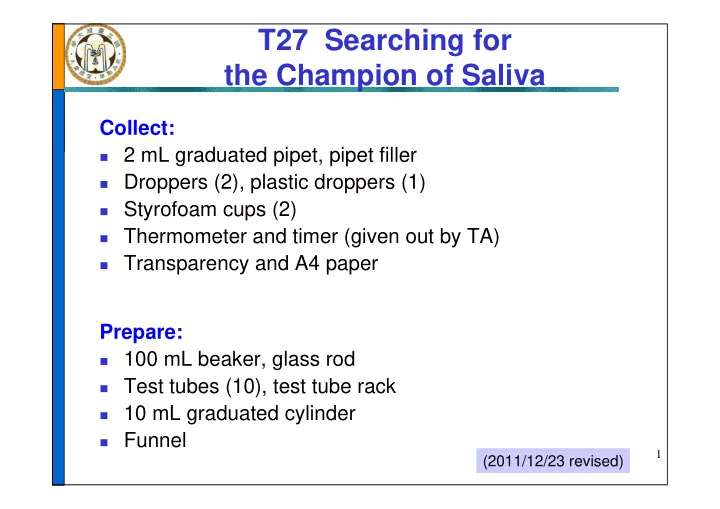
Collect:

 2 mL graduated pipet, pipet filler  Droppers (2), plastic droppers (1)  Styrofoam cups (2)  Thermometer and timer (given out by TA)  Transparency and A4 paper

Prepare:

 100 mL beaker, glass rod  Test tubes (10), test tube rack  10 mL graduated cylinder  Funnel

T27 Searching for the Champion of Saliva

(2011/12/23 revised)

slide-2
SLIDE 2

2

Objective

 Learn the iodine test  Determine the catalytic efficiency of salivary amylase for

the hydrolysis of starch

 Investigate the factors that affect the activity of the

enzyme

slide-3
SLIDE 3

3

Amylase in Saliva

Amylase: Catalyze hydrolysis of starch Computer modeling of amylase Saliva:

  • To keep our mouth moist and clean
  • Moisten the food for easier swallow
  • Helps digestion
slide-4
SLIDE 4

4

Characteristics of Enzymes

Characteristics of enzymes

 Enzymes are usually proteins in nature  The enzymatic catalysis is highly specific (usually work on

a specific substrate)

 The enzymatic catalysis is highly efficient  The enzymatic catalysis is highly affected by environmental

conditions, such as pH, temperature…etc.

slide-5
SLIDE 5

5

Iodine Test of the Catalytic Activity of Amylase

Oligo- saccharide (Red-Brown) Maltose (Yellowish

  • Brown)

Amylase Hydrolysis Amylase Hydrolysis

I- + I2 → I3

  • (Iodine indicator)

I3

  • Starch

Blue-black complex Brown The higher the efficiency of the catalyst, the shorter time it takes to complete the hydrolysis reaction. (Blue-black soln.)

I3

  • /starch
slide-6
SLIDE 6

 Take one transparency  Use plastic dropper to

drop iodine soln. on cells of transparency

 Prepare 5~10 drops of

iodine testing soln.

6

Procedure I. Catalytic Activity of Amylase

 Clean and dry 10 test tubes  Prepare salivary amylase

soln.

  • 1 mL saliva (self-produced)
  • Add 25 mL of 0.5% NaCl
  • Mix with glass rod
  • Record soln. temperature

Prepare reacting soln.

  • 1 mL of 2% starch soln.
  • Add 1 mL of pH 7 buffer
slide-7
SLIDE 7

7

Procedure I. Catalytic Activity of Amylase

  • 1. Obtain 2 mL salivary

amylase soln. with 2 mL graduated pipet

Starch in pH 7 buffer soln. Add to soln. and start timing

  • 2. Use dropper to take and

drop the reaction mixture

  • n the iodine testing soln.
  • n transparency
  • 3. Observe and record the time

until blue-black color disappears Test the activity every 30 s. or 1 min. Note:

 Avoid the tip of dropper touching the

droplet of reacting soln. for contamination

 Obtain fresh reaction mixture in test tube

for each testing

slide-8
SLIDE 8

8

Procedure II. Effect of pH on Catalytic Activity

1 mL of pH 5 or 9 buffer soln 1 mL of 2% starch soln.

pH 5 pH 9 buffer

Add 2 mL salivary amylase soln. Observe and record the reaction time Iodine test

Note:  Wash and rinse the dropper for each trial  Compare catalytic activity of amylase in pH 5, 7, and 9 buffer solutions

slide-9
SLIDE 9

9

Procedure III. Effect of Temperature on Catalytic Activity

  • 1. Obtain 2 Styrofoam cups and prepare 80 oC hot-water bath

Prepare two test tubes (1) 2 mL salivary amylase (2) 1 mL starch soln. and 1 mL pH 7 buffer

Place in hot-water bath for 5 min.

Iodine test for 10 min.

 Mix the soln. in

two test tubes to react

 Place the tube

back in hot- water bath

 Start timing

  • 2. Repeat the above steps in 0 and 50 oC water bath

Cool the test tube and bring the

  • temp. of reaction mixture back to

room temp.

Test the activity for another 5 min.

slide-10
SLIDE 10

10

Compare Catalytic Activity of Salivary Amylase with Classmates

Who is the champion of saliva?

slide-11
SLIDE 11

11  Salivary amylase solution and reacting solution should be

mixed quickly and start timing at the same time

 Hot water is heated in fume hood  Hot-water bath should be close to or equal to 80 oC (avoid

getting burnt)

 Transparency should be rinsed with water, wiped dry, and

handed back along with A4 paper

 Hand in plastic droppers used for iodine test to recycle

Notice