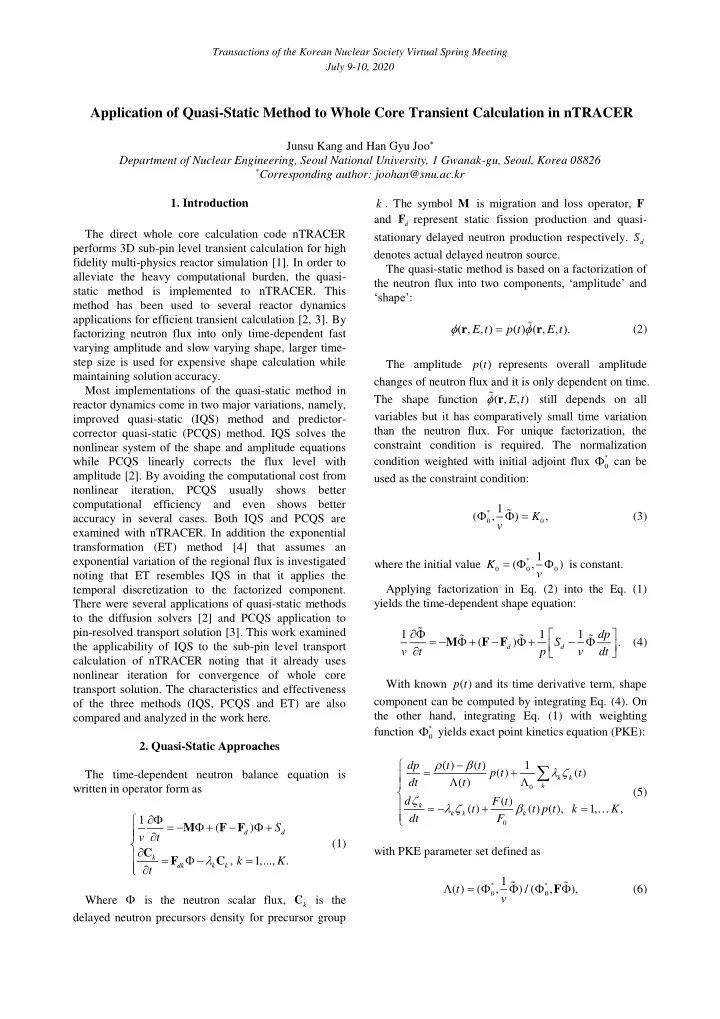

SLIDE 1
Application of Quasi-Static Method to Whole Core Transient Calculation in nTRACER
Junsu Kang and Han Gyu Joo Department of Nuclear Engineering, Seoul National University, 1 Gwanak-gu, Seoul, Korea 08826
*Corresponding author: joohan@snu.ac.kr
- 1. Introduction
The direct whole core calculation code nTRACER performs 3D sub-pin level transient calculation for high fidelity multi-physics reactor simulation [1]. In order to alleviate the heavy computational burden, the quasi- static method is implemented to nTRACER. This method has been used to several reactor dynamics applications for efficient transient calculation [2, 3]. By factorizing neutron flux into only time-dependent fast varying amplitude and slow varying shape, larger time- step size is used for expensive shape calculation while maintaining solution accuracy. Most implementations of the quasi-static method in reactor dynamics come in two major variations, namely, improved quasi-static (IQS) method and predictor- corrector quasi-static (PCQS) method. IQS solves the nonlinear system of the shape and amplitude equations while PCQS linearly corrects the flux level with amplitude [2]. By avoiding the computational cost from nonlinear iteration, PCQS usually shows better computational efficiency and even shows better accuracy in several cases. Both IQS and PCQS are examined with nTRACER. In addition the exponential transformation (ET) method [4] that assumes an exponential variation of the regional flux is investigated noting that ET resembles IQS in that it applies the temporal discretization to the factorized component. There were several applications of quasi-static methods to the diffusion solvers [2] and PCQS application to pin-resolved transport solution [3]. This work examined the applicability of IQS to the sub-pin level transport calculation of nTRACER noting that it already uses nonlinear iteration for convergence of whole core transport solution. The characteristics and effectiveness
- f the three methods (IQS, PCQS and ET) are also
compared and analyzed in the work here.
- 2. Quasi-Static Approaches
The time-dependent neutron balance equation is written in operator form as 1 ( ) , 1,..., .
d d k dk k k
S v t k K t M F F C F C (1) Where is the neutron scalar flux,
k
C is the delayed neutron precursors density for precursor group k . The symbol M is migration and loss operator, F and
d
F represent static fission production and quasi- stationary delayed neutron production respectively.
d
S denotes actual delayed neutron source. The quasi-static method is based on a factorization of the neutron flux into two components, ‘amplitude’ and ‘shape’:
( , , ) ( ) ( , , ). E t p t E t r r (2) The amplitude ( ) p t represents overall amplitude changes of neutron flux and it is only dependent on time. The shape function ( , , ) E t r still depends on all variables but it has comparatively small time variation than the neutron flux. For unique factorization, the constraint condition is required. The normalization condition weighted with initial adjoint flux
*
can be used as the constraint condition:
*
1 ( , ) , K v (3) where the initial value
*
1 ( , ) K v is constant. Applying factorization in Eq. (2) into the Eq. (1) yields the time-dependent shape equation: 1 1 1 ( ) .
d d
dp S v t p v dt M F F (4) With known ( ) p t and its time derivative term, shape component can be computed by integrating Eq. (4). On the other hand, integrating Eq. (1) with weighting function
*
yields exact point kinetics equation (PKE): ( ) ( ) 1 ( ) ( ) ( ) ( ) ( ) ( ) ( ), 1, ,
k k k k k k k
dp t t p t t dt t d F t t t p t k K dt F
(5) with PKE parameter set defined as
* *