The Australian Research Council Key Centre in Transport Management
Institute of Transport Studies (Monash)
w
t
i
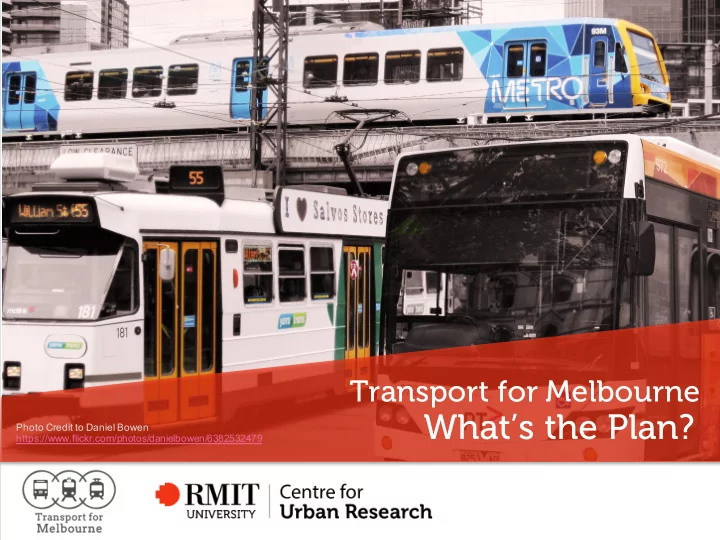
Transport for Melbourne
What’s the Plan?
Photo Credit to Daniel Bowen https://www.flickr.com/photos/danielbowen/6382532479
t w i Transport for Melbourne Whats the Plan? Photo Credit to - - PowerPoint PPT Presentation
t w i Transport for Melbourne Whats the Plan? Photo Credit to Daniel Bowen https://www.flickr.com/photos/danielbowen/6382532479 Institute of Transport Studies (Monash) The Australian Research Council Key Centre in Transport Management
The Australian Research Council Key Centre in Transport Management
Institute of Transport Studies (Monash)
i
Photo Credit to Daniel Bowen https://www.flickr.com/photos/danielbowen/6382532479
The Australian Research Council Key Centre in Transport Management
Institute of Transport Studies (Monash)
The Australian Research Council Key Centre in Transport Management
Institute of Transport Studies (Monash)
The Australian Research Council Key Centre in Transport Management
Institute of Transport Studies (Monash)
Prof Graham Currie Public Transport Research Group Institute of Transport Studies Monash University
Transport for Melbourne What’s the plan? Thursday 4th August 2016
6
This paper examines Melbourne public transport performance
Mode Problems Land Use Problems Improvement? Futures
7
8
Buses ARE Melbourne’s public transport for most residents, which is a problem….
10 20
kilometres
Port Phillip Bay Western Port
Melbourne can only be serviced by bus services since rail and tram services lie considerable distances from where people live
travel to
strategy team identified that 2.16M Melbournians lived In areas where buses were bus was the
public transport. 0.98M lived within access distance of rail services
9
…because there arent many
10 20
kilometres
Port Phillip Bay Western Port
Melbourne can only be serviced by bus services since rail and tram services lie considerable distances from where people live
travel to
strategy team identified that 2.16M Melbournians lived In areas where buses were bus was the
public transport. 0.98M lived within access distance of rail services
Weekday Service Frequency (2006)
Peak Off Peak
40m 50m
Weekday Service Span
Weekday
06:46-18:53
10
The bus network on weekdays...
Source: Currie (2003) Source: Currie (2003)
Weekday Bus Services
Source: Currie (2003)
11
…contrasts somewhat with weekends
Source: Currie (2003)
Sunday Bus Services
12
Frequency drives Australian ridership performance
12
220 271 304 305 307 400 402 404 407 410 437 442 443 508 527 552 561 564 612 623 624 627 683 685 766 781 784 785 800 811 812 850 926 700 (903) 703 888 889 900 901 503 506 507 521 541 542 545 546 548 T500 T501 100 111 120 124 125 130 135 140 150 155 160 170 180 200 210 212 250 555 T61 T62 T63 T64 T65 T70 T71 T75 T80
20,000 40,000 60,000 80,000 100,000 120,000 10,000 20,000 30,000 40,000 50,000 60,000 70,000 80,000
Boardings per route km Vehicle trips/annum
Melbourne Bus Melbourne Smartbus Adelaide NE Busway Brisbane SE Busway Sydney T-Ways
Source: Currie, G. and Delbosc A (2011) ‘Understanding bus rapid transit route ridership drivers: An empirical study of Australian BRT systems’ TRANSPORT POLICY Volume 18, Issue 5, September 2011, Pages 755-764
13
In general our bus service level is poor compared to world practice
13 Source: Pan D (2013) ‘Key Transport Statistics of World Cities’ Journeys Sept 2013
14
Tram services are struggling in growing traffic congestion
14 Source: VCEC (2006) Inquiry into Managing Transport Congestion
15
Melbourne is the worlds biggest “streetcar” system
1 67 71 66 49 44 31 25 24 24 23 1 8 1 4 1 3 1 2 9 9 1 1 1 7 4 4 3 1 48 41 9 8 7 5 4 3 3 3 2 1 1 1
20 40 60 80 100 120 140 160 180
M E L BO UR NE T O RO N T O Du sse ldTram Track Km in Mixed Traffic
German Cities French Cities UK Cities USA Cities
Melbourne Toronto
Source: Currie G and Shalaby A (2007) ‘Success and Challenges in Modernising Streetcar Systems – Experience in Melbourne and Toronto’ Transportation Research Record No 2006 Transportation Research Board Washington DC ISSN 0361-1981 pp 31-39 2007
16
17
Mixed Traffic service impedes performance
40 34 32 31 30 30 26 26 25 25 25 22 21 21 21 21 21 20 20 20 20 1 9 1 9 1 9 1 9 1 9 1 8 1 8 1 8 1 8 1 8 1 8 1 8 1 8 1 8 1 7 1 7 1 7 1 7 1 7 1 7 1 7 1 7 1 7 1 7 1 7 1 6 1 6 1 6 1 6 1 6 1 6 1 6 1 5 1 5 1 5 1 5 1 5 1 5 1 5 1 4 1 4 1 4 1 4 1 4 1 3 1 2 1 2 1 1 95 10 15 20 25 30 35 40 45 50
Skagen, Guadalajara, Toulouse, Washington, Laon, Stuttgart, Hong Kong, Strasbourg, New York, M annheim, Los Angeles, Rotterdam, Tunis, Hong Kong, M ainz, Heidelberg M unich, Riga, Berlin, Oslo, Paris, Budapest, Zwickau, Constanta, Amsterdam, Creil, Vienna, Zagreb, Genève M ELBOURNE Torino, Toronto, Tallinn, Würzburg, M ilano, Lisbon,Average Speed (KPH)
Source: UITP Databank
Average Operating Speeds – World Tram/Light Rail Systems
City/ System
Melbourne (15/16 kph)
Melbourne Tram Reliability
considered to be NOT running on time
more than 1 min early of more than 6 mins late
Source: Track Record
18
Melbourne tram ridership is low compared to overseas systems; due to low relative frequency
18
2 4 6 8 10 12 14 16 50,000 100,000 150,000 200,000 250,000
P a s s e n g e r s p e r v e h i c l e k m Vehicle trips per annum BRT (Australia) Light Rail (Australia) Light Rail (USA) Light Rail (Europe)
Source: Currie G and Delbosc A (2013) ‘Exploring Comparative Ridership Drivers of Bus Rapid Transit and Light Rail Transit Routes’ JOURNAL OF PUBLIC TRANSPORTATION Journal of Public Transportation, Vol. 16, No. 2, 2013 pp47-65
19
Better performing railways are built on new not old infrastructure and strong resilience/reliability
33 45 52.6 55 20 30 40 50 60 Melbourne Singapore Hong Kong Perth
Average Speed (Kph)
15 50 100 10 20 30 40 50 60 70 80 90 100 110 Melbourne Sydney Best Practice Singapore Hong Kong
Breakdowns in Service (000 kms)
Never Recorded
20
...yet expanding rail, thus making it more complex, has been our approach to mass transit expansion
21
Unplanned disruptions are common; e.g. reported signal faults; 1,900 p.a. (5+/day)
21 Source: Adam Carey, The Age, ‘Signal failures are causing chronic rail delays’ 23/10/2013 Reported Signaling Disruptions
months to August 2013)
Metro Trains "We are installing advanced computer technology which improves control of the signalling system, but our field equipment is outdated and requires replacing,"
22
Melbourne rail demand growth has been impressive by any standard
127.9 131.8 133.8 134.9 146.0 162.4 178.6 201.2 213.9 219.3 228.9 222 225.5 120.0 140.0 160.0 180.0 200.0 220.0 240.0
2000-1 2001-2 2002-3 2003-4 2004-5 2005-6 2006-7 2007-8 2008-9 2009-10 2010-11 2011-12 2012-13
Year
History of Rail Patronage - Melbourne
Rail Demand M trips p.a.
Source: Department of Transport/ Public Transport Victoria Annual Reports
23
24
So what do passengers think about these issues?
25
Source: Currie G Delbosc A (2015) Variation in Perceptions
Transport Performance Between International Cities Using Spiral Plot Analysis' TRANSPORTATION RESEARCH RECORD
0.5 Safe at night Reliability Frequency Safe during day PT available where and when needed Deal with disruptions quickly Get to stops/stations Quality of service Make connections Available on weekends Get information about PT Disruptions don't happen often Meet costs Information to plan journey People I care for can use it safely Available at night Ease of buying/using ticket Overcrowding Staff curteous and friendly Physical access Can make trips to new places on PT Travel time compared to car Comfortable with strangers on PT
Boston Brisbane London Melbourne New York Perth San Francisco Sydney Toronto Average Highest Importance Lowest Importance
PERFORMANCE MINUS IMPORTANCE RATINGS SPIRAL PLOT
26
27
The Transit Orientation of Development
27
Source: Cervero and Kockleman (1997)
Density – the concentration and compactness of development within geographic space Diversity – the land use mix including the balance and compatability
(and transit) Design – which relates how the various land uses are combined, linked and presented in terms of ease of access and attractiveness
28
Source: Aston L, Currie G and K Pavkova (2016) ) ‘Does Transit Mode Influence the Transit-Orientation of Urban Development? - An Empirical Study’ JOURNAL OF TRANSPORT GEOGRAPHY Vol 55 (2016) pp83-91
Walkers Paradise Very Walkable Somewhat Walkable Car Dependent 2 8
The Transit Orientation of Development – Design (Walkability) in Melbourne
29
Minimum Density (including JOBS) for Effective PT Provision (Newman & Kenworthy (2006)
The Transit Orientation of Development – Density in Melbourne
Source: Aston L, Currie G and K Pavkova (2016) ) ‘Does Transit Mode Influence the Transit-Orientation of Urban Development? - An Empirical Study’ JOURNAL OF TRANSPORT GEOGRAPHY Vol 55 (2016) pp83-91
30
Source: Aston L, Currie G and K Pavkova (2016) ) ‘Does Transit Mode Influence the Transit-Orientation of Urban Development? - An Empirical Study’ JOURNAL OF TRANSPORT GEOGRAPHY Vol 55 (2016) pp83-91
The Transit Orientation of Development – OVERALL Melbourne – only in central areas
31
32
Since 2001 PT service increased 63% (66% bus/ 36% rail, 10% tram) but - but population growth continues at a faster pace…
100 110 120 130 140 150 160 170
2001-2 2002-3 2003-4 2004-5 2005-6 2006-7 2007-8 2008-9 2009-10 2010-11 2011-12 2012-13 2013-14 2014-15 2015-16e 2016-17e
Rail Tram Bus Total
Index of Public Transport Service Kms p.a (2001-2=100)
Year Vehicle Kms p.a. (2001-2=100)
3.6 3.6 3.6 3.7 3.8 3.8 3.9 4.0 4.1 4.2 4.3 4.3 4.4 4.5 4.6 4.7 3 3.2 3.4 3.6 3.8 4 4.2 4.4 4.6 4.8 5
200 1-2 200 3-4 200 5-6 200 7-8 200 9-10 201 1-12 201 3-14 201 5- 16e
520
Population Growth (M)
Year Population (M)
Source: Department of Transport/ Public Transport Victoria Annual Reports
33
…in last 10 years, per capita service increased to 22% but declined since 2011 (we have gone down by 9% points); recent trend is flat
Source: Department of Transport/ Public Transport Victoria Annual Reports
100 102 102 100 102 105 107 112 114 121 122 119 114 113 113 113 95 100 105 110 115 120 125
2001-2 2002-3 2003-4 2004-5 2005-6 2006-7 2007-8 2008-9 2009-10 2010-11 2011-12 2012-13 2013-14 2014-15 2015- 16e 2016- 17e
Year Relative Service Level Per Head Service Levels (Vkms supplied) Per Capita
34
35
Melbourne is expected to increase in size by another 1-2M people in 20- 30 years
0.35 0.67 0.98 1.27 1.55 1.82 2.08 2.33 0.5 1 1.5 2 2.5 2011 2016 2021 2026 2031 2036 2041 2046 2051 1 2 3 4 5 6 7
Growth (M) Year
Source: Victoria in Future (2012)
Forecast Melbourne Population Growth Population Growth Total (M)
36
Melbourne Metro; exciting but capacity upgrade is long overdue now – current start date is 2026!
37
Melbourne rail grade separations; exciting some capacity relief but not an increase in service
38
Where is tram and bus priority? – SmartBus; downgraded?
39 www.worldtransitresearch.info
9
40
40
41
1
42
Planning Public Transport Services – Short Course Melbourne 15-18 August, 2016
43
44
45
46
47
48
www.transportformelbourne.org
Thank you all for your participation this evening TfM thanks RMIT, Centre for Urban Research, for hosting this Forum