T he book of Jeremiah opens with The Last Kings of Judah a divine - - PDF document

t
SMART_READER_LITE
LIVE PREVIEW

T he book of Jeremiah opens with The Last Kings of Judah a divine - - PDF document

Jeremiah Lesson One: Jeremiahs Call Reading: Jeremiah 1; 2 Chronicles 34-36 T he book of Jeremiah opens with The Last Kings of Judah a divine call that is issued to a young man. Jeremiah is called Josiah to speak the Word of God in a


slide-1
SLIDE 1

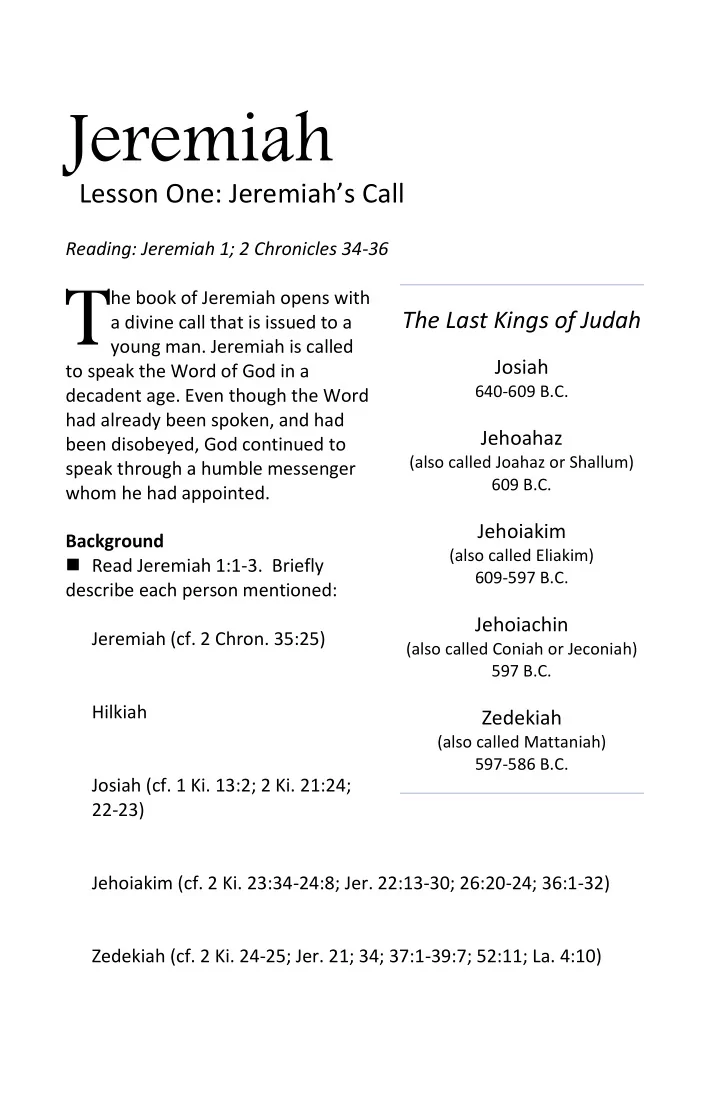
The Last Kings of Judah

Josiah

640-609 B.C.

Jehoahaz

(also called Joahaz or Shallum) 609 B.C.

Jehoiakim

(also called Eliakim) 609-597 B.C.

Jehoiachin

(also called Coniah or Jeconiah) 597 B.C.

Zedekiah

(also called Mattaniah) 597-586 B.C.

Reading: Jeremiah 1; 2 Chronicles 34-36 he book of Jeremiah opens with a divine call that is issued to a young man. Jeremiah is called to speak the Word of God in a decadent age. Even though the Word had already been spoken, and had been disobeyed, God continued to speak through a humble messenger whom he had appointed. Background  Read Jeremiah 1:1-3. Briefly describe each person mentioned: Jeremiah (cf. 2 Chron. 35:25) Hilkiah Josiah (cf. 1 Ki. 13:2; 2 Ki. 21:24; 22-23) Jehoiakim (cf. 2 Ki. 23:34-24:8; Jer. 22:13-30; 26:20-24; 36:1-32) Zedekiah (cf. 2 Ki. 24-25; Jer. 21; 34; 37:1-39:7; 52:11; La. 4:10)

T

Jeremiah

Lesson One: Jeremiah’s Call

slide-2
SLIDE 2

 Who is Judah? Where is Israel?  What was the “exile of Jerusalem?” Jeremiah’s Call  When did God call Jeremiah? How did Jeremiah first feel upon receiving this call? What were some of the challenges he faced at the beginning of his ministry?  When did God appoint Jeremiah? (Jer. 1:5). What does this tell us about God’s view of the unborn? (see Ps. 139:13-16).  What does it mean to be “consecrated?” Does Exodus 13:2, 12 help your understanding? Jeremiah’s Message  What is “inspiration?” What do we know about the process, and how should this affect the way we read God’s Word? (see Jer. 1:9; 2 Sam. 23:12; 1 Cor. 2:9-13; 4:6; 2 Tim. 3:16-17; 2 Pet. 1:21).  Why did God communicate to Jeremiah with visions? Does he communicate to us in this manner today? (cf. Heb. 1:1-2). What visions did Jeremiah see, and what was their significance? Vision #1 (vv. 11-12) _______________________________________ ________________________________________________________ Vision #2 (vv. 13-16) _______________________________________ ________________________________________________________

slide-3
SLIDE 3

Important Dates

Israel Falls to Assyria 721 B.C. Jeremiah Begins Preaching 627 B.C. Nineveh Falls to Babylon 612 B.C. Josiah Dies 609 B.C. Judah Conquered by Babylon; Captives Taken (Incl. Daniel) 605 B.C. Jehoiachin, Ezekiel, and 10,000 More Taken Captive 597 B.C. Jerusalem & Temple Destroyed 586 B.C. Captives Released by Persia 536 B.C.

 What was Jeremiah’s basic message to Judah? What would it accomplish? Would this be an easy message to deliver?  Why and how was God punishing Judah? Who is the “north”?  Why did God have to do this? Jeremiah Today  Do Christians receive a “call”? (see Acts 2:38-39; Rom. 8:28; 1 Cor. 1:2, 26- 31; 2 Thes. 2:14; 2 Tim. 1:4). Are we called in the same manner as Jeremiah?  What are we called to do? Does everybody have the same kind of calling? (see Matt. 25:13-30; Rom. 12:4- 8; 1 Cor. 12:12-31).  Did what you learned about Jeremiah’s call make a difference in your life? If so, how?

slide-4
SLIDE 4

Readings for Meditation “Inspiration is that mysterious process by which the divine causality worked through the human prophets without destroying their individual personalities and styles to produce divinely authoritative and inerrant writings.” Norman L. Geisler and William E. Nix, General Introduction to the Bible

“It is possible that the word of Jehovah may be uttered, and men may not detect it as the word of Jehovah, and so may murder the

  • messenger. We need to pray, not merely that the word of Jehovah may

come to us, but that we may know it when it comes, lest we also perish by the way, and that, with the blood of the messenger upon our hands.”

  • G. Campbell Morgan

“In the [eternal purpose of God] all things pertaining to man’s redemption are set before God, and among them his predetermination that man should be called by the gospel. “In which (salvation) he called you by our gospel.” [2 Thes. 2:14] Hence to be called according to God’s purpose…is to be called by the gospel. It is therefore not to be called by some secret impulse of the Holy Spirit; neither is it to be called “effectually” or “ineffectually,” as the schoolmen phrase it. It is simply to be called by hearing the gospel preached. This call we are absolutely free to accept or reject; and accordingly as we do that or this, we will be saved or lost.”

  • Moses Lard