T oward Socio-T echnical Franco Zambonelli Universit di Modena e - - PowerPoint PPT Presentation

t oward socio t echnical
SMART_READER_LITE
LIVE PREVIEW

T oward Socio-T echnical Franco Zambonelli Universit di Modena e - - PowerPoint PPT Presentation

T oward Socio-T echnical Franco Zambonelli Universit di Modena e Urban Superorganisms Reggio Emilia perspectives on situated awareness & participation franco.zambonelli@unimore.it CollectiveWhat? E Pluribus Unum E Pluribus Unum


slide-1
SLIDE 1

T

  • ward Socio-T

echnical Urban Superorganisms

perspectives on situated awareness & participation

Franco Zambonelli

Università di Modena e Reggio Emilia franco.zambonelli@unimore.it
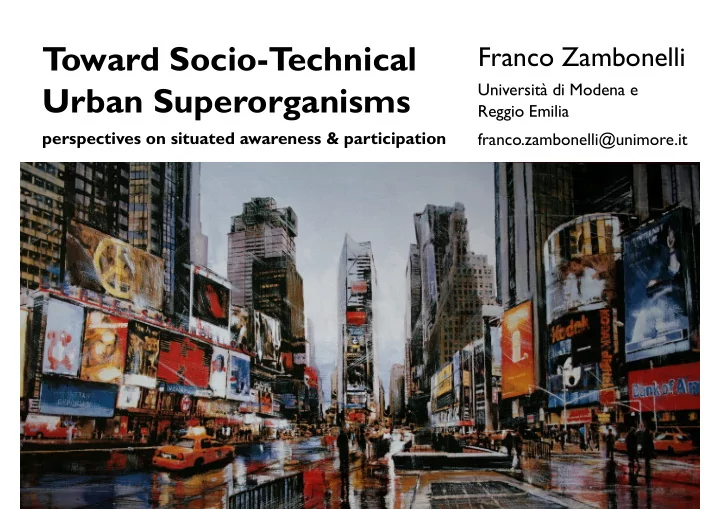
slide-2
SLIDE 2

Collective…What?

slide-3
SLIDE 3

E Pluribus Unum

slide-4
SLIDE 4

E Pluribus Unum

slide-5
SLIDE 5

E Pluribus Unum

slide-6
SLIDE 6

Superorganisms

  • Colonies ¡of ¡ants, ¡termites, ¡
  • etc. ¡
  • Organisms ¡composed ¡of ¡

many ¡individual ¡ones ¡

  • That ¡exhibit ¡finalized ¡

collec>ve ¡par>cipa>ve ¡ behaviors ¡(or ¡“collec>ve ¡ intelligence”) ¡

slide-7
SLIDE 7

Urban Superorganisms

  • Can ¡our ¡urban ¡

environments ¡become ¡ superorganisms? ¡

  • What ¡could ¡this ¡actually ¡

mean? ¡

  • Why ¡socio-­‑technical? ¡
slide-8
SLIDE 8

Smart Cities: From Senseable…

  • Sensing what’s

happening

– Via ICT devices – And social networks

  • To better

understand (via data analysis)

– City and social dynamics – At a global level

Sense ¡ Understand ¡ (compute) ¡

slide-9
SLIDE 9

…T

  • Actuable
  • We can “shape”
  • ther than

understand

– Actuating ICT devices – Steering human actions

  • Closing the loop

that enables finalized urban behaviors possible

Sense ¡ Understand ¡ (compute) ¡ Act ¡ (Steer) ¡

slide-10
SLIDE 10

…T

  • Actuable
  • We can “shape”
  • ther than

understand

– Actuating ICT device – Steering human actions

  • Closing the loop

that enables finalized urban behaviors possible

Sense ¡ Understand ¡ (compute) ¡ Act ¡ (Steer) ¡

slide-11
SLIDE 11

Urban Superorganisms: ICT Side

  • An ICT
  • enriched urban environment with rich

sensing, actuating, and computing (SAC) capabilities

– Sensing: sensor networks, tags, smart objects,etc. – Actuating: traffic controllers, public digital displays, critical infrastructures – Computing: highly distributed and decentralized, with inter-connected computational engines everywhere

slide-12
SLIDE 12

Urban Superorganisms: Human Side

  • People with smart phones or alike (or whatever will

appear in the future as wearable devices) contribute to such SAC capabilities

– Sensing: the 5 senses + smart phones – Actuating: the body – Computing: human & social intelligence

slide-13
SLIDE 13

Urban Superorganisms: Putting All T

  • gether
  • The ICT and Human/Social level

blurred to the point of invisibility:

  • Complementing each other in a

process of high value co-creation

  • In the resulting overall “urban
  • rganism”, we can achieve very

high-levels of collective

– Perception – Awareness – Action

  • Dramatically changing the way we

move, live, work, and play, in our towns

slide-14
SLIDE 14

Living in a Superorganism

  • Collective vs individual awareness

– Reflecting on ourselves as members of a community

  • Be capable of understanding and acting together in real time

– Immediate feedback to/from the community

slide-15
SLIDE 15

Collective Mobility, for Instance

  • Mobility per se :: steer for car, bike, ride sharing
  • Childcare :: steering & monitoting children on their way to

school

  • Exhibitions :: steer to avoid crowd or suggest paths
  • All of these requiring collective sensing awareness and action
  • And relying on a trade off between bottom up self-
  • rganization of behaviors and top-down behavior steering
slide-16
SLIDE 16

Traffic Steering: T

  • p-down non participatory design
slide-17
SLIDE 17

Traffic Steering: bottom up self-organizing solution

slide-18
SLIDE 18

Traffic Steering: mixing top down and bottom up

slide-19
SLIDE 19

Traffic Steering: Future socio-technical superorganims

By Prof. Peter Stone @UTA.edu

slide-20
SLIDE 20

The SAPERE Project

  • SAPERE “Self-aware Pervasive

Service Ecosystems”

– EU FP7 FET – Starting October 1st 2010, lasting 3 years

  • Key Challenges

– To define and implement a framework for adaptive service ecosystems – Models + Middleware – Experience with pervasive urban services and pervasive displays

slide-21
SLIDE 21

The SAPERE Approach

  • Nature-inspired (Biochemical)

– Simply metaphor for combining/aggregating services in a spontaneous way – Whether human or ICT ones

  • Spatially-situated

– To match the nature of urban scenarios

– Adaptive

– Spontaneous reconfiguration of activities and interactions

slide-22
SLIDE 22

The SAPERE Architecture

  • Humans & ICT Devices

– Interact by injecting/ consuming service/data components

  • Service Components

– Execute in a sort virtual “Spatial substrate” – Moving, acting, composing, as from eco-laws

  • Eco Laws

– Rule local activities and interactions – Apply based on state of local components – Self-organization of collective behavior

slide-23
SLIDE 23

Steering Mobility in SAPERE

slide-24
SLIDE 24

Steering Behaviors in SAPERE with an Ecosystem of Displays

slide-25
SLIDE 25

Open Challenges

— Tools to engineer

— What programming languages and abstractions? — Role of existing social networks in future ecosystems?

— Engineerng and controlling emergent behaviors

— How to find the proper tradeoff between top down design

and bottom up self-organization

— What you steer is what you get?

— Incentives for human participation

— Reputation, virtual money, situated games, or what?

slide-26
SLIDE 26

Conclusions

  • Our future cities will become sorts of superorganisms
  • Human & ICT tightly coupled
  • Collective participation and action
  • How can we engineer these?
  • SAPERE is doing some steps in the right direction
  • Yet there are a lot of challenges to solve