T minus 7 classes Quiz on Probability next class Know material on - - PowerPoint PPT Presentation

t minus 7 classes
SMART_READER_LITE
LIVE PREVIEW

T minus 7 classes Quiz on Probability next class Know material on - - PowerPoint PPT Presentation

T minus 7 classes Quiz on Probability next class Know material on the slides we covered Homework will be released in a few hours Will be based on how far we get today Due in one week (11/19) Exams are being graded (along with


slide-1
SLIDE 1

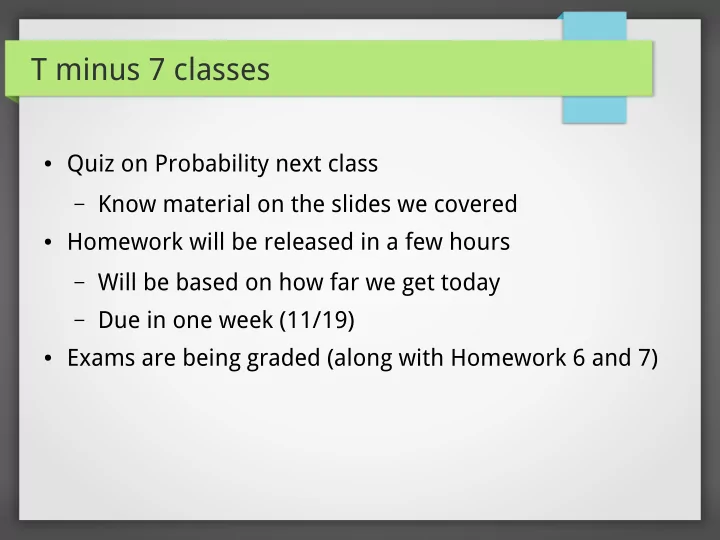
T minus 7 classes

  • Quiz on Probability next class

– Know material on the slides we covered

  • Homework will be released in a few hours

– Will be based on how far we get today – Due in one week (11/19)

  • Exams are being graded (along with Homework 6 and 7)
slide-2
SLIDE 2

Current Grade Status

slide-3
SLIDE 3

CMSC 203: Lecture 20

Probably Probability

(I hope the projector works today)

slide-4
SLIDE 4

General Probabilities

  • For sample space S with countable outcomes,

probability p(s) for each outcome s meets conditions: 1) 2)

  • Function p is the probability distribution
  • p(s) should equal limit of the times s occurs divided by

number of times experiment is performed (as experiment count grows without bound)

slide-5
SLIDE 5

Probability Distributions

  • If S is a set with n elements, a uniform distribution

assigns probability of 1/n for each element of S

  • Selecting element from sample space with uniform

distribution is selecting an element at random

  • Example : What is probability of rolling an odd number
  • n a dice if the dice is loaded so 3 comes up twice as
  • ften as each other number?
slide-6
SLIDE 6

Conditional Probability

  • Conditional probability: Probability E will occur given F,

where E and F are events with p(F ) > 0

  • Examples:

– Bit string of length 4 is generated at random. What is the

probability it contains two consecutive 0s given that the first bit is 0?

– What is the probability a family will have two boys, given

they already have one boy?

slide-7
SLIDE 7

Independence

  • When two events are independent, the occurrence of
  • ne of the events gives does not affect the other
  • Two events are independent
  • Example: E is an the event that a randomly generated bit

string of length 4 begins with a 1, and F is the event that this bit string contains an even number of 1s. Are E and F independent?

slide-8
SLIDE 8

The Birthday Problem

  • What is the minimum number of people who need to be

in a room so hat the probability that at least two of them have the same birthday is greater than 50%?

slide-9
SLIDE 9

The Birthday Problem

  • What is the minimum number of people who need to be

in a room so hat the probability that at least two of them have the same birthday is greater than 50%?

slide-10
SLIDE 10

Some CS Applications

  • Hash Tables
  • Monte Carlo

– Primality Testing – Monte Carlo Search Trees

slide-11
SLIDE 11

Bayes' Theorem

  • Suppose that E and F are events from a sample space S

such that

slide-12
SLIDE 12

Bayes' Theorem Terms

  • H: Hypothesis
  • E: Evidence
  • p(H): “Prior” probability of H
  • p(H|E): “Posterior” probability
  • p(E|H): “Likelihood”
  • p(E): Normalizing constant
slide-13
SLIDE 13

Bayes' Theorem Application

  • There is a rare disease that 1 in 100,000 people has.

There is a test that is correct 99.0% of the time when the person has the disease, and 99.5% correct when testing a person who does not have the disease. Can we find:

– probability a person who tests positive has disease? – probability a person who tests negative doesn't?

Disease :( No disease! :) Positive Test CORRECT False positive Negative Test False negative CORRECT

slide-14
SLIDE 14

Random Variables

  • A function from sample space of an experiment to the

set of real numbers

– A random variable assigns a real number to each

possible outcome

– Not actually a variable; not actually random

  • Your book hates this, too
slide-15
SLIDE 15

Example of Random Variable

  • Let be the random variable that equals the number
  • f heads that appear when t is the outcome
slide-16
SLIDE 16

Distribution of Random Variable

  • The distribution of a random variable X on sample

space S is the set of pairs for all where is the probability X takes the value r

  • Example : Taking 3 coin flips from the previous example
  • Therefore, the distribution of is the set of pairs:
slide-17
SLIDE 17

Examples of Random Variables

  • Sum of numbers when dice is rolled
  • Amount of rain (or snow) that falls on a particular day
  • How many goats you can win in Monty Hall problem
  • All probability distributions
slide-18
SLIDE 18

Expected Value

  • Expected value: The average value of a random variable

when an experiment is performed many times

– Number of heads expected to show up? – Expected number of comparisons to find element in a

list using a linear search?

– Expected value of playing the lottery / poker / drilling

giant holes into the Earth to find oil

  • Also called the expectation or mean of a random

variable

slide-19
SLIDE 19

Expected Value Formula

  • Expected value of random variable X on sample space S
  • Example: Let X be the number that comes up when a die is
  • rolled. What is the expected value of X ?
  • The final exam of a discrete mathematics course consists of 50

true/false questions, each worth two points, and 25 multiple- choice questions, each worth 4 points. The probability that a student answers a T/F question correctly is .9 and the chance they answer a multiple choice question correctly is .8. What is their expected score?

slide-20
SLIDE 20
  • St. Petersburg Paradox
  • There's a new gambling game at the casino:

– Single player game, consisting of 1 fair coin – The pot starts at $1, and the coin is flipped:

  • If heads, the pot is doubled
  • If tails, the game ends and you win the pot

– tl;dr - you win dollars if heads comes on flip

  • What is the expected value of this game? How much

would you pay to play this game?