T minus 6 classes Quiz on Probability next class Know material on - - PowerPoint PPT Presentation

t minus 6 classes
SMART_READER_LITE
LIVE PREVIEW

T minus 6 classes Quiz on Probability next class Know material on - - PowerPoint PPT Presentation

T minus 6 classes Quiz on Probability next class Know material on the slides we covered Homework 8 will be due in one week Slight changes in schedule Should give more time on HW8 and HW9 CMSC 203: Lecture 21 More Probability


slide-1
SLIDE 1

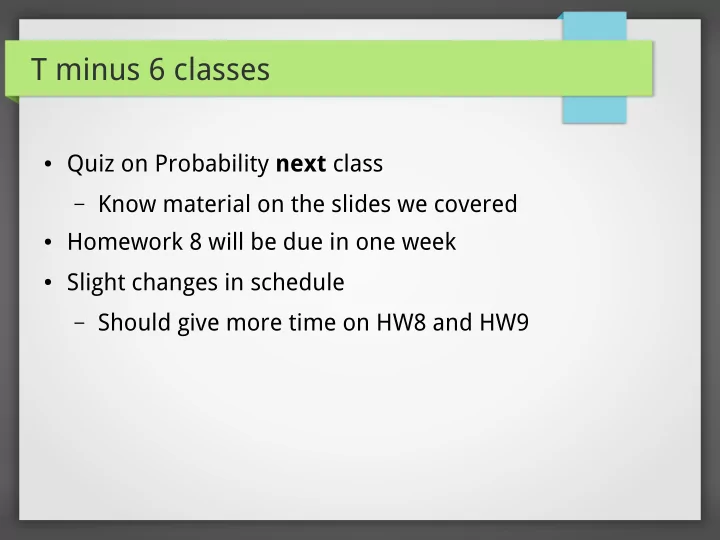
T minus 6 classes

  • Quiz on Probability next class

– Know material on the slides we covered

  • Homework 8 will be due in one week
  • Slight changes in schedule

– Should give more time on HW8 and HW9

slide-2
SLIDE 2

CMSC 203: Lecture 21

More Probability

slide-3
SLIDE 3

Bayes' Theorem

  • Suppose that E and F are events from a sample space S

such that

slide-4
SLIDE 4

Bayes' Theorem Terms

  • H: Hypothesis
  • E: Evidence
  • p(H): “Prior” probability of H
  • p(H|E): “Posterior” probability
  • p(E|H): “Likelihood”
  • p(E): Normalizing constant
slide-5
SLIDE 5

Bayes' Theorem Application

  • There is a rare disease that 1 in 100,000 people has.

There is a test that is correct 99.0% of the time when the person has the disease, and 99.5% correct when testing a person who does not have the disease. Can we find:

– probability a person who tests positive has disease? – probability a person who tests negative doesn't?

Disease :( No disease! :) Positive Test CORRECT False positive Negative Test False negative CORRECT

slide-6
SLIDE 6

Random Variables

  • A function from sample space of an experiment to the

set of real numbers

– A random variable assigns a real number to each

possible outcome

– Not actually a variable; not actually random

  • Your book hates this, too
slide-7
SLIDE 7

Example of Random Variable

  • Let be the random variable that equals the number
  • f heads that appear when t is the outcome
slide-8
SLIDE 8

Distribution of Random Variable

  • The distribution of a random variable X on sample

space S is the set of pairs for all where is the probability X takes the value r

  • Example : Taking 3 coin flips from the previous example
  • Therefore, the distribution of is the set of pairs:
slide-9
SLIDE 9

Examples of Random Variables

  • Sum of numbers when dice is rolled
  • Amount of rain (or snow) that falls on a particular day
  • How many goats you can win in Monty Hall problem
  • All probability distributions
slide-10
SLIDE 10

Expected Value

  • Expected value: The average value of a random variable

when an experiment is performed many times

– Number of heads expected to show up? – Expected number of comparisons to find element in a

list using a linear search?

– Expected value of playing the lottery / poker / drilling

giant holes into the Earth to find oil

  • Also called the expectation or mean of a random

variable

slide-11
SLIDE 11

Expected Value Formula

  • Expected value of random variable X on sample space S
  • Example: Let X be the number that comes up when a die is
  • rolled. What is the expected value of X ?
  • The final exam of a discrete mathematics course consists of 50

true/false questions, each worth two points, and 25 multiple- choice questions, each worth 4 points. The probability that a student answers a T/F question correctly is .9 and the chance they answer a multiple choice question correctly is .8. What is their expected score?

slide-12
SLIDE 12
  • St. Petersburg Paradox
  • There's a new gambling game at the casino:

– Single player game, consisting of 1 fair coin – The pot starts at $1, and the coin is flipped:

  • If heads, the pot is doubled
  • If tails, the game ends and you win the pot

– tl;dr - you win dollars if heads comes on flip

  • What is the expected value of this game? How much

would you pay to play this game?

slide-13
SLIDE 13

CMSC 203: Lecture 21

Relations

slide-14
SLIDE 14

What is Relations?

  • Relation: A strcture that represents the relationships

between elements of sets

  • Subset of the Cartesian product of the sets
  • Examples:

– Pairs of cities linked by airline flights? – Phases of a project in a viable order? – Storing information in a database?

slide-15
SLIDE 15

Expressing Relations

  • Most direct way to express relationship between

elements in two sets is ordered pairs

  • Sets of ordered pairs are binary relations

– Binary relation from A to B is a subset of A x B –

  • Example : Let A be the set of students at UMBC and B be

the set of courses. Let Rbe the relation that consist of pairs (a, b) where a is a student enrolled in course b.

slide-16
SLIDE 16

Functions as Relations

  • Recall function f from A to B maps elements exactly one

element in B to every element in A

  • Graph of f is a set of ordered pairs (a, b) where b = f(a)
  • Graph of f is a subset of A x B, so it is a relation
  • Relations are a generalizations of graphs of functions
slide-17
SLIDE 17

Relations on a Set

  • A relation on a set A is a relation from A to A
  • Example s:

– A is the set {1, 2, 3, 4}. Which ordered pairs are in the

relation R = {(a, b) | a divides b}?

– Which of these relations contain the pair (1, 2):

slide-18
SLIDE 18

Properties of Relations

  • Reflexive

  • Symmetric

  • Antisymmetric

  • Transitive

slide-19
SLIDE 19

Combining Relations

  • Two relations from A to B can be combined in any way

two sets can be combined

– Due to relations being subsets of A x B

  • We can perform operations such as

– – – – –