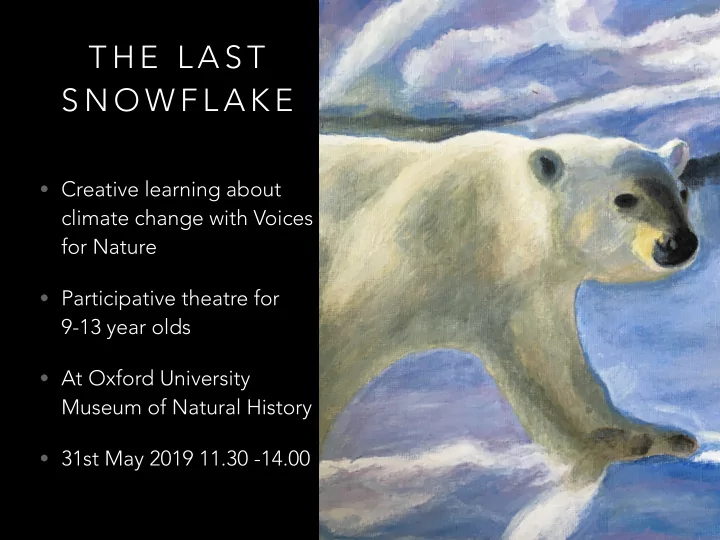
T H E L A S T S N O W F L A K E Creative learning about climate - - PowerPoint PPT Presentation

t h e l a s t s n o w f l a k e
SMART_READER_LITE
LIVE PREVIEW

T H E L A S T S N O W F L A K E Creative learning about climate - - PowerPoint PPT Presentation

T H E L A S T S N O W F L A K E Creative learning about climate change with Voices for Nature Participative theatre for 9-13 year olds At Oxford University Museum of Natural History 31st May 2019 11.30 -14.00 T H E A R C T I


slide-1
SLIDE 1

T H E L A S T S N O W F L A K E

  • Creative learning about

climate change with Voices for Nature

  • Participative theatre for

9-13 year olds

  • At Oxford University

Museum of Natural History

  • 31st May 2019 11.30 -14.00
slide-2
SLIDE 2

T H E A R C T I C

  • includes, North Pole, Arctic Ocean and adjacent seas; parts of

Alaska, Canada, Finland, Greenland, Iceland, Norway, Russia and Sweden

  • Has varying snow cover, sea ice and diverse land habitats

(tundra and some boreal forest)

  • Home to many indigenous peoples and with towns and cities
  • Home to land animals (eg polar bears, muskox, arctic fox,

wolf, caribou); sea animals (whales, seals); birds (eg snowy

  • wl) plants (eg cotton grass, bearberry, birch)
slide-3
SLIDE 3

A N TA R C T I C

  • The south polar region includes the South Pole, the Southern

Ocean, with islands, mountain ranges and huge ice shelves

  • Almost entirely and permanently covered by ice and snow; only

two species of flowering plants (Antarctic hair grass and pearlwort) but range of mosses, liverworts, lichens and microfungi

  • Home to seals, penguins, whales; albatrosses and petrels; fish (eg

antarctic ice fish); squid; krill

  • No indigenous people, only scientists and other visitors
slide-4
SLIDE 4

C L I M AT E C H A N G E A N D P O L A R R E G I O N S

  • Global warming leads to melting of ice (major loss of habitat)
  • Melting of ice leads to rising global water levels
  • Melting ice changes the salt levels of ocean (loss of habitat)
  • Melting permafrost releases carbon stored in soil making global warming worse
  • Less ice mass means less of the sun’s rays/heat reflected back into the

atmosphere making temperatures rise more

  • Climate change impacts worst in Arctic region and Antarctic peninsula
  • Speed of change so fast that adaptation may not be possible for polar plants

and creatures

  • Humans contribute to/cause climate change so WE CAN ALL DO SOMETHING

TO HELP

slide-5
SLIDE 5

www.voicesfornature.net

Watercolour sketch of South Georgia, Antarctica by Bruce Pearson