
SLIDE 1
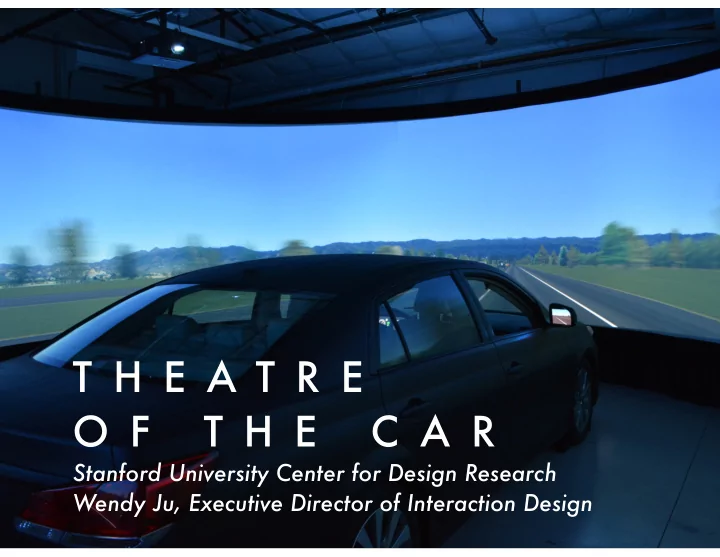
T H E A T R E O F T H E C A R Stanford University Center for - - PowerPoint PPT Presentation
T H E A T R E O F T H E C A R Stanford University Center for Design Research Wendy Ju, Executive Director of Interaction Design We are designing how people will interact with the vehicles of the future. We are performing research on
Mechanical Engineering Post-Doc
Master’s student in Computer Science
Mechanical Engineering PhD Candidate
Research Staff
Communication PhD Candidate
Mechanical Engineering PhD Candidate
Communication PhD Candidate
Mechanical Engineering PhD Candidate
Computer Science Post-Doc
Mechanical Engineering PhD Candidate
Learning Sciences and Design PhD Candidate
Mechanical Engineering PhD Candidate
Research Staff
Master’s in Mechanical Engineering
Design MFA
Master’s student in Chemical Engineering
Updated 4/12/2016
Updated 4/11/2016
R . U . R . ( R O S S U M ’ S U N I V E R S A L R O B O T S ) B Y K A R E L Č A P E K ( 1 9 2 0 )
Johns, M., et al. The Driver has Control: Exploring Driving Performance with Varying Automation Capabilities. Driver Assessment 2015, June, Salt Lake City UT. Miller, D. et al. Exploring Transitional Autonomous Driving with New and Old
Miller, D.B., et al. Distraction Becomes Engagement in Autonomous Vehicles. Best Student Paper in Surface Transportation Track at 2015 Annual Meeting of the Human Factors & Ergonomics Society, October 2015.
35# 13# 47# 1# 48# 0#
0# 5# 10# 15# 20# 25# 30# 35# 40# 45# 50#
Aware# Drowsy# Aware# Drowsy# Aware# Drowsy# Supervision#Task# Reading#Task# Movie#Task#
Drowsy#Drivers##?#by#Secondary#Task#
Miller, D.B., et al. Distraction Becomes Engagement in Autonomous Vehicles. Best Student Paper in Surface Transportation Track at 2015 Annual Meeting of the Human Factors & Ergonomics Society, October 2015.
Mok, B., et al. Timing of Unstructured Transitions in Automated Driving. Intelligent Vehicles 2015, June, Seoul, Korea.
Mok, B., et al. Timing of Unstructured Transitions in Automated Driving. Intelligent Vehicles 2015, June, Seoul, Korea.
Behind the scenes, real-time monitoring and control over course, voice interface and dash elements enable improvised interaction Video/Audio Monitoring & Recording Real-time Text-to-Speech Generation Instrument Cluster/ Events Deployment/ Wizard Control Course Monitor & Automated Driving Controller Interaction Wizard Driving Wizard
Mok, B., et al. Understanding Driver-Automated Vehicle Interactions through Wizard of Oz Design Improvisation. Driving Assessment, June 22-25, 2015. Salt Lake City, UT.
Driving Wizard Interaction Wizard Participant “Driver”
Baltodano, S., et al. The RRADS Platform: A Real Road Autonomous Driving Simulator. AutoUI 2015, September 1-3, 2015, Nottingham UK.
Rothenbücher, D., et al. Ghost Driver: A field study investigating the interaction between pedestrians and driverless vehicles. AutoUI 2015, September 1-3, 2015, Nottingham UK.
Wendy Ju wendyju@stanford.edu Center for Design Research Stanford University My book, The Design of Implicit Interactions, is now available from Morgan & Claypool online and on Amazon.com.