Lambda Terms Raffaella Bernardi 22-10-2020 1 Exercise 1: From Set - - PDF document

lambda terms
SMART_READER_LITE
LIVE PREVIEW

Lambda Terms Raffaella Bernardi 22-10-2020 1 Exercise 1: From Set - - PDF document

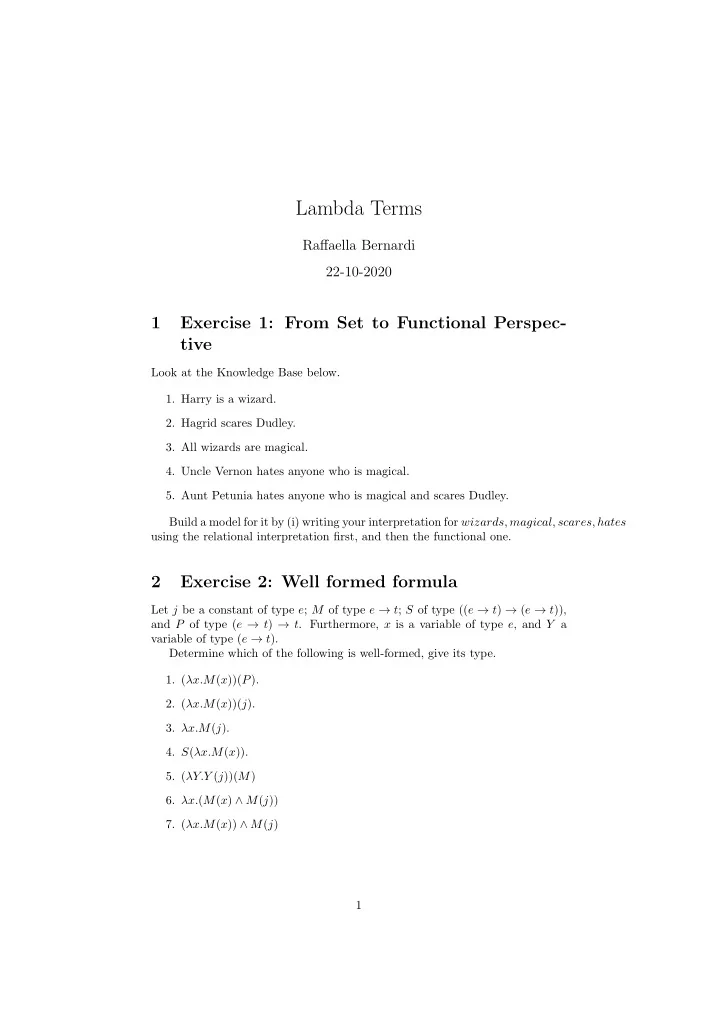
Lambda Terms Raffaella Bernardi 22-10-2020 1 Exercise 1: From Set to Functional Perspec- tive Look at the Knowledge Base below. 1. Harry is a wizard. 2. Hagrid scares Dudley. 3. All wizards are magical. 4. Uncle Vernon hates anyone who is


slide-1
SLIDE 1

Lambda Terms

Raffaella Bernardi 22-10-2020

1 Exercise 1: From Set to Functional Perspec- tive

Look at the Knowledge Base below.

  • 1. Harry is a wizard.
  • 2. Hagrid scares Dudley.
  • 3. All wizards are magical.
  • 4. Uncle Vernon hates anyone who is magical.
  • 5. Aunt Petunia hates anyone who is magical and scares Dudley.

Build a model for it by (i) writing your interpretation for wizards, magical, scares, hates using the relational interpretation first, and then the functional one.

2 Exercise 2: Well formed formula

Let j be a constant of type e; M of type e → t; S of type ((e → t) → (e → t)), and P of type (e → t) → t. Furthermore, x is a variable of type e, and Y a variable of type (e → t). Determine which of the following is well-formed, give its type.

  • 1. (λx.M(x))(P).
  • 2. (λx.M(x))(j).
  • 3. λx.M(j).
  • 4. S(λx.M(x)).
  • 5. (λY.Y (j))(M)
  • 6. λx.(M(x) ∧ M(j))
  • 7. (λx.M(x)) ∧ M(j)

1

slide-2
SLIDE 2

3 Exercise 3: β-conversion

Let j be a constant of type e; M of type (e → t), and A of type e → (e → t). Furthermore, x and y are variables of type e, and Y is a variable of type e → t. Reduce the following expression as much as possible by means of β-conversion.

  • 1. λx(M(x))(j)
  • 2. λY (Y (j))(M)
  • 3. λxλY (Y (x))(j)(M)
  • 4. λx∀y(A(x)(y))(j)
  • 5. λx∀y(A(x)(y))(y)
  • 6. λY (Y (j))λx(M(x))
  • 7. λY ∀x(Y (x))λy(A(x)(y))

2

slide-3
SLIDE 3

4 Solutions

4.1 Exercise 1

[ [wizard] ] = {harry} {x|wizard(x) = 1} [ [magical] ] = {harry} {x|magical(x) = 1} [ [scares] ] = {(hagrid, dudley)} {(x, y)|(scares (y)) (x)} [ [hates] ] = {(vernon, harry)} {(x, y)|(hates (y)) (x)}

4.2 Exercise 2

  • 1. (λx.M(x))(P).

[NWF]

  • 2. (λx.M(x))(j).

[WF]

  • 3. λx.M(j).

[NWF: vacus abstraction]

  • 4. S(λx.M(x)).

[WF]

  • 5. (λY.Y (j))(M)

[WF]

  • 6. λx.(M(x) ∧ M(j))

[WF]

  • 7. (λx.M(x)) ∧ M(j)) [NWF: λx.M(x) and M(j) are of types e → t and t,
  • resp. ∧ coordinates terms of types t]

4.3 Exercise 3

  • 1. λx(M(x))(j)

[M(j)]

  • 2. λY (Y (j))(M)

[M(j)]

  • 3. λxλY (Y (x))(j)(M)

[M(j)]

  • 4. λx∀y(A(x)(y))(j)

[∀y.A(j)(y)]

  • 5. λx∀y(A(x)(y))(y)

[∀y.A(z)(y)]

  • 6. λY (Y (j))λx(M(x))

[M(j)]

  • 7. λY ∀x(Y (x))λy(A(x)(y))

[∀z.A(x)(z)] 3