System Programming in Windows Naming in Windows: Kernel Objects and - - PDF document

system programming in windows
SMART_READER_LITE
LIVE PREVIEW

System Programming in Windows Naming in Windows: Kernel Objects and - - PDF document

CSCE Intro to Computer Systems System Programming in Windows System Programming in Windows Naming in Windows: Kernel Objects and Kernel Object Handles Processes, Jobs, Threads Synchronization Kernel Objects Whenever you want to


slide-1
SLIDE 1

CSCE Intro to Computer Systems System Programming in Windows 1

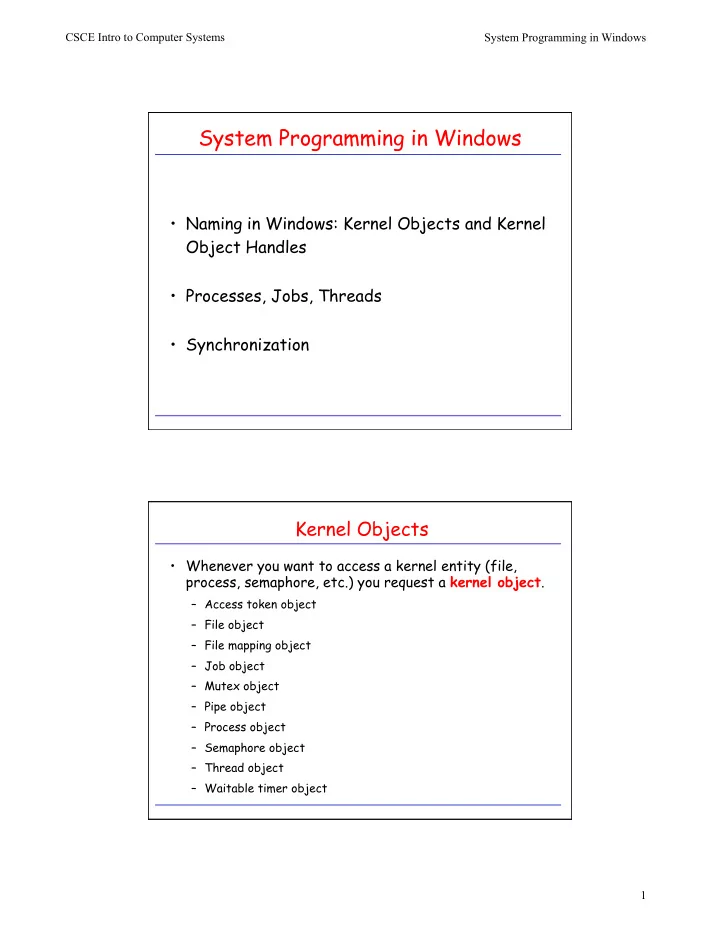
System Programming in Windows

  • Naming in Windows: Kernel Objects and Kernel

Object Handles

  • Processes, Jobs, Threads
  • Synchronization

Kernel Objects

  • Whenever you want to access a kernel entity (file,

process, semaphore, etc.) you request a kernel object.

– Access token object – File object – File mapping object – Job object – Mutex object – Pipe object – Process object – Semaphore object – Thread object – Waitable timer object

slide-2
SLIDE 2

CSCE Intro to Computer Systems System Programming in Windows 2

Object Lifetime and Garbage Collection

  • Objects can be accessed from multiple processes.
  • Counters keep track of that.

counter 1 2 1 Pi Pj kernel object create! create! close! close!

Creating Kernel Objects

HANDLE CreateThread( PSECURITY_ATTRIBUTES psa, size_t dwStackSize, LPTHREAD_START_ROUTINE pfnStartAddress, PVOID pvParam, DWORD dwCreationFlags, PDWORD pdwThreadId); HANDLE CreateFile( PCTSTR pszFileName, DWORD dwDesiredAccess, DWORD dwShareMode, PSECURITY_ATTRIBUTES psa, DWORD dwCreationDisposition, HANDLE hTemplateFile); HANDLE CreateFileMapping( HANDLE hFile, PSECURITY_ATTRIBUTES psa, DWORD flProtect, DWORD dwMaximumSizeHigh, DWORD dwMaximumSizeLow, PCTSTR pszName);

slide-3
SLIDE 3

CSCE Intro to Computer Systems System Programming in Windows 3

Closing Kernel Objects

// Indicate to the system that you // are done manipulating the object. BOOL CloseHandle(HANDLE hObject);

Note: Application may leak objects, but when terminates, handles are closed.

Sharing Kernel Objects

  • Q: How do we share pipes, semaphores, etc. across

processes?

  • “Share by Handle Inheritance”
  • “Share by Name”
  • “Share by Handle Duplication”
slide-4
SLIDE 4

CSCE Intro to Computer Systems System Programming in Windows 4

“Share by Name”

HANDLE CreateMutex( PSECURITY_ATTRIBUTES psa, BOOL bInitialOwner); HANDLE CreateMutex( PSECURITY_ATTRIBUTES psa, BOOL bInitialOwner PCTSTR pszName);

vs.

“Share by Handle Duplication”

BOOL DuplicateHandle ( HANDLE hSourceProcessHandle, HANDLE hSourceHandle, HANDLE hTargetProcessHandle, HANDLE hTargetHandle, // output param. DWORD dwDesiredAccess, BOOL bInheritHandle, DWORD dwOptions );

slide-5
SLIDE 5

CSCE Intro to Computer Systems System Programming in Windows 5

Writing an Application

  • Applications can be window-based or console-based.

int WINAPI _tWinMain( HINSTANCE hInstanceExe, // address of executable HINSTANCE , // was used in 16-bit PTSTR pszCmdLine, int nCmdShow ) int _tmain( int argc, TCHAR *argv[], TCHAR *envp[] )

Creating a Process

BOOL CreateProcess( PCTSTR pszApplicationName, PTSTR pszCommandLine, PSECURITY_ATTRIBUTES psaProcess, PSECURITY_ATTRIBUTES psaThread, BOOL bInheritHandles, DWORD fdwCreate, PVOID pvEnvironment, PCTSTR pszCurDir, PSTARTUPINFO psiStartInfo, PPROCESS_INFORMATION ppiProcInfo );

  • Note: Windows does not maintain a parent-child

relationship between processes. TCHAR szCmdL[] = TEXT(“NOTEPAD”); BOOL CreateProcess( NULL, szCmdL, NULL, NULL, FALSE, 0, NULL, NULL, &si, &pi);

slide-6
SLIDE 6

CSCE Intro to Computer Systems System Programming in Windows 6

Jobs (hey, something new!)

  • Q: How to manage multiple process as a group without parent-

child relationship?

  • Q: How to define constraints on group of processes?

– e.g. max CPU utilization for an application

  • Solution: Cluster processes into groups: Jobs

// Create a named job object. HANDLE hJob = CreateJobObject(NULL, TEXT(“Jeff”)); // Put our own process in the job. AssignProcessToJobObject(hJob, GetCurrentProcess()); // Closing the job does not kill our process or the job. // But the name (“Jeff”) is immediately disassociated with the job. CloseHandle(hJob);

Threads

Note:

  • Some variables in C/C++ run time libraries may be shared across

threads, thus causing race conditions. – errno, _doserrno, strtok, …

  • Therefore, for multithreaded C/C++ programs to run properly,

local data structures must be allocated for new thread that uses run time library.

  • Therefore, rather than calling CreateThread, use

_beginthreadx.

HANDLE CreateThread( PSECURITY_ATTRIBUTES psa, DWORD cbStackSize, PTHREAD_START_ROUTINE pfnStartAddr, // thread function PVOID pvParam, // thread func param DWORD dwCreateFlags, PDWORD pdwThreadID); // output parameter

slide-7
SLIDE 7

CSCE Intro to Computer Systems System Programming in Windows 7

Thread Synchronization in User Mode

  • Atomic Access: Interlocked
  • Critical Sections
  • Slim Reader-Writer Locks
  • Condition Variables

Interlocked Operations

// atomically assign lValue to lTarget LONG InterlockedExchange( PLONG volatile plTarget, LONG lValue); // atomically add lIncrement to lAddend LONG InterlockedExchangeAdd( PLONG volatile plAddend, LONG lIncrement); PVOID InterlockedCompareExchange( PLONG plDestination, LONG lExchange, LONG lComparand); // pseudocode!! LONG InterlockedCompareExchange( PLONG plDestination, LONG lExchange, LONG lComparand) { LONG lRed = *plDestination; if (*plDestination == lComparand) *plDestination = lExchange; return(lRet); }

slide-8
SLIDE 8

CSCE Intro to Computer Systems System Programming in Windows 8

Interlocked Operations

// Global variable long g_x = 0; DWORD WINAPI ThreadFunc1(PVOID pvParam) { g_x++; return(0); } DWORD WINAPI ThreadFunc1(PVOID pvParam) { g_x++; return(0); } DWORD WINAPI ThreadFunc1(PVOID pvParam) { InterlockedExchangeAdd(&g_x, 1); return(0); } DWORD WINAPI ThreadFunc1(PVOID pvParam) { InterlockedExchangeAdd(&g_x, 1); return(0); }

Critical Sections

// EXAMPLE int g_nSum = 0; CRITICAL_SECTION g_cs; DWORD WINAPI FirstThread(PVOID pvParam) { EnterCriticalSection(&g_cs); g_nSum = 0; for(int n = 1; n <= 10; n++) { g_nSum += n; } LeaveCriticalSection(&g_cs); return(g_nSum); }

slide-9
SLIDE 9

CSCE Intro to Computer Systems System Programming in Windows 9

Condition Variables

// Wait on condition variable BOOL SleepConditionVariable( PCONDITION_VARIABLE pConditionVariable, PCRITICAL_SECTION pCriticalSection, DWORD dwMilliseconds); // Signal VOID WakeConditionVariable( PCONDITION_VARIABLE pConditionVariable); // Signal all VOID WakeAllConditionVariable( PCONDITION_VARIABLE pConditionVariable);

Thread Synchronization with Kernel Objects

  • Wait functions
  • Event kernel objects
  • Waitable timer kernel objects
  • Semaphore kernel objects
  • Mutex kernel objects
slide-10
SLIDE 10

CSCE Intro to Computer Systems System Programming in Windows 10

Thread Synchronization with Kernel Object

  • Most kernel objects (events, waitable timer, threads,

jobs, processes, semaphores, mutexes) can be in signaled or non-signaled mode.

// Calling thread waits until object becomes signaled. DWORD WaitForSingleObject( HANDLE hObject, // kernel object that is sig/non-sig DWORD dwMilliseconds // time-out );

Event Kernel Objects

HANDLE CreateEvent ( PSECURITY_ATTRIBUTES psa, BOOL bManualReset, BOOL bInitialState, PCTSTR pszName); // Change event to signaled state BOOL SetEvent(HANDLE hEvent); // Change event to non-signaled state BOOL ResetEvent(HANDLE hEvent); Recall: We wait with WaitForSingleEvent(…).

slide-11
SLIDE 11

CSCE Intro to Computer Systems System Programming in Windows 11

Waitable Timer Kernel Objects

HANDLE CreateWaitableTimer ( PSECURITY_ATTRIBUTES psa, BOOL bManualReset, PCTSTR pszName); BOOL SetWaitableTimer ( HANDLE hTimer, const LARGE_INTEGER * pDueTime, // first event LONG lPeriod, // interval between events PTIMERAPCROUTINE pfnCompletionRoutine, // handler function PVOID pvArgToCompletionRoutine, // parameters to hand func. BOOL bResume);

Semaphores and Mutexes

HANDLE CreateSemaphore ( PSECURITY_ATTRIBUTES psa, LONG lInitialCount, LONG lMaximumCount, PCTSTR pszName);

We gain access to semaphore and mutex by calling wait function. We release them by calling ReleaseMonitor or ReleaseMutex function.

HANDLE CreateMutex ( PSECURITY_ATTRIBUTES psa, PCTSTR pszName, DWORD dwFlags, DWORD dwDesiredAccess);

slide-12
SLIDE 12

CSCE Intro to Computer Systems System Programming in Windows 12

Synchronous and Asynchronous Device I/O

  • Synchronous I/O: easy.
  • Asynchronous I/O:

– The OVERLAPPED structure – I/O Completion ports (tricky!)

The Windows Thread Pool

  • Call a function asynchronously
  • Call a function at a timed interval
  • Call a function when a single Kernel Object becomes

signaled

  • Call a function when asynchronous I/O requests

complete

slide-13
SLIDE 13

CSCE Intro to Computer Systems System Programming in Windows 13

Other Topics…

  • Fibers
  • Virtual Memory
  • Memory-Mapped Files
  • Dynamically Linked Libraries
  • … and that’s about it!

THANK YOU!