System-One year later SAFE Europe Symposium Brief -31 March 2010 - - PowerPoint PPT Presentation

system one year later
SMART_READER_LITE
LIVE PREVIEW

System-One year later SAFE Europe Symposium Brief -31 March 2010 - - PowerPoint PPT Presentation

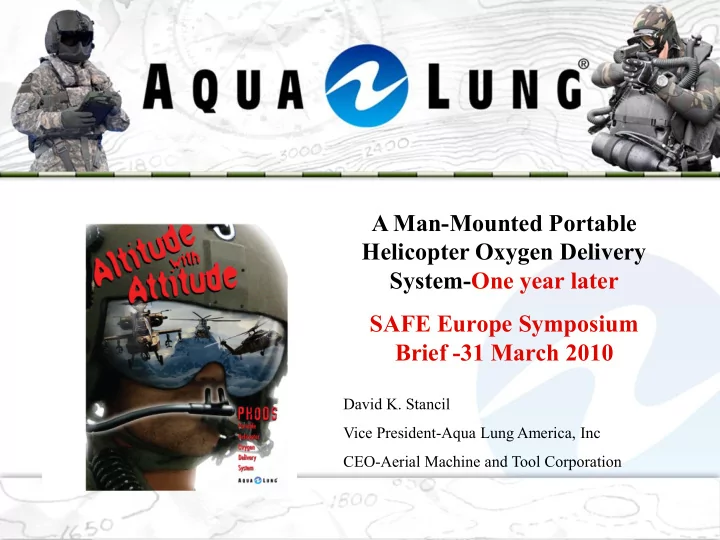
A Man-Mounted Portable Helicopter Oxygen Delivery System-One year later SAFE Europe Symposium Brief -31 March 2010 David K. Stancil Vice President-Aqua Lung America, Inc CEO-Aerial Machine and Tool Corporation Briefing Objectives Team

slide-1
SLIDE 1

A Man-Mounted Portable Helicopter Oxygen Delivery System-One year later SAFE Europe Symposium Brief -31 March 2010

David K. Stancil Vice President-Aqua Lung America, Inc CEO-Aerial Machine and Tool Corporation

slide-2
SLIDE 2

Briefing Objectives

  • Team members
  • Background of system
  • PHODS system
  • Testing
  • Applications
  • Oxygen in the field
  • Companion product-PHODS Console
  • Conclusion
slide-3
SLIDE 3

Team Members

  • Aqua Lung America

– High pressure breathing devices and regulators

  • Gentex, West

– Helmets and Resporitory Systems

  • Mountain High

– Oxygen supply systems for civil gliders (high altitude)

  • Breathing Air Systems

– Oxygen and compressed gas

slide-4
SLIDE 4

PHODS-SAFE 2008 Team Achievement Award

slide-5
SLIDE 5

Background

  • Operations in Afghanistan exposed and demonstrated Army

Aviation needs

  • No system specifically designed for helicopter flight below

18,000 ft

  • Need for a robust and individual supplemental system
  • Need for proper integration into today's combat gear
  • Need for the automatic delivery of oxygen
  • Need for a compact and efficient oxygen system
slide-6
SLIDE 6

Factors

Current theater of operations Varying environment Varying terrain Sand Fatigue Flight @ moderate altitude (>14,000 ft) Mountains Survival Evasion Escape

slide-7
SLIDE 7

Portable Helicopter Oxygen Delivery System

  • Definition:
  • A light weight portable oxygen delivery system that once

turned on will deliver oxygen to the user and change delivery volumes based on the altitude.

  • Can be used as a primary delivery of oxygen, an emergency

system and for escape & evasion at high altitudes. Secondary, but not designed for, can also be used for medical applications.

slide-8
SLIDE 8

Oxygen Use in Rotor Wing Aircraft

US Army USAF US Navy AR 95-1; February 2006 AFI 11-202V3, April 2006 OPNAVINST 3710.7T. March 2004 Up to 10,000 ft- Unrestricted Up to 10,000 ft- Unrestricted Up to 10,000 ft- Unrestricted 10,000-12,000- 1 hour maximum 10,000-12,500- 1 hour maximum 10,000-13,000- 3 hours maximum 12,000-14,000- 30 minutes maximum 12,500-14,000- 30 minutes maximum Above 13,000 Supplemental oxygen must be used Above 14,000- Supplemental

  • xygen must be used

Above 14,000- Supplemental

  • xygen must be used

Total flight time above 10,000 ft shall not exceed 1 hour

Existing U.S. DOD Regulations

slide-9
SLIDE 9

System Overview

slide-10
SLIDE 10

Portable Supply System

Output Q.D. Refill Port ON/Off Knob

Pressure Gauge

slide-11
SLIDE 11

Helmet System Connections

slide-12
SLIDE 12

PHODS Cannula by Gentex

Robust clip in mount Removable cover Flexible boom

slide-13
SLIDE 13

PHODS Cannula

  • Robust flexible boom
  • Delivers oxygen to user via nasal passage
  • Mounts on all helmets
  • Attachable and removable in flight
  • Removable soft rubber cover for cleaning or replacement
  • Placed on right or left side of helmet
  • Must breath through your nose
  • Estimated duration up to 3.0 hours
slide-14
SLIDE 14

AH-64 Apache Helmet Integration

slide-15
SLIDE 15

Potential Integration into other helmets

Note: Mounts, cannula, or oral/nasal mask have only been tested and approved for use with Gentex helmets

slide-16
SLIDE 16

Optional Oral Nasal Mask

  • Based on the MBU-20 design
  • Lightweight soft rubber mask
  • Attachment by Maxiofacial shield

clips

  • Fits inside maxiofacial shield
  • Standard military microphone
  • Consumes more oxygen than

cannula

  • Estimated duration 2.0 Hours
slide-17
SLIDE 17

Oxygen Pulse Controller by Mountain High

  • Commercial item from civil glider community

– Electronic auto-profiling “Pulse Demand” regulator – Digital micro-computer electronics for absolute accuracy – Visual alarm for apnea, pinched tube and empty cylinder – Senses barometric pressure – Senses user inspiration – Delivers measured O2 automatically – Adapts to each individual that includes anticipating breathing cycles

slide-18
SLIDE 18

Oxygen Pulse Controller “OPC”

OPC Modes of Operation

  • Off
  • On = Automatically begins delivery of oxygen on ascent

through 10,000 ft msl

  • F 20 = Oral nasal mask setting for increased flow
  • R/M = Reserve Manual mode for increased flow available

at any altitude. (Used for Inspection, Pre-breathing or Medical use)

  • Automatically stops delivery at 8,000ft msl in descent
slide-19
SLIDE 19

Testing Criteria

  • USASAM/FAA Altitude

Chambers

– Pilot Volunteers – Rest & Exercise

  • 10,000 ft
  • 15,000 ft
  • 18,000 ft

– Effectiveness of O2 Delivery

  • Pulse Oximetry
  • Color Vision

– Ease of Use

slide-20
SLIDE 20

Reports Issued-USAARL(U.S. Army Aeromedical Research Lab)

  • USAARL #2007-14-PHODS
  • USAARL #2008-04-Cannula and HGU 56/P
  • USAARL #2008-13-Oro-Nasal Mask

These can be downloaded from the www.usaarl.army.mil web site.

slide-21
SLIDE 21

SpO2 vs Altitude

Altitude (thousands of feet)

10 15 18

SpO2 (%)

80 85 90 95 100 105 SpO2 (Rest OFF O2) SpO2 (Rest ON O2) 91% SpO2 Level

slide-22
SLIDE 22

SpO2 vs Altitude

Altitude (thousands of feet)

10 15 18

SpO2 (%)

80 85 90 95 100 105 Pre Exercise - Cannula Post Exercise - Cannula Pre Exercise - Mask Post Exercise - Mask 91% SpO2 Level

slide-23
SLIDE 23

PHODS Mask testing March 2010-Dayton T. Brown Co.

PHODS MASK OFFICIAL TEST SETUP PHOTO

  • Mask mounted on ANSTI head, connected to Breathing

Machine by Hard Tubing.

  • Breathing Machine located in insulated box positioned

below head. Machine was insulated and heated to prevent freezing during -25 F portion of test.

  • OPC was mounted directly on side of head. Plastic bag

was to provide protection from humidity during 100% condensing humidity portion of test. OPC was not being evaluated during this test rather part of setup.

  • Elastic Cord/PVC tube was used to compensate for helmet

compression which occurred during initial cycles causing mask to break seal.

  • Mask was tested to MIL-STD-810F, Method 520.2, Proc.

III,Temperature/Altitude/Humidity,Total number of Test Cycles: 10 .Tested to 165F and -25F, 0-22,000 FT MSL, and 0-100% humidity.

slide-24
SLIDE 24

PHODS Mask testing March 2010-Dayton T. Brown Co.

PHODS MASK OFFICIAL EXPLOSIVE ATMOSPHERE TEST SETUP Mask Low Impedance Microphone was connected to an Aqua Lung supplied activation fixture which duplicated pilot voice transmissions while in Explosive Atmosphere. Continued transmissions occurred from maximum test altitude of 22K MSL, to 0 MSL Sea Level. Mask was tested to MIL-STD-810F, Method 511.4, Proc. I

slide-25
SLIDE 25

PHODS Mask testing March 2010-Dayton T. Brown Co.

Test Reference Test Specification High Temperature Storage Total number of Test Cycles: 7 +85C or 185F MIL-STD-810F, Method 501.4,

  • Proc. I

Low Temperature Storage/ Low Pressure (Altitude) Total number of Test Cycles: 1

  • 54C or -65F

MIL-STD-810F, Method 500.4,

  • Proc. I

MIL-STD-810F, Method 502.4,

  • Proc. I

Vibration – Cat. 24 (minimum int.) MIL-STD-810F, Method 514.5,

  • Proc. I

Additional Tests Performed

slide-26
SLIDE 26

Fill Adapter, K-Cylinder-PHODS

102911 ADAPTER

  • CGA 540 to fit K cylinder
  • Gauge
  • Flow restrictor
  • Open/close valve
  • Bleeder valve
  • Hand tight PHOD

connector

slide-27
SLIDE 27

Mobile Oxygen Cylinder Recharge System-MOCRS

  • Generates OBOGS Grade Oxygen (90+-

3% Purity) using Pressure Swing Absorption molecular sieve ceramics

  • Easily Transported to forward deployed

ALSE locations

  • Complete with cart, 2 K-cylinders, 6

position PHODS fill chamber

  • Runs Automatically and requires little

attention and will shut down if oxygen purity drops

slide-28
SLIDE 28

Touch screens

slide-29
SLIDE 29

PHODS 16 Man Console

  • 50 Cubic ft. cylinders - Ballistic protected container

Legacy System New PHODS Console

slide-30
SLIDE 30

PHODS 16 Man Console

slide-31
SLIDE 31

Technical Training

slide-32
SLIDE 32

Support Equipment

  • Provisioning spare parts kits
  • Dedicated “clean” tool kit
  • U.S. Army approved user training IKP training materials for

fielding

  • Complete technical training packing under development
  • Deployable ability to generate oxygen
slide-33
SLIDE 33

PHODS Current Status

  • AWR Completed
  • Under Contract with Army with 2000+ shipped
  • Fielding underway and systems in use daily
  • 16 Man O2 console 95% complete (Level III

ballistic Liner)

  • Oxygen Generating System fielded
  • Complete logistics support in place
  • User training package complete
  • Maintenance package complete
slide-34
SLIDE 34

PHODS-A Year Later

The U.S. Army has successfully fielded roughly 1500 systems to the following units: 159th Avn (Ft Campbell, KY) 82nd Avn (Ft Bragg, NC) 1-52 Avn (Alaska) 160th SOAR 3 ID (Savannah, GA)

  • B. Co 1-168 (Ft Lewis, WA)

AASF (Reno, NV)

  • B. Co 1-158 (Germany)

1-228th Avn (Honduras) 2-29 Inf Regt Flight Co (Ft Benning, GA) 101st Avn (Ft Campbell, KY)

  • B. Co 1-168 (Pendleton, OR)
  • C. Co 1-171 Med (Santa Fe, NM) A & B Co 1-207 Avn (Alaska)

4th CAB (Ft Hood, TX)

slide-35
SLIDE 35

Comments from the field

  • U.S. Army 160TH SOAR (Special Operations)

“We flew PHODS last night for the first time. We actually flew with it for 7 hours and where actually using it for about 5 1/2 hours continuously. We where up as high as 13000 MSL and where pretty constant at 9500 MSL. It worked great and was not cumbersome at all. At the end of the night, I still had a half of a bottle left. It was slowly delivering oxygen at 7500 MSL and then it increased the delivery cycle and volume of oxygen as we ascended through 10000 MSL. You can actually hear the puffs of oxygen when it delivers it to the cannula. That was comforting as it let us know it was working. I had my FE check the guys in the back every 30 minutes.”

  • “The crew members did consume slightly more oxygen than the pilots

due to workload while hoisting in the snow at 12500 MSL. Overall, our guys where very happy with it and it worked really well. Much better than we expected. We will be flying it again tonight. The only thing we wish we had here is the extra cases of bottles purely for worst case contingencies. Thanks again.”

slide-36
SLIDE 36

Comments from the field

3 ID “We used on a CSAR Mission in December greatly adding to mission success.” 4th CAB “We are currently performing high altitude training using PHODS and we are requesting a system for each crewmember assigned.”

slide-37
SLIDE 37

PHODS Conclusion

  • PHODS is an efficient and automatic supplemental oxygen

delivery system that maintains blood oxygen saturation and has been sucessfully fielded to the warfighter.

  • Designed specifically for helicopters
  • Multiple applications
  • Flexible integration for all helo applications
  • Established subcomponents and proven team members
  • Turn key support – maintenance, training & O2 generation
slide-38
SLIDE 38

QUESTIONS?

slide-39
SLIDE 39

Aqua Lung America POC

Dave Stancil Dstancil@aqualung.com 760-597-5065