SYRACUSE UNIVERSITY Eating Disorders Team Susan Pasco, PhD, - - PowerPoint PPT Presentation

syracuse university
SMART_READER_LITE
LIVE PREVIEW

SYRACUSE UNIVERSITY Eating Disorders Team Susan Pasco, PhD, - - PowerPoint PPT Presentation

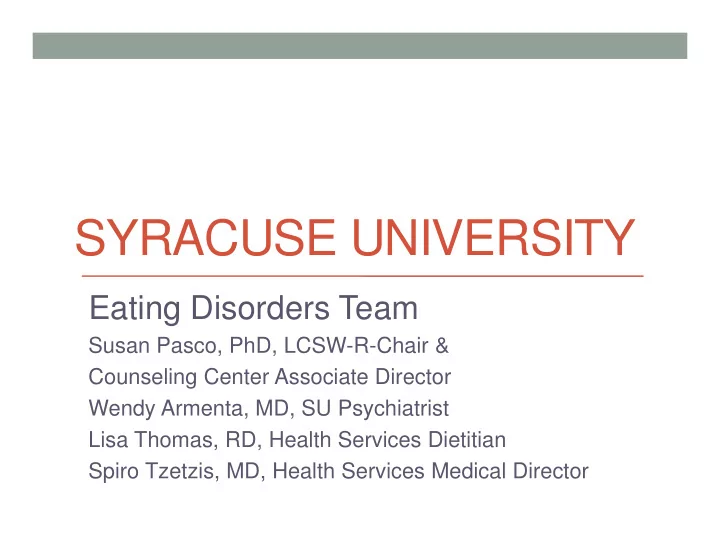
SYRACUSE UNIVERSITY Eating Disorders Team Susan Pasco, PhD, LCSW-R-Chair & Counseling Center Associate Director Wendy Armenta, MD, SU Psychiatrist Lisa Thomas, RD, Health Services Dietitian Spiro Tzetzis, MD, Health Services Medical


slide-1
SLIDE 1

SYRACUSE UNIVERSITY

Eating Disorders Team

Susan Pasco, PhD, LCSW-R-Chair & Counseling Center Associate Director Wendy Armenta, MD, SU Psychiatrist Lisa Thomas, RD, Health Services Dietitian Spiro Tzetzis, MD, Health Services Medical Director

slide-2
SLIDE 2

Team-Multidisciplinary Approach

  • Counseling Center Therapists
  • Psychiatrist
  • Medical Providers
  • Registered Dietitian
  • Student Assistance
  • Meets weekly
  • Referring providers may attend
slide-3
SLIDE 3

Why develop a team approach?

  • Complex patients
  • Evaluation of severity of symptoms
  • Determination of a level
  • Collaboration
  • Unified message
  • Support each other
slide-4
SLIDE 4

Impetus of forming a team

  • Prior to the team, ED patients presented in a variety of

ways

  • ED patients were resistant to recommended referrals
  • What criteria were we going to use to classify level of

care?

  • What is the role of each person on the team?
  • What do we do when a student requires a higher level of

care?

slide-5
SLIDE 5

Initial Entry to the ED Team

  • Staff at UHS, CC, or SA may refer students to the ED

Treatment Team after an initial assessment in their respective office.

  • While individual providers within any one of the three
  • ffices may conduct an initial assessment with a student,

the ED Team will determine whether the coordinated care provided by the team is appropriate and treatment will not commence until the case has been reviewed by the ED Team.

  • Prior to ED Team review student may be scheduled for

follow-up appointments for risk management reasons.

slide-6
SLIDE 6

Student’s Understanding

  • At the time of initial assessment, providers at UHS and

CC, and SA should explain and discuss the ED Treatment Team process and the need for a signed release of information form allowing UHS, CC, and SA to openly communicate regarding the student’s situation.

  • When a student is initially assessed at UHS or CC the

initiating provider should complete the ED Referral Form and fax this form to the appropriate office along with the ED Treatment Team ROI form.

slide-7
SLIDE 7

Student Responsibility

  • In order to initiate eating disorder support services, you must

agree to participate in a team approach. This means having a medical provider, a registered dietician, and a therapist. You must also grant permission to these providers to discuss their care collaboratively. If you do not agree with this collaborative approach, Division of Student Affairs services will still be available for you in regards to other concerns, but you will not be eligible for eating disorder support services.

  • Goals and a care plan will be discussed and set with you upon

initiation of support services. Individual goals will be based on physical, nutritional, and emotional health. Your health status will determine the frequency of visits and monitoring with the various team members. Goals may change as progress is made or if a health decline occurs.

slide-8
SLIDE 8

Authorization

  • Acknowledgement and Authorization to Disclose Information
  • I authorize SU Health Services, SU Counseling Center, and the

Office of Student Assistance to communicate any and all information in their possession regarding support for my eating disorder, and any related health concerns, in a confidential and professional manner that is consistent with applicable federal, state, and local laws governing the confidentiality of protected health information. If has been explained to me that this authorization is voluntary. This authorization is subject to revocation in writing at any time. If not previously revoked, this authorization will terminate upon the completion or termination

  • f my course of care.
slide-9
SLIDE 9

Initial Assessment

  • Initial Counseling Center then Medical evaluation is

performed before agreeing to accept student onto the team.

  • If accepted, the student will then meet with our Registered

Dietitian

  • Student Assistance may be requested to become involved

anywhere along the process

  • Psychiatry may become involved if medication is felt to be

beneficial or for other comorbid psychiatric treatment

slide-10
SLIDE 10

Counseling Center

All CC providers are able to perform an initial assessment which includes the following:

  • assessment of eating disorder symptoms including review of

current and past body weights

  • assessment of depression, anxiety, alcohol, and substance

abuse

  • review of interpersonal and familial history
  • review of past treatment history
  • assessment of suicidal risk
  • previous and current diagnosis
  • level of care decision making
  • recommended treatment
slide-11
SLIDE 11

Counseling Center

The Counseling Center will provide weekly psychotherapy for those students who are:

  • fairly well motivated to engage in treatment,
  • demonstrate good insight
  • deemed self-sufficient in establishing the structure needed to

eat/gain weight and/or to control binging and purging behaviors

  • Are medically stable and able to benefit from a brief treatment

model

Students requiring treatment beyond the brief treatment model are referred into the Syracuse community for counseling follow-up.

slide-12
SLIDE 12

Medical

  • Focus is on Medical Stability and

assessment of risks.

  • All providers perform assessments
  • 45 minute appointment
  • Template is followed
slide-13
SLIDE 13

Physical Exam

  • Comprehensive Assessment
  • Weight (rate and amount of weight loss change)
  • Orthostatics
  • Temperature
  • Respiratory Rate
  • BMI
  • Nutritional Status
  • Methods of weight control
  • Menstrual history
  • Psychiatric history
  • Family History
slide-14
SLIDE 14

Initial Evaluation

Studies

  • Complete blood count
  • Comprehensive serum metabolic profile, other

electrolytes (Magnesium, Phosphorus) and enzymes (amylase, lipase)

  • Thyroid function tests
  • Pregnancy test if sexually active
  • Electrocardiogram (ECG)
  • +/- Gonadotropins and sex steroids
  • Consider bone mineral density study
slide-15
SLIDE 15

Physical Exam

  • GENERAL
  • Marked weight loss, gain or fluctuations
  • Weight loss, weight maintenance or failure to gain

expected weight in an adolescent who is still growing and developing

  • Cold intolerance
  • Weakness
  • Fatigue or lethargy
  • Dizziness
  • Syncope
  • Hot flashes, sweating episodes
slide-16
SLIDE 16

Oral and Dental

  • Oral trauma/lacerations
  • Dental erosion and dental

caries

  • Parotid enlargement
slide-17
SLIDE 17

Cardiorespiratory

  • Chest pain
  • Heart palpitations
  • Arrhythmias
  • Shortness of breath
  • Edema
slide-18
SLIDE 18

Gastrointestinal

  • Epigastric discomfort
  • Early satiety, delayed gastric

emptying

  • Gastroesophageal reflux
  • Hematemesis
  • Hemorrhoids and rectal prolapse
  • Constipation
slide-19
SLIDE 19

Endocrine

  • Amenorrhea or irregular menses
  • Loss of libido
  • Low bone mineral density and

increased risk for bone fractures and osteoporosis

  • Infertility
slide-20
SLIDE 20

Neuropsychiatric

  • Seizures
  • Memory loss/Poor concentration
  • Insomnia
  • Depression/Anxiety/Obsessive

behavior

  • Self-harm
  • Suicidal ideation/suicide attempt
slide-21
SLIDE 21

Dermatologic

  • Lanugo hair
  • Hair loss
  • Yellowish discoloration of skin
  • Callus or scars on the dorsum of

the hand (Russell’s sign)

  • Poor healing
slide-22
SLIDE 22

Emergency Room referral

  • Heart Rate<40 bpm
  • BP <90/60 mmHg
  • Glucose <60mg/dl
  • Potassium <3mEq/L
  • Electrolyte imbalance
  • Temp <97.0 F Dehydration
  • Hepatic, renal, or cardiovascular organ

compromise requiring acute treatment;

  • Poorly controlled diabetes
slide-23
SLIDE 23

Registered Dietitian

  • May meet weekly initially but will quickly move to biweekly
  • r every 3-4 weeks.
  • Blind weight monitoring with discussion about differences

in weight between appointments only

  • Will call individual therapist to update about significant

changes, weight and symptoms.

  • Team will meet jointly with students to discuss high level

concerns and referrals to higher level of care.

  • All notes faxed to therapist and home team.
  • May be member of treatment team in the community but
  • nly when pt is at “Level 1” or in relapse prevention.
slide-24
SLIDE 24

Registered Dietitian cont…

  • Written update from home based support team is required

after semester and summer breaks in order to re establish with SU eating disorder support services.

  • New assessment at Syracuse University is required each

semester.

  • Psychoeducation group co-led by Registered Dietitian and

Therapist from Counseling Center.

  • Group Chats with eating disorder prevention as focus (per

request) – Therapist and Registered Dietitian co lead.

slide-25
SLIDE 25

Assessment

  • Medical, Dietary, and

Treatment History

  • Assess for

Motivation/Ambivalence

  • Physical and Eating

Disorder related Symptom Assessment

  • Dietary Patterns
slide-26
SLIDE 26

Motivation

  • 1. Why are they here? Required or personal desire for

particular outcome.

  • 2. Level of fear – does family know, medical concerns,

body image concerns, impact on academics/social/athletics, co-morbid mental health concerns such as OCD, anxiety, depression.

  • 3. Insight about role of eating disorder in their life. Why do

they think they use these behaviors? Making a mental note of the above, guides in creating well suited goals and the starting place for motivational interviewing to progress student through nutrition counseling.

slide-27
SLIDE 27

Physical Symptoms

  • Fatigue
  • Dizziness/Fainting
  • Chest Pain
  • Shortness of Breath
  • Edema
  • Nausea/Vomiting
  • Diarrhea/Constipation
  • Blood in Vomit/Stool
  • Pain - teeth, bone,

joint, frequent injuries?

  • Reflux/GERD
  • Headaches
  • Hair Loss/Lanugo
  • Cold Intolerance
  • Muscle Cramping
  • Sleep patterns
  • Anxiety/Depression
  • Digestive – pain, gas,

bloating, cramping

  • Self-harm
slide-28
SLIDE 28

Eating Disorder Related Symptoms

  • Binging/Purging
  • Laxatives, Diuretics,

Dieting Aids, Caffeine

  • Diarrhea – via Lactose

Intolerance

  • Diabetes – Insulin

manipulation

  • Menstruation
  • Exercise (define exercise)
  • Chew and Spit
  • Restricting
  • Herbal teas/supplements

for altering metabolism or weight

slide-29
SLIDE 29

Weight, Weight History and Discussion

  • Blind weights – communicate weight differences
  • Using growth chart as opposed to BMI and Ideal Body

Weight can be helpful with progression when discussing with the student.

  • Getting weight history up front allows for more accurate

reporting.

  • Frame goal weight as “A healthy goal weight is one at

which you do not need to restrict your intake”

  • Health Focus as opposed to Weight Focus
slide-30
SLIDE 30

Dietary Patterns

  • Skipping and spacing of meals
  • Meal size, snack size
  • Pace of eating
  • Calorie counting/intake
  • Food Fears/Rules – may not communicate completely

until rapport is established

  • Food consistency patterns – ie fluids or foods that do not

need to be chewed

  • Alcohol intake
  • Food Temps, Spicy, Adulterating foods/odd combinations
  • Family history in regards to dietary patterns and health

beliefs

slide-31
SLIDE 31

Psychiatry

  • Referrals for medication management come either from the Counseling Center or Health
  • Services. However, often students present to psychiatry for a comorbid psychiatric disorder

and their eating disorder is uncovered during the course of the Psychiatric Comprehensive

  • Intake. The team meetings are an effective and efficient way of allowing each member of the

multidisciplinary team to keep abreast of each students’ status.

  • Anorexia Nervosa - There is limited evidence for the use of medications to restore weight,

prevent relapse or to treat chronic anorexia nervosa.

  • Bulimia Nervosa – The World Federation of Societies of Biological Psychiatry identified 36

randomized, controlled trial of medications for the treatment of bulimia Nervosa.

  • Tricyclic antidepressants – Grade A evidence exists with a moderate risk-benefit ratio.
  • Fluoxetine – Grade A evidence exists with a good risk-benefit ratio
  • Topirimate – Grade A evidence exists with a moderate risk-benefit ratio.
  • Binge Eating Disorder – The World Federation of Societies of Biological Psychiatry identified

26 randomized, controlled trials of pharmacological treatments for binge eating disorder.

  • Grade A evidence supports the use of Imipramine with moderate risk-benefit ratio.
  • Grade A evidence supports the use of sertraline and citalopram/escitalopram with good

risk-benefit ratio.

  • Grade A evidence supports the use of topirimate with moderate risk-benefit ration.
  • Grade D evidence exists for the use of fluvoxamine and fluoxetine (inconsistent results).
slide-32
SLIDE 32

Psychiatry continued

  • Comorbidity of Psychiatric Conditions in patients with eating

disorders. Depression is the most common comorbid condition in all of the eating disorders and often the symptom that leads the patient to seek care. The majority of studies suggest that well over 50% have comorbid depression and some studies suggest as high as 90%. Bipolar disorder is more often comorbid with Bulimia. Anxiety disorders are the second most common condition. Research has shown that two-thirds suffer from anxiety disorders which includes OCD (most commonly seen with AN restricting type) PTSD (more often seen with bulimia), GAD and phobias.

slide-33
SLIDE 33

Psychiatry continued

  • Substance abuse occurs in about 50% of those with

eating disorders. Anorexics are more likely to abuse substances that reduce appetite such as amphetamines and cocaine while those with bulimia and binge eating disorder are prone to abuse of many substances including alcohol, emetics, laxatives, and heroin.

  • Personality Disorders (Axis II disorders) are also common

in eating disordered patients. Borderline personality disorder is most common and this is more often comorbid with Bulimia. Avoidant personality disorder is more common in Anorexia Nervosa. Axis II comorbidity is linked to unfavorable outcome in the eating disorder.

slide-34
SLIDE 34

Criteria

slide-35
SLIDE 35

Criteria con’t

slide-36
SLIDE 36

Recommendation for Higher Level of Care

  • You have recently participated in an assessment with the Syracuse University Eating Disorder Treatment Team. During this

assessment you reported your average daily caloric intake to be ____ calories and that, on average, you are engaging in binging ____ times per day and purging ____ times per day. (If student is engaged in laxative abuse, excessive exercise,

  • r other concerning compensatory behavior describe it here.) During the assessment your weight was ____ pounds,

which corresponds to ___% of your ideal body weight. (If student is experiencing any medical problems describe them here.)

  • We are very concerned about your eating disorder and the potential serious health related consequences. In addition, we

believe the likelihood of you achieving optimal academic success is dramatically reduced as a result of your eating disorder. Given these factors and the current level of care needed to best address your eating disorder, we are recommending that you take a medical leave of absence and pursue treatment via a residential based treatment program. Such a treatment program will provide you with the necessary level of care to assist you in beginning your recovery process. We are happy to assist you in identifying a program that will be consistent with these recommendations.

  • If you decide to remain at Syracuse University, you will continue to be eligible to access University Health Services for medical

concerns unrelated to your eating disorder, as well as the crisis services provided by the Syracuse University Counseling Center and the Office of Student Assistance. However, given that the level of care needed to support treatment for your eating disorder exceeds our team’s resources, you will not be able to access treatment for your eating disorder through our team at this time, as we strongly believe that you would most benefit from a residential based program.

  • These recommendations are offered in the interest of your health and your future success at Syracuse University, and we hope

you will adopt them. We recognize that this feedback may be difficult to receive. Our intention with these recommendations is not to punish you, but rather to assist you in receiving the level of care needed to address your eating disorder. If you choose to pursue a medical leave of absence, the Office of Student Assistance will be happy to assist you in finalizing this process.

  • Please feel free to contact either one of us with any questions or concerns.
  • Sincerely,
slide-37
SLIDE 37

Higher Levels of Care

  • Intensive outpatient programs are indicated when percent of ideal body

weight is higher than 80%, and there is fair motivation. This level of care is appropriate when the client needs some meal support and when mild external structure will produce significant behavioral change.

  • Day treatment/partial hospitalization is indicated for patients when

percent of ideal body weight is higher than 80%, with lower motivation, who may be preoccupied with intrusive thoughts and needs significantly higher external structure. This level of care provides a much greater level

  • f meal support and structure to patients.
  • Residential care is generally indicated when a patient needs supervision

for all meals, whose percent of ideal body weight is less than 85%, and requires a fulltime structured environment to reduce behaviors and increase medical stability.

  • Inpatient hospitalization is generally indicated for patients requiring

medial stabilization, who may be experiencing low motivation and may have an existing psychiatric disorder that requires hospitalization and full time supervision. When medical stability is as risk all other criteria must take a backseat until stability is achieved. Once medically stable, other treatment decisions can be made.

slide-38
SLIDE 38

Team challenges

  • Communication with providers not on the team who are

referring or involved with treating students with ED symptoms

  • Working with off-campus providers who may not

understand or agree with our treatment guidelines

  • Working and/or responding to students who are resistant

to ED Team’s treatment recommendations

  • Managing high volume of students in need of treatment

for eating disorders

  • Making referrals for students in need of a higher level of

care who have limited financial means and/or no insurance coverage.