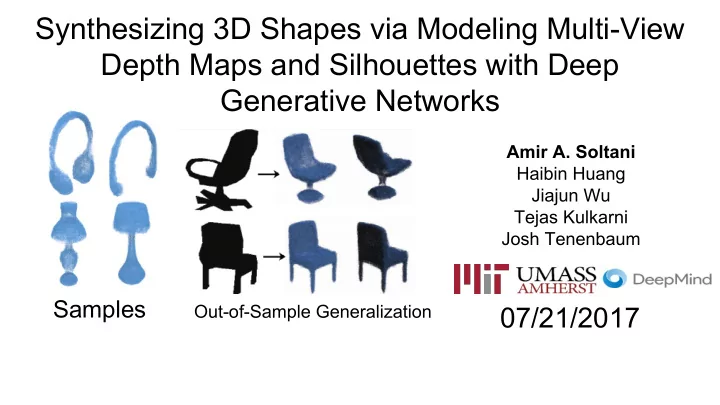
SLIDE 1
Amir A. Soltani Haibin Huang Jiajun Wu Tejas Kulkarni Josh Tenenbaum
Synthesizing 3D Shapes via Modeling Multi-View Depth Maps and Silhouettes with Deep Generative Networks
07/21/2017
Samples
Out-of-Sample Generalization
SLIDE 2
Motivation - Autonomous Vehicles
SLIDE 3
Motivation - Robotics
SLIDE 4 Motivation
- Computer Vision cannot simply rely on 2D data to solve 3D problems
- We need to have good 3D representations to solve inverse problems
- A generative model for 3D is a good starting point (A lot more needed though)
- Good progress has been made in the past 2 or 3 years
- Still, the choice of 3D representation is being debated
- Each representation has advantages and disadvantages
- So far there is not a good agreement on which representation to use
SLIDE 5 Choice of Representation
Multi-view Template-based Point clouds Meshes Voxels
SLIDE 6 3D Representation - Voxels
- Computational complexity is very high (O3) if used naively
- Cannot Model High-Res Shapes
- Details can easily get lost
- Highly sparse at higher resolutions
- Cannot model regular structures easily
SLIDE 7 3D Representation - Voxels
- Directly predicting high-res voxel-based outputs is very hard
- Highest so far is 64 x 64 x 64
- One model per object category
Wu et al, NIPS 2016
SLIDE 8 3D Representation - Point Clouds
- Not a lot of work done using point clouds so far
- Things start to get mathematically-involved from here
- The choice of loss function, non-differentiability issues etc
- Not obvious how many points to have
Image courtesy: Hao Su
SLIDE 9 3D Representation - Point Clouds
Su et al, CVPR 2017
SLIDE 10 3D Representation - Meshes
- Cannot directly apply out-of-the-box models on
- Mathematically Involved
- Can be seen as a graph as well
Image courtesy: Hao Su
- Need to Construct Special Kind of Kernels for CNNs
SLIDE 11 3D Representation - Template-Based (CAD)
Image courtesy: Haibin Huang
- Again, Not Able to Easily Apply Out-of-Box Models on
- Data Is Very Hard to Obtain
- Offers Compositionality Intrinsically and Explicitly
- Hard to Model Shapes Never Seen Before
- Might be a Good Option for Learning Functionalities
SLIDE 12 3D Representation - Multi-View
- Multi-view representation is very lightweight
- Can easily apply out-of-the-box CNN models on
- Offers Flexibility (Depth Maps) and Eases the Computation Significantly
- Although 2D, Still Explicitly Models 3D Shapes
- Allows Generating Hi-Res, Detailed, Novel Objects
- Without the machinery required for new voxel-based models
- Not Mathematically Involved
- More Intuitive
SLIDE 13 Motivations
- Synthesize/Generate Hi-Res, Detailed and Novel Shapes
- Use Some Sort of a Representation Whose Data is Easily Obtainable
- No Doubt that it is Very Easy to Obtain 2D images or RGBD or just D
- Have Out-of-Sample Generalizability
- A Step Forward Towards Obtaining 3D Concepts Efficiently to Solve Inverse Vision
Problems
- Model 3D via 2D (inspired by biological vision)
- Share the Same Representations For All Categories
SLIDE 14 Pipeline - Data Set
- Used ShapeNet Core
- Contains Aligned, Normalized Shapes
- ~37k for train, ~3k for test
- Normalized and Aligned
- Render 20 views of depth maps
- Camera Positions Fixed
SLIDE 15 Pipeline - Architectures
- Train 3 Different VAE Models
- AllVPNet: Train with All 20 Views
- DropoutNet: Train with 2-5 Randomly Chosen Views
- SingleVPNet: Train with 1 Randomly Chosen View
- Z Layer Has 100 Nodes for Unconditional and 40 for Conditional
- L1 Loss Function is Used During Training
SLIDE 16 Pipeline - Architectures
L1 L1
SLIDE 17 Pipeline - 3D Reconstruction
- Deterministic Function is Used to Generate the Final 3D Point Cloud
- Number of Points is Between ~30k to ~400k depending on Shape Complexity
- Not fixed!
SLIDE 18
Results - Sampling
Random Sampling
SLIDE 19 Results - Sampling
Random Samples’ Nearest Neighbors
Training set Reconstruction Random Sample
SLIDE 20
Results - Sampling
Random Samples
SLIDE 21
Results - Sampling
More Random Samples
SLIDE 22
Results - Sampling
More Random Samples
SLIDE 23
Results Samples
Conditional Sampling
SLIDE 24
Results - Sampling
Conditional Sampling
SLIDE 25
Results - Sampling
Conditional Samples
SLIDE 26 Results - Conditional Sampling
Nearest Neighbors
Training set Reconstruction
Training set Reconstruction
SLIDE 27 Results - Conditional Sampling
Nearest Neighbors
Training set Reconstruction
SLIDE 28
Results - Reconstruction
SLIDE 29
Results - Classification
Classification, Reconstruction Error
SLIDE 30 Results - Reconstruction
Out-of-Sample Generalization
- Put Silhouettes/Depth Maps into 224 x 224 canvases
- Camera Pose Not Fixed
- Different Size and Orientation
- NYUD and Silhouettes from the Internet
- Images Scaled to Fit
- The Rest of The Results Are All Obtained Through SingleVPNet Model
SLIDE 31
Results - Reconstruction
Out-of-Sample Generalization (NYUD)
SLIDE 32
Results - Reconstruction
Out-of-Sample Generalization (Uncond. SinlgeVPNet - NYUD Silhouettes)
SLIDE 33
Results - Reconstruction
Out-of-Sample Generalization (Uncond. SinlgeVPNet - NYUD Silhouettes)
SLIDE 34
Results - Reconstruction
Out-of-Sample Generalization (Silhouettes From Web)
SLIDE 35 Results - Representation Analysis
Consistent Representation
- Naturally Would Like to Get The Same Shape Across All Views
- Intuitively-Thinking, Uncertainty is Actually Part of Consistency
- Obtaining Good Priors Is Important!
SLIDE 36
Results - Analysis
Consistent Representation
SLIDE 37
Results - Analysis
Consistent Representation
SLIDE 38
Results - Analysis
Priors Matter!
SLIDE 39
Results - Analysis
What 3D shape is this?
SLIDE 40
Results - Analysis
SLIDE 41 Results - Analysis
- Model’s Prediction: “airplane”
- Obtaining good, inductive biases is hard but helps a lot!
- Behaves like a hierarchical prior
- Quite meaningful and intuitive
SLIDE 42
Results - Analysis
Implicitly Learning About Parts
SLIDE 43
Results - Analysis
Implicitly Learning About Parts
SLIDE 44 Concolusion
- We showed an effective paradigm for learning 3D shapes using multiview representation
- Samples obtained look realistic, novel and detailed
- Out-of-sample generalization is attainable via good generative models + meaningful priors
- Hierarchical priors can effectively induce enough bias to generate meaningful results
- Parts can be learned implicitly. Hard to explicitly learn parts for real-word tasks
- Strong inductive biases helps get meaningful 3D shapes on highly occluded inputs
SLIDE 45 Future Directions and Challenges
- Current data sets are not sufficient to learn about 3D vision
- 3D shapes are the end product of an underlying process: physics
- Current data-driven approaches do get us to where we want to be
- 3D shapes are composed of things like material, mass, etc
- To meaningfully interact with 3D shapes we need to do more!
- Learning fast, and accurate physics simulators might be a good starting point
SLIDE 46
Future Directions and Challenges
Thank you!
SLIDE 47
Results - Conditional Sampling
Conditional Samples
SLIDE 48 Results - Classification, Recon. Err.
- The Goal Is Not to do Classification or Recon. But to Have Hierarchical Priors
- Strong Regularization
SLIDE 49
Results - IoU
IoU numbers for ShapeNet Core
SLIDE 50
Results - Conditional Sampling
More Conditional Samples
SLIDE 51
Results Conditional Sampling
More Conditional Samples
SLIDE 52
Results - Analysis
What about this?
SLIDE 53
Results - Analysis
SLIDE 54
Results - Analysis
SLIDE 55
Results - Analysis