Synchronization Protocols End-to-End Scheduling Framework 1. Task - - PDF document

synchronization protocols
SMART_READER_LITE
LIVE PREVIEW

Synchronization Protocols End-to-End Scheduling Framework 1. Task - - PDF document

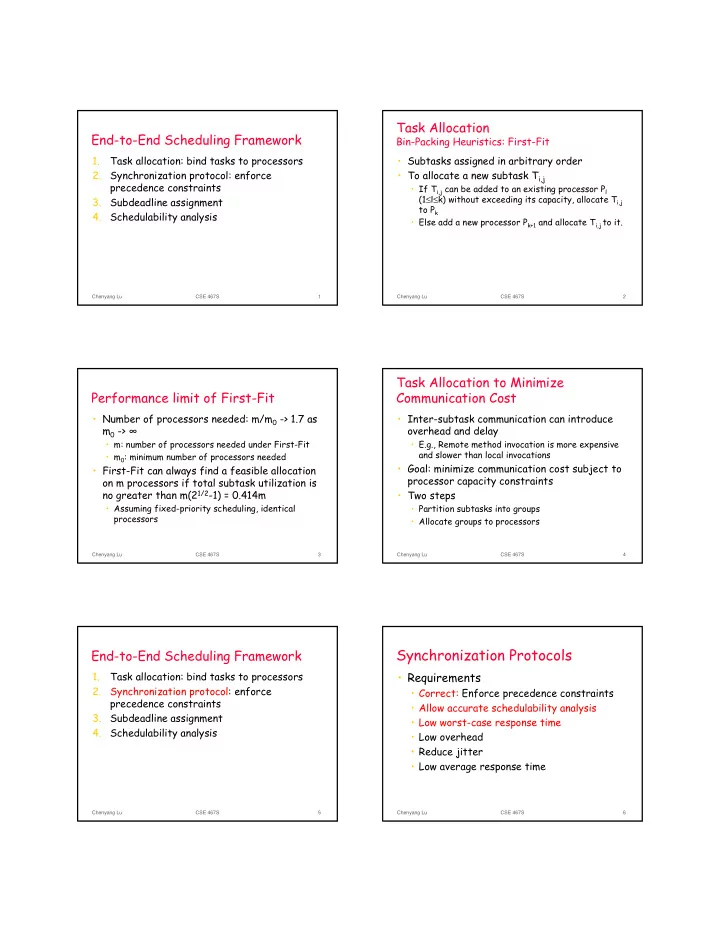
Task Allocation End-to-End Scheduling Framework Bin-Packing Heuristics: First-Fit 1. Task allocation: bind tasks to processors Subtasks assigned in arbitrary order 2. Synchronization protocol: enforce To allocate a new subtask T i,j


slide-1
SLIDE 1

Chenyang Lu CSE 467S 1

End-to-End Scheduling Framework

1. Task allocation: bind tasks to processors 2. Synchronization protocol: enforce precedence constraints 3. Subdeadline assignment 4. Schedulability analysis

Chenyang Lu CSE 467S 2

Task Allocation

Bin-Packing Heuristics: First-Fit

  • Subtasks assigned in arbitrary order
  • To allocate a new subtask Ti,j
  • If Ti,j can be added to an existing processor Pl

(1≤l≤k) without exceeding its capacity, allocate Ti,j to Pk

  • Else add a new processor Pk+1 and allocate Ti,j to it.

Chenyang Lu CSE 467S 3

Performance limit of First-Fit

  • Number of processors needed: m/m0 -> 1.7 as

m0 -> ∞

  • m: number of processors needed under First-Fit
  • m0: minimum number of processors needed
  • First-Fit can always find a feasible allocation
  • n m processors if total subtask utilization is

no greater than m(21/2-1) = 0.414m

  • Assuming fixed-priority scheduling, identical

processors

Chenyang Lu CSE 467S 4

Task Allocation to Minimize Communication Cost

  • Inter-subtask communication can introduce
  • verhead and delay
  • E.g., Remote method invocation is more expensive

and slower than local invocations

  • Goal: minimize communication cost subject to

processor capacity constraints

  • Two steps
  • Partition subtasks into groups
  • Allocate groups to processors

Chenyang Lu CSE 467S 5

End-to-End Scheduling Framework

1. Task allocation: bind tasks to processors 2. Synchronization protocol: enforce precedence constraints 3. Subdeadline assignment 4. Schedulability analysis

Chenyang Lu CSE 467S 6

Synchronization Protocols

  • Requirements
  • Correct: Enforce precedence constraints
  • Allow accurate schedulability analysis
  • Low worst-case response time
  • Low overhead
  • Reduce jitter
  • Low average response time
slide-2
SLIDE 2

Chenyang Lu CSE 467S 7

Greedy Protocol

  • Release job Ji,j;k as soon as Ji,j-1;k is completed
  • Subtasks may not be periodic under a greedy

protocol

  • Difficult for schedulability analysis
  • Higher-priority tasks arrive early high worst-

case response time for lower-priority tasks

  • Jitter can accumulate over multiple hops

Chenyang Lu CSE 467S 8

Critique on Greedy Protocol

  • Correctness
  • Allow schedulability analysis
  • Worst-case response time
  • Overhead
  • Jitter
  • Low average response time

Chenyang Lu CSE 467S 9

Phase-Modification Protocol (PMP)

  • Idea: Enforce periodic release based on worst-case

response time

  • Every job Ji,j;k is released at time
  • si: start time of job Ji,1;1
  • wil: worst case response time of Til
  • Assumptions
  • Require upper bound on the response time of all subtasks
  • Require global clock

− =

+ − +

1 1 ,

) 1 (

j l l i i i

w p k s

Chenyang Lu CSE 467S 10

Critique on PMP

  • Incorrect if tasks have release jitter or
  • verrun
  • Allow schedulability analysis
  • Low worst-case response time
  • Overhead:
  • No explicit synchronization
  • Depend on global clock synchronization
  • Low jitter
  • High average response time

Chenyang Lu CSE 467S 11

Modified PMP

  • Same as PMP except
  • A subtask cannot be released unless its

predecessor has been completed

  • Assumptions
  • Require upper bound on the response time of all

subtasks

  • Require a sync message from predecessor

indicating its predecessor has been completed

  • Does not require global clock synchronization
  • Indicate “ahead time” in sync message

Chenyang Lu CSE 467S 12

Critique on MPMP

  • Correct
  • Allow accurate schedulability analysis
  • Low worst-case response time
  • Overhead
  • require explicit synchronization
  • Does not require global clock sync
  • Low jitter
  • High average response time
slide-3
SLIDE 3

Chenyang Lu CSE 467S 13

Release Guard

  • If processor never idles since last release

time ri,k+1;j-1

  • release Ji,k+1;j either when it receives a sync

message from Ji,k;j or at time ri,k+1;j-1+pi, whichever is later

  • Else:
  • release Ji,k+1;j when receiving a sync message or

when processor becomes idles, whichever is later.

  • Improve average response time without affecting

schedulability at the cost of jitter

Chenyang Lu CSE 467S 14

RG Assumptions

  • Assumptions
  • Does not require upper bound on the response time
  • f all subtasks
  • Does not require global clock synchronization
  • Work best for loosely coupled system!

Chenyang Lu CSE 467S 15

Critique on Release Guard

  • Correct
  • Allow accurate schedulability analysis
  • Low worst-case response time
  • Overhead
  • require explicit synchronization
  • Does not require global clock synchronization
  • Low jitter (if rule 2 is not used)
  • Improved average response time (if rule 2 is

used)

Chenyang Lu CSE 467S 16

Score Board: Sync protocols

H/L L M/H L Y Y RG L H H L Y Y MPMP L H H L Y N PMP H L L H N Y Greedy Jitter Global Info. Avg RT WCRT Sched Correct

  • Use MPMP or RG if
  • Information about all tasks are available a priori
  • System has global clock sync
  • Otherwise only RG can be used

Chenyang Lu CSE 467S 17

Subdeadline assignment

  • Subdeadline priorities under EDF & DM

response times

  • Optimal subdeadline assignment is NP-hard
  • Offline: heuristic search algorithms
  • Online: simpler heuristics

Chenyang Lu CSE 467S 18

Subdeadline Assignment Heuristics

  • Notations
  • (Relative) deadline di of task Ti
  • (Relative) subdeadline dij of subtask Tij (1 ≤ j ≤ n(i))
  • Slack of subtask Tij: sij = dij - eij
  • Ultimate Deadline (UD): dij = di
  • But some subtasks must finish earlier than the end-to-end

deadline!

  • Effective Deadline (ED):
  • Assign all slack to 1st subtask

∑ ∑

+ = − =

− − =

) ( 1 1 1 i n j k ik j k ik i ij

e d d d

slide-4
SLIDE 4

Chenyang Lu CSE 467S 19

More Heuristics

  • Proportional Deadline (PD):
  • Assign slack proportionally to execution time
  • Normalized Proportional Deadline
  • Assign more slack to subtasks on busier processors

∑ =

=

) ( 1 i n k ik ij i ij

e e d d

∑ =

=

) ( 1 , ,

)) ( ( ) (

i n k k i ik j i ij i ij

V u e V u e d d

Chenyang Lu CSE 467S 20

Scheduling

  • Single processor
  • Periodic tasks
  • Fixed priority vs. dynamic priority
  • Deadline vs. period
  • Resource contention
  • Aperiodic + periodic tasks
  • Distributed systems

Chenyang Lu CSE 467S 21

Scheduling Aperiodic Tasks

  • Hybrid task set: periodic tasks + aperiodic tasks
  • Problem: Arrival time is unknown
  • Sporadic task with a hard deadline
  • Inter-arrival time must be lower bounded
  • Schedulability analysis: treated as a periodic task with

period = minimum inter-arrival time

  • Aperiodic task with a soft deadline
  • Possibly unbounded inter-arrival time
  • Goals:
  • maintain hard guarantees on periodic tasks
  • Reduce response time of aperiodic tasks

Chenyang Lu CSE 467S 22

Background Scheduling

  • Treat aperiodic tasks as lowest-priority tasks
  • Advantages
  • Simple
  • Aperiodic tasks has no impact on the

schedulability of periodic tasks

  • Disadvantage
  • Aperiodic tasks have very long response times

when the utilization of periodic tasks is high

  • Acceptable only if
  • System is not busy
  • Aperiodic tasks can tolerate long delays

Chenyang Lu CSE 467S 23

Polling Server

  • Polling server (PS): a periodic task used to

serve aperiodic requests

  • Period: ps
  • Capacity: cs
  • Rules
  • Released periodically with period ps
  • Serves any pending aperiodic requests
  • Suspends itself if
  • it has used up its capacity, or
  • no aperiodic request is pending
  • Server capacity is replenished to cs in the next

period

Chenyang Lu CSE 467S 24

Schedulability

  • The aperiodic requests have the same impact
  • n periodic tasks as a periodic task.
  • n tasks with m PS’: Up + Us ≤ Ub(n+m)
  • Can have multiple PS’ (with different periods)

for different aperiodic requests

  • Disadvantage: If an aperiodic request

“misses” the execution of PS, it has to wait till the next period long response time.

slide-5
SLIDE 5

Chenyang Lu CSE 467S 25

Deferrable Server (DS)

  • Unlike PS, DS preserves unused capacity until the end
  • f the current period
  • Better response to aperiodic requests
  • However, DS’ impact on periodic tasks is different

from an periodic task

Chenyang Lu CSE 467S 26

Utilization Bound with DS

  • Under RMS
  • As n ∞:
  • When Us = 0.186, min Ub = 0.652
  • System is schedulable if

⎥ ⎥ ⎦ ⎤ ⎢ ⎢ ⎣ ⎡ − ⎟ ⎟ ⎠ ⎞ ⎜ ⎜ ⎝ ⎛ + + + = 1 1 2 2

/ 1 n s s s b

U U n U U ⎟ ⎟ ⎠ ⎞ ⎜ ⎜ ⎝ ⎛ + + + = 1 2 2 ln

s s s b

U U U U ⎟ ⎟ ⎠ ⎞ ⎜ ⎜ ⎝ ⎛ + + ≤ 1 2 2 ln

s s p

U U U

Chenyang Lu CSE 467S 27

Pointers

  • Class hand-out
  • Rate Monotonic
  • A Practitioner's Handbook for Real-Time Analysis:

Guide to Rate Monotonic Analysis for Real-Time Systems, Klein et. al.

  • EDF
  • Deadline Scheduling for Real-Time Systems: EDF

and Related Algorithms, Stankovic et. al.

  • General
  • Hard Real-Time Computing Systems, G. Buttazzo.
  • Real-Time Systems, Jane Liu.