SLIDE 1 Symmetries in trees
McGill University, September 2013 Olivier Bernardi (Brandeis University)
First part is joint work with Alejandro Morales (UQAM)
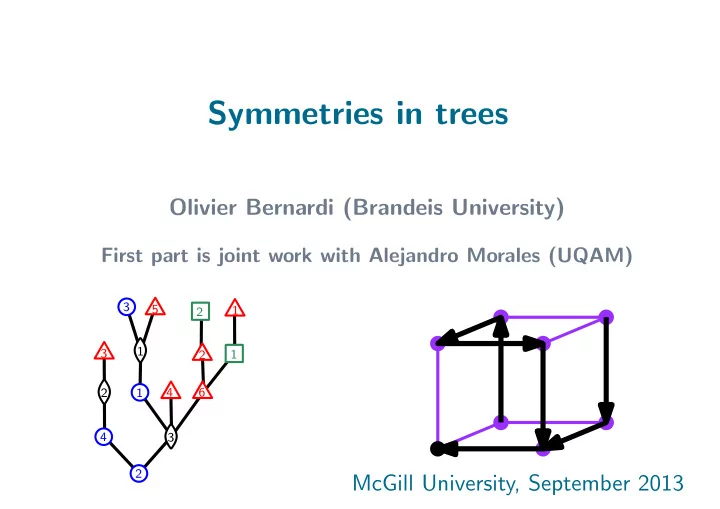
1 2 3 2 5 4 2 3 3 4 6 1 1 1 2
SLIDE 2
Part I Multitype Cayley trees
SLIDE 3
Cayley trees A tree is a connected acyclic graph. A Cayley tree of size n is a tree with vertex set [n] := {1, 2, . . . , n}. 1 8 6 3 2 4 5 7
SLIDE 4
Cayley trees A tree is a connected acyclic graph. A Cayley tree of size n is a tree with vertex set [n] := {1, 2, . . . , n}. Theorem [Sylvester 1857]. The number of Cayley trees of size n is nn−2.
SLIDE 5 Cayley trees A tree is a connected acyclic graph. A Cayley tree of size n is a tree with vertex set [n] := {1, 2, . . . , n}. Theorem [Sylvester 1857]. The number of Cayley trees of size n is nn−2.
1 3 2 4 3 3 3 3 3 3 3 3 2 3 1 4 2 4 1 3 2 3 1 4 3 1 2 4 4 3 2 1 3 3 3 3 3 3 3 3 3 2 1 4 3 4 1 2 3 3 3 3 3 3 3 3 4 2 1 3 4 3 1 2 3 3 3 3 3 3 3 3 1 3 2 4 1 4 2 3
- Example. There are 16 Cayley trees of size n = 4.
3 3 3 3 3 3 3 3 1 2 3 4 1 4 3 2 3 3 3 3 3 3 3 3 1 2 4 3 1 3 4 2
SLIDE 6
Multitype Cayley trees A multitype Cayley tree of size (n1, . . . , nd) is a tree with vertex set V = {(t, i), t ∈ [d], i ∈ [nt]} .
SLIDE 7
Multitype Cayley trees A multitype Cayley tree of size (n1, . . . , nd) is a tree with vertex set V = {(t, i), t ∈ [d], i ∈ [nt]} . type 1
1 2 3 2 5 4 2 3 3 4 6
root vertex type 2 type 3
1 1
type 4
1 2
size = (4, 3, 6, 2) vertex (3, 6)
SLIDE 8 Multitype Cayley trees A multitype Cayley tree of size (n1, . . . , nd) is a tree with vertex set V = {(t, i), t ∈ [d], i ∈ [nt]} . Theorem [Knuth 68, Bousquet-M´ elou, Chapuy 12]. The number
- f multitype Cayley trees of size (n1, . . . , nd) with root-vertex of type
ρ such that the type of adjacent vertices differ by ±1 is nρ n1nd
d
ni (ni−1 + ni+1)ni−1, with n0 = nd+1 = 0.
type 1 1 2 3 2 5 4 2 3 3 4 6 root vertex type 2 type 3 1 1 type 4 3 2 1 4
SLIDE 9 Warm up: counting Cayley trees by degrees Theorem [Cayley 1889]: The generating function of Cayley trees of size n counted according to their degrees is
xdeg(1)
1
xdeg(2)
2
· · · xdeg(n)
n
= x1x2 · · · xn(x1 + x2 + . . . + xn)n−2.
SLIDE 10 Warm up: counting Cayley trees by degrees Theorem [Cayley 1889]: The generating function of Cayley trees of size n counted according to their degrees is
xdeg(1)
1
xdeg(2)
2
· · · xdeg(n)
n
= x1x2 · · · xn(x1 + x2 + . . . + xn)n−2. Known proofs: Recurrences, matrix-tree theorem, Prufer’s code, Joyal’s endofunction approach, Pitman’s double counting argument.
SLIDE 11 Warm up: counting Cayley trees by degrees For α = (α1, . . . , αn) we denote by Tα the set of Cayley trees of size n where vertex i has degree αi. We must take α1, . . . , αn > 0 such that
αi = 2n − 2.
SLIDE 12 Warm up: counting Cayley trees by degrees For α = (α1, . . . , αn) we denote by Tα the set of Cayley trees of size n where vertex i has degree αi.
- Claim. If βi = αi − 1, βj = αj + 1 and βk = αk for k = i, j, then
(αi − 1)|Tα| = (βj − 1)|Tβ|.
SLIDE 13 Warm up: counting Cayley trees by degrees For α = (α1, . . . , αn) we denote by Tα the set of Cayley trees of size n where vertex i has degree αi. Proof.
- Claim. If βi = αi − 1, βj = αj + 1 and βk = αk for k = i, j, then
(αi − 1)|Tα| = (βj − 1)|Tβ|. i i j j bijection
Tree in Tα with a marked edge incident to i not on the path i j. Tree in Tβ with a marked edge incident to j not on the path i j.
SLIDE 14 Warm up: counting Cayley trees by degrees For α = (α1, . . . , αn) we denote by Tα the set of Cayley trees of size n where vertex i has degree αi.
- Claim. If βi = αi − 1, βj = αj + 1 and βk = αk for k = i, j, then
(αi − 1)|Tα| = (βj − 1)|Tβ|.
(n−2)! (α1−1)!···(αn−1)!|T(n−1,1,1,...,1)| =
α1−1,...,αn−1
1
SLIDE 15 Warm up: counting Cayley trees by degrees For α = (α1, . . . , αn) we denote by Tα the set of Cayley trees of size n where vertex i has degree αi.
- Claim. If βi = αi − 1, βj = αj + 1 and βk = αk for k = i, j, then
(αi − 1)|Tα| = (βj − 1)|Tβ|.
(n−2)! (α1−1)!···(αn−1)!|T(n−1,1,1,...,1)| =
α1−1,...,αn−1
Hence,
xdeg(1)
1
xdeg(2)
2
· · · xdeg(n)
n
= x1x2 · · · xn(x1 + x2 + . . . + xn)n−2.
SLIDE 16 Warm up: counting Cayley trees by degrees For α = (α1, . . . , αn) we denote by Tα the set of Cayley trees of size n where vertex i has degree αi.
- Claim. If βi = αi − 1, βj = αj + 1 and βk = αk for k = i, j, then
(αi − 1)|Tα| = (βj − 1)|Tβ|.
(n−2)! (α1−1)!···(αn−1)!|T(n−1,1,1,...,1)| =
α1−1,...,αn−1
Hence,
xdeg(1)
1
xdeg(2)
2
· · · xdeg(n)
n
= x1x2 · · · xn(x1 + x2 + . . . + xn)n−2. Rooted version:
xch(1)
1
xch(2)
2
. . . xch(n)
n
= (x1 + x2 + · · · + xn)n−1, where ch(i) is the number of children of vertex i.
SLIDE 17
Main result Let n = (n1, . . . , nd) be a tuple of positive integers. Let Tρ(n) be the set of multitype Cayley trees of size n, and root-type ρ.
SLIDE 18 Main result Let n = (n1, . . . , nd) be a tuple of positive integers. Let Tρ(n) be the set of multitype Cayley trees of size n, and root-type ρ.
1 2 3 2 5 4 2 3 3 4 6 root vertex 1 1 1 2
Vertex (t, i) = (2, 3) gives weight x1,2,3 x2
3,2,3.
where chs(t, i)= number of children of type s of the vertex (t, i). The weight of a tree T is w(T) =
xchs(t,i)
s,t,i
,
SLIDE 19 Main result Let n = (n1, . . . , nd) be a tuple of positive integers. Let Tρ(n) be the set of multitype Cayley trees of size n, and root-type ρ. Theorem [B., Morales].
w(T) =
d
d
nt
xs,t,i
1
×
d,ρ
nt
xs,t,i
.
Cayley trees with vertex-set [d] and root-vertex ρ.
The weight of a tree T is w(T) =
xchs(t,i)
s,t,i
.
SLIDE 20 Main result Let n = (n1, . . . , nd) be a tuple of positive integers. Let Tρ(n) be the set of multitype Cayley trees of size n, and root-type ρ. Theorem [B., Morales].
w(T) =
d
d
nt
xs,t,i
1
×
d,ρ
nt
xs,t,i
. Lρ = (Ls,t)s,t∈[d]\{ρ}, with
= −
i∈[nt] xs,t,i if s = t
Ls,s =
The weight of a tree T is w(T) =
xchs(t,i)
s,t,i
. det(Lρ)
SLIDE 21 Main result The weight of a tree T is w(T) =
xchs(t,i)
s,t,i
. Theorem [B., Morales].
w(T) =
d
d
nt
xs,t,i
1
×
d,ρ
nt
xs,t,i
. Example: Spanning trees of Km,n rooted on a black vertex. Set d = 2, ρ = 1, n1 = m, n2 = n, x1,1,i = x2,2,j = 0. Denote x2,1,i = xi, x1,2,j = yj.
xch(bi)
i
y
ch(wj) j
= (x1 + · · · + xm)n(y1 + · · · + yn)m−1.
SLIDE 22 Sketch of proof. For α = (αs,t,i)s,t∈[d],i∈[nd] we denote by Tα the set of Cayley trees such that vertex (t, i) has αs,t,i children of type s.
- Claim. If βs,t,i = αs,t,i − 1 and βs,t,j = αs,t,j + 1 but everything else
is the same, then αs,t,i|Tα| = βs,t,j|Tβ|.
SLIDE 23 Sketch of proof. For α = (αs,t,i)s,t∈[d],i∈[nd] we denote by Tα the set of Cayley trees such that vertex (t, i) has αs,t,i children of type s. Proof.
- Claim. If βs,t,i = αs,t,i − 1 and βs,t,j = αs,t,j + 1 but everything else
is the same, then αs,t,i|Tα| = βs,t,j|Tβ|.
vertex (t, i) vertex (t, j) root-vertex vertex (t, i) vertex (t, j) root-vertex vertex (t, j) vertex (t, i) (a) (b)
vertex (t, i) vertex (t, j) root-vertex root-vertex
SLIDE 24 Sketch of proof. For α = (αs,t,i)s,t∈[d],i∈[nd] we denote by Tα the set of Cayley trees such that vertex (t, i) has αs,t,i children of type s.
- Claim. If βs,t,i = αs,t,i − 1 and βs,t,j = αs,t,j + 1 but everything else
is the same, then αs,t,i|Tα| = βs,t,j|Tβ|. Corollary: It suffices to count trees in which vertices not labelled 1 are leaves (the “star-trees”).
SLIDE 25 Sketch of proof. For α = (αs,t,i)s,t∈[d],i∈[nd] we denote by Tα the set of Cayley trees such that vertex (t, i) has αs,t,i children of type s.
- Claim. If βs,t,i = αs,t,i − 1 and βs,t,j = αs,t,j + 1 but everything else
is the same, then αs,t,i|Tα| = βs,t,j|Tβ|. Corollary: It suffices to count trees in which vertices not labelled 1 are leaves (the “star-trees”).
xchs(t,i)
s,t,i
=
nt
xs,t,i
.
SLIDE 26 Sketch of proof. For α = (αs,t,i)s,t∈[d],i∈[nd] we denote by Tα the set of Cayley trees such that vertex (t, i) has αs,t,i children of type s.
- Claim. If βs,t,i = αs,t,i − 1 and βs,t,j = αs,t,j + 1 but everything else
is the same, then αs,t,i|Tα| = βs,t,j|Tβ|. Corollary: It suffices to count trees in which vertices not labelled 1 are leaves (the “star-trees”).
xchs(t,i)
s,t,i
=
nt
xs,t,i
.
Moreover, star-trees are easy to count:
ychs(t,1)
s,t
=
d,ρ
ys,t ×
d
d
ys,t
.
Adding the leaves Choosing subtree made of the d vertices labeled 1
SLIDE 27 Application 1: counting trees by edge type Thm [Bousquet, Chauve, Labelle, Leroux 03]. Let n = (n1, . . . , nd) be positive integers. The number of trees in Tρ(n) with ms,t edges of type (s, t) is
(ns − 1)!
nms,t
t
ms,t!
d,ρ
ms,t.
SLIDE 28 Application 1: counting trees by edge type Thm [Bousquet, Chauve, Labelle, Leroux 03]. Let n = (n1, . . . , nd) be positive integers. The number of trees in Tρ(n) with ms,t edges of type (s, t) is
(ns − 1)!
nms,t
t
ms,t!
d,ρ
ms,t. Proof: Set xs,t,i = xs,t in the main formula
w(T) =
d
d
nt
xs,t,i
1
×
d,ρ
nt
xs,t,i
and extract the coefficient of the monomial xmx,t
s,t .
SLIDE 29 Application 2: counting embedded trees Thm [Knuth 68]. Let n = (n1, . . . , nd) be positive integers. Let D ⊂ [d]2. The number of trees in Tρ(n) with edge-type in D is
d
(s,t)∈D
nt
ns−1
d,ρ A⊂D
nt
SLIDE 30 Application 2: counting embedded trees Thm [Knuth 68]. Let n = (n1, . . . , nd) be positive integers. Let D ⊂ [d]2. The number of trees in Tρ(n) with edge-type in D is
d
(s,t)∈D
nt
ns−1
d,ρ A⊂D
nt
- Proof. Set xs,t,i =
- 1 if (s, t) ∈ D,
0 otherwise in the main formula
w(T) =
d
d
nt
xs,t,i
1
×
d,ρ
nt
xs,t,i
.
SLIDE 31 Application 2: counting embedded trees Thm [Knuth 68]. Let n = (n1, . . . , nd) be positive integers. Let D ⊂ [d]2. The number of trees in Tρ(n) with edge-type in D is
d
(s,t)∈D
nt
ns−1
d,ρ A⊂D
nt Corollary [Bousquet-M´ elou, Chapuy 12]. The number of trees in Tρ(n) such that the type of adjacent vertices differ by ±1 is nρ n1nd
d
ni (ni−1 + ni+1)ni−1.
SLIDE 32 Application 3: injective trees and profile A tree is injective if each vertex has at most one vertex of each type. Thm [B., Morales]. Let n = (n1, . . . , nd) be positive integers. Let D ⊂ [d]2. The number of injective trees in Tρ(n) with edge-type in D is
d
δs,ρ − 1 +
(s,t)∈D nt
ns − 1
d,ρ A⊂D
nt.
SLIDE 33 Application 3: injective trees and profile A tree is injective if each vertex has at most one vertex of each type.
- Proof. Set xs,t,i = 0 if (s, t) /
∈ D in the main formula
w(T) =
d
d
nt
xs,t,i
1
×
d,ρ
nt
xs,t,i
. and extract coefficient. Thm [B., Morales]. Let n = (n1, . . . , nd) be positive integers. Let D ⊂ [d]2. The number of injective trees in Tρ(n) with edge-type in D is
d
δs,ρ − 1 +
(s,t)∈D nt
ns − 1
d,ρ A⊂D
nt.
SLIDE 34 Application 3: injective trees and profile Corollary [Bousquet-M´ elou, Chapuy 12]. Let a, b ≥ 0 and n = (n−a, n−a+1, . . . , nb−1, nb) be a tuple of positive numbers. The number of binary trees having shadow n is n0 n−anb
b
δs,0 − 1 + ns−1 + ns+1 ns − 1
1 1 3 4 3 2
SLIDE 35 Application 3: injective trees and profile Corollary [Bousquet-M´ elou, Chapuy 12]. Let a, b ≥ 0 and n = (n−a, n−a+1, . . . , nb−1, nb) be a tuple of positive numbers. The number of binary trees having shadow n is n0 n−anb
b
δs,0 − 1 + ns−1 + ns+1 ns − 1
1 1 3 4 3 2 (The shadow of trees is related to the Integrated SuperBrownian Excursion)
SLIDE 36 Application 4: complete degree distributions
type 1 1 2 3 2 5 4 2 3 3 4 6 root vertex type 2 type 3 1 1 type 4 1 2
The indegree of a vertex is the tuple c = (c1, . . . , cd), where cs is the number of children of type s.
Indegree c = (1, 0, 2, 0)
SLIDE 37 Application 4: complete degree distributions Thm [B., Morales]. Let n = (n1, . . . , nd) be positive integers. The number of trees in Tρ(n) with Nt,c vertices of type t and indegree c is
nt!(nt − 1)!
c!Nt,cNt,c! ×
d,ρ
ms,t. where ms,t =
csNt,c = number of edges of type (s, t). The indegree of a vertex is the tuple c = (c1, . . . , cd), where cs is the number of children of type s.
SLIDE 38 Application 4: complete degree distributions The indegree of a vertex is the tuple c = (c1, . . . , cd), where cs is the number of children of type s. Thm [B., Morales]. Let n = (n1, . . . , nd) be positive integers. The number of trees in Tρ(n) with Nt,u,c vertices of type t with parent
- f type u and indegree c is
- t∈[d]
nt!
(ms,t − 1)!
c!Nt,u,cNt,u,c! ×
ms,t,u, where ms,t= number of edges of type (s, t), and ms,t,u= number of 2-paths of type (s, t, u).
spanning tree of the line graph L(Kd)
SLIDE 39 Application 5. Multivariate Lagrange inversion formula Thm [Bender, Richmond 98]. Let G1, . . . , Gd+1, be power series in d variables with non-zero constant terms. The unique tuple (f1, . . . , fd) of power series in x1, . . . , xd satisfying ∀t ∈ [d], ft = xtGt(f1, .., fd) have coefficients given by [xn]Gd+1(f1, .., fd) = [xn]
d
xi ni
d + 1,ρ
d+1
(s,t)∈A
∂ ∂xs Gt(x)nt.
SLIDE 40
Part II Spanning trees of the hypercube
SLIDE 41
Hypercube The hypercube of dimension n is the graph with vertex set {0, 1}n and edges between vertices differing on one coordinate. Ceci est un hypercube de dimension 3. (1,0,0) (0,0,0) (0,0,0) (0,1,0) (1,1,0) (1,1,1) (0,1,1) (0,0,1) (1,0,1)
SLIDE 42 Counting spanning trees
- Theorem. The number of spanning trees of the n-hypercube is
2−n
v=(0,0,..,0)
2|v|. 1, 4, 384, 42467328, 20776019874734407680, . . .
SLIDE 43 Counting spanning trees
- Theorem. The number of rooted spanning trees of the hypercube is
- v∈{0,1}n
v=(0,0,..,0)
2|v|.
SLIDE 44 Counting spanning trees
- Theorem. The number of rooted spanning trees of the hypercube is
- v∈{0,1}n
v=(0,0,..,0)
2|v|.
SLIDE 45
Counting spanning trees An arc (u, v) has direction i ∈ [n] and spin ǫ ∈ {0, 1} if v is obtained from u by changing the ith coordinate into ǫ.
(1,0,0) (0,0,0) (0,0,0) (0,1,0) (1,1,0) (1,1,1) (0,1,1) (0,0,1) (1,0,1)
direction 3 spin 0.
SLIDE 46 Counting spanning trees An arc (u, v) has direction i ∈ [n] and spin ǫ ∈ {0, 1} if v is obtained from u by changing the ith coordinate into ǫ.
(1,0,0) (0,0,0) (0,0,0) (0,1,0) (1,1,0) (1,1,1) (0,1,1) (0,0,1) (1,0,1)
x3,0 The weight of a rooted tree T is w(T) =
xdir(a),spin(a). w(T) = x1,0 x1,1 x2
2,0 x2 3,0 x3,1
SLIDE 47 Counting spanning trees Theorem [⇔ Martin, Reiner 03.]. The total weight of the rooted spanning trees of the hypercube is
v=(0,0,...,0)
i, vi=1
xi,0 + xi,1 .
SLIDE 48 Counting spanning trees Theorem [⇔ Martin, Reiner 03.]. The total weight of the rooted spanning trees of the hypercube is
v=(0,0,...,0)
i, vi=1
xi,0 + xi,1 . (x1,0 + x1,1)(x2,0 + x2,1)(x1,0 + x1,1 + x2,0 + x2,1)
SLIDE 49 Counting spanning trees Theorem [⇔ Martin, Reiner 03.]. The total weight of the rooted spanning trees of the hypercube is
v=(0,0,...,0)
i, vi=1
xi,0 + xi,1 .
- Proof. Use the matrix-tree theorem (for weighted directed graphs):
Total weight of rooted spanning trees =
λ=0 λ,
where the λ’s are the eigenvalues of the Laplacian L = (Lu,v)u,v∈V , defined by Lu,v = −w(u, v) , and Lu,u =
v w(u, v).
SLIDE 50 Counting spanning trees Theorem [⇔ Martin, Reiner 03.]. The total weight of the rooted spanning trees of the hypercube is
v=(0,0,...,0)
i, vi=1
xi,0 + xi,1 .
- Proof. Use the matrix-tree theorem (for weighted directed graphs):
Total weight of rooted spanning trees =
λ=0 λ,
where the λ’s are the eigenvalues of the Laplacian L = (Lu,v)u,v∈V , defined by Lu,v = −w(u, v) , and Lu,u =
v w(u, v).
Compute the eigenvalues of L: use either representation theory of abelian groups, or induction.
SLIDE 51 Counting spanning trees Theorem [⇔ Martin, Reiner 03.]. The total weight of the rooted spanning trees of the hypercube is
v=(0,0,...,0)
i, vi=1
xi,0 + xi,1 . Combinatorial proof?
SLIDE 52 An easy special case
v=(0,0,...,0)
i, vi=1
xi,0 + xi,1 .
(1, 1, 1) (0, 0, 0)
Proof.
- Claim. The special case xi,1 = 0 holds.
SLIDE 53 An easy special case
v=(0,0,...,0)
i, vi=1
xi,0 + xi,1 .
(1, 1, 1) (0, 0, 0)
Proof.
v = (1, 1, 0)
v=(0,0,...,0)
i,vi=1
xi,0 x1,0 + x2,0
- Claim. The special case xi,1 = 0 holds.
SLIDE 54
The key property: independence of spins. Thm [B.]. Let S = {s1, . . . , sk} be a subset of edges in direction n. Let T be a uniformly random spanning tree conditioned to contain exactly these edges in direction n.
(1,0,0) (0,0,0) (0,0,0) (0,1,0) (1,1,0) (1,1,1) (0,1,1) (0,0,1) (1,0,1)
SLIDE 55
The key property: independence of spins. Thm [B.]. Let S = {s1, . . . , sk} be a subset of edges in direction n. Let T be a uniformly random spanning tree conditioned to contain exactly these edges in direction n. Then the spins of the edges s1, . . . , sk are uniformly random and independent. Example.
SLIDE 56
The key property: independence of spins. Thm [B.]. Let S = {s1, . . . , sk} be a subset of edges in direction n. Let T be a uniformly random spanning tree conditioned to contain exactly these edges in direction n. Then the spins of the edges s1, . . . , sk are uniformly random and independent. Example. This remains true if one further conditions on the number ni,ǫ of edges with direction i and spin ǫ, for i ∈ [n − 1], ǫ ∈ {0, 1}. n1,0 = 1, n1,1 = 0
SLIDE 57 The key property: independence of spins. Thm [B.]. Let S = {s1, . . . , sk} be a subset of edges in direction n. Let T be a uniformly random spanning tree conditioned to contain exactly these edges in direction n. Then the spins of the edges s1, . . . , sk are uniformly random and independent. This remains true if one further conditions on the number ni,ǫ of edges with direction i and spin ǫ, for i ∈ [n − 1], ǫ ∈ {0, 1}. This explains why xn,0 and xn,1 always appear together in the formula
v=(0,0,...,0)
i, vi=1
xi,0 + xi,1 . More precisely, it proves that changing the variables xn,0 and xn,1 respectively into xn,0 + xn,1 and 0 does not change the total weight. ⇒ Formula follows from independence of spins + special case.
SLIDE 58
Independence of spins in bunkbed graphs Example. A bunkbed graph is a graph of the form G × K2. G G × K2
SLIDE 59 Independence of spins in bunkbed graphs Example. A bunkbed graph is a graph of the form G × K2. G G × K2
- Remark. The hypercube is a bunkbed graph: Hn = K2 × · · · × K2.
SLIDE 60 Independence of spins in bunkbed graphs A bunkbed graph is a graph of the form G × K2. Projection: 1 1 1 2 1 Example. The projection of a tree T of G × K2 specifies:
- which vertical edges are used,
- for each arc a of G, the number of a-arcs in T.
SLIDE 61 Independence of spins in bunkbed graphs A bunkbed graph is a graph of the form G × K2. The projection of a tree T of G × K2 specifies:
- which vertical edges are used,
- for each arc a of G, the number of a-arcs in T.
Theorem [B.] Let T be a uniformly random rooted spanning tree of G × K2, conditioned to have a given projection. Then, the spins of the vertical edges are uniformly random and independent.
SLIDE 62
Proof. Induction on # vertices of G. Claim: there is a vertex v of G such that either (1) indegree(v) = 0 in the projection, or (2) indegree(v) = 1 in the projection and there is no vertical edge at v. 1 1 1 2 1
SLIDE 63
Proof. Induction on # vertices of G. Claim: there is a vertex v of G such that either (1) indegree(v) = 0 in the projection, or (2) indegree(v) = 1 in the projection and there is no vertical edge at v. Case (1). G′ = G − v. 1 1 1 2 1 1 1 2
2-to-1 correspondence (a) No vertical edge at v. v
SLIDE 64
Proof. Induction on # vertices of G. Claim: there is a vertex v of G such that either (1) indegree(v) = 0 in the projection, or (2) indegree(v) = 1 in the projection and there is no vertical edge at v. Case (1). G′ = G − v. 1 1 1 2 1 1 1 2
2-to-1 correspondence (a) No vertical edge at v. v
SLIDE 65
Proof. Induction on # vertices of G. Claim: there is a vertex v of G such that either (1) indegree(v) = 0 in the projection, or (2) indegree(v) = 1 in the projection and there is no vertical edge at v. Case (1). G′ = G − v.
(a) No vertical edge at v. (b) A vertical edge at v.
1 1 1 2 1
2-to-1 correspondence v
1 1 2 1
SLIDE 66
Proof. Induction on # vertices of G. Claim: there is a vertex v of G such that either (1) indegree(v) = 0 in the projection, or (2) indegree(v) = 1 in the projection and there is no vertical edge at v. Case (1). G′ = G − v. Case (2). G′ = G − v + e.
1-to-1 correspondence
1 1 1 1 1 1
v
1 1 1 1 1 1 1 1
e e
+
SLIDE 67
Proof. Induction on # vertices of G. Claim: there is a vertex v of G such that either (1) indegree(v) = 0 in the projection, or (2) indegree(v) = 1 in the projection and there is no vertical edge at v. Case (1). G′ = G − v. Case (2). G′ = G − v + e.
1-to-1 correspondence
1 1 1 1 1 1
v
1 1 1 1 1 1 1 1
e e
+
SLIDE 68
Independence of spins and tree weights Theorem [B.] Let T be a uniformly random rooted spanning tree of G × K2, conditioned to have a given projection. Then, the spins of the vertical edges are uniformly random and independent. Corollary If wG(x0, x1) is the total weight of the rooted spanning trees of G × K2 then wG(x0, x1) = wG(x0 + x1, 0).
SLIDE 69 Independence of spins and tree weights Theorem [B.] Let T be a uniformly random rooted spanning tree of G × K2, conditioned to have a given projection. Then, the spins of the vertical edges are uniformly random and independent. Corollary. wHn =
v=(0,0,...,0)
i, vi=1
xi,0 + xi,1 . Corollary If wG(x0, x1) is the total weight of the rooted spanning trees of G × K2 then wG(x0, x1) = wG(x0 + x1, 0).
SLIDE 70 Additional results
- Independence of spins also holds for rooted forests of G × K2.
Theorem [B.]. The total weight of the rooted forests of the hypercube (with weight t by tree) is
t +
xi,0 + xi,1 .
SLIDE 71 Additional results
- Independence of spins also holds for strong product G ⊠ K2.
G G ⊠ K2
- Independence of spins also holds for rooted forests of G × K2.
SLIDE 72 Additional results
- Independence of spins also holds for strong product G ⊠ K2.
- Another combinatorial proof of the hypercube formula.
Equivalently: for all v ∈ {0, 1}, FHn −
xi,0 + xi,1 = 0. We want to prove FHn(t) =
t +
xi,0 + xi,1 . Use a sign reversing involution.
forest enumerator
- Independence of spins also holds for rooted forests of G × K2.
SLIDE 73 Additional results
- Independence of spins also holds for strong product G ⊠ K2.
- Another combinatorial proof of the hypercube formula.
⇒ Formula for hypercube with main diagonals. FDn(x, y; t) =
t + 2y · 1|v| odd +
xi,0 + xi,1
- Independence of spins also holds for rooted forests of G × K2.
SLIDE 74
Conjecture Using the matrix-tree theorem one gets: FG×Kp(t) = FG(t) · FG(t + x1 + x2 . . . + xp)p−1. Conjecture. If T is a uniformly random spanning tree of G × Kp conditioned to a have a certain projection, then the weight of the subforests in the copies of Kp are independent. 2 2 3 1 1
1 1 2 1 Projection of G × K3
SLIDE 75 Thanks.
1 2 3 2 5 4 2 3 3 4 6 1 1 1 2