
SLIDE 1
1
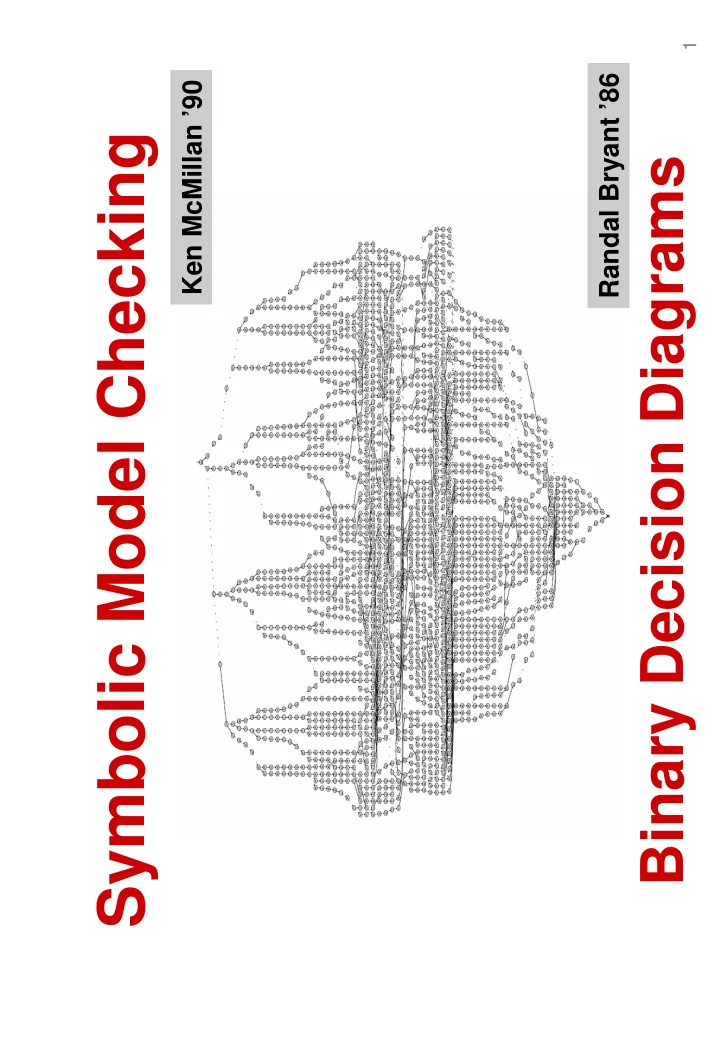
Binary Decision Diagrams
Randal Bryant ’86
Symbolic Model Checking
Ken McMillan ’90
Symbolic Model Checking Binary Decision Diagrams 2 Combinatorial - - PDF document
1 Randal Bryant 86 Ken McMillan 90 Symbolic Model Checking Binary Decision Diagrams 2 Combinatorial Circuits 3 Eight Queen Combinatorial Problems Sudoku Control Programs A Train Simulator, visualSTATE (VVS) 1421 machines 11102
1
Randal Bryant ’86
Ken McMillan ’90
2
3
Sudoku Eight Queen
4
1421 machines 11102 transitions 2981 inputs 2667 outputs 3204 local states Declare state sp.: 10^ 476
“ I d e a l ” p r e s e n t a t i
: 1 b i t / s t a t e w i l l c l e a r l y N O T w
k !
5
6
A short review
7
8
9
Variable is set to 0 Variable is set to 1 Each path determines a partial (set of) truth assignments. Result of the boolean expression under the given assigment found in value of terminal.
10
11
12
13
Edges to 0 implicit
14
15
16
17
18
19
20
21
22
1 2 3 4
23
1 2 3 4
1 2 3 4 1 2 3 4
24
1 2 3 4
1 2 3 4 1 2 3 4
25
1 2 3 4 1 2 3 4
1 2 3 4
1 2 3 4 1 2 3 4
26
27
Trans(x1,x2,y1,y2):= !x1 & !x2 & !y1 & y2 + !x1 & !x2 & y1 & y2 + x1 & !x2 & !y1 & y2 + x1 & !x2 & y1 & y2 + x1 & x2 & y1 & !y2;
28
Trans(x1,x2,y1,y2):= !x1 & !x2 & !y1 & y2 + !x1 & !x2 & y1 & y2 + x1 & !x2 & !y1 & y2 + x1 & !x2 & y1 & y2 + x1 & x2 & y1 & !y2;
29
00 10 01 11 00 10 01 11
Trans(x,y,u,v) =
+ (BTrans(u,v) & y=x)
ATrans(x,y) BTrans(u,v)
Trans(x,y,u,v) =
30
23 nodes x1,x2,y1,y2,u1,u2,v1,v2 45 nodes x1,x2,u1,u2, y1,y2 ,v1,v2 20 nodes x1,y1,x2,y2,u1,v1,u2,v2
Polynomial size BDDs guaranteed in size of argument BDDs [Enders,Filkorn, Taubner’91]
31
Reach1 Reach1
Reach(x) := Init(x); REPEAT Old(x) := Reach(x); New(y) := Exists x.(Reach(x) & Trans(x,y)); Reach(x) := Old(x) + New(x) UNTIL Old(x) = Reach(x)
00 10 01 11 Reach0 Reach2 Relational Product: May be constructed without building intermediate (often large) &-BDD.
32
P1 :: while True do T1 : wait(turn=1) C1 : turn:=0 endwhile || P2 :: while True do T2 : wait(turn=0) C2 : turn:=1 endwhile P1 :: while True do T1 : wait(turn=1) C1 : turn:=0 endwhile || P2 :: while True do T2 : wait(turn=0) C2 : turn:=1 endwhile Mutual Exclusion Program
33
I 1 I 2 t= 0 T1 I 2 t= 0 T1 T2 t= 0 I 1 T2 t= 0 I 1 C2 t= 0 T1 C2 t= 0 C1 I 2 t= 1 T1 T2 t= 1 C1 T2 t= 1 T1 I 2 t= 1 I 1 T2 t= 1 I 1 I 2 t= 1
34
vars x1 x2; vars y1 y2; vars u1 u2; vars v1 v2; vars t s; ATrans := (!x1 & !x2 & !y1 & y2 & (s=t)) + (!x1 & x2 & !y1 & y2 & !t & !s) + (!x1 & x2 & y1 & !y2 & t & s) + (x1 & !x2 & !y1 & !y2 & !s); BTrans := (!u1 & !u2 & !v1 & v2 & (s=t)) + (!u1 & u2 & !v1 & v2 & t & s) + (!u1 & u2 & v1 & !v2 & !t & !s) + (u1 & !u2 & !v1 & !v2 & s); TT := (ATrans & (u1=v1) & (u2=v2)) + (BTrans & (x1=y1) & (x2=y2));
00 01 10
35
ATrans TT
36
Reach(x) := Init(x); REPEAT Old(x) := Reach(x); New(y) := Exists x.(Reach(x) & Trans(x,y)); Reach(x) := Old(x) + New(x) UNTIL Old(x) = Reach(x)
37
Reach(x) := Init(x); REPEAT Old(x) := Reach(x); New(y) := Exists x.(Reach(x) & Trans(x,y)); Reach(x) := Old(x) + New(x) UNTIL Old(x) = Reach(x)
38
Reach(x) := Init(x); REPEAT Old(x) := Reach(x); New(y) := Exists x.(Reach(x) & Trans(x,y)); Reach(x) := Old(x) + New(x) UNTIL Old(x) = Reach(x)
Reach Reach & x1 & !x2 & u1 & !u2 MUTEX ?
39
00 10 01 11 00 10 01 11
Bis(x,u):= 1; REPEAT Old(x,u) := Bis(x,u); Bis(x,u) := Forall y. Trans(x,y) => (Exists v. Trans(u,v) & Bis(y,v)) & Forall v. Trans(u,v) => (Exists y. Trans(x,y) & Bis(y,v)); UNTIL Bis(x,u)=Old(x,u)
vars x (y) vars u (v)
40
00 10 01 11
41
p p q p,q
1 3 2
vars x1 x2; vars y1 y2; Trans(x1,x2,y1,y2) := !x1 & !x2 & !y1 & y2 + !x1 & !x2 & y1 & y2 + ………… ; P(x1,x2) := !x1 & !x2 + !x1 & x2 + x1 & !x2; Q(x1,x2) := ……… ;
42
p p q p,q
1 3 2
Exists y1,y2. Trans(x1,x2,y1,y2) & P(y1,y2);
43
p p q p,q
1 3 2
Exists y1,y2. Trans(x1,x2,y1,y2) & P(y1,y2);
44
p p q p,q
1 3 2
Forall y1,y2. Trans(x1,x2,y1,y2) => P(y1,y2);
45
p p q p,q
1 3 2
Forall y1,y2. Trans(x1,x2,y1,y2) => P(y1,y2);
46
p p q p,q
1 3 2
A(x1,x2) = P(x1,x2) & Forall y1,y2. Trans(x1,x2,y1,y2) => A(y1,y2); max fixpoint
47
p p q p,q
1 3 2
A(x1,x2) = P(X1,x2) & Forall y1,y2. Trans(x1,x2,y1,y2) => A(y1,y2); max fixpoint
48
p p q p,q
1 3 2
U(x1,x2) = Q(x1,x2) + { P(x1,x2) & Forall y1,y2. Trans(x1,x2,y1,y2) => U(y1,y2) }; min fixpoint
49
p p q p,q
1 3 2
U(x1,x2) = Q(X1,x2) + { P(x1,x2) & Forall y1,y2. Trans(x1,x2,y1,y2) => U(y1,y2) }; min fixpoint
50
T(xu,yv) =
+ (BTrans(u,v) & y=x) T(xu,yv) = ATrans(x,y) & BTrans(u,v)
Asynchronous Synchronous
Exists y. ATrans(x,y) & S(yu) + Exists v. BTrans(u,v) & S(xv)
Exists yv. Atrans(x,y) & Btrans(u,v) & S(yv) Exists y. Atrans(x,y) & (Exists v. Btrans(u,v) & S(yv))
51
Beologic’s Products: salesPLUS salesPLUS visualSTATE visualSTATE
1980-95: Independent division of B&0 1995- : Independent company B&O, 2M Invest, Danish Municipal Pension Ins. Fund 1998: BAAN 2000: IAR Systems A/S Customers:
ABB B&O Daimler-Benz Ericson DIAX ESA/ESTEC FORD Grundfos LEGO PBS Siemens ……. (approx. 200)
Verification Problems:
Our techniques has reduced verification by an order of magnitude (from 14 days to 6 sec)
(STATEEXPLOSION)
52
53
1421 machines 11102 transitions 2981 inputs 2667 outputs 3204 local states Declare state sp.: 10^ 476
“ I d e a l ” p r e s e n t a t i
: 1 b i t / s t a t e w i l l c l e a r l y N O T w
k !
54
State Space St-of-Art
ComBack
System Mach. Declared Reach
Checks Visual
ST Sec MB Sec MB
VCR 7 10^ 5 1279 50 < 1 < 1 6 < 1 7 JVC 8 10^ 4 352 22 < 1 < 1 6 < 1 6 HI-FI 9 10^ 7 1416384 120 1200 1.0 6 3.9 6 Motor 12 10^ 7 34560 123 32 < 1 6 2,0 AVS 12 10^ 7 1438416 173 3780 6.7 6 5.7 6 Video 13 10^ 8 1219440 122
6 1.5 6 Car 20 10^ 11 9.2 10^ 9 83
9 1.8 6 N6 14 10^ 10 6399552 443
7 218 6 N5 25 10^ 12 5.0 10^ 10 269
7 9.1 6 N4 23 10^ 13 3.7 10^ 8 132
7 6.3 6
Train1 373 10^ 136
6 Train2 1421 10^ 476
11
Machine: 166 MHz Pentium PC with 32 MB RAM
55
State Space St-of-Art
ComBack
System Mach. Declared Reach
Checks Visual
ST Sec MB Sec MB
VCR 7 10^ 5 1279 50 < 1 < 1 6 < 1 7 JVC 8 10^ 4 352 22 < 1 < 1 6 < 1 6 HI-FI 9 10^ 7 1416384 120 1200 1.0 6 3.9 6 Motor 12 10^ 7 34560 123 32 < 1 6 2,0 AVS 12 10^ 7 1438416 173 3780 6.7 6 5.7 6 Video 13 10^ 8 1219440 122
6 1.5 6 Car 20 10^ 11 9.2 10^ 9 83
9 1.8 6 N6 14 10^ 10 6399552 443
7 218 6 N5 25 10^ 12 5.0 10^ 10 269
7 9.1 6 N4 23 10^ 13 3.7 10^ 8 132
7 6.3 6
Train1 373 10^ 136
6 Train2 1421 10^ 476
11
Machine: 166 MHz Pentium PC with 32 MB RAM
56
[ TACAS’98 ]
57
Train Gate Signal l t r STOP BW FW t l,t r r
DOWN DOWN
t l UP DOWN GR RED d
RED
u g re
58
visualSTATE
n synchronously combined machines Mi = (Si,si
0,Ti)
where Ti ⊆ Si× E × Gi× M(O)× Si
Input Events Guards on
machines locations Syntax Semantics (s1,…,sn) – e , ∪ oi (s1’,…,sn’) iff si - e,gi,oi si’ with gi (s1,…,sn)=true
si = si’ and oi=Ø and whenever si - e, gi then gi (s1,…,sn)=false Output
i=1..n
59
DOWN UP S T O P BW FW G R R E D
STOP BW FW t l,t r t r l
DOWN DOWN
UP DOW N GR RED d
RED
u g re
60
DOWN UP S T O P BW FW G R R E D re d l r
STOP BW FW t l,t r t r l
DOWN DOWN
UP DOW N GR RED d
RED
u g re
61
Reachability
62
63
STOP BW FW t l,t r t r l
DOWN DOWN
UP DOWN GR RED d
RED
u g re
TRAIN GATE SIGNAL
64
STOP BW FW t l,t r t r l
DOWN DOWN
UP DOW N GR RED d
RED
u g re
IDEA: Compute backward reachable states as much as possible with minimal set
Increase set of considered machines when necessary!
Consider TRAIN
FW BW STOP
TRAIN
65
STOP BW FW t l,t r t r l
DOWN DOWN
UP DOW N GR RED d
RED
u g re
IDEA: Compute backward reachable states as much as possible with minimal set
Increase set of considered machines when necessary!
Consider TRAIN
FW BW STOP
TRAIN
D O W N D O W N
Ignoring INPUT event
66
STOP BW FW t l,t r t r l
DOWN DOWN
UP DOW N GR RED d
RED
u g re
IDEA: Compute backward reachable states as much as possible with minimal set
Increase set of considered machines when necessary!
Consider TRAIN
FW BW STOP
TRAIN
D O W N D O W N
Ignoring INPUT event
67
STOP BW FW t l,t r t r l
DOWN DOWN
UP DOW N GR RED d
RED
u g re
FW BW
TRAIN
RED
Ignoring transtions with source in
68
STOP BW FW t l,t r t r l
DOWN DOWN
UP DOW N GR RED d
RED
u g re
FW BW
TRAIN
RED
Ignoring transtions with source in Any state projecting to can reach a state projecting to
69
STOP BW FW t l,t r t r l
DOWN DOWN
UP DOW N GR RED d
RED
u g re
DOWN UP S T O P BW FW G R R E D
70
[ TACAS’99 ]
71