
SLIDE 1
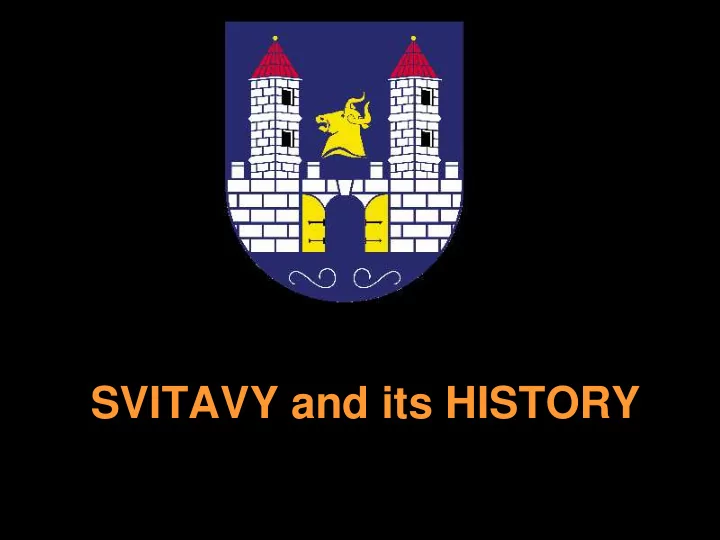
SVITAVY and its HISTORY The town of Svitavy, which ranks among the - - PowerPoint PPT Presentation
SVITAVY and its HISTORY The town of Svitavy, which ranks among the oldest towns in this region, is located on the border of Moravia and East Bohemia in the undulating landscape of Svitavy Highlands. Medieval settlers founded a hamlet
the present population of 18,000 inhabitants began its history in the 12th
the middle of the 12th century monks from Litomyšl founded a settlement with a church along trade routes, and named it after the local stream known as Svitava.
The church was consecrated to St Giles, and the territory was added to estates owned by the Litomyšl
German settlers were invited by Olomouc bishop Bruno of Schauenburk to develop local forest lands. The Olomouc bishop's diocese subsequently made a claim to the settlement of Svitava and its environs.
The ownership argument was settled
border between the two rivals had been defined and the town was awarded to Olomouc
village and a new church consecrated to the Virgin Mary were built, and the original "Old Svitava" was slowly losing its importance until it finally merged with the new village.
The town started to grow and flourish also thanks to various episcopal and royal
confirmed and granted magisterial rights, permitted annual fair markets, and acknowledged the hereditary rights and
In 1380, the construction of the town walls
usual wall was fortified by a round wall and there were created three gates and a brook
spreading of the town the walls started to be demolished.
Thanks to another fire in1818 the Brnenska gate, which used to stay near Ottendorfer house, and the Prazska gate, which used to stay near the church of the Visitation of the Virgin Marry, were demolished, and the brook around the town was filled up. About 1900 the third gate,which was demolished, called Middle gate too. Only the town bastation, standing near the bus station, has been kept up to now.
During the Hussite wars in the 15th century the town was besieged several times. Then the Litomyšl episcopal monks found a temporary asylum inside the fortified town and so it again came under the monastic rule. The crisis caused by the Hussite wars passed by 1484 when Svitavy became once again the property of Olomouc bishops, but it was incorporated into the Mírov diocese.
The town entered the Renaissance century strengthened and consolidated. Though a lot of
copies form a substantial part of the municipal archives and describe the rise of the town. As the town had grown in size, Craft Guilds were established.
As early as 1512 a mention about a smith guild cropped up in documents. Other guilds included shoemakers, weavers, furriers and potters who carried on their business in Svitavy. All of them contributed to the creation of the "Golden Age" of the town as the 16th century is nicknamed.
In 1538 the Town Council bought a house in the square and established the Town Hall there. The Town Council led a several-year-long conflict with the magistrate. Finally the magistrate's rights were purchased by the Council in 1599 and the town began the new century as a legally and economically independent institution, though formally dependent upon the Olomouc diocese.
The Thirty Years´ War caused moral and economical disaster for the whole country. The Czech lands were endangered by both Catholic and Protestant armies, and were threatened by plague and cholera epidemics. After the drastic fall of population and total devastation, the resurrection of the town followed. New Guild Rules were issued, and the process of building, manufacturing, and trading was initiated. The town rose from ashes and flourished also due to reforms declared by absolutist Austrian monarchs.
important roads where every day wagons carried yarn, drapery, cloth, and other textile fabrics and woven materials essential for textile manufacturing. Svitavy proved to be able to compete in market and so every effort was aimed at supporting this branch of industry. No wonder the town could be called the "textile pillar" of the monarchy.
quite high thanks to production of textiles, frequent economic crises did not spare the town
nothing unusual. Textile provided the town with profit, but in 1781 an inconspicuous flame broke
almost all of the town, and the money had to be spent on the reconstruction.
destroyed, and the Town Hall, church, brewery, and nearly all of the square and suburbs were damaged. However, Napoleonic wars at the beginning of the 19th century and epidemics associated with them meant yet another disaster.
The revolution in 1848 set the town free from the control of the Olomouc diocese, and established a regional civil administration in the town of Moravská Trebová. Svitavy gained both the inland revenue office and its own court. The town's population at that time was 4,431 people, and was growing despite the war between Prussia and Austria in 1866. It was in Svitavy where Prussian King Wilhelm negotiated the truce with Austrian diplomats.
In the late 19th century a lot of institutions were established thanks to some unselfish well-to-do businessmen and their financial backing. Examples of such institutions were a retirement house, an
town became the library that was built by a native of Svitavy - Valentin Oswald Ottendorfer who ranked among highly respected politicians in New York. The library building and the reading-room were opened in Ottendorfer´s presence. It housed about 25,000 volumes in its depository and no wonder it became
lands. FOTO IN OTHER SIDES
gave rise to ethnic conflicts which mark the period in the early 20th century. Despite the German politicians´ intention to separate and despite their desire for autonomy within the disintegrating Austrian monarchy
embodied into Czechoslovakia in 1918 and it became its integral part.
With the rise of Nazism, the efforts of German- speaking inhabitants to be annexed to the Third Reich succeeded following the occupation of Czechoslovakia by Germany in 1938. This act resulted in new conflicts after the war when German Nazi-sympathizers and collaborators were deported.
The town had to face new problems created by a massive immigration after people from all parts of post-war Czechoslovakia were re-settled here. Stagnation of economy was one of the consequences we have been fighting ever since then.
mid-12th century - St Giles´ Church was built in the settlement of Svitava (the church in the cemetery) 1256 - a document mentions the town of Svitavy and the settlement of Stará Svitava (Old Svitava) as belonging to Olomouc bishops 1389 - the town was fortified 1421 - the parish/branch/diocese of Litomyšl bishop settled in Svitavy 1424 - the town was plundered by the Hussites 1515 - foundation of town's archives 1538 - establishment of the Town Hall 1892 - opening of Ottendorfer´s library 1892 – building of Langer villa and Budig villa
1938 - Svitavy became a part of the Third Reich 1945-46 - post-war deportation of German inhabitants from the country 1960 – became a part of East – Bohemian region 1989 – in the Czech-Slovak Republic was “the velvet revolution“ 1994 - reconstructed Peace square and parts of town 1997 – became a part of Pardubice region 2001 - opening of sport hall “Na Střelnici” 2003 – reconstructed the Jewish cemetery 2006 – Svitavy celebrated 750th jubilee from the first reference
is being rebuilt. It is called “THE FACTORY”.
AUTHOR: Antonín Benc, Simona Votřelová a Harald Čadílek FOTO: Antonín Benc TRANSLATION: Simona Votřelová