
SLIDE 1
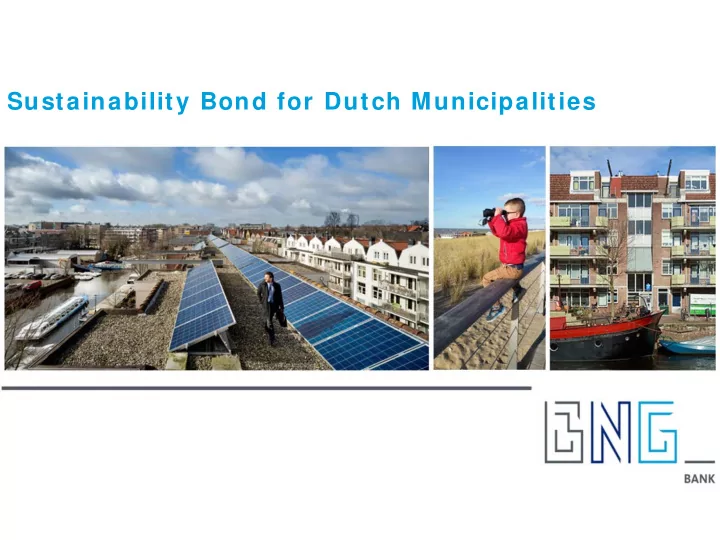
Sustainability Bond for Dutch Municipalities November 2018 Disclaim - - PowerPoint PPT Presentation
Sustainability Bond for Dutch Municipalities November 2018 Disclaim er THE SLIDES USED IN THIS PRESENTATION ARE STRICTLY CONFIDENTIAL AND HAVE BEEN PREPARED EXCLUSIVELY TO SUPPORT RELATED ORAL DISCUSSIONS. THE INFORMATION CONTAINED IN THIS
November 2018
2
THE SLIDES USED IN THIS PRESENTATION ARE STRICTLY CONFIDENTIAL AND HAVE BEEN PREPARED EXCLUSIVELY TO SUPPORT RELATED ORAL DISCUSSIONS. THE INFORMATION CONTAINED IN THIS PRESENTATION IS BEING FURNISHED TO YOU SOLELY FOR YOUR INFORMATION AND MAY NOT BE REPRODUCED OR REDISTRIBUTED TO ANY OTHER PERSON. This presentation is based on information provided by BNG Bank N.V. (the “Company”) and other publicly available information as indicated herein. The information contained in this presentation does not constitute or form part of any offer for sale or subscription of or solicitation or invitation of any offer to buy or subscribe for any securities in the United States or any other jurisdiction nor shall it or any part of it form the basis of or be relied on in connection with any contract or commitment whatsoever. Any decision to invest in or acquire securities of the Company must be based wholly on the information contained in an offering document or prospectus (the “Offering Document”) issued or to be issued by the Company in connection with any such offer and not on the contents hereof and this presentation should not be considered as a recommendation by the Company that any recipient of this presentation should subscribe for or purchase any Securities in any jurisdiction in which such offer, sale or invitation is not authorized or to any person to whom it is unlawful to make such an offer, sale or invitation. This presentation does not contain all relevant information relating to the Company or its securities, particularly with respect to the risks and special considerations involved with an investment in the securities of the Company, and is qualified in its entirety by reference to the detailed information which will appear in the Offering Document. No securities of the Company have been or will be registered under the US Securities Act of 1933, as amended (the “Securities Act”). Accordingly, any securities of the Company will only be issued in the United States pursuant to an exemption from or in a transaction not subject to the registration requirements of the Securities Act. This presentation contains “forward-looking statements” (as defined in the U.S. Private Securities Litigation Reform Act of 1995) regarding the intent, belief or current expectations of the Company's management with respect to its financial condition and future results of operations. You can identify forward-looking statements by discussions of strategy, plans or intentions. These statements reflect the Company's current views with respect to future events and by their nature are subject to risks, uncertainties and assumptions because they relate to events and depend on circumstances that may or may not occur in the future. Should one or more of these risks or uncertainties materialize, or should underlying assumptions prove incorrect, the actual results of the Company may vary materially from those expressed in or implied by the forward-looking statements contained or deemed to be contained herein. Given these risks and uncertainties, you are cautioned not to place undue reliance on forward-looking statements, which speak only as of the date of this presentation. For a discussion of some of the important factors that could cause the Company’s results to differ from those expressed in or implied by the forward-looking statements contained herein, please refer to the Offering Document that will be delivered in connection with any securities offering. The Company disclaims any obligation to update, or to announce publicly any revision to, any of the forward-looking statements contained in this presentation.
November 2018
3
November 2018
4
November 2018
5 Municipalities
Housing Associations
irrevocable/ irreversible/ unlimited
Health Care institutions
irrevocable/ irreversible/ unlimited
Others
(June 2018)
November 2018
6
(of total outstanding loans to Dutch public sector)
first half
November 2018
7
November 2018
8
(as per November 2018)
November 2018
9
Investment’ and in the ‘Framework for Dutch Housing Associations’
Sustainability Centre of Tilburg University (TSC-Telos)
municipalities and sustainable Dutch social housing associations.
November 2018
10
*TSC-Telos specializes in operationalizing sustainable development in regional and urban initiatives. TSC-Telos Research areas are Climate Action & Resource Efficiency, Corporate Social Responsibility, Social Innovation and Governance. Sustainalytics provided an external opinion on the framework. **Sustainalytics B.V. (Sustainalytics), a provider of environmental, social and governance (ESG) research and analysis, evaluated BNG Bank’s Sustainability Bond transaction set forth in this Prospectus and the alignment thereof with industry best practice, provided views on the robustness and credibility of the Sustainability Bond within the meaning of the alignment with industry best practice.
November 2018
11 Use of proceeds Top class of sustainable municipalities in the Netherlands, as defined in the ‘Sustainability Framework for Best in Class Municipality Investment (2018)’ Process for project evaluation and selection The selection is done by an independent party: Tilburg Sustainability Center
Sustainable Development Goals (2016). Additionally, Sustainalytics provided an independent second opinion on the framework Management of proceeds The proceeds of the bond will be tracked by the issuer and allocated to BNG Bank’s lending and investment operations to municipalities. This will be audited internally. The proceeds of the sustainability bond will (re)finance loans for the top class
Reporting Annually TSC-Telos will prepare a Performance or Impact report. This report will give an update on the sustainability scores of the 125 Elected Municipalities for the 2018 Sustainability Bond for Dutch Municipalities. The data used for the annual impact reporting by TSC-Telos comes from
November 2018
12
*Due to recent municipal reorganisations, the total number of Dutch municipalities has decreased from 390 in 2016, 388 in 2017 to 380 in 2018. Please see Appendix 1 for more information.
Sustainability Bond Framework by Telos, University
3 capitals 20 themes 126 quantitative impact indicators from public
14 Types of Municipalities 380 Dutch Municipalities*
Quantitative types
Qualitative types
Top 15 best-ranking of sustainable municipalities in the Netherlands 125 Elected Sustainable municipalities = 33% of the total number of Dutch Municipalities
November 2018
13
Indicators in theme energy and climate
November 2018
14
Ecological Capital
Themes Indicators Soil Contaminated sites with health risks, contaminated sites with spreading risks, contaminated sites with ecological risks, soil sealing, nitrogen deposition Air Emission of carbon-dioxide (CO2), emission of nitrogen (NOx), emission of particulate matter (PM2.5), emission of volatile organic substances (NMVOS), concentration nitrogen-dioxide (NO2), concentration of ozone (O3), concentration
Annoyance and Emergencies Annoyance by odors, annoyance by noise, noise intensity, light intensity, risk contour, floods, flooding, earthquakes, urban heat islands Water Water quality: fish population, water quality: macro-fauna, water quality: flora, physical-chemical water quality, water quality: other substances, water quality: priority substances, nitrogen emissions to surface water, phosphorous emissions to surface water Nature and Landscape Public green, distance to recreational water, share of forest and natural area, biodiversity, red list species Energy Wind energy, solar energy, natural gas use households, electricity use households, energy label houses, natural gas use companies, energy use companies Resources and Waste Total household waste, household general waste, organic waste, paper and cardboard waste, packaging glass, plastics
Social-Cultural Capital
Themes Indicators Social Participation Social cohesion, social contacts, loneliness, general trust, volunteers, informal care giving, being active in society Economic Participation Financial assets household, Long-term unemployment, Social welfare benefits, Poor households Arts and Culture Performing Arts & Cinema’s, distance to museum, national monuments, municipal monuments, protected sights, cultural employment Health Insufficient movement, Risky behavior, Distance to general practitioner, medicine use, Distance to hospital, Life expectancy, Assessment of own health, Chronic illness, Confused people Safety Violent crimes, Property crimes, Vandalism, youth crimes, road safety, child abuse, feelings of insecurity Residential Environment Satisfaction with dwelling, satisfaction with living environment, satisfaction with local shops and services, distance to daily services, migration, new houses developed, vacancy houses, affordable housing Education Distance to primary school, distance to secondary school, final examination mark, real-time to diploma, school dropouts, youth unemployment, education level population Political participation Political engagement, turnout local elections, turnout national elections, political trust
Economic Capital
Themes Indicators Labor Employment function, Human resources exploitation, Unemployment, Incapacity for work, ageing labor force Spatial Local Conditions for Businesses Stock business parks, Net/gross area ratio business parks, Share outdated business parks, work locations, vacant office spaces, vacant retail spaces Competitiveness Gross regional product per capita, share of startups, share of bankruptcies, share of fast-growing enterprises, share of employment in economic top sectors, investments of non-financial companies Infrastructure and Mobility Access to train station, access to main roads and highways, shares of electric vehicles, recharging stations for electric vehicles, access to public busses Knowledge Share highly educated people, share of knowledge workers, capacity (applied) scientific education, high- and medium-tech employment, employment in the creative industry
November 2018
15
November 2018
16
“Sustainalytics is of the opinion that the TSC-Telos Sustainability Monitor Methodology provides a robust approach to rating the sustainability performance of Dutch municipalities. Furtherm ore, elected municipalities represent top- performing municipalities, a typical ‘best-in-class approach’. Sustainalytics considers that this is a robust and consistent approach. Even though the use of proceeds will be for general-purpose use by ‘best-in-class’ sustainable municipalities, Sustainalytics is of the opinion that the assessm ent implem ented ensures that bond proceeds will be directed towards m unicipalities with stronger ecological, social and economic performance and municipalities that are m ore likely to use those funds to financing projects with good sustainability credentials. However, Sustainalytics recognizes that this approach has som e limitations regarding the ability to manage social and environm ental risks and m easure impact associated with the use of proceeds of this sustainability bond. Investors and
stakeholders will be able to view aggregate im pacts achieved by the municipalities by reviewing publicly disclosed impact information published by TSC-Telos.” “Based on the above, Sustainalytics is confident that BNG Bank is well positioned to issue sustainability bonds, and that the BNG Bank 2018 Sustainability Bond Framework is robust and transparent and in alignment with the four core components of ICMA’s Sustainability Bond Principles 2018.”
Sustainalytics – BNG Bank Sustainability Bond for Dutch Sustainable Municipalities ( 2 0 1 8 )
November 2018
17
November 2018
18
November 2018
19
way Telos makes sure that the instrument stays up-to-date. The year ecological quality of surface water and Chemical quality of surface water are replaced with the sub-indicators of water quality and turnout local- and turnout national elections are moved to the new stock political participation.
good overall quality of drinking water in the Netherlands
data unavailability.
municipalities has decreased to 380. In comparison to last year’s ‘Socially Responsible Investment Bond 2017’ framework report, there have been several municipal reorganisations:
municipality ‘Midden-Groningen’.
into the new municipality of ‘Waadhoeke’.
‘Leeuwarden’
‘Westerwolde’.
November 2018
20
* forecast
sources: Central Plan Bureau and Dutch Central Bank