Surviving to Thriving Supporting Transformation, Reentry, and - - PowerPoint PPT Presentation

surviving to thriving
SMART_READER_LITE
LIVE PREVIEW

Surviving to Thriving Supporting Transformation, Reentry, and - - PowerPoint PPT Presentation

Surviving to Thriving Supporting Transformation, Reentry, and Connections to Employment for Young Adults WEBINAR | April 2020 CLASP | clasp.org 1 1 Ask questions! Use the questions feature on the control panel to send us questions! CLASP


slide-1
SLIDE 1

1

CLASP | clasp.org 1
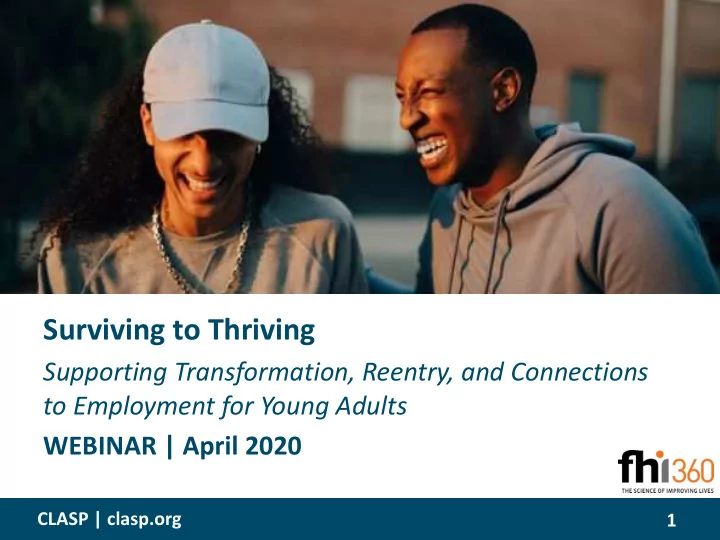
Surviving to Thriving

Supporting Transformation, Reentry, and Connections to Employment for Young Adults WEBINAR | April 2020

slide-2
SLIDE 2

2

CLASP | clasp.org 2

Ask questions!

Use the questions feature

  • n the control panel to

send us questions!

slide-3
SLIDE 3

3

CLASP | clasp.org 3

Today’s presenters

Kisha Bird, CLASP Caitlin Dawkins, FHI 360

slide-4
SLIDE 4

4

CLASP | clasp.org 4

Today’s presenters

Franco Vega, The RightWay Foundation Galen Demus, KentuckianaWorks Lukee Forbes, City of Albany

slide-5
SLIDE 5

5

CLASP | clasp.org 5

Purpose of Today’s Webinar

  • Lift up practical programmatic solutions that support

second chances for young people and raise policy and systems considerations to address equity, collateral consequences, and opportunity.

  • Highlight the Compass Rose Collaborative (CRC)

– The CRC connects young adults ages 18-24 who have had contact with the juvenile justice or criminal justice system to employment, education pathways, and supportive services across nine communities. FHI 360 serves as the intermediary for the CRC.

slide-6
SLIDE 6

6

CLASP | clasp.org 6

Poll

How many people live under correctional control of the criminal justice system?

slide-7
SLIDE 7

7

CLASP | clasp.org 7

Surviving to Thriving

slide-8
SLIDE 8

8

CLASP | clasp.org 8

Surviving to Thriving

slide-9
SLIDE 9

9

CLASP | clasp.org 9

BEST PRACTICES

YOUTH DEVELOPMENT, WORKFORCE DEVELOPMENT, AND REENTRY

  • Prioritize youth transformation and goals
  • Maintain organizational partnerships
  • Work to remove systemic obstacles and

barriers to youth success

slide-10
SLIDE 10

10

CLASP | clasp.org 10

What is the Compass Rose Collaborative (CRC)?

CRC began as a 3-year program funded by the U.S. Department of Labor (DOL). The CRC connects young adults who have had contact with the juvenile justice or criminal justice system to employment, education pathways, and supportive services across nine communities with the goal of recidivism reduction. Young people between the ages of 18-24 are eligible. FHI 360 serves as the intermediary.

slide-11
SLIDE 11

11

CLASP | clasp.org 11

Organizations involved in the CRC

FHI 360, Washington, D.C. (intermediary)

  • City of Albany Department of Youth and Workforce

Services, Albany, New York

  • City of Los Angeles Economic and Workforce Development

Department, Los Angeles, California

  • CommunityWorks, Inc., Denver, Colorado
  • Greater Louisville Workforce Development Board, Inc.,

Louisville, Kentucky

  • Mayor’s Office of Employment Development, Baltimore,

Maryland

  • Office of Workforce Development’s Youth Options

Unlimited (YOU) Division, Boston, Massachusetts

  • Our Piece of the Pie, Inc., Hartford, Connecticut
  • Phoenix Youth and Family Services, Inc., southeast

Arkansas

  • St. Louis Agency on Training and Employment, St. Louis,

Missouri

slide-12
SLIDE 12

12

CLASP | clasp.org 12

FHI 360 as an intermediary

  • Training and technical assistance
  • Evidence-based model
  • Capacity building
  • Peer learning and exchanges
  • Best and promising practices
  • Data culture
  • Sound financial structure
slide-13
SLIDE 13

13

CLASP | clasp.org 13

slide-14
SLIDE 14

14

CLASP | clasp.org 14

Our Outcomes for the 2017 grant as of 9/30/19:

109% Enrollment 73% enrolled in long-term education or employed 70% of participants earned credentials Over 100 employers committed to support second chances Less than 2% recidivism rate 100% provision of supportive services

slide-15
SLIDE 15

15

CLASP | clasp.org 15

Franco Vega

slide-16
SLIDE 16

16

CLASP | clasp.org 16

Operation Second Chance (Youth Training)

  • A 32-hour trauma-informed workshop series in which

mental health and well-being are embedded in our employment readiness training for transition-age youth impacted by the justice and foster care systems.

  • Operation Second Chance emphasizes the importance of

processing trauma through therapy and teaches youth to manage trauma responses to promote job success.

  • Upon completion of the program, youth have access to

training, paid internships, and job opportunities with our employer partners, as well as The RightWay’s supportive services.

slide-17
SLIDE 17

17

CLASP | clasp.org 17

Removing Barriers to Success

  • Using a trauma-informed and healing-centered approach to service provision.
  • Having licensed psychotherapists who have experience working with transition-age

youth impacted by multiple systems provide trauma-informed mental health services to young people.

  • Educating youth about the impacts of trauma on employment and overall health

and well-being during employment readiness training.

  • Working with private entities to obtain property that could house multiple CRC
  • participants. These young people would be provided with RightWay’s supportive

services in-house.

  • Using funds to provide Transit Access Passes or to assist youth with obtaining

driver’s training/license.

  • Offering a $2000 interest-free car loan to program participants who have been

employed for at least 6 months and are maintaining weekly check-ins with RightWay staff.

slide-18
SLIDE 18

18

CLASP | clasp.org 18

Partnerships Are Key

  • Employers: Provide jobs and workplace mentoring. Commit to being

trained in trauma-informed workplace mentoring best practices (Motivate, Mentor, Manage training).

  • Probation/Parole: Maintain communication pre- and post- release
  • Youthsource Centers: Provide funds for paid-work experience
  • PBS | The RightWay Foundation's Journey to Jobs
slide-19
SLIDE 19

19

CLASP | clasp.org 19

How RightWay Supports Young People

  • Focusing on trauma-informed and healing-centered

approaches when developing programming and considering partnerships with other service providers.

  • Continuing supportive services, even after an exit

from or completion of a program.

  • Offering flexible mental health support.
  • Training employer partners on trauma-informed best

practices and encouraging supervisors to become workplace mentors.

slide-20
SLIDE 20

20

CLASP | clasp.org 20

Galen Demus

Career Coach Team Lead Reimage Program Louisville, Kentucky

20

slide-21
SLIDE 21

21

CLASP | clasp.org 21

Overview of KentuckianaWorks

  • Workforce Development Board, helping job seekers

find jobs, career options, education and training in the Louisville MSA and several surrounding counties.

  • Help employers meet their workforce needs by

connecting them with skilled, qualified employees.

  • This is a value added benefit to our programs and

services because of the partnerships they have created with a number of established training programs.

  • Gives our program direction in real time to prepare our

young adults to take advantage of trainings in these areas of employment.

slide-22
SLIDE 22

22

CLASP | clasp.org 22

Our program and what it offers

  • Kentucky Youth Career Center (KYCC): Provides

educational and career opportunities and job search help for Louisville youth ages 16-24. KYCC is the actual physical space for the Reimage program.

  • Reimage: A partnership with KentuckianaWorks and

the Office of Safe and Healthy Neighborhoods, Reimage works with young adults 16-24 who have been touched by the court system. We provide assistance in the following areas…

slide-23
SLIDE 23

23

CLASP | clasp.org 23

We can help our participants

1) Get career pathway trainings and credentials 2) Find a job or start their career path 3) Earn their GED or enroll in college 4) Navigate the court system 5) Assist with transportation and work/school uniforms 6) Legal aid, housing, counseling and much much more!

slide-24
SLIDE 24

24

CLASP | clasp.org 24

Best Practices: Removing systemic obstacles that pose barriers to our participants success

  • Provide a variety of training options: opening up those perceived

“closed” doors:

– Construction – Manufacturing – IT – Youth Development – Culinary – Welding – CNA – Phlebotomy

  • Career Coaches (Tyler Radford, Ronika Sullivan, Chris Forehand)

become the “experts” in 2-3 of the fields above and become the program liaison for the participant and their success.

slide-25
SLIDE 25

25

CLASP | clasp.org 25

Mitigating the barriers

  • In House Resources:

– Transportation=Bus Tickets/Monthly Passes – ID/Birth Certificate=Career Coach – Food=Dare to Care – No Computer=Computer Lab Access – Housing=Housing For The Homeless Case Mgr. – Relaxation=Book Closet

slide-26
SLIDE 26

26

CLASP | clasp.org 26

Mitigating the Barriers

  • Community Partnership Resources:

– Trauma/Mental Health= Cardinal Success Counseling – Substance Abuse= Various Rehab Centers, Clinical & Holistic – Probation & Parole= Positive Referral Relationship – Little Work Experience= Entry Level Job Partners

slide-27
SLIDE 27

27

CLASP | clasp.org 27

Lukee Forbes

“ Life can change in 2 seconds. Always make strategic decisions with that in mind. Compass Rose has helped me to realize that you can’t be who you want to be until you realize who you are. Now, I cannot even recognize the person that I used to be.” (Lukee, Albany, NY)

slide-28
SLIDE 28

28

CLASP | clasp.org 28

slide-29
SLIDE 29

29

CLASP | clasp.org 29

Rebuilding and Restoration A Call to Action

The CRC best practices are a step in the larger process of reimagining the justice system. Reimagining the justice system requires moving towards large-scale investments in decarceration and a focus

  • n restorative justice in
  • ur programs and

policies.

slide-30
SLIDE 30

30

CLASP | clasp.org 30

Policy and Systems Considerations

Identification is access Coordination and cross-systems approaches Flexibility and resources Removing employment barriers Alignment of corrections and community education Supportive services access

slide-31
SLIDE 31

31

CLASP | clasp.org 31

Questions?

  • Use the questions

feature to ask any questions!

slide-32
SLIDE 32

32

CLASP | clasp.org 32

Contact us

  • KBird@clasp.org
  • CDawkins@FHI360.org
  • Franco@TheRightWayFoundation.org
  • Galen.demus@kentuckianaworks.org
  • Lukeeforbes0@gmail.com