Surveys the changing state and the behavior of the physical - - PowerPoint PPT Presentation

surveys the changing state and the behavior of the
SMART_READER_LITE
LIVE PREVIEW

Surveys the changing state and the behavior of the physical - - PowerPoint PPT Presentation

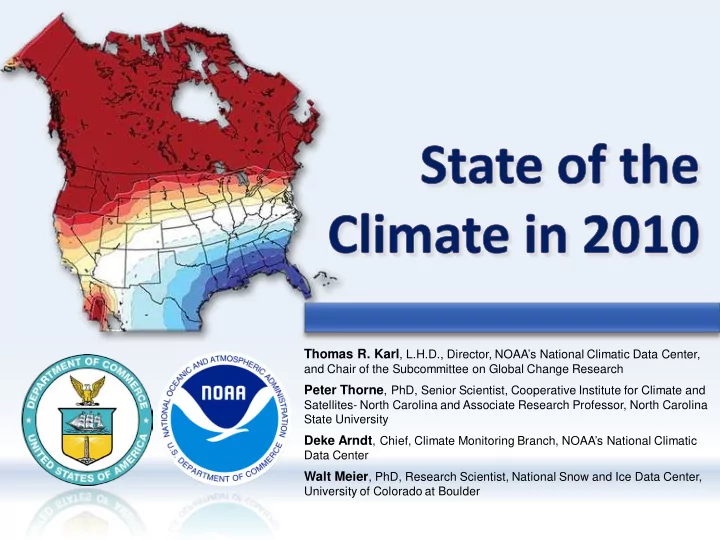
Thomas R. Karl , L.H.D., Director, NOAAs National Climatic Data Center, and Chair of the Subcommittee on Global Change Research Peter Thorne , PhD, Senior Scientist, Cooperative Institute for Climate and Satellites- North Carolina and Associate


slide-1
SLIDE 1

Thomas R. Karl, L.H.D., Director, NOAA’s National Climatic Data Center,

and Chair of the Subcommittee on Global Change Research

Peter Thorne, PhD, Senior Scientist, Cooperative Institute for Climate and

Satellites- North Carolina and Associate Research Professor, North Carolina State University

Deke Arndt, Chief, Climate Monitoring Branch, NOAA’s National Climatic

Data Center

Walt Meier, PhD, Research Scientist, National Snow and Ice Data Center,

University of Colorado at Boulder

slide-2
SLIDE 2

June 2011 June 2011

  • Surveys the changing state

and the behavior of the physical climate system

  • Now tracks 41 global-scale

climate indicators

  • Peer reviewed report has 368

authors from 45 countries

2

June 2011 State of the Climate in 2010

slide-3
SLIDE 3

June 2011 June 2011

3 Air samples collected weekly at NOAA’s Mauna Loa observatory continue to show a rise in the concentration of carbon dioxide. Three data sets show global surface temperatures continue to rise; 2010 was one of the two warmest years on record. Greenland's ice sheet lost more mass in 2010 than at any time in the past ten years.

Global average surface temperature among the two warmest of the instrumental record

June 2011 State of the Climate in 2010

slide-4
SLIDE 4

June 2011 June 2011

Two recurrent climate patterns had major impacts

  • n 2010 weather:
  • El Niño / La Niña
  • Arctic Oscillation

“Climate is what you expect, weather is what you get.” -- Robert A. Heinlein

Washington D.C.,

  • Feb. 2010

4

June 2011 State of the Climate in 2010 Vancouver, British Columbia February 2010

slide-5
SLIDE 5

June 2011 June 2011

  • Report added four new indicators to better understand changes in

the global climate

5

June 2011 State of the Climate in 2010

Global Average Nighttime Lake Surface Temperature Anomalies

Year

slide-6
SLIDE 6

June 2011 June 2011

6

State of the Climate in 2010

  • Multiple indicators, same bottom line conclusion

– Consistent and unmistakable signal from the top of the atmosphere to the bottom of the oceans

Year

slide-7
SLIDE 7

June 2011 June 2011

  • Many extreme events at regional and

local levels

– 2009/10 coldest European winter since 1978/79 – February 2010 – a month of extremes in North America:

  • Several U.S. cities had snowiest months on record
  • Warm, dry, with limited snow for 2010 Winter Olympics in

Vancouver, British Columbia

– Summer:

  • Russia: Deadly summer heat wave
  • Pakistan: Floods displaced over 20 million people

– Most of the world (except the Atlantic) had a very inactive tropical cyclone year – Catastrophic flooding in Australia – Drought in Brazil

7

June 2011 State of the Climate in 2010

Pakistan Meteorology Department

Pakistan flooding Russian Heat Wave

slide-8
SLIDE 8

June 2011 June 2011

  • Lingering effects of El Niño were responsible, in part, for 2010

being one of two warmest years on record

  • Relationship between emerging La Niña and very slow tropical

cyclone season in the Pacific

  • La Niña also associated with

Australia flooding

8

June 2011 State of the Climate in 2010

Yellow indicates El Niño; Blue indicates La Niña

slide-9
SLIDE 9

June 2011 June 2011

  • Record negative values in

Feb 2010

  • Impacts to the Northern

Hemisphere

– U.S. and Western Europe endured record or near-record cold during winter 2009/10 and winter 2010/11 – Parts of northern North America, Greenland, and Asia experienced profound warmth at the same time

9

June 2011 State of the Climate in 2010

slide-10
SLIDE 10

June 2011 June 2011

  • Changes occurring faster than in most of the rest of the world
  • 2010 maximum sea ice extent was latest in 30 years - March 31

State of the Climate in 2010

10

  • September sea ice extent

was third smallest of the past 30 years

  • Trends in snow cover

duration, permafrost, and vegetation continued or accelerated

Ice Extent Anomalies

June 2011 State of the Climate in 2010

slide-11
SLIDE 11

June 2011 June 2011

  • Record-setting temperatures along entire western Greenland, both

near the ground and higher in the atmosphere

  • The high temperatures contributed to greater ice sheet melting

– April–September 2010 melt was about 8 percent more than the previous record set in 2007

State of the Climate in 2010

11

Three Greenland meteorological station records illustrating the long-term time series of yearly-average temperatures Cumulative area changes for 35 major glaciers

  • f Greenland’s ice sheet

June 2011 State of the Climate in 2010

slide-12
SLIDE 12

June 2011 June 2011

  • 2010 global average surface

temperature among the two warmest on record

  • Two recurrent climate patterns –

El Niño / La Niña and Arctic Oscillation - had major impacts on 2010 weather

  • 2010 report tracks 41 climate
  • indicators. Long-term trends

continue to show the world is warming

12

State of the Climate in 2010

slide-13
SLIDE 13

13

State of the Climate in 2010 full report and Highlights available online

http://www.ncdc.noaa.gov/bams-state-of-the-climate