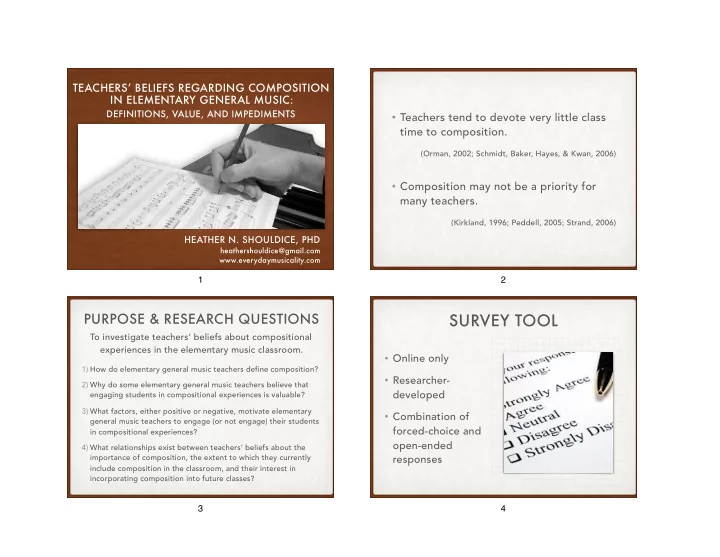
SURVEY TOOL To investigate teachers beliefs about compositional - - PowerPoint PPT Presentation

survey tool
SMART_READER_LITE
LIVE PREVIEW

SURVEY TOOL To investigate teachers beliefs about compositional - - PowerPoint PPT Presentation

TEACHERS BELIEFS REGARDING COMPOSITION IN ELEMENTARY GENERAL MUSIC: DEFINITIONS, VALUE, AND IMPEDIMENTS Teachers tend to devote very little class time to composition. (Orman, 2002; Schmidt, Baker, Hayes, & Kwan, 2006) Composition


slide-1
SLIDE 1

TEACHERS’ BELIEFS REGARDING COMPOSITION IN ELEMENTARY GENERAL MUSIC:

DEFINITIONS, VALUE, AND IMPEDIMENTS HEATHER N. SHOULDICE, PHD

heathershouldice@gmail.com www.everydaymusicality.com

1

  • Teachers tend to devote very little class

time to composition.

(Orman, 2002; Schmidt, Baker, Hayes, & Kwan, 2006)

  • Composition may not be a priority for

many teachers.

(Kirkland, 1996; Peddell, 2005; Strand, 2006)

2

PURPOSE & RESEARCH QUESTIONS

To investigate teachers’ beliefs about compositional experiences in the elementary music classroom.

1) How do elementary general music teachers define composition? 2) Why do some elementary general music teachers believe that engaging students in compositional experiences is valuable? 3) What factors, either positive or negative, motivate elementary general music teachers to engage (or not engage) their students in compositional experiences? 4) What relationships exist between teachers’ beliefs about the importance of composition, the extent to which they currently include composition in the classroom, and their interest in incorporating composition into future classes?

3

SURVEY TOOL

  • Online only
  • Researcher-

developed

  • Combination of

forced-choice and

  • pen-ended

responses

4

slide-2
SLIDE 2
  • Please describe the characteristics of music composition. (e.g.,

What is composition? What does it entail?)

  • How important is it for elementary general music students to

engage in composition?

  • Why do you feel composition is or isn’t important for elementary

music students?

  • On average, how frequently do you incorporate composition

activities in your Kindergarten classes? In your Grade 1 classes? Grade 2 classes? Grade 3 classes? Grade 4 classes? Grade 5 classes?

  • What influences your decision to NOT incorporate composition in

elementary general music? (OR what influences you to not incorporate composition more frequently?)

  • How interested are you in incorporating composition into future

elementary general music classes?

5

SURVEY SAMPLE

  • Solicited from

membership in state music education

  • rganizations and

district websites

  • 245 respondents (26%

response rate)

  • 22 were not eligible; 47

were incomplete.

  • Remaining sample= 176

6

DEFINITIONS IMPORTANCE/ USE/VALUE IMPEDIMENTS

7

DEFINITIONS OF COMPOSITION

8

slide-3
SLIDE 3

DEFINITIONS OF COMPOSITION

CREATING

  • “The creating of original music.”
  • “Creation of musical thought.”
  • “Creative process.”

EXPRESSION/COMMUNICATION

  • “Intentionally ordering sounds in a way to convey ideas and/or

feelings.”

  • “Creating using a palette of sounds and silence, in order to

Express your self.”

REPLICATION

  • “Is when you create something and are able to re-create/play/

sing it again and again.”

  • “Can be replicated, either from written record or memorized

recall.”

9

DEFINITIONS OF COMPOSITION

ROLE/PRESENCE OF NOTATION?

  • “Is the written form of communication from one musician to

another.”

  • “Is the process of notating musical ideas.”
  • “Should be written in some form.”
  • “Whether it is composed by ear, or written.”
  • “For some, this may entail writing notes down onto a staff. . .

For others, composition may be strictly aural.”

  • “One does not need to know notation in order to compose.”

10

DEFINITIONS OF COMPOSITION

COMPLEXITY?

  • “Is the process of coming up with a unique musical idea and

building upon that idea to create a whole musical piece.”

  • “Is the process of writing a complete piece of music. It

involves rhythm, melody, chords, tempo, dynamics, and

  • ccasionally lyrics.”
  • “Can be as simple as creating an interesting rhythm or

melody or as complex as creating a piece for several singers

  • r instruments.”
  • “Is the process of creating something new musically, whether

it be a simple ostinato pattern, or a lengthy complex piece.”

11

IMPORTANCE/USE/VALUE OF COMPOSITION

12

slide-4
SLIDE 4

IMPORTANCE OF COMPOSITION

“How important is it for elementary general music students to engage in composition?”

13

USE OF COMPOSITION

“Do you currently incorporate composition into your elementary music classes?”

14

USE OF COMPOSITION

“Do you currently incorporate composition into your elementary music classes?”

Moderate positive correlation (r = .379, p < .01) between participants’ beliefs about the importance

  • f composition in

elementary general music and whether they currently incorporate composition.

IMPORTANCE/

15

USE OF COMPOSITION

16

slide-5
SLIDE 5

USE OF COMPOSITION

17

Moderate positive correlations (r = .379-.487) between participants’ beliefs about the importance of composition and frequency incorporating composition for each grade level except grade 1.

USE OF COMPOSITION IMPORTANCE/

18

FUTURE USE OF COMPOSITION

“How interested are you in incorporating composition into future elementary general music classes?”

19

FUTURE USE OF COMPOSITION

“How interested are you in incorporating composition into future elementary general music classes?”

Strong positive correlation (r = .780, p < .01) between beliefs about the importance of composition in level

  • f interest in

incorporating composition into future classes.

20

slide-6
SLIDE 6

VALUE OF COMPOSITION

  • Understanding
  • Ownership
  • Creativity
  • Self-expression

21

VALUE OF COMPOSITION

UNDERSTANDING

  • Developing knowledge
  • “In order for students to fully understand music they

listen to, they must understand how it is put together.”

  • Application/synthesis
  • “When students are given the opportunity to compose,

they apply that knowledge and learn how to really use it.”

  • Assessment
  • “Allows [the] teacher a window into their students’

musical minds and a way to see what musical knowledge their students have mastered and internalized.”

22

VALUE OF COMPOSITION

OWNERSHIP

  • “Teaches kids that they can also be music inventors, that they

don't always have to perform what someone else has already done.”

  • “Students need to be aware that they have the power to

create music.”

  • “Kids usually love it because they get to [make] ‘their own’

music.”

23

VALUE OF COMPOSITION

CREATIVITY

  • “Every other subject regurgitates facts and applies formulas.

Music [composition] is one of the few areas where we can create.”

  • “I think there are many students whose creativity is boundless

and it would be a shame to hold them back because our own agenda dictates that they sing, dance, and perform.”

24

slide-7
SLIDE 7

VALUE OF COMPOSITION

SELF-EXPRESSION

  • “[Is] a practice in learning to communicate through music.”
  • “Gives students a chance to ‘directly’ express who they are

with sound, something that is extremely valuable, something that is often times missing in school music programs.”

25

IMPEDIMENTS TO COMPOSITION

  • Time
  • Logistics

26

IMPEDIMENTS TO COMPOSITION

TIME

  • Contact Time
  • “Budget cuts to the music program in which some classes

have been reduced to once a week.”

  • “If I had more time with my students I would like to

incorporate composition more.”

  • Time Required
  • “Composition is time consuming.”
  • “It tends to take up more class time than I feel is

appropriate.”

27

IMPEDIMENTS TO COMPOSITION

LOGISTICS

  • Class Size

There is only one of me and there are 25 students who need my help.”

  • Lack of Resources

If I had more instruments ... that my students could use to make a composition, it would be easier for the entire class to participate in a composition assignment.”

I travel to 3 schools, do not have my own room, teach ala cart [sic].”

28

slide-8
SLIDE 8

IMPLICATIONS

  • Teachers’ conceptions of composition likely

influence whether, when, and/or how they teach it.

  • Teachers who don’t believe composition is

important are less likely to teach it.

  • Broadening teachers’ conceptions of

composition may help alleviate perceived impediments.

29