
SLIDE 1
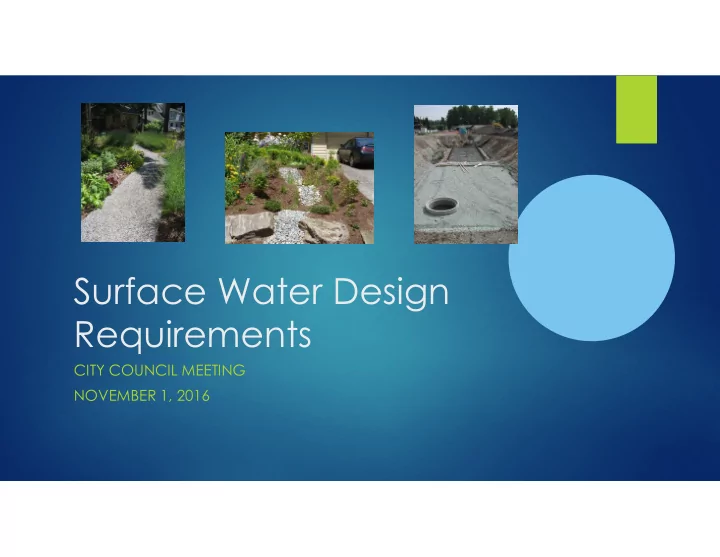
Surface Water Design Requirements
CITY COUNCIL MEETING NOVEMBER 1, 2016
Surface Water Design Requirements CITY COUNCIL MEETING NOVEMBER 1, - - PowerPoint PPT Presentation
Surface Water Design Requirements CITY COUNCIL MEETING NOVEMBER 1, 2016 Goal Provide direction on which version of the Addendum to include in the Public Works Pre-approved Plans and Policies Impervious Added and Replaced with
CITY COUNCIL MEETING NOVEMBER 1, 2016
Provide direction on which version of the Addendum to include in
the Public Works Pre-approved Plans and Policies
2% - Small Projects 10% - Large Projects 88% - Existing Impervious Area
Impervious Added and Replaced with Development/Redevelopment Expected 2017-2035
Adopted Ordinance O-4538 which adopts the King County
package
Council split 3-3 on requiring flow control facilities for small projects Return to Council when 7 Council members are present for decision
by December 31, 2016
2016 King County Surface Water Design Manual 2016 King County Stormwater Pollution Prevention Manual Kirkland Addendum to the 2016 King County Surface Water Design
Manual (Discussing tonight)
Cross-reference between KMC and King County Code Chapter
9.04, 9.12 and 16.82
October 24th Open House
Addendum includes implementation details: revisions and
clarifications
Addendum is incorporated in Public Works Pre-Approved Plans and
Policies
Public Works Director has authority to develop and update Public
Works Pre-Approved Plans and Policies, but seeks Council direction
Details of drainage review types and requirements Implementation details regarding offsite analysis of wetlands and
water quality problems
Additional alternatives for water quality treatment, remaining
consistent with the 2014 Ecology Manual
Clarification of soil infiltration testing requirements Table that cross-references Kirkland and King County codes
Requires flow control facilities for
small projects
Does not require flow control
facilities for small projects Note: Small projects are those that propose to add between 7,000 and < 10,000 sf of impervious surface
443 parcels total by 2035 that
would have to provide tanks under Alternative 1 but not under Alternative 2
Most are in Forbes (124) Juanita
(92) and Champagne (84) watersheds
This is about 1/3 of overall number
develop/redevelop in City
Example excerpt
2% - Small Projects 10% - Large Projects 88% - Existing Impervious Area
Impervious Added and Replaced with Development/Redevelopment Expected 2017-2035
17% - Small Projects 83% - Large Projects
Small Project Impervious Added and Replaced Relative to Total Impervious Added and Replaced Through Development/Redevelopment 2017-2035
Greater protection for downstream
resources
Higher construction cost Site-specific feasibility concerns City would be responsible for inspection
and maintenance of these facilities (estimated 10-15 would be added per year)
Increased protection for downstream
resources would not be provided
Potential for downstream flooding due to
cumulative impacts
City may have a need to provide flow control
at a later date, and it would be costly for rate payers
Regional facilities to provide flow control
would be hard to site The developer will factor development costs, including stormwater costs, into the price that they will pay for undeveloped land
Alternative 1: Require flow control facilities for
Conduct Study
LID Feasibility Tools Other means of implementing LID Evaluation of flow control sizing under both manuals Return to Council with findings / recommendations
Which Alternative Addendum?
Alternative 1: Requires flow control facilities for small projects OR Alternative 2: Does not require flow control facilities for small projects
Incorporate preferred version of the Addendum into the Pre-
approved Plans and Policies
Continue to evaluate cost, fee, and program impacts as part of
2017-2018 budget
Requirements become effective January 1, 2017