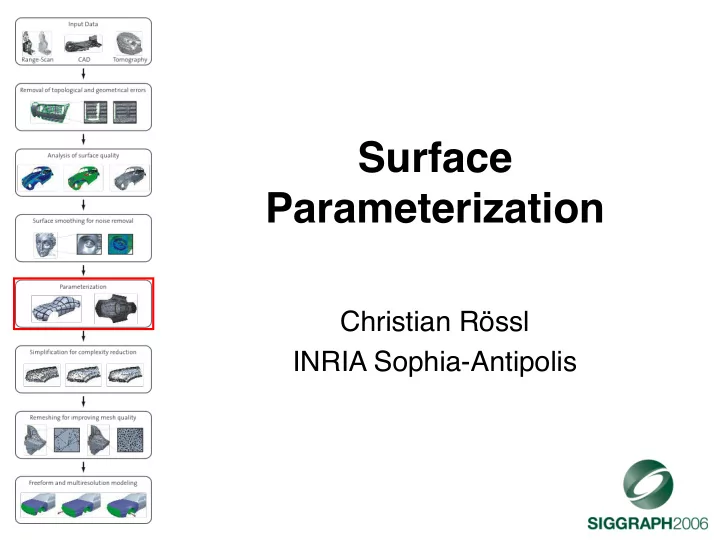
Surface Parameterization Christian Rssl INRIA Sophia-Antipolis - - PowerPoint PPT Presentation

surface parameterization
SMART_READER_LITE
LIVE PREVIEW

Surface Parameterization Christian Rssl INRIA Sophia-Antipolis - - PowerPoint PPT Presentation

Surface Parameterization Christian Rssl INRIA Sophia-Antipolis Outline Motivation Objectives and Discrete Mappings Angle Preservation Discrete Harmonic Maps Discrete Conformal Maps Angle Based Flattening Reducing


slide-1
SLIDE 1

Surface Parameterization

Christian Rössl INRIA Sophia-Antipolis

slide-2
SLIDE 2

Christian Rössl, INRIA 237

Outline

  • Motivation
  • Objectives and Discrete Mappings
  • Angle Preservation
  • Discrete Harmonic Maps
  • Discrete Conformal Maps
  • Angle Based Flattening
  • Reducing Area Distortion
  • Alternative Domains
slide-3
SLIDE 3

Christian Rössl, INRIA 238

Surface Parameterization

[www.wikipedia.de]

slide-4
SLIDE 4

Christian Rössl, INRIA 239

Surface Parameterization

[www.wikipedia.de]

slide-5
SLIDE 5

Christian Rössl, INRIA 240

Surface Parameterization

slide-6
SLIDE 6

Christian Rössl, INRIA 241

Motivation

  • Texture mapping

Lévy, Petitjean, Ray, and Maillot: Least squares conformal maps for automatic texture atlas generation, SIGGRAPH 2002

slide-7
SLIDE 7

Christian Rössl, INRIA 242

Motivation

  • Many operations are simpler on planar domain

Lévy: Dual Domain Exrapolation, SIGGRAPH 2003

slide-8
SLIDE 8

Christian Rössl, INRIA 243

Motivation

  • Exploit regular structure in domain

Gu, Gortler, Hoppe: Geometry Images, SIGGRAPH 2002

slide-9
SLIDE 9

Christian Rössl, INRIA 244

Surface Parameterization

slide-10
SLIDE 10

Christian Rössl, INRIA 245

Surface Parameterization

f X U

Jacobian

slide-11
SLIDE 11

Christian Rössl, INRIA 246

Surface Parameterization

f X U dX = J dU

slide-12
SLIDE 12

Christian Rössl, INRIA 247

Surface Parameterization

f X U dX = J dU ||dX ||2 = dU JTJ dU

{

First Fundamental Form

slide-13
SLIDE 13

Christian Rössl, INRIA 248

  • By first fundamental form I

– Eigenvalues λ1,2 of I – Singular values σ1,2 of J (σi2= λi)

  • Isometric

– I = Id, λ1= λ2=1

  • Conformal

– I = µ Id , λ1 / λ2=1

  • Equiareal

– det I = 1, λ1 λ2=1

Characterization of Mappings

angle preserving area preserving

slide-14
SLIDE 14

Christian Rössl, INRIA 249

Piecewise Linear Maps

  • Mapping = 2D mesh with same connectivity

f X U

slide-15
SLIDE 15

Christian Rössl, INRIA 250

Objectives

  • Isometric maps are rare
  • Minimize distortion w.r.t. a certain measure

– Validity (bijective map) – Boundary – Domain – Numerical solution

triangle flip e.g.,spherical linear / non-linear? fixed / free?

slide-16
SLIDE 16

Christian Rössl, INRIA 251

Discrete Harmonic Maps

  • f is harmonic if
  • Solve Laplace equation
  • In 3D: "fix planar boundary and smooth"

u and v are harmonic Dirichlet boundary conditions

slide-17
SLIDE 17

Christian Rössl, INRIA 252

Discrete Harmonic Maps

  • f is harmonic if
  • Solve Laplace equation
  • Yields linear system
  • Convex combination maps

– Normalization – Positivity

(again)

slide-18
SLIDE 18

Christian Rössl, INRIA 253

Convex Combination Maps

  • Every (interior) planar vertex is a

convex combination of its neighbors

  • Guarantees validity if boundary is mapped to a

convex polygon (e.g., rectangle, circle)

  • Weights

– Uniform (barycentric mapping) – Shape preserving [Floater 1997] – Mean Value Coordinates [Floater 2003]

  • Use mean value property of harmonic functions

Reproduction of planar meshes

slide-19
SLIDE 19

Christian Rössl, INRIA 254

Conformal Maps

  • Planar conformal mappings

satisfy the Cauchy-Riemann conditions and

slide-20
SLIDE 20

Christian Rössl, INRIA 255

Conformal Maps

  • Planar conformal mappings

satisfy the Cauchy-Riemann conditions

  • Differentiating once more by x and y yields
  • and

and ⇒

and similar

conformal ⇒ harmonic

slide-21
SLIDE 21

Christian Rössl, INRIA 256

Discrete Conformal Maps

  • Planar conformal mappings

satisfy the Cauchy-Riemann conditions

  • In general, there are no conformal mappings for

piecewise linear functions! and

slide-22
SLIDE 22

Christian Rössl, INRIA 257

Discrete Conformal Maps

  • Planar conformal mappings

satisfy the Cauchy-Riemann conditions

  • Conformal energy (per triangle T)
  • Minimize

and

slide-23
SLIDE 23

Christian Rössl, INRIA 258

Discrete Conformal Maps

  • Least-squares conformal maps [Lévy et al. 2002]
  • Satisfy Cauchy-Riemann conditions in

least-squares sense

  • Leads to solution of linear system
  • Alternative formulation leads to same solution…

where

slide-24
SLIDE 24

Christian Rössl, INRIA 259

Discrete Conformal Maps

  • Same solution is obtained for

cotangent weights Neumann boundary conditions

[Desbrun et al. 2002] Discrete Conformal Maps

+ fixed vertices

slide-25
SLIDE 25

Christian Rössl, INRIA 260

Discrete Conformal Maps

slide-26
SLIDE 26

Christian Rössl, INRIA 261

Discrete Conformal Maps

  • Free boundary depends on choice of fixed

vertices (>1)

ABF

slide-27
SLIDE 27

Christian Rössl, INRIA 262

Angle Based Flattening

  • Perserve angles  specify problem in angles

– Constraints

  • triangle
  • Internal vertex
  • Wheel consistency

– Objective function

ensure validity preserve angles 2D ~3D

"optimal" angles (uniform scaling)

[Sheffer&de Sturler 2000]

slide-28
SLIDE 28

Christian Rössl, INRIA 263

Angle Based Flattening

  • Free boundary
  • Validity: no local self-intersections
  • Non-linear optimization
slide-29
SLIDE 29

Christian Rössl, INRIA 264

Angle Based Flattening

  • Free boundary
  • Non-linear optimization

– Newton iteration – Solve linear system in every step

[Zayer et al. 2005]

slide-30
SLIDE 30

Christian Rössl, INRIA 265

And how about area distortion?

slide-31
SLIDE 31

Christian Rössl, INRIA 266

Reducing Area Distortion

  • Energy minimization based on

– MIPS [Hormann & Greiner 2000] – modification [Degener et al. 2003] – "Stretch" [Sander et al. 2001] – modification [Sorkine et al. 2002]

  • r
slide-32
SLIDE 32

Christian Rössl, INRIA 267

Non-Linear Methods

  • Free boundary
  • Direct control over distortion
  • No convergence guarantees
  • May get stuck in local minima
  • May not be suitable for large problems
  • May need feasible point as initial guess
  • May require hierarchical optimization even for

moderately sized data sets

slide-33
SLIDE 33

Christian Rössl, INRIA 268

Linear Methods

  • Efficient solution of a sparse linear system
  • Guaranteed convergence
  • Fixed convex boundary
  • May suffer from area distortion for complex meshes
  • An alternative approach to reducing area distortion…

– How accurately can we reproduce a surface on the plane? – How do we characterize the mapping?

slide-34
SLIDE 34

Christian Rössl, INRIA 269

Reducing Area Distortion

isometry

slide-35
SLIDE 35

Christian Rössl, INRIA 270

Reducing Area Distortion

  • Quasi-harmonic maps [Zayer et al. 2005]
  • Iterate (few iterations)

– Determine tensor C from f – Solve for g

estimate from f

slide-36
SLIDE 36

Christian Rössl, INRIA 271

Examples

slide-37
SLIDE 37

Christian Rössl, INRIA 272

Examples

Stretch metric minimization Using [Yoshizawa et. al 2004]

slide-38
SLIDE 38

Christian Rössl, INRIA 273

Reducing Area Distortion

  • Introduce cuts  area distortion vs. continuity
  • Often cuts are unavoidable (e.g., open sphere)

Treatment of boundary is important!

slide-39
SLIDE 39

Christian Rössl, INRIA 274

Reducing Area Distortion

  • Solve Poisson system [Zayer et al. 2005]

estimate from previous map * Similar setting used in mesh editing *

slide-40
SLIDE 40

Christian Rössl, INRIA 275

Spherical Parameterization

  • Sphere is natural domain for genus-0 surfaces
  • Additional constraint
  • Naïve approach

– Laplacian smoothing and back-projection – Obtain minimum for degenerate configuration

slide-41
SLIDE 41

Christian Rössl, INRIA 276

Spherical Parameterization

  • (Tangential) Laplacian Smoothing and

back-projection

– Minimum energy is obtained for degenerate solution

  • Theoretical guarantees are expensive

– [Gotsman et al. 2003]

  • A compromise?!

– Stereographic projection – Smoothing in curvilinear coordinates

slide-42
SLIDE 42

Christian Rössl, INRIA 277

Arbitrary Topology

  • Piecewise linear domains

– Base mesh obtained by mesh decimation – Piecewise maps – Smoothness

slide-43
SLIDE 43

Christian Rössl, INRIA 278

Literature

  • Floater & Hormann: Surface parameterization: a

tutorial and survey, Springer, 2005

  • Lévy, Petitjean, Ray, and Maillot: Least squares

conformal maps for automatic texture atlas generation, SIGGRAPH 2002

  • Desbrun, Meyer, and Alliez: Intrinsic parameterizations
  • f surface meshes, Eurographics 2002
  • Sheffer & de Sturler: Parameterization of faceted

surfaces for meshing using angle based flattening, Engineering with Computers, 2000.