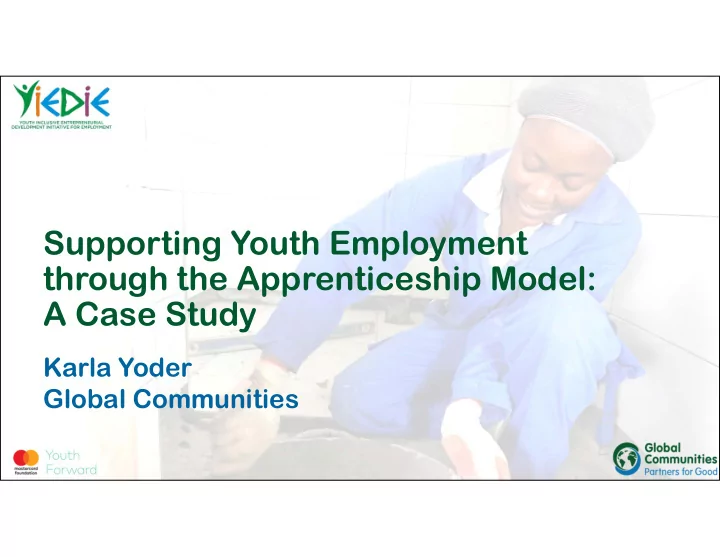
Supporting Youth Employment through the Apprenticeship Model: A - - PowerPoint PPT Presentation

supporting youth employment through the apprenticeship
SMART_READER_LITE
LIVE PREVIEW

Supporting Youth Employment through the Apprenticeship Model: A - - PowerPoint PPT Presentation

Supporting Youth Employment through the Apprenticeship Model: A Case Study Karla Yoder Global Communities YIEDIE Project Summary Goal: Create economic opportunities in Ghanas construction sector for nearly 24,000 disadvantaged youth


slide-1
SLIDE 1

Supporting Youth Employment through the Apprenticeship Model: A Case Study

Karla Yoder Global Communities

slide-2
SLIDE 2

YIEDIE Project Summary

  • Goal: Create economic opportunities in Ghana’s

construction sector for nearly 24,000 disadvantaged youth ages 17‐24

  • Implemented by Global Communities in partnership

with Mastercard Foundation

  • Five years: 2015‐2020
  • Five cities: Accra, Kumasi, Sekondi‐Takoradi, Ashaiman

and Tema

  • Components:
  • Skills training, support services and access to finance for youth to obtain

employment or start their own businesses

  • Collaborate with sector stakeholders to improve the enabling environment for

youth employment in construction

slide-3
SLIDE 3

3

Traditional vs Improved Apprenticeship

Agreement between master craftsperson and apprentice or parents Average duration of 3 years $40 ‐ $140 + supplies and uniforms Skills assessment done by master trainer MOU between master and a TVET institution that places youth 6 months $100 in TVET fees + practice materials and personal protective equipment Nationally‐recognized proficiency certification

slide-4
SLIDE 4

Elements of the Model

  • Curriculum development
  • Identification of master

craftspeople

  • Youth placement
  • Materials provision
  • Entrepreneurship training
  • Counseling sessions
  • Certification
slide-5
SLIDE 5

Outcomes

  • 16,020 youth (12,775 men and 3,245

women) trained by 1,787 master trainers

  • One-year follow-up:
  • 66% had been employed or self-

employed in the past 12 months

  • 27% had a business, 48% worked for
  • thers, 15% had multiple livelihoods
  • 26% continued to work with the master

craftspeople who trained them

  • Master trainers continue to deliver

condensed training and use the curriculum

Trade Area Number of Youth Trained Carpentry 506 Draftsmanship 183 Electrical technician 2,759 Fiberglass and aluminum fabrication 2,291 Interior decoration 2,931 Heavy machine operation 2,287 Masonry 1,122 Metal fabrication 1,721 Painting 578 Plaster of Paris design 77 Plumbing 421 Steel bending 292 Survey technical assistant 141 Tile laying 711 Grand Total 16,020

slide-6
SLIDE 6

Lessons Learned

  • Six-month training period not

sufficient for some trades

  • Differing delivery of

curriculum across workshops and cohorts

  • Limits to increasing women’s

participation in non- traditional occupations

slide-7
SLIDE 7

Recommendations

  • Site visits and performance

assessments

  • Pre-training assessments to

allow customization

  • Ensure proximity of

apprentices to master craftspeople

  • Gender-sensitivity and anti-

harassment training

slide-8
SLIDE 8

Thank you!

kyoder@globalcommunities.org