Support and Disclaimer The Forgotten Need: Supported by the - - PowerPoint PPT Presentation

support and disclaimer the forgotten need
SMART_READER_LITE
LIVE PREVIEW

Support and Disclaimer The Forgotten Need: Supported by the - - PowerPoint PPT Presentation

2/23/2017 Support and Disclaimer The Forgotten Need: Supported by the National Institute for Dental Oral Care in Underserved Patients and Craniofacial Research RO3DE165701 R21 DEO18523 U54 DE142501 ( CAN-DO I) Susan A.


slide-1
SLIDE 1

2/23/2017 1

The Forgotten Need: Oral Care in Underserved Patients

Susan A. Fisher-Owens, MD, MPH, FAAP

UCSF Care of the Vulnerable and Underserved February 23, 2017

1

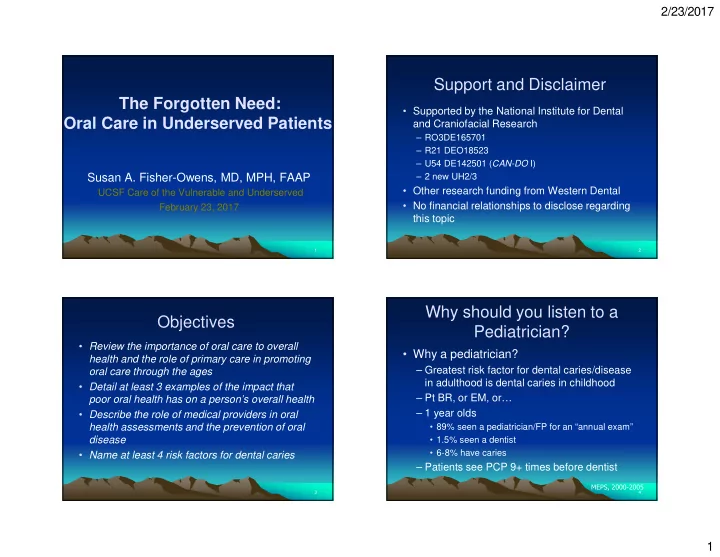
Support and Disclaimer

  • Supported by the National Institute for Dental

and Craniofacial Research

– RO3DE165701 – R21 DEO18523 – U54 DE142501 (CAN-DO I) – 2 new UH2/3

  • Other research funding from Western Dental
  • No financial relationships to disclose regarding

this topic

2

Objectives

  • Review the importance of oral care to overall

health and the role of primary care in promoting

  • ral care through the ages
  • Detail at least 3 examples of the impact that

poor oral health has on a person’s overall health

  • Describe the role of medical providers in oral

health assessments and the prevention of oral disease

  • Name at least 4 risk factors for dental caries

3

Why should you listen to a Pediatrician?

  • Why a pediatrician?

– Greatest risk factor for dental caries/disease in adulthood is dental caries in childhood – Pt BR, or EM, or… – 1 year olds

  • 89% seen a pediatrician/FP for an “annual exam”
  • 1.5% seen a dentist
  • 6-8% have caries

– Patients see PCP 9+ times before dentist

MEPS, 2000-2005

4

slide-2
SLIDE 2

2/23/2017 2

…About oral health???

  • Big issue in children…
  • Dental caries--the most common chronic

disease of childhood

Gift, 1992; Surgeon General’s Report 2000; Brown 1996; Macek 2004; Pew 2014; NCHS 1996, NHANES III

5

…About Oral Health?

  • Increasing prevalence with age--bigger

issue in adults

  • By end of life, nearly every American has

had complications with his/her teeth

6

…About oral health???

  • Huge area of disparities—great test case

7

Not just pretty teeth

Being free of chronic oral-facial pain conditions, oral and pharyngeal (throat) cancers, oral soft tissue lesions, birth defects such as cleft lip and palate, and scores of other diseases and disorders that affect the oral, dental, and craniofacial tissues

SGR, 2000

8

slide-3
SLIDE 3

2/23/2017 3

…As people with hearts

Would you miss:

Eating salad? Crunching on an apple? Being allowed to play

  • utside?

Going to school? Being able to get a job?

Photos courtesy of Operation Smile What would it be like, seeing yourself for the first time?

Why should you care?

9

…As people who pay taxes

  • The nation’s yearly dental bill, 2014: >$113.5 billion

– Tens of billions of dollars in direct medical care and indirect costs of chronic craniofacial pain conditions such as temporomandibular disorders, trigeminal neuralgia, shingles, or burning mouth syndrome – $100,000 minimum individual lifetime costs of treating craniofacial birth defects such as cleft lip and palate – Costs of oral and pharyngeal cancers and autoimmune diseases – Costs associated with the unintentional and intentional injuries that so often affect the head and face – Social and psychological consequences and costs…

  • California’s National Guard

Wall, 2015; Health Care Financing Administration 2000; Surgeon General’s Report 2000; Belt, 2005

Why should you care?

10

The Emergency Department

  • 2.5% of all visits for adults 18 to 44--for

nontraumatic dental pain

  • Increasing at 3 times the rate of other

reasons for ED visits

  • In 2012, 2.18 million visits (0-18 10%)

– Cost $1.6 billion, averaging ~$750 per visit – Mostly self-pay or government insurance – Almost 80% could be diverted, but 70%

  • utside regular dentists’ hours

Sun et al, AJPH 2015; Lee et al, AJPH 2012; Wall, Vujicic 2015

11

Disparities

12

slide-4
SLIDE 4

2/23/2017 4

Inequities in Oral and Systemic Health

  • Before ACA, over 46 million Americans

lacked health insurance, 108 million lacked dental insurance

– Essential benefit vs. mandatory

  • Adults, especially those with chronic

conditions, often cite oral health as their top unmet health need

SGR, 2000; Davidoff, 2005; Belt, 2005

13

Inequities

  • Concentrated

– ~80% of disease in 25% of children – 18% in low-risk group

Brown, 1996; Vargas, 1998; Kaste, 1999; Healthy People 2010, 2000; NCCP, 2006

Why should you care?

14

Race/Ethnic Disparities

  • Greatest area of health care disparities--

race/ethnic

– For children 2-5 years, 75% of caries occurred in 8%

  • f population (non-Hispanic blacks, or Mexican

Americans)

Brown, 1996; Vargas, 1998; Kaste, 1999; Healthy People 2010, 2000; NCCP, 2006

Disparities

15

Race/Ethnic Disparities, cont’d

  • Greatest area of health care disparities--race/ethnic

– Mexican-American

  • Ages 2-19 years--almost 2x rate of untreated dental caries as

white or black non-Hispanic children

  • Even as young as 12-23 months old, Mexican-American

children 3.5-4.6x more likely to have caries than children of

  • ther racial/ethnic backgrounds

– American Indian and Alaska Natives ages 2-4 years: 5x the national average for caries, increasing to ages 15-19 years, when 91% of the population has caries (Indian Health Service, 2002)

  • 1/4th report not smiling for fear of teeth appearance
  • 1/3rd miss school because of tooth pain

Brown, 1996; Vargas, 1998; Kaste, 1999; Healthy People 2010, 2000; NCCP, 2006

Disparities

16

slide-5
SLIDE 5

2/23/2017 5

Children of color are 2-3x more likely to have untreated decay as white children

8 17 23 16 10 20 30 White Black Chinese Hispanic % of Children With Untreated Caries

% of SFUSD Kindergarten Children with Untreated Caries by Race/Ethnicity, 2012-2013 SFUSD, 2013

17

Socioeconomic Disparities

  • Rates 4.4 times

higher in 12-23 mo for children < 125% FPL

  • All cases in kids

<200% FPL

  • 12 times as many

restricted activity days

Health People 2010, 2000; US GAO, 2000

Disparities

18

ADA 2016

19

ADA 2016

20

slide-6
SLIDE 6

2/23/2017 6

ADA 2016

21

Attitudes Consistent Across Income Levels and Age Groups…

ADA 2016

22

Except…

ADA 2016

23

Overlap of Race/Ethnicity and Poverty

Why should you care?

24

slide-7
SLIDE 7

2/23/2017 7 Children in some SF neighborhoods have experienced 2-3x more caries

Chinatown North Beach Nob Hill/Russian Hill/Polk Tenderloin South of Market Bayview/Hunter’s Point Visitation Valley Excelsior Portola

25

Disparities in Services

  • Socioeconomic

– Children near Federal Poverty Level (FPL) are 50% as likely to have sealants as those >200% of the FPL

  • Race/ethnic

– Rates for sealants for black and Mexican-American children are 33% lower than those for white children

Dye 2007

Why should you care?

26

Pew, 2016

27 28

slide-8
SLIDE 8

2/23/2017 8

Association of Race/Ethnicity and Oral Health Outcomes

Fisher-Owens et al, JPHD 2012

29

Assn of Race/Ethnicity and Oral Health Outcomes--Model 1

Fisher-Owens et al, JPHD 2012

30

Assn of Race/Ethnicity and Oral Health Outcomes—Models 1--> 5

Fisher-Owens et al, JPHD 2012

31

Impact of Oral Disease-- Children and Families

32

slide-9
SLIDE 9

2/23/2017 9

33

Increased Costs

  • Cost to the health care system

– Direct – Indirect

  • Learning and school performance

– Impact on child – Impact on schools

  • Additional costs—eg, parents time lost to

work

CHRONIC CARIES EFFECT References: Vujicic 2013, Taylor 2009, Casamassimo 2009

School Impact

  • 117,000 hours of school lost per 100,000

school-age children, with an additional 17,000 activity days beyond school time restricted per 100,000 individuals

  • ~52 million school hours annually
  • 874,000 days in CA last year

34

Oral-Systemic Disease Connections

  • Children and poor school performance

– Increased 1.4 times with poor oral OR poor general health – Increased 2.3 times with poor oral AND general health

Blumenshine ,SGR, 2000

References: Blumenshine 2008; Taylor 2009 35

Oral-Systemic Connections

  • Eg, ADHD

– Medications – Self-medication – Higher dental anxiety – Higher caries rates (12x) – Higher traumatic injury rates – Lower executive function – Different dietary habits – Worse homecare habits

36

slide-10
SLIDE 10

2/23/2017 10

Picture taken from Huffington Post

Why should you care?

37

Linda Davidson / The Washington Post

Why should you care?

38

Mouth’s Role in Body

  • Integral to systemic

health

– Productivity – Quality of life

  • Portal/Pros

– Entryway of nutrition – Source of communication, pleasure, social interaction, and cultural facial and dental esthetics

http://digestive.niddk.nih.gov/ddiseases/pubs/barretts/ Hollister, 1993; SGR, 2000

39

Mouth’s Role in Body, cont’d

  • Portal/Cons

– Infection or inflammation portal

http://digestive.niddk.nih.gov/ddiseases/pubs/barretts/ SGR, 2000; Sheiham, 2000

40

slide-11
SLIDE 11

2/23/2017 11

Impact of Disease on Adults

  • Oral-systemic disease connections

– Heart and lung diseases – Stroke – Low-birth-weight, premature births – Diabetes – Dementia

Health Care Financing Administration 2000; JADA 2016

41

Adults with Heart Disease

  • Routine periodontal treatment decreased

cost of dental care

  • AND overall medical care—by 25%

Taylor, 2009

42

Adults with History of Stroke

  • Routine periodontal treatment decreased

cost of dental care

  • AND overall medical care—by 35%

Taylor, 2009

43

Adults with Diabetes

  • Routine periodontal treatment decreased

cost of dental care

  • AND overall medical care—by 28%

Taylor, 2009

44

slide-12
SLIDE 12

2/23/2017 12

Pregnancy

  • Low birth weight
  • Premature birth

45

Dementia

  • “Cold sores” (HSV1) linked to cognitive decline

(Bearer 2011)

  • Poor dental health increased the likelihood of

dementia by 30-40% over a 32-year period, regardless of cardiovascular status (Sighrao 2015)

– Tooth loss, studied over 13 years in China (Li,)

  • More likely to have incidents/accidents (Kobayashi

2016)

  • Periodontitis and cognitive decline in

Alzheimer’s patients (Ide 2016)

46

ESRD

  • ¼ of patients never brushed their teeth

(Ruospo 2014)

– Only a minority ever flossed

  • Poorer dental health associated with early

death in pts on hemodialysis (Palmer 2015)

47

Not Enough Free Tooth Brushes in the World

From Dr. Zea Malawi, adapted from T. Frieden, AJPH, 2010.

48

slide-13
SLIDE 13

2/23/2017 13

Oral-Systemic Disease Connections, cont’d

  • Common risk factors

– Poor diet, substance use, poor hygiene, and stress

  • Benefitted by nutrition, sanitation, hygiene

improvements

  • For both, disparities often associated with

race/ethnicity, gender, income, education, geographic location, insurance coverage, chronic conditions, age, and health literacy

SGR, 2000; Seiham, 2000 49 50

Communicability/ “Transmissability”

  • Biologic
  • Non-biologic

– Dental anxiety – Society norms

CHRONIC CARIES EFFECT Kanegane 2009; Valencia-Rojas 2008 51

Communicability

  • Biologic
  • Non-biologic

– Dental anxiety

  • Higher with previous negative experience (Kanegane)
  • In parent

– Society norms

CHRONIC CARIES EFFECT Kanegane 2009; Valencia-Rojas 2008 52

Communicability

  • Biologic
  • Non-biologic

– Dental anxiety

  • Higher with previous negative experience (Kanegane)
  • In parent

– Society norms

CHRONIC CARIES EFFECT Kanegane 2009; Valencia-Rojas 2008

slide-14
SLIDE 14

2/23/2017 14

Communicability

  • Biologic
  • Non-biologic

– Dental anxiety

  • Higher with previous negative experience (Kanegane)
  • In parent

– Society norms

CHRONIC CARIES EFFECT

Kanegane 2009; Valencia-Rojas 2008

53 54

Actions Providers Can Take

  • Fluoride Varnish
  • Counselling
  • Advocacy

55

56

Dental Decay ≠ Rotting Wood

acid Bacterial biofilm decay

Early Cavities Can Be Arrested or Reversed Improved oral hygiene Improved diet Fluoride applications

56

slide-15
SLIDE 15

2/23/2017 15

Adapted from Featherstone, BMC Oral Health 2006

57

Fluoride’s mechanism(s)

  • Cariostatic
  • 4 mechanisms

– Enhances tooth (re)mineralization – Arrests/reverses tooth demineralization – Inhibits acid-producing bacteria responsible for caries – Decreases enamel solubility

  • Works via saliva and plaque

– Concentrates in plaque – Primarily topical effect, even when given systemically

58

Sources of fluoride

  • Natural

– Mineral, in phosphate rock – Naturally dissolves in water—just adjusting level – Tea – Seafood

  • Toothpaste (range from 0-prescription)

59

Clinical Sources of fluoride

  • Community fluoridated water

– ~74% of US population have access – Recommended level of 0.7 mg/L

  • Toothpaste
  • Tablets
  • Varnish

60

slide-16
SLIDE 16

2/23/2017 16

61Optimal fluoride dose: 0.05 mg/kg/day

1 cup of water ~ 0.25mg

Bottled Water

62 63

http://www.sierraclub.org/committees/cac/water/bottled_water/

64

slide-17
SLIDE 17

2/23/2017 17

  • Increased use of bottled water in children
  • f Latino or African American heritage

(Gorelick 2011)

Disparities

65

Disparity in Access to CWF Rural vs Urban

  • Mean present population with access to

fluoridated water

– Urban 72.6% – Rural 64.6%

  • Dentists per 1,000 population (adults or

pediatric provider

– Urban 0.51 – Rural 0.33

  • Also, significantly fewer dental visits

66

Hendryx 2010

67

Graphic prepared by Eugenio Beltran of

  • CDC. , from 1999-

2004 data for 12-19 yo

68

slide-18
SLIDE 18

2/23/2017 18

Fluoride Varnish

  • Can and should be applied during well

child visits

– ?Retirement homes?

  • Meaningful Use measure
  • CPT code—99188 (or D1203)

69

…As Pragmatists

  • ROI—<1$ cost, can be reimbursed $18
  • Savings—$0.15 saved/$1 spent
  • Almost 2/3 disease reduction (Ng 2012)
  • --AND NOT HARD TO WORK INTO

WORKFLOW!!

Why should you care?

70

Counselling

71

Counselling

  • Case JV

72

slide-19
SLIDE 19

2/23/2017 19

73

Counselling

  • http://1.bp.blogspot.com/_PXqKN8TJUZA/

SKXbaSaMKVI/AAAAAAAAABM/2Qp2a3f _8Q4/s1600-h/fatkids.jpg

http://1.bp.blogspot.com/_PXqKN8TJUZA/SKXbaSaMKVI/AAAAAAAAABM/2Qp2a3f_8Q4/s1600-h/fatkids.jpg www.healingdaily.com/conditions/cavities.htm

74

Diet—very similar to obesity prevention

  • No juice/sugar-sweetened beverages
  • Limit concentrated carbohydrates

(dried fruit vs. lollipop)

  • Get off bottle as soon as possible

75

Motivational Interviewing

  • Pressure to change facilitates

resistance

  • Get patient to talk…you listen
  • Give choices (key!)
  • Acceptance facilitates change
  • Small steps

76

slide-20
SLIDE 20

2/23/2017 20

Oral Health Policy and Collaboration

Interprofessional education/meetings Shared best practices Evidence based primary care oral health models Dental providers train primary care providers Primary care providers can train dentists : chronic disease and behavior management Joint campaigns Brush, Book, Bed Water fluoridation

77 78

Advocacy

79

Other Opportunities for Engagement

  • Lobby

– Workforce issues – Policies requiring screening without treatment – Dental in FQHCs – Community Water Fluoridation – SCHIP and dental – Research funding

  • AAP committee
  • Referral lists

…As Advocates

80

slide-21
SLIDE 21

2/23/2017 21

Community Water Fluoridation

  • 25% disease reduction (Kumar 2014)
  • Almost $10 saved for every dollar invested

in CWF (Edelstein 2015)

  • Campaign for Dental Health

http://www.ilikemyteeth.org/

SGR, 2000; Sheiham, 2000

81

Summary

  • Oral health problems are common and can be

severe

  • Key disparities in oral health—affecting our

patients!

  • Water

– Encourage consumption of water, particularly fluoridated water in high-risk patients

  • Oral health affects systemic health

– Dental referrals are not enough

82

Questions? Susan.Fisher-Owens@ucsf.edu

83

Thank you!

84

slide-22
SLIDE 22

2/23/2017 22

85

  • A few weeks after I started researching

this story, I developed a sore throat. My glands were swollen, and I felt tired and

  • lightheaded. I'd been traveling a lot—by

planes, trains, and subway—and I had spent time on college campuses and in

  • clinics. Since swine flu had just hit the

United States, I wondered whether I'd picked up the virus somewhere along the way…

June Thomas, Slate Sept 28, 2009

86

  • Then one morning, I bit into a piece of

toast and felt a sharp pain. It was as if I had driven a pin deep into the gum…

  • If the sickness was located anywhere
  • ther than in my mouth, a visit to the

doctor would be covered by my medical

  • insurance. A trip to the dentist's office, on

the other hand, could cost me serious money.

June Thomas, Slate Sept 28, 2009

87

Percentage of women delivering in California who received no dental care during pregnancy, by race/ethnicity: MIHA 2002-2007

66% 54% 61% 54% 82% 69% 50% 64% 48% 63% 50% 55% 58% 77% 0% 20% 40% 60% 80% 100%

African American American Indian API not US- born API US-born Latina not US- born Latina US- born European American

All women (n=21,732) Women w/dental problem (n=11,346)

88

slide-23
SLIDE 23

2/23/2017 23 Main reason for not receiving dental care during pregnancy among women with dental problems, MIHA 2004-2007 (n=8,558)

28% 21% 21% 19% 11% Financial barriers Attitudinal barriers No perceived need Patient thought care unsafe Provider advised against care

89

Key findings

  • About half of all women reported a dental

problem of some sort during pregnancy

  • Approximately two-thirds did not receive

dental care during pregnancy, even among those reporting a problem

– Disparities existed by income, education, race/ethnicity – But, prevalence of no care high even among women with moderate incomes or some college education

90 91

…As world citizens

Why should you care?

92