
SLIDE 1
18TH INTERNATIONAL CONFERENCE ON COMPOSITE MATERIALS
1 Introduction One-dimensional magnetic nanostructures have recently attracted much attention because of their intriguing properties that are not realized by their bulk or particle form[1]. These nanostructures are also potentially useful for the application to ultrahigh-density data storage, as well as the sensor and bulletproof vest[2-4]. The magnetic particles in magnetic nanofibers of blending types can’t fully align along the external magnetic field because magnetic particles are arrested in solid polymer
- matrix. To improve the mobility of magnetic
particles, we used magneto-rheological fluid (MRF) having the good mobility and dispersibility. Superparamagnetic core/sheath composite nanofibers were obtained with MRF and poly- ethylene terephthalate (PET) solution via a coaxial electrospinning technique. Coaxial electrospinning is suitable for fabricating core/sheath nanofibers encapsulating MRF materials within a polymer
- sheath. The magnetite nanoparticles in MRF were
dispersed within core part of the nanofibers. This study aimed to fabricate core/sheath magnetic composite nanofibers using coaxial electrospinning and characterize several properties. In this study, we report the successful fabrication of core/sheath structured magnetic nanofibers by coaxial
- electrospinning. Optimum conditions (flow rate,
applied voltage and distance) to fabricate core/sheath structured magnetic nanofibers with uniform dispersion of magnetic nanoparticles in the core part were explored. The magnetic and mechanical features of the magnetic nanofibers were characterized.
- 2. Experimentals
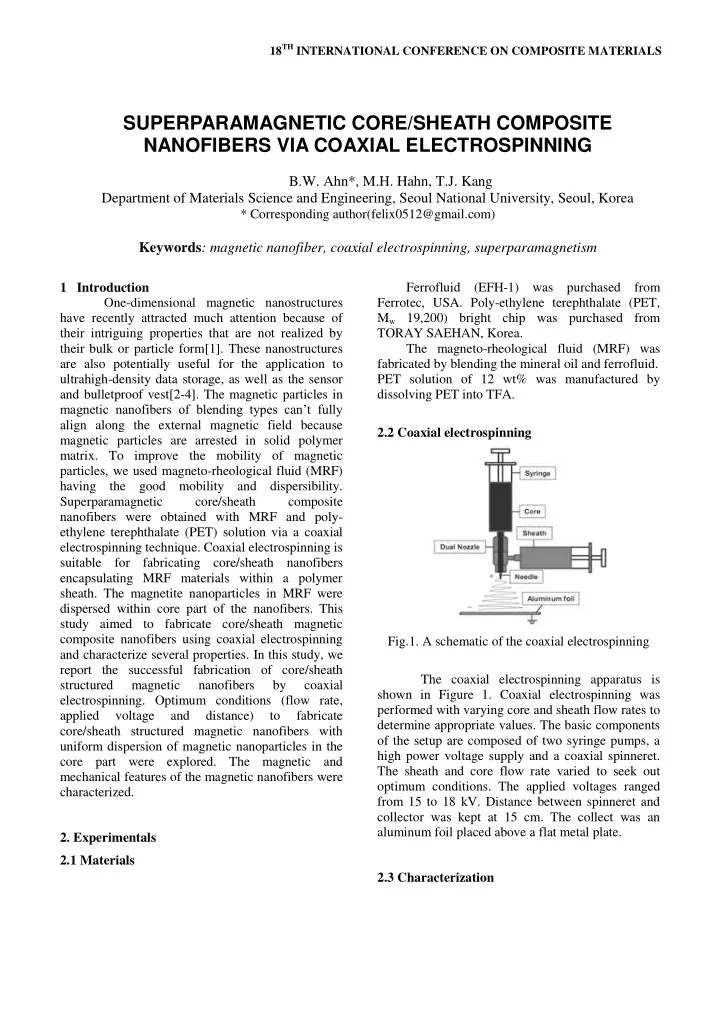
2.1 Materials Ferrofluid (EFH-1) was purchased from Ferrotec, USA. Poly-ethylene terephthalate (PET, Mw 19,200) bright chip was purchased from TORAY SAEHAN, Korea. The magneto-rheological fluid (MRF) was fabricated by blending the mineral oil and ferrofluid. PET solution of 12 wt% was manufactured by dissolving PET into TFA. 2.2 Coaxial electrospinning Fig.1. A schematic of the coaxial electrospinning The coaxial electrospinning apparatus is shown in Figure 1. Coaxial electrospinning was performed with varying core and sheath flow rates to determine appropriate values. The basic components
- f the setup are composed of two syringe pumps, a
high power voltage supply and a coaxial spinneret. The sheath and core flow rate varied to seek out
- ptimum conditions. The applied voltages ranged