Supernova remnants as cosmic ray laboratories Tony Bell University - - PowerPoint PPT Presentation

supernova remnants as cosmic ray laboratories
SMART_READER_LITE
LIVE PREVIEW

Supernova remnants as cosmic ray laboratories Tony Bell University - - PowerPoint PPT Presentation

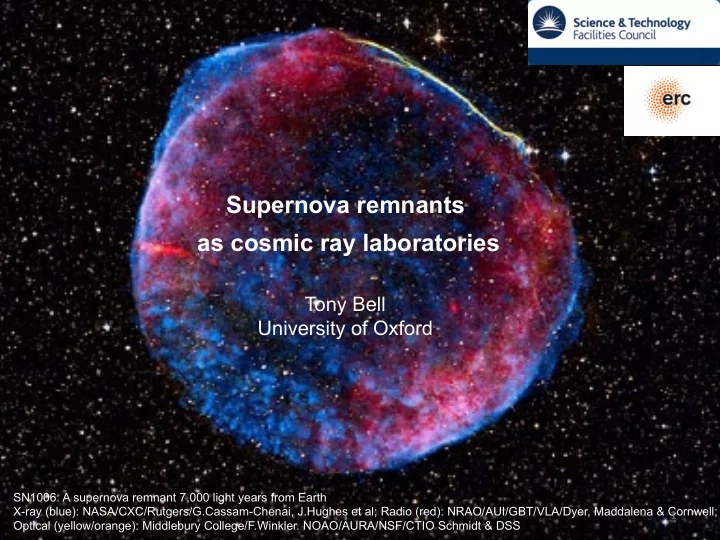
Supernova remnants as cosmic ray laboratories Tony Bell University of Oxford SN1006: A supernova remnant 7,000 light years from Earth X-ray (blue): NASA/CXC/Rutgers/G.Cassam-Chenai, J.Hughes et al; Radio (red): NRAO/AUI/GBT/VLA/Dyer, Maddalena


slide-1
SLIDE 1

Supernova remnants as cosmic ray laboratories

Tony Bell University of Oxford

SN1006: A supernova remnant 7,000 light years from Earth X-ray (blue): NASA/CXC/Rutgers/G.Cassam-Chenai, J.Hughes et al; Radio (red): NRAO/AUI/GBT/VLA/Dyer, Maddalena & Cornwell; Optical (yellow/orange): Middlebury College/F.Winkler. NOAO/AURA/NSF/CTIO Schmidt & DSS 1

slide-2
SLIDE 2

g

r

! 1) Spatial confinement

Larmor radius less than size of accelerating plasma

"

# = %

&'

CR energy in eV

( < *+, 2) All acceleration comes from electric field

  • = −/×+

velocity of thermal plasma Maximum energy gain: maximum electric field !× ( < /+,

  • = −/×+

Physics behind Hillas energy

CR

Please note: I use T for CR energy (E is electric field)

2

slide-3
SLIDE 3

To get to maximum (Hillas) energy: optimally correlated

Where is the electric field in shock acceleration?

shock upstream Scattering on random magnetic field downstream !" = −%"×' !( = −%(×' %" %( Random E due to turbulent B

+, +- = v. 0 ⇒ + , +- = 2. v×3

CR energy gain: v , 3

3

slide-4
SLIDE 4

Hillas: necessary but not sufficient

The case of diffusive shock acceleration shock upstream !" diffusion coefficient #"= downstream !$ diffusion coefficient #$= Lagage & Cesarsky (1983): %&''() = 4 #" !"$ + #$ !$$

%&''() =

  • !"

#./01 = 23

4

3 !$ = !" 4 #$ !$$ ≪ #" !"$ (debatable)

7 = 3 4 89 8:;<=

>`9

!"@- equivalent to 7 = 1 4 B CD

>`9

!"@-

Assuming that

Maximum CR energy is To reach Hillas energy: need scattering length equal to Larmor radius B~CD This is Bohm diffusion

CD Bohm diffusion

4

slide-5
SLIDE 5

A disordered field needs some structure on Larmor scale

  • f every particle being accelerated (GeV to PeV/EeV).

OK for shocks (Fourier components of delta function) OK for broad spectrum turbulence Problematic for magnetic reconnection, shear acceleration

Hillas: necessary but not sufficient

General considerations: getting to Hillas energy ! = −$×& depends on frame CR to need to move relative to u u = 0 frame ) = *+, CR to need to move distance L parallel to −$×& electric field ) = ∫ v. ! dl In disordered field need correlation between v and E E . Makes Fermi1 better than Fermi2 (usually) ) = ∫ v. ! dl Needs Plasma Physics!

5

slide-6
SLIDE 6

Bohm diffusion indicated by synchrotron spectrum turnover

Cas A, Stage et al 2006

(ℎ#)%&= 3×10,

  • .

/

1

2 34

RXJ1737-3946 Uchiyama et al 2007 Cut-off frequencies Observed cut-off requires close to Bohm diffusion

Turnover frequency is

6

slide-7
SLIDE 7

Need amplified magnetic field

Magnetic field amplification increases to near equipartition (100s µG in SNR) PCR CR current in rest frame of upstream (moving) plasma forces drive non-resonant instability (Bell 2004,2005) produces turbulence amplifies magnetic field $%& $%&×( )

shock

7

slide-8
SLIDE 8

j x B j x B B

Cosmic ray Electric current Matthews et al (2017)

Magnetic field amplification

Instability grows until 1) Tension in field lines opposes j xB 2) CR get tied to field lines: Loop size = rg

Automatically saturates with and &~()

3 2

v c v ~

s cr s sat

U B r µ µ

8

slide-9
SLIDE 9

Historical shell supernova remnants

(interpretation: Vink & Laming, 2003; Völk, Berezhko, Ksenofontov, 2005)

Kepler 1604AD Tycho 1572AD SN1006 Cas A 1680AD Chandra observations

NASA/CXC/NCSU/ S.Reynolds et al. NASA/CXC/Rutgers/ J.Warren & J.Hughes et al. NASA/CXC/MIT/UMass Amherst/ M.D.Stage et al. NASA/CXC/Rutgers/ J.Hughes et al. 9

slide-10
SLIDE 10

B2/(8pr) (cgs) velocity

Magnetic field grows to near equipartition: limited by magnetic tension

Data for RCW86, SN1006, Tycho, Kepler, Cas A, SN1993J

Fit to obs (Vink):

G cm s km 10 700

2 / 1 3 2 / 3 1 4

µ ÷ ø ö ç è æ ÷ ÷ ø ö ç ç è æ »

  • e

n u B

G 1 . cm s km 10 400

2 / 1 2 / 1 3 2 / 3 1 4

µ h ÷ ø ö ç è æ ÷ ø ö ç è æ ÷ ÷ ø ö ç ç è æ »

  • e

n u B

Theory:

Vink (2008)

See also Völk, Berezhko, Ksenofontov, 2005

10

slide-11
SLIDE 11

Difficulty: need time to amplify magnetic field

PCR

L %& Need about 5 e-foldings in time

TeV 200

pc 2 7 2 / 1 01 .

R u n E

e

h »

Max CR energy

radius in parsec in 10,000 km s-1 in cm-3 Zirakashvili & Ptuskin (2008), Bell et al (2013) acceleration efficiency

For SNR parameters ⁄ ( %& ≈ *. ,×./0012 343567

11

slide-12
SLIDE 12

Non-resonant instability is best can do

! = #$% & Invert #'( = %$ & !') Compare with * = %×$ & ,) Instability growth rate 1) Makes optimal use of jxB force 2) Grows rapidly on small scale in initially weak B

Matthews et al (2017) 12

slide-13
SLIDE 13

Difficulty with perpendicular shocks (applies to high velocity shocks)

B into screen shock

B u E

shock ´

  • =

CR drift velocity

2

v B B E

drift

´ =

CR gain energy by drifting in E field

Without scattering, All CR get same energy gain No high energy tail

13

slide-14
SLIDE 14

CR acceleration at perpendicular shock

Jokipii 1982,1987

Strong scattering Weak scattering No scattering

Not to scale

Currents located close to shock Need very rapid magnetic field amplification

Previous discussions: Lemoine & Pelettier (2010), Sironi, Spitkovsky & Arons (2013), Reville & Bell (2014)

14

slide-15
SLIDE 15

Observed radio spectral index v. mean expansion velocity

(Klara Schure, following Glushak 1985)

ushock = c/3 ushock = c/30 ushock = c/300

Expected spectral index

15

slide-16
SLIDE 16

Fractional CR energy gain Fraction of cosmic rays lost

How particles are accelerated: diffusive shock acceleration

Shock velocity: ushock Cosmic ray density at shock: n

High velocity plasma Low velocity plasma B2 B1

shock Cosmic Ray

At each shock crossing

Krimskii 1977, Axford et al 1977, Bell 1978, Blandford & Ostriker 1978

∆" " = $%&'() * ∆+ + = − $%&'() *

Differential energy spectrum

  • (") ∝ "12

16

slide-17
SLIDE 17

Fractional CR energy gain Fraction of cosmic rays lost

How particles are accelerated: diffusive shock acceleration

Shock velocity: ushock Cosmic ray density at shock: n

Differential energy spectrum

High velocity plasma Low velocity plasma B2 B1

shock Cosmic Ray

At each shock crossing

Krimskii 1977, Axford et al 1977, Bell 1978, Blandford & Ostriker 1978

∆" " = $%&'() * 1 − -./0

  • 12

∆3 3 = − $%&'() *

4(") ∝ "8(98:;<=/:?@)/(A8:;<=/:?@ )

Now add in energy loss to Magnetic field amplification

17

slide-18
SLIDE 18

Observed radio spectral index v. mean expansion velocity ushock = c/3 ushock = c/30 ushock = c/300

!"#$/!&' 0.5 0.38 0.29 0.0

((*) ∝ *-(.-/012//34)/(5-/012//34 )

18

slide-19
SLIDE 19

One thing I have not mentioned – non-linear feedback

Reynolds & Ellison (1992) Comment: If the spectrum is steepened by other factors, non-linear curvature confined to low energies/frequencies (It has to be there, eg Drury & Völk 1981) From conclusions of Reynolds & Ellison

19

slide-20
SLIDE 20

General class of interactions producing magnetic field

Three species

  • Energetic particles: cosmic rays, fast/hot electrons in laser-plasmas
  • Thermal electrons
  • Slowly moving thermal ions

Interacting through

  • Electric field (to maintain neutrality)
  • Collisions (Coulomb, charge-exchange…)
  • Large scale magnetic field (‘frozen-in’)
  • (Sub-) Larmor-scale magnetic field (scattering, deflection)

Basic process

  • Mutual motion (advection/diffusion/drift)
  • Electric field secures neutrality
  • Curl(E

E ) generates B

20

slide-21
SLIDE 21

Borghesi et al 1998

Magnetic field generated by Biermann battery

Favoured source of primordial field

! = #$ %& ' = ()* ⇒ ,- ,. = #%×#0 %

21

slide-22
SLIDE 22

Weibel instability at shocks

Chang, Spitkovsky & Arons (2008)

Opposing electron beams: 1) Perturbed beam density 2) Magnetic field 3) Focus currents

Ramakrishna et al (2009)

Kinetic instability on scale c/wp

22

slide-23
SLIDE 23

Energetic electron beam focussed by magnetic field

Davies et al, PRE 59, 61032 (1999)

!" !# = %×(()*+,-)

)/+01/2 = − )*+,-

resistivity

23

slide-24
SLIDE 24

Fast Ignition laser laser Cold compressed DT Drill hole with laser Heat with very high power laser Cone target Kodama et al 2001 As first proposed by Tabak et al (1994)

24

slide-25
SLIDE 25

Experiment to test non-resonant instability (next summer)

Builds on series of experiments led by Gianluca Gregori

25

slide-26
SLIDE 26

Experiment next summer on OMEGA laser Experimental lead: Hui Chen (Livermore), Gianluca Gregori (Oxford)

26