Superfluid Fermi Gas Yoji Ohashi Department of Physics, Keio - - PowerPoint PPT Presentation

superfluid fermi gas
SMART_READER_LITE
LIVE PREVIEW

Superfluid Fermi Gas Yoji Ohashi Department of Physics, Keio - - PowerPoint PPT Presentation

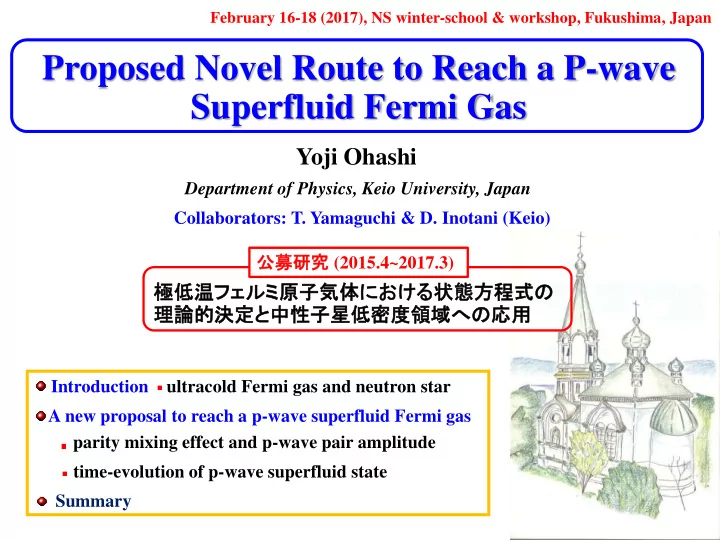
February 16-18 (2017), NS winter-school & workshop, Fukushima, Japan Proposed Novel Route to Reach a P-wave Superfluid Fermi Gas Yoji Ohashi Department of Physics, Keio University, Japan Collaborators: T. Yamaguchi & D. Inotani (Keio)


slide-1
SLIDE 1

Introduction ultracold Fermi gas and neutron star Department of Physics, Keio University, Japan

February 16-18 (2017), NS winter-school & workshop, Fukushima, Japan

Proposed Novel Route to Reach a P-wave Superfluid Fermi Gas

Yoji Ohashi

Summary A new proposal to reach a p-wave superfluid Fermi gas parity mixing effect and p-wave pair amplitude time-evolution of p-wave superfluid state Collaborators: T. Yamaguchi & D. Inotani (Keio)

極低温フェルミ原子気体における状態方程式の 理論的決定と中性子星低密度領域への応用

公募研究 (2015.4~2017.3)

slide-2
SLIDE 2

Current possible approach by human beings (21st century)

Equation of state (EoS)

internal structure

+ TOV eq.

“Mass-radius (MR)” relation

Obserbavle! Obserbavle! theorists on the earth experimentalists on the earth

(Tolman-Oppenheimer-Volkoff equation)

Neutron Star

slide-3
SLIDE 3

Qur strategy: Application of ultracold Fermi gas system as a quantum simulator for neutron star

Homepage of Gonokami Lab, University of Tokyo 6Li Fermi gas cloud

5 8

10 ~10  

Fermi atoms (6Li, 40K) are trapped in a magnetic/optical potential, and are cooled down to <O(mK), where quantum effects are important. In this gas system, one can tune the strength of an interaction between atoms by using a Feshbach resonance.

slide-4
SLIDE 4

Phase diagram of an ultracold Fermi gas neutron star

pairing interaction

~ 0

F e

p r

( 2.7fm)

e

r 

~

neutron star cold Fermi gas

3

e F

p r 

effective range re ②

+

slide-5
SLIDE 5

cold Fermi gas physics meets neutron star physics!

Cold Fermi gas EOS Neutron star EOS

Horikoshi, Koashi, Gonokami, Tajima, Ohashi, arXiv: 1612.04026

Strong-coupling theory Inclusion of pairing fluctuations beyond MF level

slide-6
SLIDE 6

cold Fermi gas physics meets neutron star physics!

Cold Fermi gas EOS Neutron star EOS

p-wave SF ?

Horikoshi, Koashi, Gonokami, Tajima, Ohashi, arXiv: 1612.04026

slide-7
SLIDE 7

cold Fermi gas

+

theory Neutron star p-wave SF

EoS

difference between cold Fermi gas and neutron star physics

Next strategy: approach to deeper inside neutron star using a p-wave superfluid Fermi gas

NO EXPERIMENTAL DATA!

slide-8
SLIDE 8

Difficulty in achieving a p-wave superfluid Fermi gas

A tunable p-wave pairing interaction has been realized in an ultracold Fermi gas.

However,

this interaction, which is necessary to form p-wave Cooper-pairs, destroys the system, before the p-wave state grows enough! p-wave interacting Fermi gas

c

T T 

p-wave SF? three-body particle loss

lifetime ~5-20 ms

23Na

MIT Science 1998

~100 ms

slide-9
SLIDE 9

Difficulty in achieving a p-wave superfluid Fermi gas

A tunable p-wave pairing interaction has been realized in an ultracold Fermi gas.

However,

this interaction, which is necessary to form p-wave Cooper-pairs, destroys the system, before the p-wave state grows enough!

s-wave superfluid Fermi gas

EOS measurement Theory NS-EOS

idea

Realization

  • f p-wave SF

p-wave superfluid Fermi gas

slide-10
SLIDE 10

The purpose of this talk

We theoretically propose a novel idea to reach a p-wave superfluid Fermi gas. Using this proposal, one may be able to overcome the long-standing difficulty that all the cold Fermi gas experiments aiming to realize this unconventional Fermi superfluid.

'

( ' ( ) ( ( ') ) , ') U

 

     r r r r r r

superfluid order parameter

pairing interaction Cooper-pair amplitude

  • wave

p

U

p-wave interacting Fermi gas

  • wave
  • wave

p p

U    

c

T T 

  • wave

p

U

c

T T 

~

'

( ) ( ')

 

  r r

  • wave
  • wave

p p

U   

'  

 

  • wave

p

U

'

( ) ( ')

 

  r r

c

T T

  • wave
  • wave

p p

U   

'  

 

slide-11
SLIDE 11

The purpose of this talk

We theoretically propose a novel idea to reach a p-wave superfluid Fermi gas. Using this proposal, one may be able to overcome the long-standing difficulty that all the cold Fermi gas experiments aiming to realize this unconventional Fermi superfluid.

'

( ' ( ) ( ( ') ) , ') U

 

     r r r r r r

superfluid order parameter

pairing interaction Cooper-pair amplitude NO p-wave interaction

e '

  • wav

p  

     

'

( ) ( ')

 

  r r

  • wave

p

U 

'

( ) ( ')

 

  r r

  • wave

p

U 

  • wav
  • w

e a ' ve p p

U

 

     

  • wave

p

 

5~20ms

slide-12
SLIDE 12

STEP 1

How to produce p-wave amplitude without using p-wave interaction

slide-13
SLIDE 13

Parity mixing effect caused by a synthetic spin-orbit coupling

  • MIT. PRL 109, 095302 (2012)

Cold Fermi gas physics can now introduce an antisymmetric spin-orbit coupling to the system by using an artificial gauge field technique.

6Li

p

spin-orbit z x

H p   

pairing symmetry spin-singlet × even parity spin-triplet × odd parity

Parity-mixing occurs! Parity is broken!

slide-14
SLIDE 14

S-wave superfluid Fermi gas with a synthetic spin-orbit coupling

† † † † /2 /2 ' /2 ' /2 , ',

  • wave

( , )

z s z

c H c c c c U p c p c c  m   m 

             

              

 

p p p p p q p q p q p q p p p q p p

Parity-broken s-wave superfluid Fermi gas Spin-orbit coupling S-wave pairing interaction BCS-Leggett strong-coupling theory at T=0

  • wave
  • wave

s s

U c c

   

  

p p p

s-wave superfluid state

  • wave

sgn( 1 1 4 )

s z

p c c c c E E

       

             

p p p p p p p

2 2

  • wave

| ( ) |

z s

p E   m

 

   

p p

p-wave Cooper-pair amplitude s-wave superfluid order parameter p-wave order parameter

slide-15
SLIDE 15

Induced p-wave Cooper-pair amplitude in the s-wave state

2

/ c c N

  

p p p

p-wave pair amplitude BCS BEC

Yamaguchi, YO, PRA 92, 013615 (2015)

slide-16
SLIDE 16

STEP 2

How to reach a p-wave superfluid state, within the lifetime, 5~20ms

slide-17
SLIDE 17

Tunable Feshbach interaction adjusted by external magnetic field

In 40K and 6Li Fermi gases, we can tune a pairing interaction by adjusting an external magnetic field.

B

  • wave

p

B

  • wave

s

B

s-wave interaction p-wave interaction

  • wave
  • wave

s s

U c c

   

  

p p p

c c

  

p p

Feshbach resonance

slide-18
SLIDE 18

Tunable Feshbach interaction adjusted by external magnetic field

In 40K and 6Li Fermi gases, we can tune a pairing interaction by adjusting an external magnetic field.

B

  • wave

p

B

  • wave

s

B

p-wave interaction

  • wave
  • wave

s s

U c c

   

  

p p p

c c

  

p p

  • wave

'

  • '

wave(

( ) , ')

z

p p

c c U

  

  

p p p

p p p

0! p-wave superfluid Fermi gas !

t 

Feshbach resonance

slide-19
SLIDE 19

Time-dependent Bogoliubov de Gennes (TdBdG) analysis

  • wave
  • wave

s s

U c c

  

  

p p p

c c

  

p p

t

s-wave spin-orbit

, U 

  • wave

z

p

U

  • wave

*

  • wave

( , ) ( , ( ) ) ( )

z z

p p

t i t t t t                

p p p p

p p

Equilibrium s-wave state

slide-20
SLIDE 20

Time-dependent Bogoliubov de Gennes (TdBdG) analysis

1 3 1 F

  • wave:(

)

  • wave: (

)

s z F p

s k a p k v

 

  

1

~

F

 

In our idea, the p-wave order parameter grows much faster than the system lifetime (~5-20ms).

slide-21
SLIDE 21

Time-dependent Bogoliubov de Gennes (TdBdG) analysis

1 3 1 F

  • wave:(

) 1

  • wave: (

) 6

s z F p

s k a p k v

 

    

Non-vanishing p(t>>0) is obtained when the initial momentum distribution is taken to be close to that in the final equilibrium p-wave state.

1 3 1 F

  • wave:(

)

  • wave: (

)

s z F p

s k a p k v

 

  

slide-22
SLIDE 22

Summary

We have proposed a novel idea to realize a p-wave superfluid Fermi gas. Our approach separately prepares p-wave pair amplitude without relying on any p- wave interaction, but using parity-broken spin-orbit coupling. Thus, it may

  • vercome the current experimental difficulty (short system lifetime (=5~20 ms

<<100 ms) by p-wave interaction).

p-wave Cooper-pair amplitude p-wave superfluid state

Our idea involves potential importance of cold Fermi gas system for the study

  • f non-equilibrium problems, such as PBF mechanism of neutron-star cooling.