Superconducting Qubits Ryan Martin 8/2/06 SBCC Major: Electrical - - PowerPoint PPT Presentation

superconducting qubits
SMART_READER_LITE
LIVE PREVIEW

Superconducting Qubits Ryan Martin 8/2/06 SBCC Major: Electrical - - PowerPoint PPT Presentation

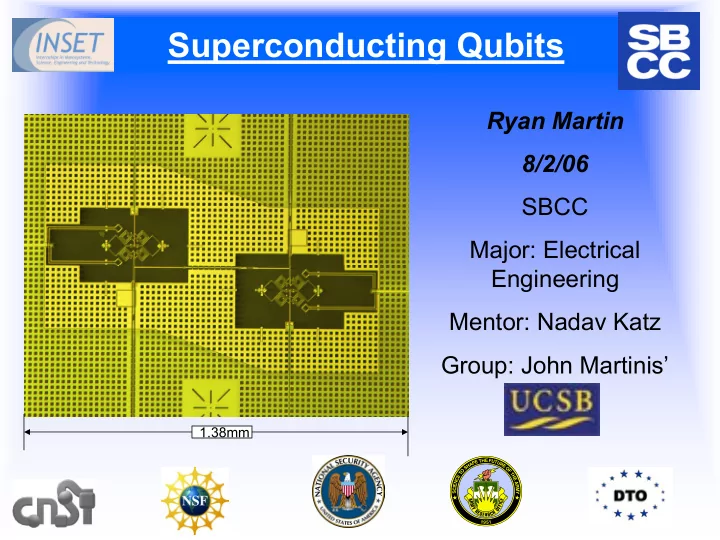
Superconducting Qubits Ryan Martin 8/2/06 SBCC Major: Electrical Engineering Mentor: Nadav Katz Group: John Martinis 1.38mm Superconducting Qubits are very scalable! so.. We could use them to build a: Quantum Computer With a


slide-1
SLIDE 1

Superconducting Qubits

Ryan Martin 8/2/06 SBCC Major: Electrical Engineering Mentor: Nadav Katz Group: John Martinis’

1.38mm
slide-2
SLIDE 2

Superconducting Qubits are very scalable! so…..

We could use them to build a: Quantum Computer

With a quantum computer, you can:

  • Run much faster simulations
  • Crack tough codes in real time
  • Impress people at parties

Quantum Computation is known to be an exponential speed increase over classical computation!

slide-3
SLIDE 3

Qubit?!?

Qubit (kyü-bit) Qubit = Quantum bit

  • A classical computer bit has two states:
  • n or off
  • A qubit is governed by

Quantum Mechanics – A qubit can be in a

  • f two states
slide-4
SLIDE 4

The Quantum World

  • Superposition means many places at
  • nce…. and then we measure it…

http://www.gly.fsu.edu/~salters/G LY1000/6_Minerals/Slide9.jpg www.ktf-split.hr

slide-5
SLIDE 5

What Superposition Can Do For You!

…Where is the state you’re in

  • In a Classical bit, A and B can only be 0 or 1
  • In a Quantum Bit, The only governing rule is:

Where is the probability of your bit measuring in the state And is the probability of measuring your bit in the state

2

B =

1 A B ψ + =

ψ

2 2

1 A B + =

2

A +

1

slide-6
SLIDE 6

The Quantum World with Electric Circuits

  • N. Katz,1 M. Ansmann,1 Radoslaw C. Bialczak,1 Erik Lucero,1 R. McDermott,1 Matthew Neeley,1

Matthias Steffen,1 E. M. Weig,1 A. N. Cleland,1 John M. Martinis,1* A. N. Korotkov2 . Coherent State Evolution in a Superconducting Qubit from Partial-Collapse Measurement. Science. 9 June, 2006. http://www.sciencemag.org/cgi/content/full/312/5779/1498?ijkey=lRLKuFaYL68Q.&keytype=ref&siteid=sci.

slide-7
SLIDE 7

Controlling Our Qubit!

Problems arise when sending electric pulses from room temperature transmission lines to virtually no impedance superconducting lines!

Our Solution…

High Frequency Low Frequency Ground

slide-8
SLIDE 8

Schematic

Inductor Bias-T in Dashed Box Low Frequency Line High Frequency Line Qubit 50 Ω Transmission Lines Impedance of Line at Qubit << 50 Ω

slide-9
SLIDE 9

Our “Bias-T”

Zoom of Inductor coils and resistors Connection to Qubit High Frequency Line Connection Low Frequency Line

slide-10
SLIDE 10
slide-11
SLIDE 11

New Possibilities

slide-12
SLIDE 12

Acknowledgements

INSET CNSI John Martinis Group: Professor: John Martinis National Science Foundation Mentor: Nadav Katz Army Research Office Markus Ansmann National Security Agency Robert McDermot Disruptive Technology Office Radek Bialzcak Eric Lucero Matthew Neeley Sam Rosenthal

slide-13
SLIDE 13

My Role:

  • Fabrication and Analysis of

microwave components

  • Experimental setup and analysis

using Adiabatic Demagnetization Refrigerator (ADR)

  • Understanding and Application of

Theory

slide-14
SLIDE 14

PV = nRT so if you ↑V = ↓T

slide-15
SLIDE 15
slide-16
SLIDE 16
slide-17
SLIDE 17

Josephson Junction

Two superconductors separated by a thin dielectric