Supe Superfund rfund Rese sear arch h Pr Progr gram am - - PowerPoint PPT Presentation

supe superfund rfund rese sear arch h pr progr gram am
SMART_READER_LITE
LIVE PREVIEW

Supe Superfund rfund Rese sear arch h Pr Progr gram am - - PowerPoint PPT Presentation

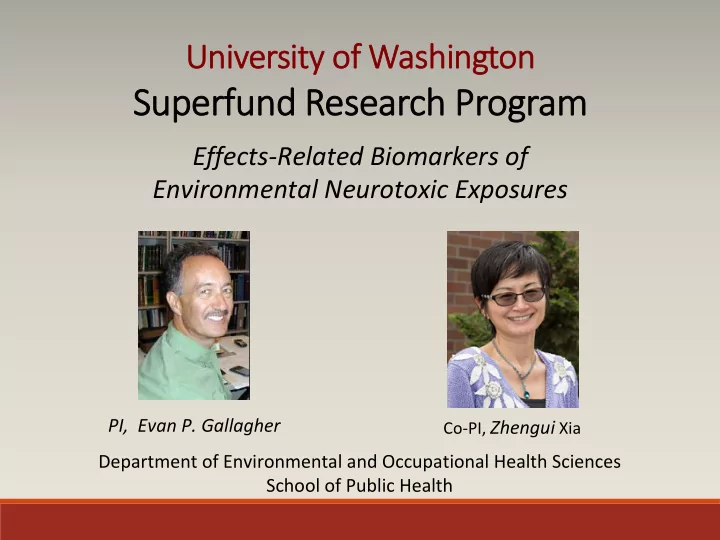
Univer Univ ersity o sity of W f Washing ashington n Supe Superfund rfund Rese sear arch h Pr Progr gram am Effects-Related Biomarkers of Environmental Neurotoxic Exposures PI, Evan P. Gallagher Co-PI, Zhengui Xia Department of


slide-1
SLIDE 1

Univ Univer ersity o sity of W f Washing ashington n

Supe Superfund rfund Rese sear arch h Pr Progr gram am

Effects-Related Biomarkers of Environmental Neurotoxic Exposures

PI, Evan P. Gallagher

Co-PI, Zhengui Xia

Department

  • f Environmental and Occupational Health Sciences

School of Public Health

slide-2
SLIDE 2

WEBSITE

slide-3
SLIDE 3

Conceptual model : UW Superfund research program

slide-4
SLIDE 4

Ou Our Resear esearch ch Pr Projects

  • jects

Mechanisms and Biomarkers of Metal Olfactory Injury in Salmon

PI, Evan Gallagher, PhD. (collaborators, Zia, Storm)

Cellular and Molecular Mechanisms of Cadmium Neurotoxicity

PI, Zhengui Xia, PhD. (collaborators Gallagher, Storm)

Role of Paraoxonases in Modulating

Cadmium and Manganese Neurotoxicity

PI, Clement Furlong, PhD. Co-PI-Lucio Costa

Arsenic in Shallow, Un-stratified and Seasonally Stratified Urban Lakes: Mobility, Bioaccumulation and Ecological Toxicity PI, Rebecca Neumann, PhD.

(collaborators Gawel, Olden, Horner-Devine, Gallagher)

slide-5
SLIDE 5

Ad

UW SRP Suppo UW SRP Support Co rt Cores es

Functional Genomics and Bioinformatics Core

Director, Theo Bammler, Ph.D.

Research Translation and Community Engagement Cores

Director, Tom Burbacher (L. Hayward, Ph.D., Communications manager)

Administrative and Training Cores

Director, Evan Gallagher, Ph.D. (E. Guzy, Program Manager)

slide-6
SLIDE 6

UW SRP investigators

slide-7
SLIDE 7

3 ppb

Project 1-Mechanisms of olfactory injury: Effect of environmental levels of Cd on salmon neurobehavior

% time in odorant arm 100 90 80 70 60 50 40 30 20 10

Effect of Cd on time spent in con-specific

  • dorant arm of a Y-maize

* * *

0 ppb 0.3 ppb

2 ppb

Pre exp. 16 d exp. Depuration of 16 d

Toxicological Sciences 2016

slide-8
SLIDE 8

Fold change relative to control

LA-ICP-MS shows that Cd rapidly accumulates and persists in the salmon olfactory epithelium

mt1a

Cadmium Conc. (ppm)

<LOQ <LOQ <LOQ

<LOQ

8 7 6 5 4 3 2 1

8 7 6 5 4 3 2 1

*** ***

Depuration

*

16day Cd exposures 0.3 2 0.3 2 Cd exposure levels (ppb)

slide-9
SLIDE 9

Regeneration of the olfactory system after Cu

Project 1. Copper injury to zebrafish OSNs is dose-dependent and targets both ciliated and microvillous OSNs

OMP:RFP TRPC2:V

enus

Eva Ma

slide-10
SLIDE 10

Regeneration of the olfactory system after Cu

Project 1. Using zebrafish transgenics we see that

  • lfactory cell proliferation increases after injury from

Copper and leads to recovery of olfaction

OMP:RFP TRPC2:Venus

0 uM (6 dpf) 10 uM Cu 24 h (6 dpf) 10 uM Cu for 24 h and 24 hr recovery (7 dpf)

BrdU labeling in OMP-RFP transgenics

  • Dr. Eva Ma
slide-11
SLIDE 11

ASARCO smelter, Ruston, WA 1890–1986

Gawel et al., 2014

surface sediment max depth seasonal Study lake (mg As/kg) (m) stratification Angle Lake 208 5.8 yes Lake Killarney 206 4.5 weak/no North Lake 85 9.0 yes Steel Lake 48 7.6 weak/no

slide-12
SLIDE 12

lankton

  • mnivorous in

Specific Aims for Project 4

  • 1. Identify physical and biogeochemical lake

attributes that promote arsenic mobilization from sediments and maintain elevated aqueous concentrations of arsenic in unstratified oxic lakes

  • 2. Determine the physical and biogeochemical

factors that control arsenic bioaccumulation through aquatic food webs in both seasonally stratified and unstratified lakes.

  • 3. Assess ecological toxicity of arsenic at

different trophic levels within both seasonally stratified and unstratified lakes using established and novel molecular biomarkers that indicate arsenic stress and injury.

zoop trout foraging insects sects macrophytes & periphyton phytoplankton

slide-13
SLIDE 13

Research Translation Core

Lisa Hayward (Manager)

SRP RTC and NIEHS Center (EDGE) CEC Ph.D. in Environmental Endocrinology Post-Doctoral work in Conservation Biology Science and Technology Policy Fellowship with AAAS Managed Communications for the Department of Interior’s Northwest Climate Science Center

slide-14
SLIDE 14

CREATING INDIVIDUALIZED RESEARCH TRANSLATION PLANS FOR EACH PROJECT

AAAS Public Engagement Plan Template Goals, near-term, mid-term, long-term

  • Information sheets for Policy Makers
  • Continuing Education

Classes for Medical Practitioners

  • Engagement with Local Regulatory

Agencies and Lake Association Members

  • Presentations for Groups such

as National Parkinson’s Foundation and Partner’s in Parkinson’s

http://theconnector.missouri.edu/wp-content/uploads/2018/04/TEMPLATE-PE-Plan-Template.pdf

slide-15
SLIDE 15

Research Translation Core (RTC)

RTC Material E-Bulletin Tweets To-the-Point Fact Sheets

slide-16
SLIDE 16

Research Translation Core (RTC)

RTC Engagement Continuing Education Pub Talk

Lower Duwamish Boat Tours

slide-17
SLIDE 17

Educating Next Generation of Community Leaders

CAMPUS VISIT FOR BRIDGE (CDC) and SURE-EH (NSF) STUDENTS

Duwamish Valley Youth Corps

Conduct tours of SRP labs with Career Day investigators and trainees Meet with Office Minority Affairs –Education Ambassadors

slide-18
SLIDE 18

Community Engagement Core (CEC)

Goal

The primary goal of the CEC is to work with community stakeholders and federal, state and local agencies to develop intervention strategies to reduce community exposures to hazardous substances in order to improve public health

slide-19
SLIDE 19

Specific Aim 1

Work with community organizations and federal, state and local agencies to develop intervention strategies to reduce exposure to fish contaminants at the Lower Duwamish Waterway (LDW) Superfund Site in Western Washington.

Community Health Advocates Katie Frevert, CEC Manager Institutional Controls meeting with Fish & Wildlife at Duwamish River Festival Fish Advisories staff

slide-20
SLIDE 20

Community Advocates for Safe Fishing

Collaborating with nonprofit

  • rganization Just

Health Action led by Linn Gould, MPH

FishNet webinar, Using a Community-Based Process to Promote Healthy Fish Consumption within the Lower Duwamish Waterway Superfund Site.

https://www.youtube.com/watch?v=NDmkoBJpKYU

slide-21
SLIDE 21

Simplifying Fishing Rules and Regulations

Working with Washington State Department

  • f Fish

and Wildlife

English Vietnamese Spanish

Maps with fishing locations and regulations

slide-22
SLIDE 22

Simplifying Fishing Rules and Regulations

Short Educational Videos on Fishing Rules & Health

The themes for these Educational Videos include:

  • 1. Opportunities Available to Fishers in the Duwamish
  • 2. What Do

I Need to Know Before Going Out? (Rules/ Regs/Safety/Fish Types)

  • 3. How to

Buy a Fishing License

  • 4. What Fishing Gear

Do I Need?

  • 5. How to

Land a Fish & Clean it Properly

  • 6. Cooking Fish

and Health Tips

slide-23
SLIDE 23

Community Engagement Core (CEC)

Specific Aim 2

Build upon our previous collaborations with the Northwest Toxic Communities Coalition (NWTCC) to address hazardous waste site issues common across neighborhoods and reduce exposures to contaminants in these waste site communities.

slide-24
SLIDE 24
slide-25
SLIDE 25

NWTCC Collaborations

Quarterly Webinars

slide-26
SLIDE 26

Needs Assessment Outcomes

  • Grant

Writing Assistance

  • Environmental Sampling