Summary of What We Know Definition (Polynomial Time Reducibility) We - - PDF document

summary of what we know
SMART_READER_LITE
LIVE PREVIEW

Summary of What We Know Definition (Polynomial Time Reducibility) We - - PDF document

Summary of What We Know Definition (Polynomial Time Reducibility) We write A P B iff there is a polynomial time computable Computability and Complexity function f such that for any input w we have w A iff f ( w ) B . Definition


slide-1
SLIDE 1

Computability and Complexity

Lecture 13

More NP-complete Problems

given by Jiri Srba

Lecture 13 Computability and Complexity 1/13

Summary of What We Know

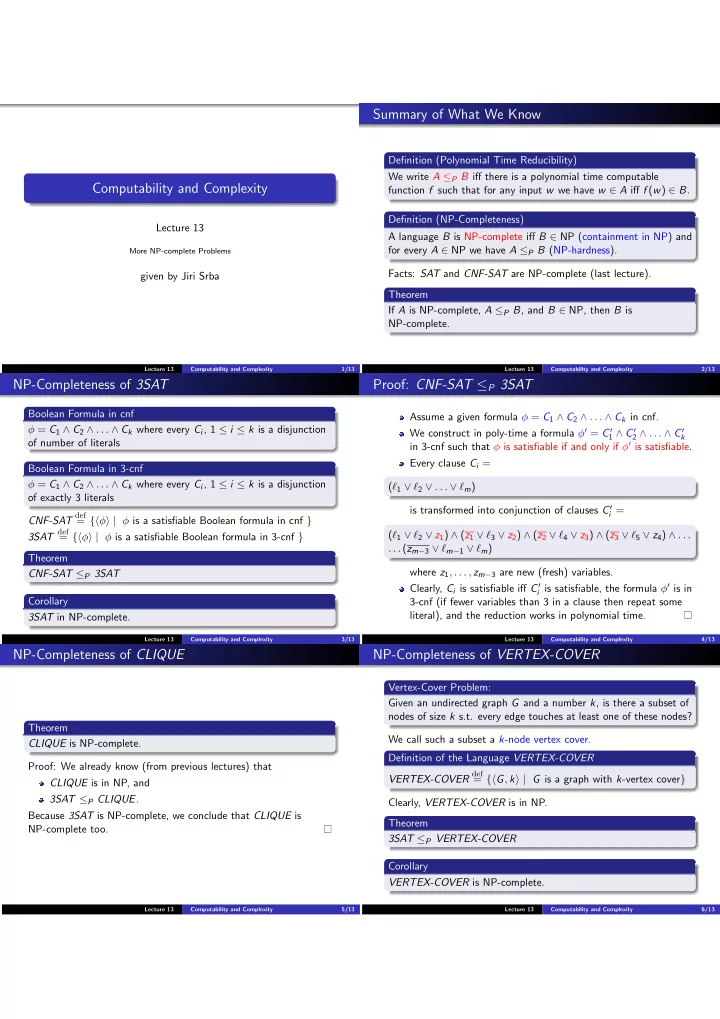
Definition (Polynomial Time Reducibility) We write A ≤P B iff there is a polynomial time computable function f such that for any input w we have w ∈ A iff f (w) ∈ B. Definition (NP-Completeness) A language B is NP-complete iff B ∈ NP (containment in NP) and for every A ∈ NP we have A ≤P B (NP-hardness). Facts: SAT and CNF-SAT are NP-complete (last lecture). Theorem If A is NP-complete, A ≤P B, and B ∈ NP, then B is NP-complete.

Lecture 13 Computability and Complexity 2/13

NP-Completeness of 3SAT

Boolean Formula in cnf φ = C1 ∧ C2 ∧ . . . ∧ Ck where every Ci, 1 ≤ i ≤ k is a disjunction

  • f number of literals

Boolean Formula in 3-cnf φ = C1 ∧ C2 ∧ . . . ∧ Ck where every Ci, 1 ≤ i ≤ k is a disjunction

  • f exactly 3 literals

CNF-SAT def = {φ | φ is a satisfiable Boolean formula in cnf } 3SAT def = {φ | φ is a satisfiable Boolean formula in 3-cnf } Theorem CNF-SAT ≤P 3SAT Corollary 3SAT in NP-complete.

Lecture 13 Computability and Complexity 3/13

Proof: CNF-SAT ≤P 3SAT

Assume a given formula φ = C1 ∧ C2 ∧ . . . ∧ Ck in cnf. We construct in poly-time a formula φ′ = C ′

1 ∧ C ′ 2 ∧ . . . ∧ C ′ k

in 3-cnf such that φ is satisfiable if and only if φ′ is satisfiable. Every clause Ci = (ℓ1 ∨ ℓ2 ∨ . . . ∨ ℓm) is transformed into conjunction of clauses C ′

i =

(ℓ1 ∨ ℓ2 ∨ z1) ∧ (z1 ∨ ℓ3 ∨ z2) ∧ (z2 ∨ ℓ4 ∨ z3) ∧ (z3 ∨ ℓ5 ∨ z4) ∧ . . . . . . (zm−3 ∨ ℓm−1 ∨ ℓm) where z1, . . . , zm−3 are new (fresh) variables. Clearly, Ci is satisfiable iff C ′

i is satisfiable, the formula φ′ is in

3-cnf (if fewer variables than 3 in a clause then repeat some literal), and the reduction works in polynomial time.

Lecture 13 Computability and Complexity 4/13

NP-Completeness of CLIQUE

Theorem CLIQUE is NP-complete. Proof: We already know (from previous lectures) that CLIQUE is in NP, and 3SAT ≤P CLIQUE. Because 3SAT is NP-complete, we conclude that CLIQUE is NP-complete too.

Lecture 13 Computability and Complexity 5/13

NP-Completeness of VERTEX-COVER

Vertex-Cover Problem: Given an undirected graph G and a number k, is there a subset of nodes of size k s.t. every edge touches at least one of these nodes? We call such a subset a k-node vertex cover. Definition of the Language VERTEX-COVER VERTEX-COVER def = {G, k | G is a graph with k-vertex cover} Clearly, VERTEX-COVER is in NP. Theorem 3SAT ≤P VERTEX-COVER Corollary VERTEX-COVER is NP-complete.

Lecture 13 Computability and Complexity 6/13

slide-2
SLIDE 2

Proof: 3SAT ≤P VERTEX-COVER

Let φ be a 3-cnf formula with m variables and p clauses. We construct in poly-time an instance G, k of VERTEX-COVER where k = m + 2p and G is given by:

For every variable x in φ add two nodes labelled with x and x and connect them by an edge (variable gadget). For every clause (ℓ1 ∨ ℓ2 ∨ ℓ3) in φ add three nodes labelled with ℓ1, ℓ2 and ℓ3 and connect them by 3 edges so that they form a triangle (clause gadget). Add an edge between any two identically labelled nodes, one from a variable gadget and one from a clause gadget.

Note that the reduction works in polynomial time and that φ is satisfiable iff G has a k-vertex cover.

Lecture 13 Computability and Complexity 7/13

NP-Completeness of HAMPATH

Theorem 3SAT ≤P HAMPATH Corollary HAMPATH is NP-complete. Proof (3SAT ≤P HAMPATH): For a given 3-cnf formula φ = (a1 ∨ b1 ∨ c1)

  • C1

∧ (a2 ∨ b2 ∨ c2)

  • C2

∧ . . . ∧ (ak ∨ bk ∨ ck)

  • Ck
  • ver the variables x1, x2, . . . , xm construct in poly-time a digraph

G and nodes s and t such that φ is satisfiable if and only if G has a Hamiltonian path from s to t.

Lecture 13 Computability and Complexity 8/13

Proof: 3SAT ≤P HAMPATH

Lecture 13 Computability and Complexity 9/13

NP-Completeness of UHAMPATH

Definition UHAMPATH def = {G, s, t | G is undirected graph with a Hamiltonian path from s to t } Theorem UHAMPATH is NP-complete. Proof: By poly-time reduction from HAMPATH. In the reduction from a directed graph to an undirected one, we replace every node with an undirected path of length 2:

Lecture 13 Computability and Complexity 10/13

NP-Completeness of SUBSET-SUM

SUBSET-SUM def = {S, t | S = {x1, . . . , xk} ⊆ N is a multiset, t ∈ N, and there is a multiset X ⊆ S s.t. X = t } Theorem SUBSET-SUM is NP-complete. Proof: By poly-time reduction from 3SAT. For a given 3-cnf formula φ = (a1 ∨ b1 ∨ c1)

  • C1

∧ (a2 ∨ b2 ∨ c2)

  • C2

∧ . . . ∧ (ak ∨ bk ∨ ck)

  • Ck
  • ver the variables x1, x2, . . . , xm construct in poly-time a set of

numbers S and a number t such that φ is satisfiable iff from S we can select numbers that add up to t.

Lecture 13 Computability and Complexity 11/13

Proof: 3SAT ≤P SUBSET-SUM

C1 C2 . . . Ck x1 1 . . . 1 . . . x1 1 . . . . . . 1 x2 1 . . . . . . 1 x2 1 . . . 1 . . . x3 1 . . . . . . x3 1 . . . 1 . . . . . . xm . . . 1 . . . xm . . . 1 1 . . . 1 . . . 1 . . . 1 . . . 1 . . . . . . 1 1 t 1 1 1 1 . . . 1 3 3 . . . 3

Lecture 13 Computability and Complexity 12/13

slide-3
SLIDE 3

Summary

Cook-Levin Theorem: SAT is NP-complete. Because poly-time reducibility (≤P) is transitive, all languages below are NP-hard. All languages below belong to NP, so they are NP-complete.

Lecture 13 Computability and Complexity 13/13