Successive Network Coding (SNC): A Mitigating Mechanism Against - - PowerPoint PPT Presentation

successive network coding snc a mitigating mechanism
SMART_READER_LITE
LIVE PREVIEW

Successive Network Coding (SNC): A Mitigating Mechanism Against - - PowerPoint PPT Presentation

Successive Network Coding (SNC): A Mitigating Mechanism Against Eavesdropping Attacks In Network Coding Based Systems Vahid N. Talooki, University of Aveiro, Portugal Network Coding (NC) allows intermediate nodes not only to store and forward


slide-1
SLIDE 1

zil, Jan. 2015

Successive Network Coding (SNC): A Mitigating Mechanism Against Eavesdropping Attacks In Network Coding Based Systems

Vahid N. Talooki, University of Aveiro, Portugal

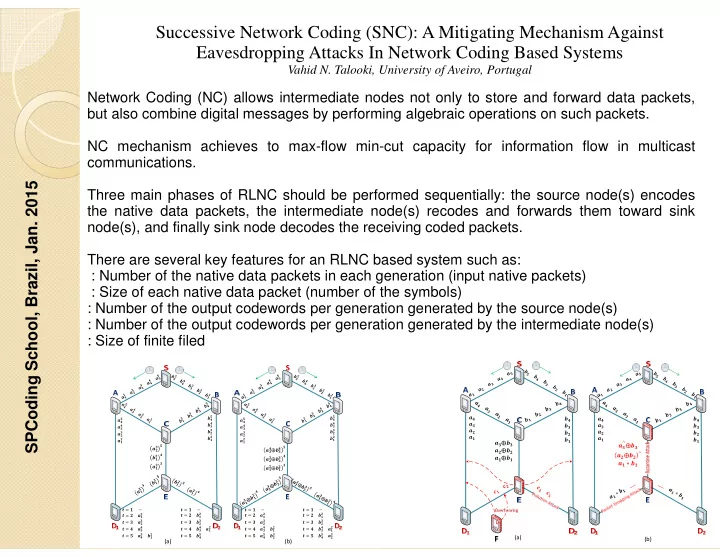
Network Coding (NC) allows intermediate nodes not only to store and forward data packets, but also combine digital messages by performing algebraic operations on such packets. NC mechanism achieves to max-flow min-cut capacity for information flow in multicast communications. Three main phases of RLNC should be performed sequentially: the source node(s) encodes the native data packets, the intermediate node(s) recodes and forwards them toward sink node(s), and finally sink node decodes the receiving coded packets. There are several key features for an RLNC based system such as: : Number of the native data packets in each generation (input native packets)

SPCoding School, Brazi

: Number of the native data packets in each generation (input native packets) : Size of each native data packet (number of the symbols) : Number of the output codewords per generation generated by the source node(s) : Number of the output codewords per generation generated by the intermediate node(s) : Size of finite filed

  • (a)

(b)

⨁ ∗ (b)

⨁ ⨁ (a)

slide-2
SLIDE 2

zil, Jan. 2015

The mentioned parameters can influence many properties of the constructed RLNC, including but not limited to: delay, code rate, code redundancy, coefficients overhead, decoding error probability, security of the code, and complexity (of encoding, recoding, and decoding

  • perations).

First target: Analysis of NC mechanism regarding i) throughput of encoding and decoding

  • perations, ii) error decoding probability in an error free channel.

SPCoding School, Brazi

slide-3
SLIDE 3

zil, Jan. 2015

The fact that transitive packets may be mixed and pass through several relay terminals to get the destination, gives opportunity to attackers for several malicious behaviors. Two main security attacks in RLNC based systems, performing by intermediate malicious node(s), are: i) eavesdropping and unauthorized access to content ii) byzantine modifications and corrupting the transitive packets

SPCoding School, Brazi

slide-4
SLIDE 4

zil, Jan. 2015

successive network coding (SNC) modifies the encoding and decoding phases of NC via concatenating two network coding schemes (LNC and RLNC). The intermediate nodes in SNC scheme are unaware of coding features and so they cannot reach native data packets without paying a cost due to high computational complexity. A malicious unauthorized intermediate node in SNC, that intends to make an eavesdropping attack by decoding the incoming coded packets, should examine many possibilities to guess the correct features of coding. Therefore the complexity of decoding operation for an eavesdroper is high and, consequently, prepares a level of security for the SNC against eavesdropping attacks. Second target: proposing a mitigation technique against eavesdroping attack in NC based systems

SPCoding School, Brazi