
SLIDE 1
Substance Use and Addictive Behaviour Conference Manchester 2014
- L. Webb
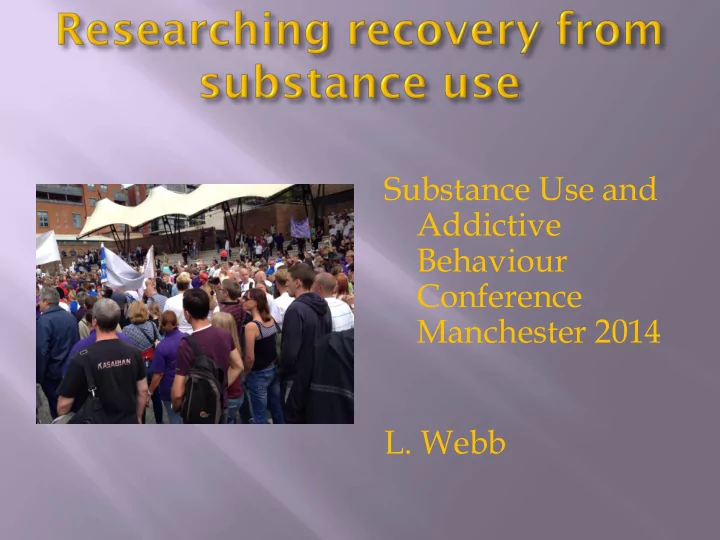
Substance Use and Addictive Behaviour Conference Manchester 2014 - - PowerPoint PPT Presentation
Substance Use and Addictive Behaviour Conference Manchester 2014 L. Webb There are many pathways to recovery 1. It is self directed & holistic 2. Involves personal recognition of need for 3. change Has cultural dimensions 4.
1.
2.
3.
4.
5.
6.
7.
8.
9.
US Centre for Substance Abuse Treatment 2009
Human rights – respect, lack of stigma Collaboration – client centred goals Peer support – role models and validation Access to services – reduce barriers
Researchers need
Be aware of power
Be aware of skill
How does policy structure
resources for recovery?
Operationalising recovery
requires indicators, measures etc
How can ‘recovery’ be
measured?
When do service providers
become controllers?
Collaborative based participatory research Members of the community are co-researchers
A combination of co-production and
Not just participatory action research
Community members
benefit from the process and the
Builds trust between
partners – working with less included groups and individuals in society
Co-production
Working together
Participatory action
research
Involving
participants
Community and
social action
Working with the
community for community benefits
Communication is not seen as a one-way
Must not privilege theoretical work over
Not to create a dichotomy between ‘the
Durie et al (2011)
Co-production
Sharing of resources Shared decision-
making
Acknowledge
difference and inequality
Community/social
action
Has non-academic
benefits
Partnership is
maintained
Ethics is not a tickbox
Aims:
to explore the use of
digital media to engage people in recovery in self discovery
Explore stories and
experiences of recovery
Outreach recovery
among key stakeholders and the public
Procedure
Work with community
group to survey,
recovery stories in the community and connected agents.
Archive and curate self
stories, experiences and reflections on change, impact and key self determined experiences
Collecting stories and views – what is recovery, how does it feel?
Inreaching with the
Voicebox
Reflections on self
experience – change.
Activism
Presenting at
conferences NHS Expo, INTAR, Big Sista, SUAB launch!
Recovery Walk –
inreaching, networking, contributing
Speaking up for
recovery
Made me proud of my
recovery
People believe in you Turning taboo into pride Active and productive
member of this community
What stories
epitomise recovery?
What represents the
experience of recovery?
Where is recovery
going?
What questions
should we be asking?
Cannot do co-
production without community action
The community
agenda becomes the researcher’s agenda
The research becomes
part of the community activity
The results must feed
back into the community agenda
Cannot do
community action without co- production
Without co-
production, community action becomes ‘us’ and ‘them’ again – researchers act as fly-
Need a
gatekeeper/liaison agent
Need time spent to
build relationships
Need partners who
are committed
Need to agree what to
research and what to do with it
Funding needs to be
joint: the fund holder is the power holder
Durose C. et al. (2011) Towards Co-production
Jacobsen, N. & Greenley, D. (2001). What is
Pohl, C. et al (2010) Researchers’ roles in