Su Surgical ical and and cl clin inical ical tech chni nique - - PDF document

su surgical ical and and cl clin inical ical tech chni
SMART_READER_LITE
LIVE PREVIEW

Su Surgical ical and and cl clin inical ical tech chni nique - - PDF document

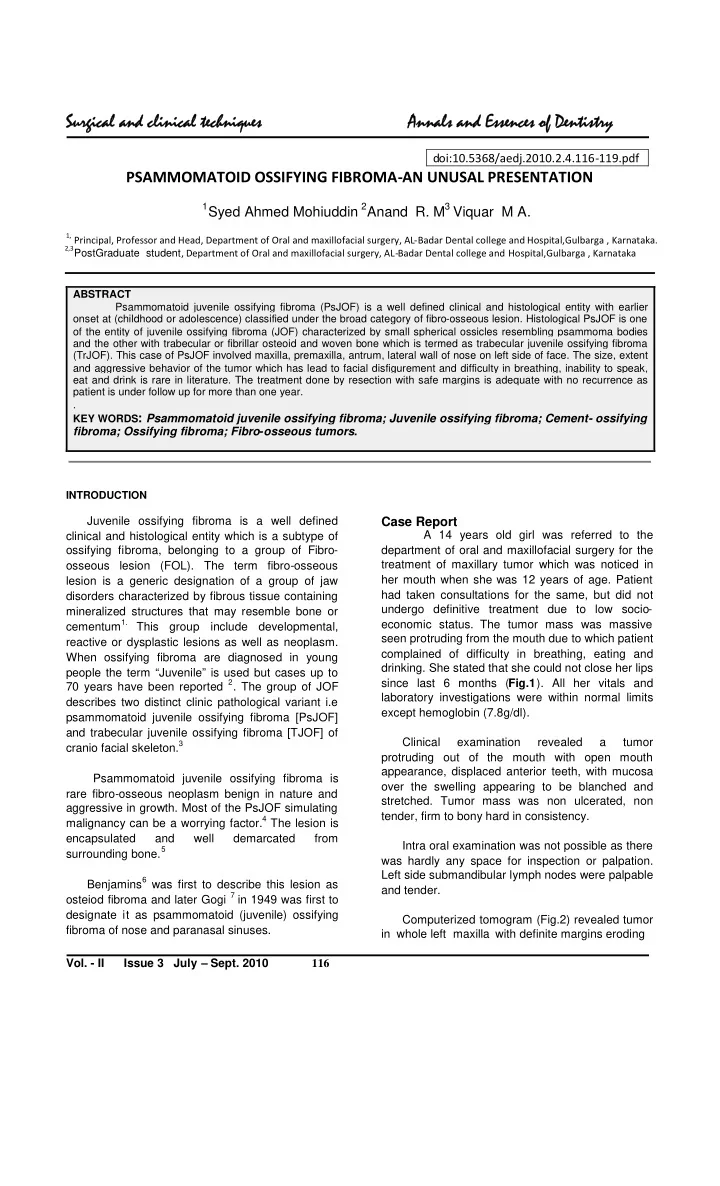
Su Surgical ical and and cl clin inical ical tech chni nique ues Annal nals an and Essence ces of Denti tistry doi:10.5368/aedj.2010.2.4.116-119.pdf PSAMMOMATOID OSSIFYING FIBROMA-AN UNUSAL PRESENTATION 1 Syed Ahmed Mohiuddin 2 Anand


slide-1
SLIDE 1

Su Surgical ical and and cl clin inical ical tech chni nique ues Annal nals an and Essence ces of Denti tistry

  • Vol. - II

Issue 3 July – Sept. 2010 116

doi:10.5368/aedj.2010.2.4.116-119.pdf

PSAMMOMATOID OSSIFYING FIBROMA-AN UNUSAL PRESENTATION

1Syed Ahmed Mohiuddin 2Anand R. M3 Viquar M A.

1, Principal, Professor and Head, Department of Oral and maxillofacial surgery, AL-Badar Dental college and Hospital,Gulbarga , Karnataka. 2,3PostGraduate student, Department of Oral and maxillofacial surgery, AL-Badar Dental college and Hospital,Gulbarga , Karnataka

ABSTRACT Psammomatoid juvenile ossifying fibroma (PsJOF) is a well defined clinical and histological entity with earlier

  • nset at (childhood or adolescence) classified under the broad category of fibro-osseous lesion. Histological PsJOF is one
  • f the entity of juvenile ossifying fibroma (JOF) characterized by small spherical ossicles resembling psammoma bodies

and the other with trabecular or fibrillar osteoid and woven bone which is termed as trabecular juvenile ossifying fibroma (TrJOF). This case of PsJOF involved maxilla, premaxilla, antrum, lateral wall of nose on left side of face. The size, extent and aggressive behavior of the tumor which has lead to facial disfigurement and difficulty in breathing, inability to speak, eat and drink is rare in literature. The treatment done by resection with safe margins is adequate with no recurrence as patient is under follow up for more than one year. . KEY WORDS: Psammomatoid juvenile ossifying fibroma; Juvenile ossifying fibroma; Cement- ossifying

fibroma; Ossifying fibroma; Fibro-osseous tumors.

INTRODUCTION

Juvenile ossifying fibroma is a well defined clinical and histological entity which is a subtype of

  • ssifying fibroma, belonging to a group of Fibro-
  • sseous

lesion (FOL). The term fibro-osseous lesion is a generic designation of a group of jaw disorders characterized by fibrous tissue containing mineralized structures that may resemble bone or

  • cementum1. This

group include developmental, reactive or dysplastic lesions as well as neoplasm. When ossifying fibroma are diagnosed in young people the term “Juvenile” is used but cases up to 70 years have been reported 2. The group of JOF describes two distinct clinic pathological variant i.e psammomatoid juvenile ossifying fibroma [PsJOF] and trabecular juvenile ossifying fibroma [TJOF] of cranio facial skeleton.3 Psammomatoid juvenile ossifying fibroma is rare fibro-osseous neoplasm benign in nature and aggressive in growth. Most of the PsJOF simulating malignancy can be a worrying factor.4 The lesion is encapsulated and well demarcated from surrounding bone.5 Benjamins6 was first to describe this lesion as

  • steiod fibroma and later Gogi 7 in 1949 was first to

designate it as psammomatoid (juvenile) ossifying fibroma of nose and paranasal sinuses.

Case Report

A 14 years old girl was referred to the department of oral and maxillofacial surgery for the treatment of maxillary tumor which was noticed in her mouth when she was 12 years of age. Patient had taken consultations for the same, but did not undergo definitive treatment due to low socio- economic status. The tumor mass was massive seen protruding from the mouth due to which patient complained of difficulty in breathing, eating and

  • drinking. She stated that she could not close her lips

since last 6 months (Fig.1). All her vitals and laboratory investigations were within normal limits except hemoglobin (7.8g/dl). Clinical examination revealed a tumor protruding out of the mouth with open mouth appearance, displaced anterior teeth, with mucosa

  • ver the swelling appearing to be blanched and
  • stretched. Tumor mass was non ulcerated, non

tender, firm to bony hard in consistency. Intra oral examination was not possible as there was hardly any space for inspection or palpation. Left side submandibular lymph nodes were palpable and tender. Computerized tomogram (Fig.2) revealed tumor in whole left maxilla with definite margins eroding

slide-2
SLIDE 2

Su Surgical ical and and cl clin inical ical tech chni nique ues Annal nals an and Essence ces of Denti tistry

  • Vol. - II

Issue 3 July – Sept. 2010 117

Fig.1. properative view of the lesion Fig.2.Coronal section .C.T. Scan Fig.3.pathological section of the excionsed mass Fig.4. Matured osteoid tissue surrounded by fibrous tissue. Fig.5. Dense fibrous tissue with focal Spherical Basophils. Fig.6. post operative view

slide-3
SLIDE 3

Su Surgical ical and and cl clin inical ical tech chni nique ues Annal nals an and Essence ces of Denti tistry

  • Vol. - II

Issue 3 July – Sept. 2010 118 maxillary sinus, zygomatic bone and lateral wall of

  • nose. It

shows a mixture of radiodensity and

  • radiolucency. Based up on aggressive behaviour

and clinico-radiographic interpretation the differential diagnosis

  • f
  • steogenic

sarcoma, chondrosarcoma, giant cell tumor, ossifying fibroma, fibrous dysplasia ,cento-ossifying fibroma was made.Histopathology of Incisional biopsy specimen revealed the lesion as Juvenile Ossifying Fibroma (Fig.3 & 4). The tumor was resected after securing airway by performing tracheostomy with safe margins as planned with Weber-Fergusson incision (Fig.5). Posteriorly debulking was done. After hemostasis was achieved and the surgical site was closed by mucocutaneous and mucosal flap and some area left to granulate. After complete healing, patient was referred to the department

  • f

prosthodontics for prosthetic rehabilitation. An

  • bturator was fabricated which aided in improving

esthetic profile, phonetics and mastication .the tumor mass which weighed 1 kg was sent to histopathological examination to study under different sections.Finally the lesion was reported as Psammamotoid juvenile ossifying fibroma.

Discussion

As per WHOclassification8, Psammomatoid Juvenile Ossifying Fibroma (PsJOF) is grouped under category of Ossifying Fibroma (Table 1). The literature regarding its incidence, behaviour, location, treatment options and recurrence vary. The diagnosis is confusing but should be based

  • n age of onset, clinical behaviour, radiographic

interpretation and detail histopathological review.

9

When initial histopathology reports as Ossifying Fibroma, it is advised to go for deeper sections of the specimen to study the other three variants i.e, Conventional ossifying fibroma, Juvenile trabecular

  • ssifying

fibroma and Juvenile psammomatoid

  • ssifying fibroma (Table 2).

Most

  • f

the authors considers Cemento-

  • ssifying

fibroma [COF] and Juvenile Ossifying fibroma to be a single entity. Samir El-Mofty3 clarifies COF as a separate lesion which is well encapsulated, predominantly seen in women in third and fourth decades, affects tooth bearing areas of jaws composed

  • f

mature and immature bone trabeculae and lobulated basophilic masses

  • f

cementum like material. Many a times concentrically laminated particles, called cementicles are seen. In contrast, the microscopic features of PsJOF are distinctive and include a cell rich fibrous stroma containing bands

  • f

cellular

  • steoid

without

  • steoblastic lining, osteoid strands and trabeculae of

woven bone characterised by innumerable round cement-like

  • r

psammoma-like particles called

  • ssicles.8

PsJOF is usually reported as asymptomatic, although facial asymmetry, nasal

  • bstruction, epistaxis and proptosis were common
  • findings. 10,11

The common sites for PsJOF were paranasal sinuses,orbital region, maxilla, mandible and other bones

  • f

craniofacial region.This case primarily involves premaxilla, maxillary sinus and zygomatic bone. Juvenile ossifying fibroma has varied radiological features like radiolucent, mixed and radiopaque depending on the degree of calcification by tumor and sometimes ‘Ground Glass’ appearance . The

  • ther lesions which radiographically mimic Juvenile
  • ssifying

fibroma are Fibrous dysplasia and Cemento-ossifying fibroma. Fibrous dysplasia blends with surrounding bone and the borders are not well defined. Cemento-ossifying fibroma has well defined sclerotic border, most of the times with tooth bearing areas, representing a fibrous capsule which may separate from the surrounding bone. Maxillary Chondrosarcoma typically occurs in the anterior region where cartilagenous tissue may be present. Radiologically it gives a mixed radiolucent and radiopacity with calcification in the center, sometimes described as ‘flocculent’ implies snow like features. Careful examination of the areas of flocculent may reveal a central nidus, which is probably cartilage surrounded by calcification.12 The other clinical entity which was also included in the differential diagnosis i.e., Osteosarcoma is usually radiolucent with no peripheral sclerosis or capsulation. If lesion involves periosteum, the typical ‘Sun Ray Spicules’ or ‘Hair on End’ trabeculae may be seen. Table 1. Classification of fibro-osseous lesions

  • f the maxillofacial region

Fibrous dysplasias

Monostotic fibrous dyplasia Polystotic fibrous dysplasia Craniofacial fibrous dysplasia

Osseous dyplasias

Peri apical osseous dysplasia Focal osseous dysplasia Florid osseous dysplasia Familial gigantiform dysplasia

Ossifying fibromas

Conventional ossifying fibroma Juvenile trabecular ossifying fibroma Juvenile Psammomatoid ossifying fibroma“

  • #Based
  • n the WHO classification and also

from Waldron, Slootweg, Bannon, Fowler and Elmofty

8,9.

slide-4
SLIDE 4

Su Surgical ical and and cl clin inical ical tech chni nique ues Annal nals an and Essence ces of Denti tistry

  • Vol. - II

Issue 3 July – Sept. 2010 119

Table 2. A working classification of the three clinicopathological variants of ossifying fibroma Ossifying fibroma Juvenile trabecular Ossifying fibroma Juvenile Psammomatoid Ossifying fibroma Age 10-50 Years 20-30 Years 3 months-72 Years (20) Female: Male 2:1 2:1 1.3:1 Site Tooth bearing areas. Mandible:Maxilla- 70:30 % Mandible-50%;Maxilla-44%; Sinonasal-6% Sinonasal-62%; Maxilla-20%; Mandible(Ramus)10%:cranium 8% Radiology well circumscribed well circumscribed, Speckled calcification well circumscribed, expands and fills paranasal sinuses, aggressive pattern tends to be radio opaque. Histology cellular fibrous tissue, storiform pattern, trabeculea of woven bone,

  • ccasional

spherical Psammamatoid calcification. Densely cellular immature

  • steoid and

bony in trabecular pattern. Osteo blast rimming and cellular osteod Densely cellular, spherical cementum like Psammamatoid calcification may permeate cancellous bone,myoid areas, giant cells , heammorage. Synonyms Cemento-ossifying Juvenile active ossifying psammous desmo

This case which is reported deserves attention due to size and presentation leading to facial disfigurement and asymmetry. Due to the massive tumor size, dysphagia and difficulty in breathing were associated symptoms which has not been documented before in literature review for PsJOF. Surgical resection with safe margins was proved to be adequate if done properly without recurrence. A high recurrence rate

  • f 30-56% is more likely due to incomplete excision

and infiltrative nature of the tumor.13 To conclude, it can be stated that JOF and its variants despite different histological patterns share clinical and radiological features. The management is also same which depents on size, site and nature of growth. These forms are uncommon but there is a need to recognise them separately and manage

  • appropriately. However, the case repored here is

followed up for more than

  • ne

year without

  • recurrence. The importance of close monitoring and

long term follow up cannot be ruled out.

References

1. Thankappan S, Nair S, Thomas V, Sharefuden KP(2009) psammomatoid and trabecular variants of juvenile ossifying fibroma-two case reports. Indian J radiol Imaging.19:116-119. 2. Johnson IC, Yousefi M, Vinh TN, Heffiner DK, Hymas US, Hartman KS (1985) Juvenile active ossifying fibroma of orbit. Ophthalmology.92:150-159[pub-med citation]. 3. Elmofty S. Psammomatoid and Trabecular Juvenile

  • ssifying fibroma of the craniofacial skeleton: Two

distinct clinicopathologic entities. Oral surgery Oral Med Oral path Oral Radiol Endod, 2002;93:296-304. 4. Rosario G, Rosario C, Laura N, Mercedes GV, Mercedes p. Psammomatoid

  • ssifying

fibromas: Immunohistochemical analysis and differential diagnosis with psammomatoid meningiomas

  • f

craniofacial bones. Oral Surg Oral Med Oral Pathol Oral Radiol Endod 2006;101:614-9 5. Sun G, Chen X, Tang E, Li Z, Li Jjuvenile ossifying fibroma

  • f

maxilla. Int J Oral Maxillofac surg, 2007;36(1):82-85. 6. Benjamins CE,Das () osteoid fibroma mit atypischer Verkalkung in sinus Frontalis.Acta Otolaryngo,1938: 26-44. 7. Gogl H.Das. Psamma-osteoid fibroma Dernase and Iheer Nebeuhohlen.Monatsschr Ochrenheikd

  • Laryngorhinol. 1949;83:1-10.

8. Slootweg and Elmofty, P.S Slootweh and S.K

  • Elmofty. Ossifying fibroma. In: L.Barnes JW. Eveson,
  • P. Reichert and D. Sidransky, Editors World Health

Organization classification of tumors, Pathology and Genetics head and neck Tumors.WHO,IAAC Press, Lyon,2005; 319-320. 9. MacDonald-Jankowski DS. Fibro-osseous lesions of the face and jaws.Clin Radiol. 2004; 59:11-25.

  • 10. Wenign BM, Vinh TN, Smirnito Poulous JG, Flower

Housion GD, Heffner DK. .Aggressive Psammomatoid ossifying fibroma of the sinonasal

  • region. A clinicopathological study of a distinct group
  • f fibroosseous lesion cancer. 1995;76:1155-1165.
  • 11. Johnson IC,Yousefi M, Vinh TN, Heffiner DK, Hymas

VJ, Hartman KS). Juvenile active ossifying fibroma. Its nature, dynamics and origin. Acta Otolaryngology. 1991;448: 1- 40.

  • 12. Staurt C W, Micheal J P. Oral Radiology Principles

and Interpretation, Mosby Elsevier, 2009, 6th edition,440-442

  • 13. Smith

FS,Laurence N, Donald MW(Juvenile aggressive psammomatoid

  • ssifying

fibroma: An interesting and challenging and unusua l case report and review of the literature .J Oral Maxillofacial Surg 2009;67:200-206

Corresponding Author

Dr.Syed Ahmed Mohiuddin M.D.S

Principal, Professor and HOD AL-Badar Dental college and Hospital SY.NO 12,Daryapur village,naganahalli Near koranti hanuman temple Gulbarga -585103 Email ID : drsyedahmed28@yahoo.com

slide-5
SLIDE 5

Su Surgical ical and and cl clin inical ical tech chni nique ues Annal nals an and Essence ces of Denti tistry

  • Vol. - II

Issue 3 July – Sept. 2010 120

slide-6
SLIDE 6

Su Surgical ical and and cl clin inical ical tech chni nique ues Annal nals an and Essence ces of Denti tistry

  • Vol. - II

Issue 3 July – Sept. 2010 121