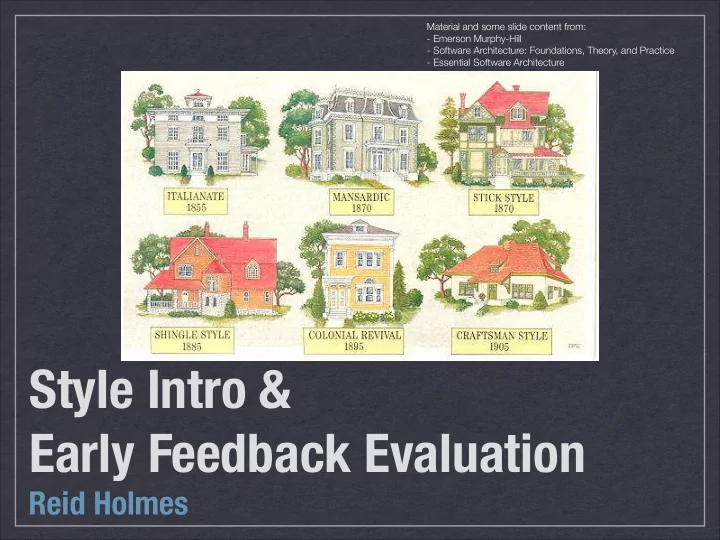
Style Intro & Early Feedback Evaluation Reid Holmes [TAILOR ET - - PowerPoint PPT Presentation

style intro early feedback evaluation
SMART_READER_LITE
LIVE PREVIEW

Style Intro & Early Feedback Evaluation Reid Holmes [TAILOR ET - - PowerPoint PPT Presentation

Material and some slide content from: - Emerson Murphy-Hill - Software Architecture: Foundations, Theory, and Practice - Essential Software Architecture Style Intro & Early Feedback Evaluation Reid Holmes [TAILOR ET AL.] Architectural


slide-1
SLIDE 1

Reid Holmes

Style Intro & Early Feedback Evaluation

Material and some slide content from:

  • Emerson Murphy-Hill
  • Software Architecture: Foundations, Theory, and Practice
  • Essential Software Architecture
slide-2
SLIDE 2

REID HOLMES - SE2: SOFTWARE DESIGN & ARCHITECTURE

Architectural styles

  • Some design choices are better than others
  • Experience can guide us towards beneficial sets
  • f choices (patterns) that have positive

properties

  • An architectural style is a named collection of

architectural design decisions that:

  • Are applicable to a given context
  • Constrain design decisions
  • Elicit beneficial qualities in resulting systems

[TAILOR ET AL.]

slide-3
SLIDE 3

REID HOLMES - SE2: SOFTWARE DESIGN & ARCHITECTURE

Architectural styles

  • A set of architectural design decisions that are

applicable to a recurring design problem, and parameterized to account for different software development contexts in which that problem appears.

  • e.g., Three-tier architectural pattern:

[TAILOR ET AL.]

slide-4
SLIDE 4

REID HOLMES - SE2: SOFTWARE DESIGN & ARCHITECTURE

Architectural styles

[CZARNECKI]

  • Defines a family of architectures that are

constrained by:

  • Component/connector vocabulary
  • Topology
  • Semantic constraints
  • When describing styles diagrammatically:
  • Nodes == components (e.g., procedures, modules, processes, databases, …)
  • Edges == connectors (e.g., procedure calls, events, db queries, pipes, …)
slide-5
SLIDE 5

REID HOLMES - SE2: SOFTWARE DESIGN & ARCHITECTURE

Good properties of an architecture

  • Result in a consistent set of principled techniques
  • Resilient in the face of (inevitable) changes
  • Source of guidance through product lifetime
  • Reuse of established engineering knowledge

[CZARNECKI]

slide-6
SLIDE 6

REID HOLMES - SE2: SOFTWARE DESIGN & ARCHITECTURE

“Pure” architectural styles

  • Pure architectural styles are rarely used in practice
  • Systems in practice:
  • Regularly deviate from pure styles.
  • Typically feature many architectural styles.
  • Architects must understand the “pure” styles to

understand the strength and weaknesses of the style as well as the consequences of deviating from the style.

[CZARNECKI]

slide-7
SLIDE 7

REID HOLMES - SE2: SOFTWARE DESIGN & ARCHITECTURE

Architectural

Styles

Language Based Layered Dataflow Shared Memory Interpreter Implicit Invocation Peer-to-Peer

Main program & Subroutines Object-

  • riented

Virtual Machine Client Server Batch- sequential Pipe-and-Filter Blackboard Rule-based Interpreter Mobile code Publish- subscribe Event-based

[TOPOLOGY FROM TAILOR ET AL.]

slide-8
SLIDE 8

REID HOLMES - SE2: SOFTWARE DESIGN & ARCHITECTURE REID HOLMES - SE2: SOFTWARE DESIGN & ARCHITECTURE REID HOLMES - SE2: SOFTWARE DESIGN & ARCHITECTURE REID HOLMES - SE2: SOFTWARE DESIGN & ARCHITECTURE

IN CLASS

slide-9
SLIDE 9

REID HOLMES - SE2: SOFTWARE DESIGN & ARCHITECTURE

Outline

  • Feedback on early evaluation forms
  • Map activities back to intended learning outcomes
  • Critique an existing architecture or design.
  • Differentiate how various architectural styles and

design patterns enhance and degrade a system’s functional-and non-functional properties.

  • Generate and justify and architecture and/or design

given a collection of requirements.

  • Produce and present concise and unambiguous

architecture and design descriptions.

  • Create and implement an architecture and design,

refining it into a complete system.

slide-10
SLIDE 10

REID HOLMES - SE2: SOFTWARE DESIGN & ARCHITECTURE

Early Evaluation Feedback

  • What will be on the final exam?
  • Any content posted to the course web page
  • Slides [easy questions]
  • Videos [easy questions]
  • Any content covered in class [hard questions]
  • The projects will not be evaluated (directly)
slide-11
SLIDE 11

REID HOLMES - SE2: SOFTWARE DESIGN & ARCHITECTURE

Early Evaluation Feedback

  • Recap videos in class.
  • Why not more examples in the videos?
  • Video quality / takes / editing concerns.
  • Course feels too app centric
  • Why multiple platforms?
slide-12
SLIDE 12

REID HOLMES - SE2: SOFTWARE DESIGN & ARCHITECTURE

Architectural Analogy

  • Kitchen design activity.
  • What are the architectural components?
  • How are they related to each other?
  • What connectors exist?
  • Why did you choose they components /

connectors / topology you did?

  • How do the connectors bind the components?
  • Why is software arch. like traditional arch.?
  • Why is software arch. not like traditional arch.?

1/4

slide-13
SLIDE 13

REID HOLMES - SE2: SOFTWARE DESIGN & ARCHITECTURE

Architectural Decomposition

  • Generate an architecture for an automated

shopping cart.

  • Identify the key components and connectors.
  • Derive a system topology.
  • Justify your decomposition.
  • Why these components?
  • Does the architecture adequately capture the

broad system goals?

  • What are the strengths and weaknesses of the

proposed architecture?

2/4

slide-14
SLIDE 14

REID HOLMES - SE2: SOFTWARE DESIGN & ARCHITECTURE

Architectural Tradeoffs

  • Generate an architecture for a context-aware

notification system.

  • Identify NFPs for a given stakeholder.
  • Justify why those NFPs matter.
  • Determine how those NFPs influence the

architecture of the system.

  • Compare the architectures derived when

different stakeholders care about divergent NFPs.

3/4

slide-15
SLIDE 15

REID HOLMES - SE2: SOFTWARE DESIGN & ARCHITECTURE

Completeness & Consistency

  • The Spec is Right.
  • For a given system description, can we identify:
  • Aspects that are inconsistent
  • Aspects that are incomplete
  • How can we build a description that all

stakeholders can understand and reason about?

  • What is the right level of abstraction for an

architectural document?

  • What tools and techniques can help us generate

complete and consistent system descriptions?

4/4