
SLIDE 1
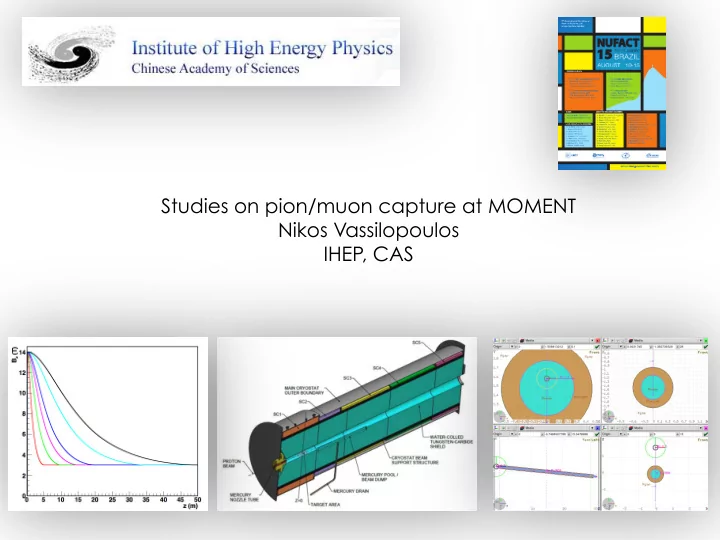
Studies on pion/muon capture at MOMENT Nikos Vassilopoulos IHEP, - - PowerPoint PPT Presentation
Studies on pion/muon capture at MOMENT Nikos Vassilopoulos IHEP, CAS particle production for Hg MOMENT Hg, L =30 cm, R = 0.5 cm: current parameters (mm) + - + - n p + b 1 0.124 0.075 1.8x10 -4 5.3x10 -5 12.4
MOMENT – Hg, L =30 cm, R = 0.5 cm: current parameters σ
b
(mm) π
+
π
+
μ- n p+ 1 0.124 0.075 1.8x10⁻⁴ 5.3x10⁻⁵ 12.4 1.38
MOMENT @ nufact15 Target Studies - NV @ Rio de Janeiro 2
for adiabatic taper solenoid
π
+ for
<E
μ
> ~ 300 ± 50% MeV (<E
μ
> ~ 57 % <E
π
> )
PT accepted r1 = 7 cm, r2 = 15 cm PT accepted r1 = 14 cm, r2 = 30 cm
_ FLUKA 2015 (1e6 p.o.t.)
PT accepted r1 = 20 cm, r2 = 43 cm
MOMENT @ nufact15 Target Studies - NV @ Rio de Janeiro 3 _
Ptrg = 2.5 MW
MOMENT @ nufact15 Target Studies - NV @ Rio de Janeiro 4
MOMENT @ nufact15 Target Studies - NV @ Rio de Janeiro 5
figure of merit: π, μ, p yields, distributions downstream of:
Bz= 14 T -> 3 T
Main Capture Solenoid “idealized” field B = 14 T, LMCS= 32 cm, rMCS= 20 cm Adiabatic Transport Solenoid L = 5, 10, 15, 20, 35, 50 m r = 20 cm - > 43.2 cm B = 14 T -> 3 T
MSC
study tilts, lengths, radii, beam-sizes
Bz= 14 T
Gaussian field approximation at MCS
L MeV / c
helix = P T (MeV / c)
upstream edge downstream edge upstream edge downstream edge 40 mrad
Bz= 14 T
220 mrad
Bz= 14 T
MOMENT @ nufact15 Target Studies - NV @ Rio de Janeiro 6
all momenta in black selection in red
statistical error < 1 % write the % of pi & mu
20, 100, 220 mrad momenta 20, 100, 220 mrad momenta
100 mrad transverse mom. π(x 7) p π(x 3) p
λhelix = 2.1∗P
L MeV / c
( )
Bz T
( )
cm
r
helix = P T (MeV / c)
3∗ Bz(T ) cm
100 mrad longitudinal mom.
statistical error < 1 %
Bz= 14 T
Bz= 14 T
Bz= 14 T
proton-tilt 14 mrad proton-tilt 10 mrad proton-tilt 0 mrad
similar yields
upstream edge downstream edge
tilt=100 mrad, rtrg= 5 mm, σb= 1 mm
Bz= 14 T
for L=15, 20, 25, 30, 35, 40 cm
λI 2λI
tilt 100 mrad Bz= 14 T
Bz= 14 T
could do less or more if needed
statistical error < 1 %
MOMENT @ nufact15 Target Studies - NV @ Rio de Janeiro 10
tilt=100 mrad, Ltrg=30 cm, σb= 1 mm
could do more in radius if needed
statistical error < 1 %
MOMENT @ nufact15 Target Studies - NV @ Rio de Janeiro 11
Target Studies - NV @ Rio de Janeiro 12
+λI
gaussian -0.3 m < z < 0.3 m 7% reduction reduction within ±λI field as used in MOMENT studies, 0.8 % reduction within ±λI
particle yields at the edge of MCS for different target parameters
fixed parameters : tilt=100 mrad or Ltrg=30 cm or r
t r g= 5 mm
Bz(0,z) = B0e−(z−z0 )2/2σ 2 B0 = 14T,z0 = −15cm
L = 5 m L = 50 m
Bz(r,z) ≈ Bz(0,z) Br(r,z) ≈ − r 2
∗ ∂Bz(0,z)
∂z
13
tilt radii length similar results to the ideal field B0 = 14 T
all momenta in black selection in red
statistical error < 1 %
MOMENT @ nufact15 Target Studies - NV @ Rio de Janeiro 14
target-center displaced by λI /2,λI with respect to B0 rMCS : 20 cm
target-center at B0 target-center displaced by λ
I/4
target center displaced by λ/2
similar yields
MOMENT @ nufact15 Target Studies - NV @ Rio de Janeiro 15
rMCS= 7, 14, 17, 20 cm best rMCS = 17-20 cm
at MCS edge:
b
=0.1cm
axis -> to be studied with higher angles between the two
tilt 100 mrad B0= 14 T
MOMENT @ nufact15 Target Studies - NV @ Rio de Janeiro 16
Bz(0,z) = B1 + B1
' ∗ z − z1
Bz(0,z) = B1 1+ a1 ∗ z−z1
( ) + a2 ∗ z−z1 ( )
2 + a3 ∗ z−z1
( )
3
Bz(0,z) = B1 1+ a1 ∗ z−z1
( ) + a2 ∗ z−z1 ( )
2 + a3 ∗ z−z1
( )
3
⎡ ⎣ ⎤ ⎦
2
L = 5 m steepest decrease of the Bz Bz(0,z) = B1 ∗e
1+a1∗ z−z1
( )+a2∗ z−z1 ( )
2+a3∗ z−z1
( )
3
slower decrease
MOMENT @ nufact15 Target Studies - NV @ Rio de Janeiro 17
1) K. Paul and C. Johnstone, Optimizing the Pion Capture and Decay Channel, MUC0289 (9 Feb. 2004) 2) Analytic Forms for an Adiabatic Tapered Solenoid Kirk T. McDonald Joseph Henry Laboratories, Princeton University, Princeton (January 25, 2010)
∗ ∂Bz(0,z)
∂z Bz(0,z) = B1 1+ a1 ∗ z−z1
( ) + a2 ∗ z−z1 ( )
2 + a3 ∗ z−z1
( )
3
field approximation implemented in FLUKA: 5 m
L = 5, 10, 15, 20, 50 m
MOMENT @ nufact15 Target Studies - NV @ Rio de Janeiro 18
@ z1= 0 m r1= 20 cm, B1=14 T @ z2= 5 -> 50 m r2= 43.2 cm, B2 = 3 T z1 = 0 m tilt 100 mrad
MOMENT @ nufact15 Target Studies - NV @ Rio de Janeiro 19
Bz= 14 T
2 + a3 ∗ z−z1
3
all momenta in black selection in red
statistical error < 1 % geometry approximation systematic error
20
statistical error < 1 %
MOMENT @ nufact15 Target Studies - NV @ Rio de Janeiro 21
22
tilt length radii
Bz(0,z) = B0e−(z−z0 )2/2σ 2 B0 = 14T,z0 = −15cm+ Bz(0,z) = B1 1+ a1 ∗ z−z1
( ) + a2 ∗ z−z1 ( )
2 + a3 ∗ z−z1
( )
3
2.5 GeV 1.5 GeV 2.5 GeV 1.5 GeV 2.5 GeV 1.5 GeV MOMENT @ nufact15
23
tilt length radii
Bz(0,z) = B0e−(z−z0 )2/2σ 2 B0 = 14T,z0 = −15cm+ Bz(0,z) = B1 1+ a1 ∗ z−z1
( ) + a2 ∗ z−z1 ( )
2 + a3 ∗ z−z1
( )
3
2.5 GeV 1.5 GeV 2.5 GeV 1.5 GeV 2.5 GeV 1.5 GeV
MOMENT @ nufact15 Target Studies - NV @ Rio de Janeiro 24
all momenta in black selection in red
statistical error < 1 %
there is a reduction of higher momentum protons with the tilt
Ltaper = 5 m Ltaper = 50 m
MOMENT @ nufact15 Target Studies - NV @ Rio de Janeiro 25
Ptrg = 2.5 MW
MOMENT @ nufact15 Target Studies - NV @ Rio de Janeiro 26
100 mrad tilt
tilt=100 mrad, Ltrg=30 cm, rtrg= 5 mm
statistical error < 1 %
similar, could do less in beam size
MOMENT @ nufact15 Target Studies - NV @ Rio de Janeiro 27
momenta
transverse momenta
momenta
MOMENT @ nufact15 Target Studies - NV @ Rio de Janeiro 29
2 + a3 ∗ z−z1
3
L = 5 m L = 50 m
MOMENT @ nufact15 Target Studies - NV @ Rio de Janeiro 30
L = 5 m L = 50 m
statistical error < 1 %
MOMENT @ nufact15 Target Studies - NV @ Rio de Janeiro 32