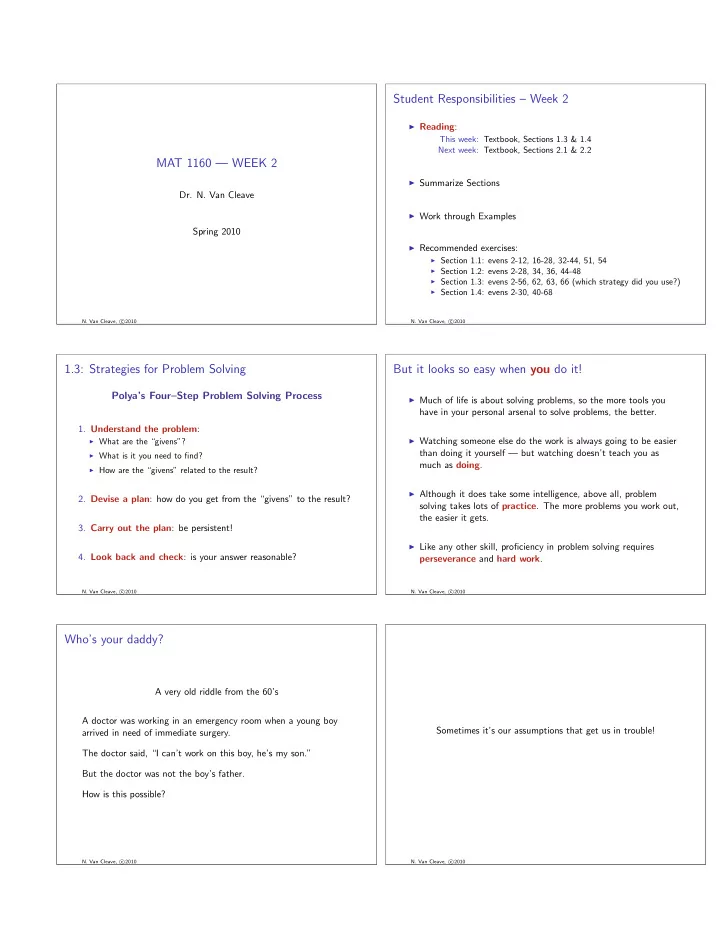

SLIDE 1
MAT 1160 — WEEK 2
- Dr. N. Van Cleave
Spring 2010
- N. Van Cleave, c
2010
Student Responsibilities – Week 2
◮ Reading:
This week: Textbook, Sections 1.3 & 1.4 Next week: Textbook, Sections 2.1 & 2.2
◮ Summarize Sections ◮ Work through Examples ◮ Recommended exercises:
◮ Section 1.1: evens 2-12, 16-28, 32-44, 51, 54 ◮ Section 1.2: evens 2-28, 34, 36, 44-48 ◮ Section 1.3: evens 2-56, 62, 63, 66 (which strategy did you use?) ◮ Section 1.4: evens 2-30, 40-68
- N. Van Cleave, c
2010
1.3: Strategies for Problem Solving
Polya’s Four–Step Problem Solving Process
- 1. Understand the problem:
◮ What are the “givens”? ◮ What is it you need to find? ◮ How are the “givens” related to the result?
- 2. Devise a plan: how do you get from the “givens” to the result?
- 3. Carry out the plan: be persistent!
- 4. Look back and check: is your answer reasonable?
- N. Van Cleave, c
2010
But it looks so easy when you do it!
◮ Much of life is about solving problems, so the more tools you
have in your personal arsenal to solve problems, the better.
◮ Watching someone else do the work is always going to be easier
than doing it yourself — but watching doesn’t teach you as much as doing.
◮ Although it does take some intelligence, above all, problem
solving takes lots of practice. The more problems you work out, the easier it gets.
◮ Like any other skill, proficiency in problem solving requires
perseverance and hard work.
- N. Van Cleave, c
2010
Who’s your daddy?
A very old riddle from the 60’s A doctor was working in an emergency room when a young boy arrived in need of immediate surgery. The doctor said, “I can’t work on this boy, he’s my son.” But the doctor was not the boy’s father. How is this possible?
- N. Van Cleave, c
2010
Sometimes it’s our assumptions that get us in trouble!
- N. Van Cleave, c
2010