Student Achievement Selected Principles: 8.1 and 8.2.b Significant - - PDF document

student achievement selected principles 8 1 and 8 2 b
SMART_READER_LITE
LIVE PREVIEW

Student Achievement Selected Principles: 8.1 and 8.2.b Significant - - PDF document

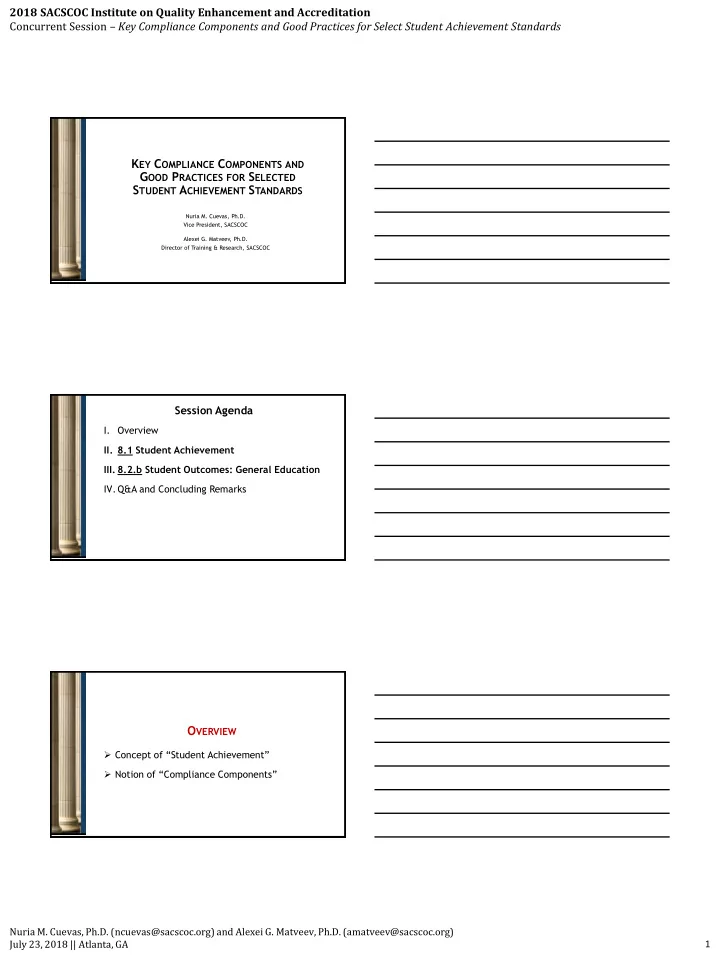
2018 SACSCOC Institute on Quality Enhancement and Accreditation Concurrent Session Key Compliance Components and Good Practices for Select Student Achievement Standards K EY C OMPLIANCE C OMPONENTS AND G OOD P RACTICES FOR S ELECTED S TUDENT A


slide-1
SLIDE 1

2018 SACSCOC Institute on Quality Enhancement and Accreditation Concurrent Session – Key Compliance Components and Good Practices for Select Student Achievement Standards

Nuria M. Cuevas, Ph.D. (ncuevas@sacscoc.org) and Alexei G. Matveev, Ph.D. (amatveev@sacscoc.org) July 23, 2018 || Atlanta, GA 1

KEY COMPLIANCE COMPONENTS AND GOOD PRACTICES FOR SELECTED STUDENT ACHIEVEMENT STANDARDS

Nuria M. Cuevas, Ph.D. Vice President, SACSCOC Alexei G. Matveev, Ph.D. Director of Training & Research, SACSCOC

Session Agenda

  • I. Overview
  • II. 8.1 Student Achievement
  • III. 8.2.b Student Outcomes: General Education
  • IV. Q&A and Concluding Remarks

OVERVIEW

  • Concept of “Student Achievement”
  • Notion of “Compliance Components”
slide-2
SLIDE 2

2018 SACSCOC Institute on Quality Enhancement and Accreditation Concurrent Session – Key Compliance Components and Good Practices for Select Student Achievement Standards

Nuria M. Cuevas, Ph.D. (ncuevas@sacscoc.org) and Alexei G. Matveev, Ph.D. (amatveev@sacscoc.org) July 23, 2018 || Atlanta, GA 2

Student Achievement Selected Principles: 8.1 and 8.2.b

  • Significant revisions in the 2018 Principles of

Accreditation

  • 8.1 (student achievement)
  • Core Requirement [CR]
  • 8.2.b (student outcomes: general education)
  • Relatively high rate of non-compliance (3.5.1, 2012 Principles)
  • Similar structure with other outcomes assessment standards

(8.2.a-educational programs and 8.2.c-academic and student services)

Compliance Components

  • Embedded in the wording of the Principles

(and frequently signaled by numbers, commas, and the use of compound modifiers),

  • the compliance components are
  • the discrete elements that must be

addressed for each requirement and standard

6
slide-3
SLIDE 3

2018 SACSCOC Institute on Quality Enhancement and Accreditation Concurrent Session – Key Compliance Components and Good Practices for Select Student Achievement Standards

Nuria M. Cuevas, Ph.D. (ncuevas@sacscoc.org) and Alexei G. Matveev, Ph.D. (amatveev@sacscoc.org) July 23, 2018 || Atlanta, GA 3

Compliance Components

Compliance Components: Notes

  • Subordinate to the Principles
  • Sum is larger than the parts
  • together, not individually, the compliance

components constitute and encompass the standard

  • Must be viewed in the context of the
  • Institution’s mission and
  • Institutional compliance certification design and

reporting approach

8

Common Components – Different Fit

9
slide-4
SLIDE 4

2018 SACSCOC Institute on Quality Enhancement and Accreditation Concurrent Session – Key Compliance Components and Good Practices for Select Student Achievement Standards

Nuria M. Cuevas, Ph.D. (ncuevas@sacscoc.org) and Alexei G. Matveev, Ph.D. (amatveev@sacscoc.org) July 23, 2018 || Atlanta, GA 4

8.1 STUDENT ACHIEVEMENT

[Core Requirement] 4.1 The institution evaluates success with respect to student achievement consistent with its mission. Criteria may include: enrollment data; retention, graduation, course completion, and job placement rates; state licensing examinations; student portfolios; or other means of demonstrating achievement of goals.

(Student achievement) + RM

8.1 The institution identifies, evaluates, and publishes goals and outcomes for student achievement appropriate to the institution’s mission, the nature of the students it serves, and the kinds of programs offered. The institution uses multiple measures to document student success.

(Student achievement) + RM

8.1: Key Compliance Components

The institution identifies, evaluates, and publishes GOALS and OUTCOMES for student achievement appropriate to the institution’s mission, the nature of the students it serves, and the kinds of programs offered. The institution uses multiple measures to document student

  • success. + RM

(Student achievement) [emphases added]

slide-5
SLIDE 5

2018 SACSCOC Institute on Quality Enhancement and Accreditation Concurrent Session – Key Compliance Components and Good Practices for Select Student Achievement Standards

Nuria M. Cuevas, Ph.D. (ncuevas@sacscoc.org) and Alexei G. Matveev, Ph.D. (amatveev@sacscoc.org) July 23, 2018 || Atlanta, GA 5

8.1: Resource Manual Note

In accord with federal regulations, it is expected that the institution will demonstrate its success with respect to student achievement and indicate the criteria and thresholds of acceptability used to determine that success…The institution is responsible for justifying both the criteria it utilizes and the thresholds of acceptability it sets… In their reviews, SACSCOC committees will examine and analyze (1) documentation demonstrating success with respect to student achievement, (2) the appropriateness

  • f criteria and thresholds of acceptability used to

determine student achievement, and (3) whether the data and other information to document student achievement is appropriately published. [emphases added]

8.1: Selected Key Terms

  • “Criteria”
  • Items or indicators of student achievement to be

measured/evaluated (and published)

  • “Multiple measures”
  • Several distinct criteria/indicators of student achievement, not

multiple ways to measure the same student achievement

  • utcome.
  • “Goals”
  • Target levels performance
  • “Thresholds of acceptability”
  • Minimal expectation set by the institution to define its own

acceptable level of achievement (i.e., a minimum target)

  • “Outcomes”
  • Student performance data

Criteria/Indicators

slide-6
SLIDE 6

2018 SACSCOC Institute on Quality Enhancement and Accreditation Concurrent Session – Key Compliance Components and Good Practices for Select Student Achievement Standards

Nuria M. Cuevas, Ph.D. (ncuevas@sacscoc.org) and Alexei G. Matveev, Ph.D. (amatveev@sacscoc.org) July 23, 2018 || Atlanta, GA 6

Goals vs. Thresholds of Acceptability 8.1: Related Expectation Table Discussions: Institutional Practices

  • 1. How does your institution operationally define the

concept of “student achievement”? How many indicators/criteria of student achievement does your institution assess, track, and report?

  • 2. How were the indicators/criteria of student

achievement selected? How does your institution justify the appropriateness of selected indicators/criteria?

  • 3. How were thresholds of acceptability and goals

established for selected indicators/criteria? How does your institution justify the appropriateness of established thresholds of acceptability?

slide-7
SLIDE 7

2018 SACSCOC Institute on Quality Enhancement and Accreditation Concurrent Session – Key Compliance Components and Good Practices for Select Student Achievement Standards

Nuria M. Cuevas, Ph.D. (ncuevas@sacscoc.org) and Alexei G. Matveev, Ph.D. (amatveev@sacscoc.org) July 23, 2018 || Atlanta, GA 7

Table Discussions: Institutional Practices

(cont’d)

  • 4. Where and how (narratives, data tables, charts,

bullet points, etc.) does your institution publish goals and outcomes for selected student achievement criteria/indicators? Have you received any feedback from students/faculty/parents/public on the published information?

  • 5. If applicable, how would your institution address the

situation of consistently falling short of meeting identified thresholds of acceptability in the Compliance Certification Report?

20

8.2.B STUDENT OUTCOMES: GENERAL EDUCATION

slide-8
SLIDE 8

2018 SACSCOC Institute on Quality Enhancement and Accreditation Concurrent Session – Key Compliance Components and Good Practices for Select Student Achievement Standards

Nuria M. Cuevas, Ph.D. (ncuevas@sacscoc.org) and Alexei G. Matveev, Ph.D. (amatveev@sacscoc.org) July 23, 2018 || Atlanta, GA 8 3.5.1 The institution identifies college- level general education competencies and the extent to which students have attained them.

(General Education Competencies)

8.2.b The institution identifies expected outcomes, assesses the extent to which it achieves these outcomes, and provides evidence of seeking improvement based on analysis of the results in the areas below: …, b. student learning outcomes for collegiate-level general education competencies of its undergraduate degree programs,…

(Student outcomes: general education)

Major Revision

  • Data Reporting IE standard
  • Identification of a set of STUDENT LEARNING OUTCOMES

FOR EACH COMPETENCY

  • Specific knowledge, skills, values, and/or attitudes associated

with a given competency

  • Documented IMPROVEMENT ACTIONS based on ANALYSIS
  • f outcomes assessment results
23

8.2: Key Compliance Components

24
slide-9
SLIDE 9

2018 SACSCOC Institute on Quality Enhancement and Accreditation Concurrent Session – Key Compliance Components and Good Practices for Select Student Achievement Standards

Nuria M. Cuevas, Ph.D. (ncuevas@sacscoc.org) and Alexei G. Matveev, Ph.D. (amatveev@sacscoc.org) July 23, 2018 || Atlanta, GA 9

8.2.b: Key Compliance Components

The institution identifies expected outcomes, assesses the extent to which it achieves these

  • utcomes, and provides evidence of seeking

improvement based on analysis of the results in the areas below: …,

  • b. student learning outcomes for collegiate-

level general education competencies of its undergraduate degree programs.

(Student outcomes: general education) [emphases added]

Table Discussions: Institutional Practices

  • 1. What is the organizational structure that allows your

institution to gain a sense of consistency in its expectations regarding general education outcomes?

  • 2. How many general education competencies and

associated outcomes does your institution have?

  • Does your institution assess all competencies/outcomes

annually?

  • 3. How does your institution ensure that identified

competencies and associated outcomes are at the collegiate level?

Table Discussions: Institutional Practices

(cont’d)

  • 4. What assessment approaches does your institution

utilize?

  • Are gen ed assessments stand alone and/or embedded in gen ed

courses/experiences and/or in major courses?

  • Does your institution use primarily quantitative or qualitative/

direct or indirect/locally-developed or external/standardized assessment instruments and tools?

  • How does your institution maintain consistency in

measurements across different courses/programs/experiences?

  • 5. How are off-campus, distance education, and transfer

students included in the gen ed assessment process?

slide-10
SLIDE 10

2018 SACSCOC Institute on Quality Enhancement and Accreditation Concurrent Session – Key Compliance Components and Good Practices for Select Student Achievement Standards

Nuria M. Cuevas, Ph.D. (ncuevas@sacscoc.org) and Alexei G. Matveev, Ph.D. (amatveev@sacscoc.org) July 23, 2018 || Atlanta, GA 10

Table Discussions: Institutional Practices

(cont’d)

  • 6. Who analyzes and synthesizes gen ed assessment

data? How are the assessment findings reported/disseminated and reviewed?

  • 7. If weaknesses are found, who develops improvement

actions and what is the process? What are the most common types of changes your institution implements to seek improvements based on analysis of assessment findings (curricular , pedagogical, academic support, professional development, assessment, etc.)? Please provide specific examples.

29

Q&A AND CONCLUDING REMARKS

slide-11
SLIDE 11

2018 SACSCOC Institute on Quality Enhancement and Accreditation Concurrent Session – Key Compliance Components and Good Practices for Select Student Achievement Standards

Nuria M. Cuevas, Ph.D. (ncuevas@sacscoc.org) and Alexei G. Matveev, Ph.D. (amatveev@sacscoc.org) July 23, 2018 || Atlanta, GA 11

31

PEER EVALUATORS: Recurring Overall Themes

32

All compliance components Alignment or logical linkages Sufficient description and analysis Evidence of systemic, systematic, and consistent implementation.

Overall Pointers

33
  • Active leadership support and engagement
  • Consistent/ongoing attention to assessment systems and

processes

  • Faculty and staff assessment expertise and professional

development

  • Effective and meaningful reporting + internal review and

feedback