Structuring Solar Development Financing, Leasing and Operating - - PowerPoint PPT Presentation

structuring solar development financing leasing and
SMART_READER_LITE
LIVE PREVIEW

Structuring Solar Development Financing, Leasing and Operating - - PowerPoint PPT Presentation

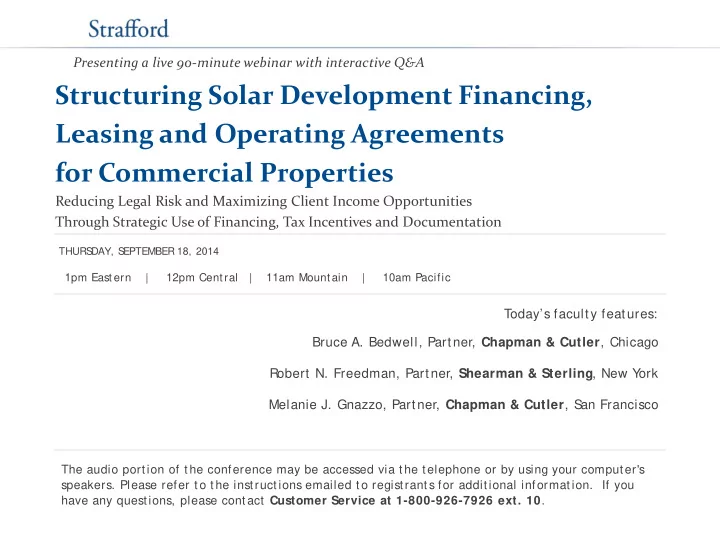
Presenting a live 90-minute webinar with interactive Q&A Structuring Solar Development Financing, Leasing and Operating Agreements for Commercial Properties Reducing Legal Risk and Maximizing Client Income Opportunities Through Strategic


slide-1
SLIDE 1

Structuring Solar Development Financing, Leasing and Operating Agreements for Commercial Properties

Reducing Legal Risk and Maximizing Client Income Opportunities Through Strategic Use of Financing, Tax Incentives and Documentation

Today’s faculty features:

1pm East ern | 12pm Cent ral | 11am Mount ain | 10am Pacific

The audio portion of the conference may be accessed via the telephone or by using your computer's

  • speakers. Please refer to the instructions emailed to registrants for additional information. If you

have any questions, please contact Customer Service at 1-800-926-7926 ext. 10.

THURS DAY, S EPTEMBER 18, 2014

Presenting a live 90-minute webinar with interactive Q&A

Bruce A. Bedwell, Partner, Chapman & Cutler, Chicago Robert N. Freedman, Partner, Shearman & Sterling, New Y

  • rk

Melanie J. Gnazzo, Partner, Chapman & Cutler, S an Francisco

slide-2
SLIDE 2

Tips for Optimal Quality

S

  • und Qualit y

If you are listening via your computer speakers, please note that the quality

  • f your sound will vary depending on the speed and quality of your internet

connection. If the sound quality is not satisfactory, you may listen via the phone: dial 1-866-755-4350 and enter your PIN when prompted. Otherwise, please send us a chat or e-mail sound@ straffordpub.com immediately so we can address the problem. If you dialed in and have any difficulties during the call, press *0 for assistance. Viewing Qualit y To maximize your screen, press the F11 key on your keyboard. To exit full screen, press the F11 key again.

FOR LIVE EVENT ONLY

slide-3
SLIDE 3

Continuing Education Credits

For CLE purposes, please let us know how many people are listening at your location by completing each of the following steps:

  • In the chat box, type (1) your company name and (2) the number of

attendees at your location

  • Click the S

END button beside the box If you have purchased S trafford CLE processing services, you must confirm your participation by completing and submitting an Official Record of Attendance (CLE Form). Y

  • u may obtain your CLE form by going to the program page and selecting the

appropriate form in the PROGRAM MATERIALS box at the top right corner. If you'd like to purchase CLE credit processing, it is available for a fee. For additional information about CLE credit processing, go to our website or call us at 1-800-926-7926 ext. 35.

FOR LIVE EVENT ONLY

slide-4
SLIDE 4

Program Materials

If you have not printed the conference materials for this program, please complete the following steps:

  • Click on the ^ symbol next to “ Conference Materials” in the middle of the left -

hand column on your screen.

  • Click on the tab labeled “ Handouts” that appears, and there you will see a

PDF of the slides for today's program.

  • Double click on the PDF and a separate page will open.
  • Print the slides by clicking on the printer icon.

FOR LIVE EVENT ONLY

slide-5
SLIDE 5

5

Solar Development Financing, Leasing and Operating Agreements

September 18, 2014

slide-6
SLIDE 6

6

  • Review of tax incentives and benefits available for solar installations
  • Financing structures and issues relevant to solar installations
  • Project Contracts and related issues arising in connection with solar

projects

Discussion Focus

slide-7
SLIDE 7

7

Federal Tax Benefits Associated with Investments in Solar Energy Assets

slide-8
SLIDE 8

Federal Tax Incentives

Federal tax incentives for investments in solar energy generating equipment include:

  • Investment Tax Credit
  • Accelerated Depreciation (5 Year MACRS)
  • Bonus Depreciation (expired at end of 2013)
  • Grant in lieu of investment tax credit (also generally expired,

except as to large scale projects in process)

8

slide-9
SLIDE 9

Federal Tax Incentives (continued)

Federal tax incentives are generally only available to the “tax owner” of the equipment

  • Exception: ITC regulations authorize pass through election that

transfers right to claim ITC (but not depreciation) to lessee if lessee would otherwise be eligible as owner Federal investment tax credits are not available if governmental or tax- exempt entities are “tax owners” or “lessees”

  • Also, no accelerated depreciation for equipment owned or leased

to such entities

9

slide-10
SLIDE 10

Tax Ownership vs Lease vs Service Contract

Various factors are relevant to determining “tax ownership”

  • IRS has published guidelines (Rev. Proc. 2001-28) for distinguishing lease vs

secured financing that are helpful in determining which party will be treated as

  • wner/lessor vs lender/lessee
  • Title does NOT control
  • Factors considered generally focus on who has economic benefit of upside/who

has economic burden of downside

PPAs involving governmental or tax exempt energy purchasers (off- takers) generally must qualify as a service agreement and not as a lease or financing arrangement

  • Tax Code (Section 7701) specifies factors for distinguishing a lease from an

agreement to provide services

  • Factors listed also focus on weighing who has economic benefits and burdens

(similar to ownership tests)

  • e.g. does service recipient or service provider control operations, bear risks of

non-operation, reap benefits of cost savings, etc.

10

slide-11
SLIDE 11

Investment Tax Credit

Credit against federal income tax otherwise due based on eligible cost

  • f qualifying assets x credit rate
  • Credit rate varies from 10-30% depending on type of energy source, type of output

(electricity vs heat) and date placed in service

  • Solar = 30% for units placed in service by 12/31/16, drops to 10% thereafter

Eligible project cost: includes only the cost of tangible personal property integral to the production or storage of solar energy

  • Does not include costs for interconnection or distribution equipment or for most

building or site improvements

  • Cost can include development fees if reasonable and arm’s length
  • If parties elect to pass ITC on to lessee, then credit is geared off fair market value
  • f leasehold interest, not cost
  • At least 80% of components must be new

11

slide-12
SLIDE 12

Investment Tax Credit

(continued)

Payment: Credit is claimed on first tax return filed after project is PIS Recapture:

  • A pro rata portion of the ITC is required to be repaid if project is sold, project is

leased to persons not eligible to claim credit (e.g. governmental or non-profit entities) or project ceases to be in service or qualify as specified energy property any time during first 5 years after PIS

12

slide-13
SLIDE 13

Grant in Lieu of Tax Credit

Applied to solar energy projects that were otherwise eligible for ITC

  • Grant was claimed in lieu of tax credits
  • Could not claim grant if owner was a pass through entity with ineligible persons as

partners or members

  • Right to claim grant could be passed through to lessee (so long as lessee is

eligible)

Amount of Grant was also 30% of eligible project cost (costs computed same as for ITC)

  • Paid in cash shortly after project is PIS
  • Right to payment can be assigned to lenders

13

slide-14
SLIDE 14

Grant in Lieu of Tax Credit

(continued)

Construction had to commence before 2012 and project must be placed in service by 12/31/16 Recapture:

  • A pro rata portion of the grant is required to be repaid if project is sold to persons

not eligible to claim credit (e.g. governmental or non-profit entities) or ceases to be in service or qualify as specified energy property any time during first 5 years after PIS

  • No recapture if project is transferred to another eligible owner or leased on a true-

lease basis to a tax-exempt or governmental entity

14

slide-15
SLIDE 15

Depreciation/MACRS

Eligible cost basis is reduced by half of any ITC (or grant) claimed

  • So if ITC (or grant) is 30%, cost basis is reduced by 15% and remaining 85% is

depreciated (deducted) using bonus depreciation up to max bonus rate

MACRS (accelerated) depreciation allowed for remaining tax basis

  • Recovery period is 5 years
  • Rate of recovery is front-loaded rather than straight line

15

slide-16
SLIDE 16

16

State Tax Benefits Associated with Investments in Solar Energy Assets

slide-17
SLIDE 17

State Tax and Other Incentives

There are also various state tax and other incentives that are applicable to the installation of new solar energy systems, including state tax credits, rebates and performance based incentives, as well as exemptions from sales taxes and property taxes for solar energy systems See, for example, the following sites for an overview of various state tax and environmental incentives:

  • www.dsireusa.org/solar
  • www.seia.org/policy

17

slide-18
SLIDE 18

18

Overview of Common Financing Structures and Issues Relevant to Solar Installations

slide-19
SLIDE 19

19

Equity Financed Structures

slide-20
SLIDE 20

Basic Lease Structure

20

Operator/ Managing Member Investor/ Non- Managing Member Owner LLC (Lessor )

5% 95%

Off-Taker (Lessee)

  • Owner LLC must qualify as tax owner of project assets (site lease, solar energy generating

equipment, licenses, etc)

  • So long as Operator and Investor are private, for profit entities and other criteria for tax incentives are

met, available tax benefits are allocated to each member

  • If lessee is a governmental entity or non-profit, project cannot claim ITC and MACRS depreciation
slide-21
SLIDE 21

Basic Service Contract Structure

21

  • Owner LLC must qualify as tax owner of project assets
  • Tax benefits get allocated among members
  • So long as power purchase agreement qualifies as a service contract, project now also qualifies for ITC

and MACRS

  • FMV puts/calls and purchase options may be used to convey ownership of residual interest in equipment

to Operator or Governmental User

  • Proceeds to Owner LLC may also include amounts received for sale of environmental attributes to local

utilities (e.g. NJ SRECs) or subsidies from local utilities (CA solar initiative)

Owner LLC (Power Seller) Operator (Managing Member) Governmental User (Power Purchaser) Investor (Non-Managing Member)

5% 95% Power $

slide-22
SLIDE 22

Partnership Flip Structure

22

  • Owner LLC must qualify as tax owner of project assets
  • Tax benefits get allocated among members but allocation percentages “flip” after certain point (typically

after later of investor earning minimum return and expiration of recapture period)

  • Parameters for flip structures involving wind projects and special allocations of tax credits were

approved by the IRS (Rev. Proc. 2007-65) and typically followed in solar projects as well

  • Flip structure mimics economic effect of put/call. FMV puts/calls and purchase options may also be

used to convey ownership of residual interest in equipment to Operator or Off-taker

Owner LLC (Lessor or Power Seller) Operator (Managing Member) Tax Equity Investor (Non-Managing Member) Off-taker (Lessee or Purchaser)

1% flipping to 95% 99% flipping to 5% $ Power

slide-23
SLIDE 23

Sale Leaseback Structure

23

  • Project LLC (or its parent) acquires site lease, arranges for construction of project and secures power

purchaser

  • Prior to PIS, project is sold to Lessor and leased back to Project LLC (typically a special purpose entity)
  • Lessor /Investor entitled to tax credits and depreciation so long as it qualifies as tax owner of project

assets, sale/leaseback occurs within 90 days of PIS and PPA qualifies as a service contract

  • Lessee and/or Off-taker may have FMV purchase options

Developer/Operator Project LLC (Lessee/Power Seller) Investor (Lessor) Off-taker (Power Purchaser)

Sale Lump $ Periodic $ Lease Power $ 100%

slide-24
SLIDE 24

Lease Pass Through Structure

24

  • Owner LLC owns all project assets, including site and energy generating equipment, but leases them to

Tenant LLC for a term of years (typically 70-80% of life of project). TenantCo enters in PPA or sub-lease with Off-taker

  • ITC can be passed through to Lessee by election; Owner LLC retains depreciation (based on 100% of

cost)

  • Tenant claims ITC based on FMV of leaseshold interest but includes 50% of ITC in income over 5 years;

cash flow from off-taker generally applied to pay rent under Tenant Lease, pay operating expenses and preferred return to tax equity

  • Project economics revert back to Owner LLC after Tenant Lease expires or via flip structure

Owner LLC (Lessor) Operator (Managing Member) Tax Equity Investor (NonManaging Member)

100% 99%

Tenant LLC (Lessee) Off-taker

1% $ Power

Lease

slide-25
SLIDE 25

25

Debt Financed Structures

slide-26
SLIDE 26

Debt Financed Structures

26

  • Construction Financing
  • Typically done through bank financing or traditional private

placement

  • 144A structure causes potential “negative arbitrage” because of

the need to fund the full amount at once

  • Term Financing
  • Financeable utility scale solar projects typically have long term

power purchase agreements which permit a longer-term financing solution but mini-perm structures are still used

  • Term financing structures include bank debt, traditional private

placement and 144A

slide-27
SLIDE 27

Debt Financed Structures (continued)

27

  • Characteristics of a Construction Financing
  • Project typically needs to be at “notice to proceed” stage--- meaning the principal

project contracts needs to be executed with conditions to the effectiveness of those agreements satisfied; permits are final, non-appealable (except for ordinary course permits which can easily be issued later)

  • Lenders fund periodically (often monthly) to pay construction costs
  • For solar projects, lenders may accept “unwrapped” panel supply and balance of

plant depending on the parties but “wrapped” or “turnkey” EPC’s are often the norm

  • Construction period funding involves continued involvement of an independent

engineer who oversees the construction process for the lenders

  • In addition to typical project-finance-type controls over amendments to material

contracts, lenders often have rights over change orders and the Borrower is typically bound to a construction budget

  • Failure to achieve “completion” and convert the loans from construction to term loans

results in an event of default (completion typically defined as EPC and PPA completion with certain additional standard conditions precedent

slide-28
SLIDE 28

28

Comparison of Bank, Private Placement and 144A

slide-29
SLIDE 29

Representations & Warranties/Covenants/Events

  • f Default/Redemptions

29

Banks/4(2) Private Placement 144A Representations and Warranties Included in either Credit Agreement (for bank deals) or the Note Purchase Agreement (for Private Placements). Purpose is to back up diligence on the asset and credit parties. Similar representations used for bank deals as for Private Placements. Representations & Warranties benefit the banks and note purchasers. Included in the Underwriting Agreement and benefit the underwriters, not the

  • noteholders. The noteholder protection for

items that would otherwise be included in the Representations & Warranties is derived from the disclosure. Project related Representations in an underwriting agreement are typically similar to those seen in a Credit Agreement or Note Purchase Agreement, but in a bank/bond transaction, Representations may be different as between the Credit Agreement and the Underwriting Agreement.

slide-30
SLIDE 30

Representations & Warranties/Covenants/Events

  • f Default/Redemptions (continued)

30

Banks/4(2) Private Placement 144A Covenants Included in a Credit Agreement or Note Purchase Agreement. Typically provide tighter controls than in a 144A transaction because the Borrower/Issuer has the ability to approach the banks/noteholders for waivers, consents and amendments. Covenants between bank deals and Private Placements are typically similar. Bank lenders typically act through an administrative agent for waivers, consents and amendments Examples Indebtedness: Limited additional indebtedness without required lender approval; Expansion Capital Expenditures: May be limited without required lender approval; Included in the Indenture. Typically provide the issuer with more flexibility than in a bank deal because of the difficulty in obtaining noteholder

  • consent. Covenants are generally designed to

not require noteholder action. Ratings affirmation may be used, and there may be increasaed, long term reliance on an Independent Engineer. Examples Indebtedness: Incurrence test may be used as well as rating affirmation; Expansion Capital Expenditures: May be approved and/or may be subject to ratings affirmation and Independent Engineer certifications;

slide-31
SLIDE 31

Representations & Warranties/Covenants/Events

  • f Default/Redemptions (continued)

31

Banks/4(2) Private Placement 144A Covenants (continued) Budget Delivery and Approval: Annual delivery to an administrative agent, and approval and compliance may also be required. Amendments to Material Agreements: While may be allowed subject to an MAE standard, lender approval may be required. Budget Delivery and Approval: May not be required; Amendments to Material Agreements: May

  • nly be subject to a “no MAE” standard

which may be certified by the Issuer. Events of Default Similar to covenants, place tighter controls than in a 144A transaction, including shorter cure periods and less flexibility to cure. Typically takes more than 50% to accelerate. Typically designed with greater flexibility for Issuers. Cure Periods, including for payment default, typically longer than in bank deals/private placements with greater emphasis on MAE exceptions. May take less than 50% to accelerate (such as 33%).

slide-32
SLIDE 32

Representations & Warranties/Covenants/Events

  • f Default/Redemptions (continued)

32

Banks/4(2) Private Placement 144A Prepayments and Redemptions Bank deals typically permit optional prepayment without penalty. Private placements typically permit optional redemptions with make-whole. Typical mandatory prepayments/redemption events include asset sales, casualty events and significant payment events under material project documents (i.e., performance liquidated damages, contract termination payments). Typically permit optional redemption with a make-whole, and may also permit an equity claw in more high-yield type

  • fferings.

Redemption events may be structured as offers as opposed to mandatory redemptions. Threshold levels for redemptions may also be set higher than in a bank deal/private placement with more flexibility to reinvest proceeds without noteholder consent.

slide-33
SLIDE 33

33

Collateral and Intercreditor Agreements

slide-34
SLIDE 34

Collateral Arrangements

34

  • Types of Property
  • Personal property (equipment, contracts, permits, licenses, etc.)
  • Investment property (equity interests in Project Company/subsidiaries

and bank accounts)

  • Real property (owned real property, leased real property, easements,

rights of way, etc.)

  • Purpose of Collateral
  • Provide lenders/investors with rights access to Project and control over
  • peration of Project
  • Provide lenders/investors with rights to foreclose and exercise remedies

against Project assets

  • Ensure that third parties (such as unsecured creditors) do not have a

senior claim over Project assets

slide-35
SLIDE 35

Collateral Arrangements (Continued)

35

  • Collateral Documentation
  • Security/Pledge Agreement: generally used to create a security

interest over assets of the Project consisting of personal property

  • Account/Depositary Agreements: generally used to create a

security interest over bank accounts and cash flow of the Project

  • Mortgages: generally used to create a security interest over real

property assets of the Project

  • Direct Agreements: provides lenders/investors with direct rights

against the Project Contract counterparties

slide-36
SLIDE 36

Collateral Arrangements (Continued)

36

  • Security/Pledge Agreements
  • Collateral Definition – All Assets except for “Excluded Assets”
  • Excluded Assets:
  • Equity interests in non-wholly owned subsidiaries and other excluded subsidiaries

(i.e., foreign subsidiaries)

  • Permits, Contracts, Leases, Licenses and other similar agreements that by their

terms prohibit assignment and provide for termination in case of an assignment

  • Permits, Concession Agreements, Licenses and other similar agreements to the

extent assignment is prohibited by law

  • Motor Vehicles and other assets that are subject to certificate of title laws
  • Concession Assignments
  • Equipment that is subject to a purchase money lien or capitalized lease
  • Accounts Receivables pledged to energy managers or pursuant to other similar

arrangements

  • De Minimis Assets
slide-37
SLIDE 37

Collateral Arrangements (Continued)

37

  • Collateral specific to a particular debt tranche (i.e., Debt Service Reserve Account; Bond

Proceeds Account)

  • Other Assets
  • Certain Covenants/Representations with respect to Collateral
  • Provisions requiring granting of “control” over certain types of collateral (i.e., investment

property)

  • Delivery of instruments, certificates, etc., for purposes of perfection
  • Letter of Credit Rights – Consent to Assignments
  • Remedies
  • Trigger Standard for Exercise of Remedies (Default, Event of Default, etc.)
  • Types of remedies:
  • Right to receive any permitted dividends
  • Right to directly collect Accounts Receivables and otherwise interact with Project

Contract counterparties

  • Right to foreclose and/or auction Collateral
slide-38
SLIDE 38

Collateral Arrangements (Continued)

38

  • Account/Depositary Agreements
  • Key Purposes:
  • Control application of cash flow of Project
  • Provide for required reserves of Project (i.e., Debt Service Reserve, Major

Maintenance Reserve, etc.)

  • Control distributions/dividends/payments to Sponsors
  • Provide mechanics for any applicable Excess Cash Flow Sweep
  • Establishment of Accounts (Construction Account, Revenue Account,

Operating Account, Insurance Proceeds/Repair Account, Debt Service Reserve Account, Debt Service Accounts, Major Maintenance Reserve Account, Liquidity Reserve Account, Asset Sale Account, Mandatory Prepayment Account, Distribution Account, Suspension Account, etc.)

  • General Rule: All Project Revenue is deposited into Revenue Account and

applied in accordance with “Waterfall”

slide-39
SLIDE 39

Collateral Arrangements (Continued)

39

  • Waterfall – provides for periodic application of amounts on deposit in Revenue Account

to Project’s payment obligations

  • General rule of order of application: O&M Expenses, Debt Service, Debt Service

Reserve Requirements, Other Reserve Requirements, Excess Cash Sweep, Dividends

  • Ability to “Invade” various accounts
  • Key issues:
  • Project tax payments
  • Payments to Affiliates under O&M Agreements or other similar Agreements
  • Treatment of payments of other permitted debt
  • Timing of Waterfall (specific limited dates (i.e., monthly/quarterly) v. general rule of

application)

  • Debt Service Reserve Requirement
  • Period of Reserve (i.e., 6 months)
  • Calculation mechanism
  • Effect of interest rate hedges
  • Effect of prepayments
  • Treatment as designated Collateral for a particular debt tranche
slide-40
SLIDE 40

Collateral Arrangements (Continued)

40

  • Upfront Funding of Construction Costs
  • Conditions to Withdrawal from Construction/Bond Proceeds Account
  • Treatment of Punch List Requirements
  • True up/Prepayment Mechanic upon Completion
  • Mortgages/Real Property Collateral
  • Governed by law where real property is located
  • Covered Amount of Debt
  • Typically 75-100% of Senior Debt Amount
  • May be limited to value of underlying real property collateral in

jurisdictions with mortgage recording taxes

  • Key deliverables: Title Insurance, Surveys
  • Treatment of Construction Liens
  • Landlord Estoppels
slide-41
SLIDE 41

Collateral Arrangements (Continued)

41

  • Direct Agreements
  • Provides for acknowledgment by Project Counterparty of Lender/Investor rights in

Project Contracts

  • Key Terms:
  • Acknowledgment of Lender/Investor security interest
  • Agreement to make payments into designated pledged accounts of Project
  • Limits on amendments/modifications to Project Contracts
  • Agreement to notify Lenders/Investors of defaults under Project Contract
  • Cure and Step-In rights of Lenders/Investors in respect of Project Contract
  • Monetary, Non-Monetary, Bankruptcy Default
  • Replacement Contract Rights
  • Other provisions/assurances specific to contract
slide-42
SLIDE 42

Collateral Arrangements (Continued)

42

  • Intercreditor Issues
  • Subordination
  • Legal or Structural Subordination
  • Lien or Debt Subordination
  • Governs Pro Rata Sharing Rights of Multiple Tranches of Debt to

Collateral

  • Addresses Voting Rights of Secured Creditors
  • Voting Rights of Hedge Counterparties
  • Tranche v. Single Class Voting Structure
  • Treatment of Collateral Proceeds (pre and post default)
  • Treatment of Lender Tranche Specific Collateral (i.e., Debt Service

Reserve Accounts)

  • Staged Voting
  • Agent Obligations
slide-43
SLIDE 43

43

Review of Typical Documents and Contract Issues Arising In Connection With Solar Projects

slide-44
SLIDE 44

Common Financing Documents

The primary financing documents will vary depending on type of financing, but may include:

  • Bank Loan

– Loan and Security Agreement or Credit Agreement

  • Private Placement of Securities / 144A Issuance

– Note Purchase Agreement; Indenture

  • Sale Leaseback

– Sale Agreement – Facility Lease Agreement – Participation Agreement – Loan Agreement

44

slide-45
SLIDE 45

Common Financing Documents

(continued)

  • Partnership Flip

– Equity Capital Contributions Agreement – Partnership Agreement or LLC Agreement – Tax Indemnity Agreement

  • Inverted Lease

– Partnership Agreement – Tenant Lease – Sublease – Tax Indemnity Agreement

45

slide-46
SLIDE 46

Common Financing Documents

(continued)

In addition to the main financing documents, financing documentation will (depending on the structure) include a number of ancillary and security documents, including:

  • Security Agreements
  • Pledge Agreements
  • Consent and Agreements
  • Account Control Agreements
  • Mortgages
  • Real Property Consent, Subordination and Non-Disturbance

Agreements

  • Title Insurance Policies
  • Fixture Filings
  • Financing Statements

46

slide-47
SLIDE 47

Common Project Agreements

Solar projects will have various project agreements. The primary project agreements will include:

  • Power Purchase and Sale Agreement (Offtake Agreement)
  • Renewable Energy Certificate Purchase and Sale Agreement(s)
  • Interconnection Agreement
  • Real Property Agreement(s)
  • Construction Agreement(s)
  • Equipment Supply Agreement(s) (Inverters and Panels)
  • Operation and Maintenance Agreement(s)

47

slide-48
SLIDE 48

Common Project Agreements (continued)

Power Purchase and Sale Agreement

  • Agreement pursuant to which an end user commits to purchase

all power generated by the solar facility for a term of years

  • Typically in the form of:

– Power Purchase Agreement – Energy Services Agreement

  • Key contract considerations:

– How binding is the buyer’s commitment to pay – How are curtailment, non-production and other risks allocated – What are the parties’ termination rights

48

slide-49
SLIDE 49

Common Project Agreements (continued)

REC Purchase and Sale Agreement

  • Agreement pursuant to which an end user commits to purchase

the Renewable Energy Certificates (RECs) from the project for a term of years

  • A REC is an electronic certificate that evidences the generation of
  • ne megawatt hour of renewable energy
  • A majority of states have enacted Renewable Portfolio Standards

(RPS) that require a minimum percentage of energy generated by utilities located in the state to come from renewable sources

  • Under most regimes, compliance can be demonstrated by

purchasing RECs that satisfy the RPS requirements

49

slide-50
SLIDE 50

Common Project Agreements (continued)

REC Purchase and Sale Agreement (continued)

  • Key contract considerations:

– Can the RECs be sold separately, or are they bundled with the power; do they have to be sold to the utility – How binding is the buyer’s commitment to pay – What are the parties’ termination rights – Does the facility’s output satisfy the applicable statutory requirements for renewable energy certificates

50

slide-51
SLIDE 51

Common Project Agreements (continued)

Interconnection Agreement

  • Agreement pursuant to which the project is connected to the

utility’s electric grid

  • Key contract considerations:

– Under what circumstances, if any, can the utility disconnect the project from the grid – If the project is disconnected, can the project deliver its output to the end user – Degree of voluntary curtailment rights at utility – Whether project operator is the customer or the site owner (if latter, can lead to unexpected complications if site owner goes

  • ut of business)

51

slide-52
SLIDE 52

Common Project Agreements (continued)

Real Property Agreement

  • Agreement(s) pursuant to which the project is granted all rights

necessary to build, operate and maintain the project on the site

  • Typically in the form of:

– Ground Lease – Easement Note: Could be part of the Offtake Agreement

  • Key contract considerations:

– Do the agreements provide all necessary rights, including access to and from the project – Are there conflicting or superior rights that could interfere with the project’s rights – Who has obligation to remove equipment at end of term and can it be abandoned in place

52

slide-53
SLIDE 53

Common Project Agreements (continued)

Construction Agreement

  • Agreement pursuant to which a contractor is retained to design,

procure and install the solar facility

  • Typically in the form of and Engineering, Procurement and

Construction Contract

  • Key contract considerations:

– Will the project be completed on time (liquidated damages) – Will the project be completed within budget (fixed price or guaranteed maximum price) – Does the contract provide proper warranties and guarantees – Is the scope of work sufficient (no gaps in work) – What are the parties’ termination rights – Are all liens removed once construction is complete

53

slide-54
SLIDE 54

Common Project Agreements (continued)

Equipment Supply Agreement(s) – Inverters and Panels

  • Agreement pursuant to which a contractor is retained to design, engineer

and supply one or more components of the solar facility

  • Key contract considerations:

– Generally the same considerations as the construction contract – Are all necessary IP rights transferred/licensed – Are there property performance guarantees related to equipment – Extent and duration of manufacturer warranties (especially in case of inverters). Most panel and inverter warranties last for 5 years but many funding sources want extended warranties on inverters (e.g. 10 years or more) unless cash reserved maintained for inverter replacements Note: The equipment supply provisions may be wrapped by the EPC contractor and included in the construction agreement

slide-55
SLIDE 55

Common Project Agreements (continued)

Operation and Maintenance Agreement(s)

  • Agreement pursuant to which provider agrees to provide (i) periodic

inspections and routine maintenance, consistent with that necessary to rely on manufacturer’s warranties, for a fixed annual fee and (ii) emergency or non-routine repairs, maintenance, inspections etc. as necessary and for a supplemental charge

  • Sometimes, the O&M Agreement will include a production guarantee

from the O&M provider

  • Key contract considerations:

– Are fees reasonable – Is the scope of work sufficient (no gaps in work) – Does the contract provide proper warranties and guarantees – What are the parties’ termination rights – Are all liens removed once work is complete

55

slide-56
SLIDE 56

56

Other Contract Issues To Consider

  • Do all of the contracts work together (e.g., do liquidated damages in

the construction contract work with liquidated damages in the power purchase and sale agreement)

  • Can the key contracts be collaterally assigned to lenders
  • Do key contracts have appropriate step-in rights
  • Do key contracts have appropriate lender cure periods
  • Do key contracts have customary lender safeguards (e.g., limits on

ability to amend, assign, terminate)

slide-57
SLIDE 57

57

Questions?

slide-58
SLIDE 58

Bruce A. Bedwell

Bruce Bedwell is a partner in Chapman's Corporate Finance Department. Bruce’s practice focuses primarily on representing clients in the financing, development, acquisition and distribution of projects, with a focus on renewable energy projects. His public-private partnership experience includes projects in the transportation, marine port, airport, and lottery industries. His experience also includes drafting and negotiating financing documents, wind turbine supply agreements, purchase agreements, construction contracts, service agreements, operation and maintenance agreements, warranty agreements, transportation agreements, power purchase agreements, natural gas agreements, swap agreements and a variety of corporate documents. Bruce has advised clients with respect to an array of legal matters related to energy projects and legal, business and regulatory matters associated with the United States energy markets, and has represented clients in administrative litigation and other proceedings before the Federal Energy Regulatory Commission and various state public utility commissions. Before joining Chapman in 2013, Bruce practiced in the Chicago office of Paul Hastings.

Chapman and Cutler LLP 111 West Monroe Street Chicago, IL 60603 312.845.3755 312.516.3255 (fax) bedwell@chapman.com 58

slide-59
SLIDE 59

Robert N. Freedman

Robert Freedman is a partner in Shearman & Sterling’s New York office. Robert is recognized as a “highly respected” and leading lawyer in project finance by Chambers & Partners, IFLR 1000, Guide to the World’s Leading Lawyers in Project Finance and The International Who’s Who of Project Finance Lawyers. His practice focuses on finance and development, asset acquisitions and dispositions and complex work-outs and restructurings of infrastructure assets, internationally and in the United States. He represents developers, lenders and other parties across the breadth of infrastructure sectors, including power, renewables and sustainable development, oil and gas (upstream and downstream) and transportation. Robert has been widely quoted in industry, national and international publications, including The New York Times and the Financial Times, on matters relating to renewables and other infrastructure sectors. Prior to joining Shearman & Sterling, Robert was a Managing Director and Counsel with GE Energy Financial Services, the energy investment business of the General Electric Company. Mr. Freedman is co-head of the firm’s global Sustainable Development Group and is the firm’s former co- hiring Partner.

Sherman & Sterling LLP 599 Lexington Avenue New York, New York 10022 212.848.4340 646.848.4340 (fax) robert.freedman@shearman.com 59

slide-60
SLIDE 60

Melanie J. Gnazzo

Melanie Gnazzo is a partner in the Asset Securitization, Lease Finance and Tax practice groups. She is also co-chair of the legal subcommittee for Solar Access to Public Capital (an industry standardization project sponsored by NREL) and has been recognized by Best Lawyers (2013- 2015) in the area of Structured Finance. Melanie represents a wide range of finance companies and funding sources engaged in structured finance and securitization transactions, as well as in portfolio acquisitions, dispositions, restructurings and joint ventures involving financial assets. She also provides advice with respect to tax advantaged financial and renewable energy products and investment

  • vehicles. She has considerable experience providing both tax and

commercial law advice in such transactions.

Chapman and Cutler LLP 595 Market Street San Francisco, CA 94105 415.541.0500 415.541.0506 (fax) mgnazzo@chapman.com 60

slide-61
SLIDE 61

61

This document has been prepared by Sherman & Sterling LLP and Chapman and Cutler LLP attorneys for informational purposes only. It is general in nature and based on authorities that are subject to change. It is not intended as legal advice. Accordingly, readers should consult with, and seek the advice of, their own counsel with respect to any individual situation that involves the material contained in this document, the application of such material to their specific circumstances, or any questions relating to their own affairs that may be raised by such material.

61